A viral fitness debate just reignited an old argument.
Can heavy squats and deadlifts actually hurt an athlete’s speed and explosiveness?
Dr. Layne Norton says no.
Norton holds a PhD in nutritional sciences and has years of competitive powerlifting experience.
In a video titled “Powerlifting is Bad for Athletic Performance?”, he pushes back on that idea.
Norton is known for pushing back on viral fitness claims that outpace the evidence behind them.
He built much of his platform on breaking down nutrition and training myths using published studies.
This article checks his argument against the actual peer reviewed research on strength training and sports performance.
What the Video Claims
Norton’s video responds to a claim you hear a lot in fitness circles.
The claim is that powerlifting style training makes athletes slower and less explosive.
Critics of powerlifting sometimes argue that heavy, slow lifts build the wrong kind of strength.
They worry it trades speed and athleticism for raw force production.
Part of that worry points to something coaches call the interference effect.
That is the idea that heavy strength work and speed work can blunt each other’s gains.
Some coaches assume powerlifting style training crowds out speed and power development entirely.
Norton frames his video as a defense of squats and deadlifts for athletes, not just powerlifters.
It is worth being clear about what this is and is not.
This is Norton’s own argument and framing, not a peer reviewed finding on its own.
A full transcript of the video was not available for this article.
So the rest of this piece treats his claims as his stated position.
Then it checks that position against the published science.
What the Research Shows About Strength Training and Performance
The scientific literature on this exact question runs surprisingly deep.
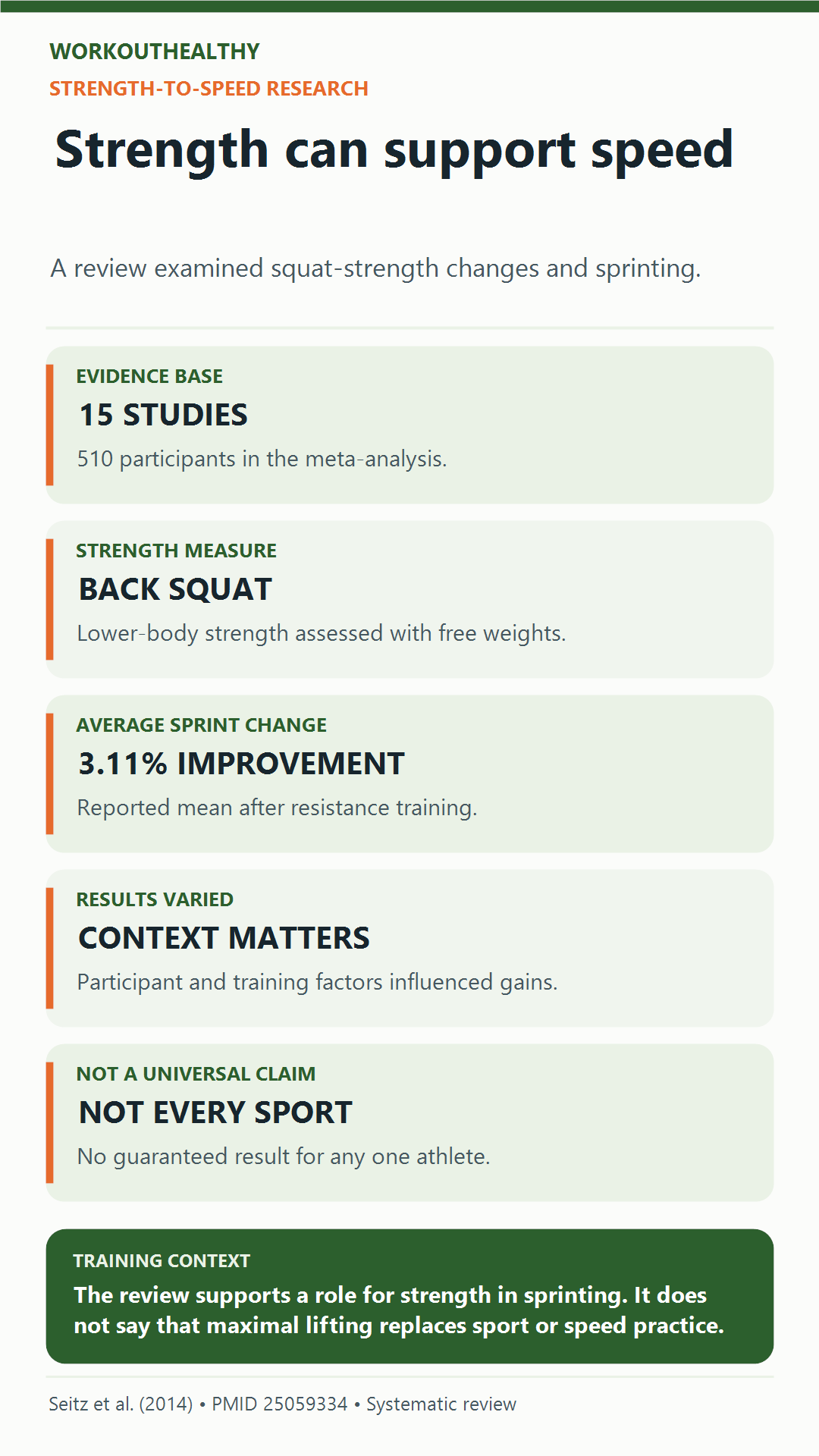
A 2014 meta-analysis in the journal Sports Medicine pooled 15 separate studies.
Together those studies tracked 510 athletes.
Researcher Laurent Seitz and colleagues looked at squat strength and sprint speed.
They found a strong link between gains in lower body strength and gains in sprint speed.
Athletes who got stronger in the squat also got faster, by about 3 percent on average.
A 3 percent sprint improvement is significant in sports decided by hundredths of a second.
The Seitz meta-analysis also looked at what changed the size of that effect.
Training frequency and the rest taken between sets both influenced how much sprint speed improved.
Athlete age and how long the program lasted did not change the result much.
That suggests the strength to speed link holds across a wide range of athletes, not just a select few.

Getting stronger in the squat is not separate from getting faster. Across 15 studies and 510 athletes, the two moved together.
A separate study on elite soccer players backs this up.
Ulrik Wisløff and colleagues measured squat strength, sprint time, and jump height in professional players.
They found a strong correlation between maximal squat strength and both sprint speed and vertical jump.
The stronger players tended to be the faster, more explosive players on the field.
A correlation like this does not prove strength alone causes speed.
But it fits neatly with what training based studies also show.
This pattern also shows up in how our own readers train.
In a recent survey, 85 percent of readers said they favor weightlifting over running as their main form of exercise.
A wider review helps explain why that preference tracks with the science.
Timothy Suchomel and colleagues reviewed the strength and performance literature in 2016.
Their review covered sprinting, jumping, changing direction, and injury risk.
They concluded that muscular strength underlies almost every athletic quality coaches care about.
The Mechanism: Why Getting Stronger Can Make You Faster
Speed on the field does not come from moving your legs faster in the air.
It comes from how hard you can push into the ground.
Suchomel and colleagues state this directly in their review.
They write that faster top running speeds come from greater ground forces, not quicker leg turnover.
A stronger squat means your leg muscles can produce more force in less time.
That force is what launches your body forward and upward.
The same basic logic applies to jumping and to changing direction quickly.
A rugby league study backs this mechanism up directly.
Paul Comfort and colleagues tracked rugby players through a preseason strength program.
Players who increased their squat strength the most also improved their sprint times the most.
The link held even though these athletes were training to be better rugby players, not powerlifters.
Heavy squats were simply one tool that helped get them there.
This is the piece of Norton’s argument that lines up cleanly with the data.
Strength and speed are not opposites competing for the same training time.
In practice, they tend to move together, at least up to a point.
Sport scientists have a name for the specific quality that ties strength to speed.
They call it rate of force development.
It measures how quickly a muscle can produce force, not just how much it can produce at maximum.
Heavy strength training raises the ceiling on how much force your muscles can produce.
Athletes still need dedicated speed and power work to turn that higher ceiling into quick, explosive movement.
Think of raw strength as the size of an engine.
Speed and power training is the tuning that lets an athlete actually use it.
What This Evidence Does Not Prove
None of this means more strength always equals more speed.
The relationship is not a straight line that continues forever.
Very strong, elite athletes typically need less added strength to see performance gains.
Less experienced lifters tend to see bigger speed jumps from getting stronger.
Strength is also just one piece of athletic performance, not the whole picture.
Sprint mechanics, coordination, and sport specific skill all matter too.
A powerlifter is not automatically a fast sprinter just because they squat a lot of weight.
Norton’s video argues against powerlifting being bad for performance.
That is a different claim than saying powerlifting is the best method for athletes.
The research supports strength training as a foundation, not a complete training plan by itself.
Most successful athletic programs pair heavy lifting with sport practice and dedicated speed work.
None of the studies above tested pure powerlifting programs on non-powerlifting athletes either.
They tested general strength gains, often from squats, inside broader athletic training.
There also appears to be something like a strength ceiling.
Once an athlete can already squat well over twice their bodyweight, adding more strength tends to help less.
For a beginner or intermediate athlete, that ceiling is usually still a long way off.
Genetics, sport specific practice hours, and technique also shape how fast someone ultimately becomes.
Common Mistakes People Make With Strength Training for Sports
One common mistake is copying a powerlifter’s program without adjusting it for sport.
Powerlifters train to lift the most weight possible in three specific lifts.
Athletes usually need speed, agility, and endurance on top of raw strength.
Doing only heavy, slow lifts without any explosive training can leave real gaps.
Explosive work like jump training pairs well with heavy squats and deadlifts.
Our guide on whether box jumps build muscle looks at how that kind of explosive training fits in.
Another mistake is ignoring recovery between heavy training sessions.
Heavy squats and deadlifts are demanding on the whole nervous system.
Athletes who add them without adjusting other training can end up run down.
A smart program balances heavy lifting days with lighter, faster training days.
Poor technique is another real risk, especially as the weight on the bar climbs.
Bad form on a heavy deadlift or squat raises injury risk fast.
A large review in the British Journal of Sports Medicine shows why that risk matters.
Jeppe Bo Lauersen and colleagues reviewed 25 controlled trials with over 26,000 participants.
Programs built around strength training cut injury risk by roughly two thirds compared to no strength work.
That was one of the strongest injury prevention effects found anywhere in the review.
Skipping strength training to avoid getting “too slow” may raise injury risk instead of lowering it.
Working with a qualified coach helps keep technique safe as the weight increases.
Some athletes should be extra careful before jumping into heavy squats and deadlifts.
Anyone with a current back, hip, or knee injury should get cleared by a doctor or physical therapist first.
Younger athletes who are still growing should master technique with lighter loads before chasing heavy singles.
Anyone returning from a long training layoff should rebuild strength gradually instead of jumping back to old numbers.
The Practical Takeaway
So what should an athlete actually do with all of this?
Start by treating heavy squats and deadlifts as a base, not the whole plan.
Two to three focused strength sessions a week is enough for most athletes.
Pair those sessions with sport practice, sprint work, and jump training.

Strength is not something athletes need to avoid to stay fast. The research points the other way.
Choosing the right lift for the right goal also matters.
Our breakdown of the floor press versus the bench press shows how small setup changes shift what a lift trains.
Most athletes do well working in the 3 to 6 rep range for their main squat and deadlift sets.
That range builds real strength without the extreme fatigue of constant maximal single lifts.
Leave a rep or two in reserve on most sets instead of grinding every set to failure.
Always warm up thoroughly before loading the bar heavy.
Progress your strength slowly and track your numbers over months, not weeks.
Focus on solid technique before adding more weight to the bar.
If you are new to heavy lifting, get coaching on your squat and deadlift form first.
Strength training also has benefits that reach beyond the field or the platform.
Readers curious about that can check our piece on whether lifting weights keeps your brain young.
The main takeaway from the research is fairly simple.
Strength training is not the enemy of athletic performance.
Used well, alongside real sport practice, it is one of the more reliable tools an athlete has.
Watch the Original Video
Want more like this? Subscribe to WorkoutHealthy Insider for practical explanations behind popular fitness claims.
References
Comfort, P., Haigh, A., & Matthews, M. J. (2012). Are changes in maximal squat strength during preseason training reflected in changes in sprint performance in rugby league players? Journal of Strength and Conditioning Research, 26(3), 772 to 776. https://doi.org/10.1519/JSC.0b013e31822a5cbf
Lauersen, J. B., Bertelsen, D. M., & Andersen, L. B. (2014). The effectiveness of exercise interventions to prevent sports injuries: A systematic review and meta-analysis of randomised controlled trials. British Journal of Sports Medicine, 48(11), 871 to 877. https://doi.org/10.1136/bjsports-2013-092538
Seitz, L. B., Reyes, A., Tran, T. T., de Villarreal, E. S., & Haff, G. G. (2014). Increases in lower-body strength transfer positively to sprint performance: A systematic review with meta-analysis. Sports Medicine, 44(12), 1693 to 1702. https://doi.org/10.1007/s40279-014-0227-1
Suchomel, T. J., Nimphius, S., & Stone, M. H. (2016). The importance of muscular strength in athletic performance. Sports Medicine, 46(10), 1419 to 1449. https://doi.org/10.1007/s40279-016-0486-0
Wisløff, U., Castagna, C., Helgerud, J., Jones, R., & Hoff, J. (2004). Strong correlation of maximal squat strength with sprint performance and vertical jump height in elite soccer players. British Journal of Sports Medicine, 38(3), 285 to 288. https://doi.org/10.1136/bjsm.2002.002071
This article is for general information only and is not medical advice. If you have an injury, ongoing pain, or a medical condition, talk to a doctor or physical therapist before you change how you train or eat.