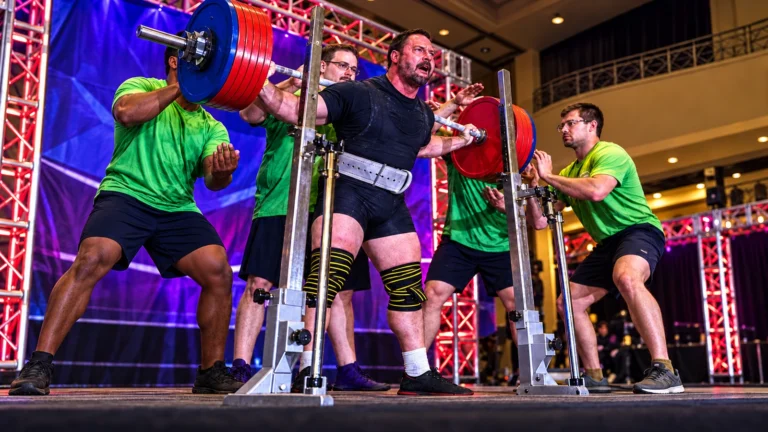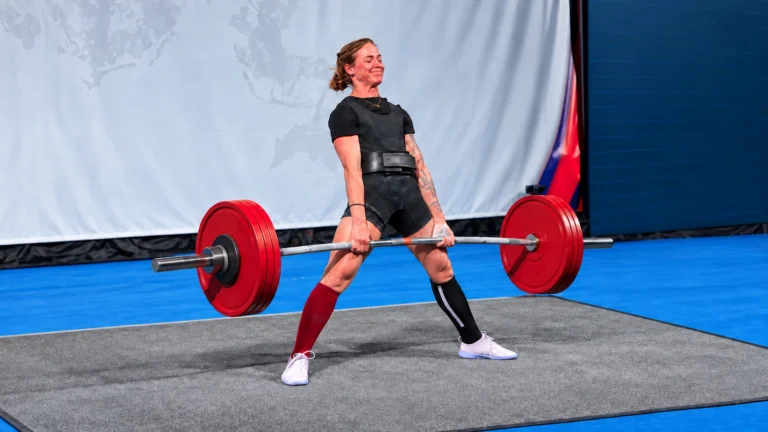

A new exercise science video series is going viral for a reason nobody expected in 2026.
It is not selling a new supplement stack, a 12-minute miracle circuit, or a wearable that promises to hack your recovery.
Strength coach Angel Botello built an entire weekly series around one simple idea instead.
Mastering the actual basics of exercise science, not chasing whatever training trend is trending this month, is what produces real progress over years, not weeks.
That framing is worth taking seriously, because it lines up with what exercise physiology research has shown for decades.
The trends change constantly.
The mechanisms that actually build strength, muscle, and endurance have not changed nearly as much.
This article steps back from any single workout trend to look at the three principles that the published research keeps coming back to.
Progressive overload, training specificity, and individual variation in how people respond to the exact same program.
Here is what the research actually says about each one, and why skipping them is the most common reason a program stops working.
What “Back to Basics” Actually Means in Exercise Science
Fitness content moves fast, and a new “hack” or trend shows up in the algorithm every few weeks.
Underneath nearly all of it, though, sit a small number of principles that have held up across thousands of published training studies.
Exercise scientists generally group these under a few headings: overload, specificity, individual variation, and recovery.
None of these ideas are new.
Some version of them has appeared in strength and conditioning textbooks for half a century.
What changes is not the principle itself.
It is how each new trend repackages the same principle in a different costume, then acts like the costume is the discovery.
A “back to basics” framing is really just a request to look past the costume and check whether a program actually applies the principle underneath it.
That is the same lens this article uses on progressive overload, specificity, and individual variation.
Progressive Overload: The Principle Behind Every Program That Works
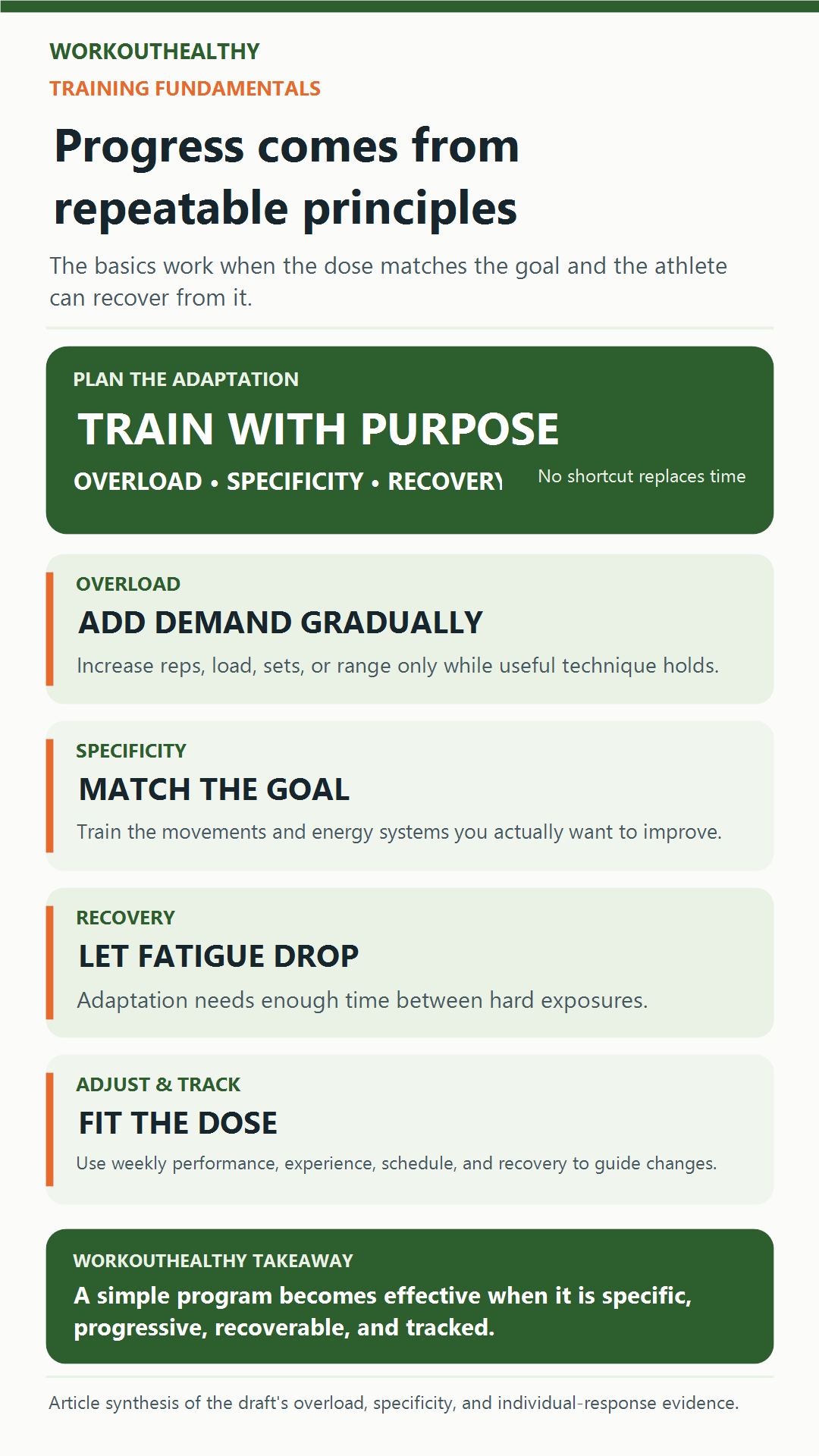
Progressive overload is the idea that a body only keeps adapting if the demand placed on it keeps increasing over time.
That demand can grow through more weight, more repetitions, more total sets, or a harder version of the same movement.
The core mechanism is straightforward.
Muscle, bone, and connective tissue adapt to stress that is slightly beyond what they have already handled.
Once the body fully adapts to a given load, that same load stops being a meaningful stimulus.
A detailed 2004 review in Medicine & Science in Sports & Exercise by William Kraemer and Nicholas Ratamess lays out exactly how this works in resistance training (Kraemer & Ratamess, 2004).
Their review describes progression models built around gradually manipulating variables like load, volume, exercise selection, and rest periods across a training cycle.
The review also makes a point that gets lost in most short-form fitness content.
Progression is not just “add more weight every week forever.”
It is a planned, cyclical increase in demand that leaves room for the body to actually absorb the new stimulus (Kraemer & Ratamess, 2004).
Progressive overload is not a single trick. It is a planning framework, and most programs that stop working have quietly stopped applying it, not outgrown it.
What the Research Says About How Much Overload Is Enough
A common misunderstanding is that overload has to feel brutal to count.
The Kraemer and Ratamess review makes clear that overload is relative to the individual, not an absolute standard everyone must hit (Kraemer & Ratamess, 2004).
A beginner can progress meaningfully by adding small amounts of weight or a rep or two every week or two.
An advanced lifter typically needs a more structured, periodized approach, because the easy, obvious progress has already happened.
The review also stresses that progression has to be tracked to mean anything at all.
Without a written log of what was actually lifted last time, there is no way to know if a program is truly progressing or just repeating the same session with a different mood attached to it.
That single distinction, tracked progression versus untracked repetition, separates a real training program from a workout habit that happens to involve weights.
Our breakdown of Mike Mentzer’s Heavy Duty training covers a real-world example of how differently overload can be applied depending on training age and program structure, while still following the same underlying principle.
Specificity: Why Training Has to Match What You Are Actually Training For
The second pillar sits alongside overload rather than replacing it.
Exercise scientists call it the specificity of training, sometimes shortened to the SAID principle, which stands for specific adaptations to imposed demands.
The idea is simple to state.
The body adapts specifically to the type of stress it repeatedly experiences, not to exercise in some generic sense.
A 2009 review in the Journal of Sports Sciences by Thomas Reilly, Tessa Morris, and Greg Whyte examines this principle across a wide range of training contexts (Reilly, Morris, & Whyte, 2009).
Their review found that training adaptations are consistently tied to the specific muscle groups, movement patterns, energy systems, and even joint angles a person actually trains.
A runner training for a marathon and a runner training for a 400 meter sprint are stressing very different systems, even though both are technically “running” (Reilly, Morris, & Whyte, 2009).
The same logic applies inside the weight room.
Heavy, low-rep training builds a different profile of adaptation than lighter, higher-rep training, even when both eventually build some muscle.
How Specificity Shows Up in Real Training and Comeback Programs
Specificity is easiest to see when someone is rebuilding fitness after a long layoff.
Our fact-check of George Foreman’s boxing comeback breaks his training down into four phases, and one of those phases is labeled specificity for exactly this reason.
General conditioning like running builds a base.
It does not by itself prepare someone for the exact demands of their actual goal.
A future 5K runner eventually needs to run.
A powerlifter eventually needs to squat, bench, and deadlift under real load.
A recreational boxer eventually needs coached rounds, not just road miles.
The Reilly review makes the same point in more clinical language, noting that physiological testing and training prescriptions should match the actual demands of the target activity rather than a generic fitness standard (Reilly, Morris, & Whyte, 2009).
Skipping this step is one of the most common ways a well-intentioned program still fails to produce the specific result someone actually wanted.
Why the Same Program Does Not Work the Same Way for Everyone
The third principle explains something every coach eventually notices firsthand.
Two people can follow an identical program, eat similarly, and sleep similarly, and still end up with meaningfully different results.
Exercise scientists describe this as individual variation in training response, and it is a well-documented feature of resistance and endurance training alike.
Training age plays a large role here.
A beginner tends to respond quickly to almost any reasonable program, because nearly everything represents new overload for an untrained body.
An experienced lifter needs a much more precisely dosed and specific stimulus to see the same rate of progress, since the easy adaptations already happened years earlier.
Genetics, baseline hormone levels, sleep quality, life stress, and total recovery capacity all shape how any one person actually responds to a given amount of training.
The Kraemer and Ratamess review explicitly builds this variability into its progression models, recommending that programs be adjusted to the individual rather than applied as a single fixed formula for every trainee (Kraemer & Ratamess, 2004).
That is also why copying an advanced lifter’s exact program rarely produces the same results for someone earlier in their training history.
The same program can be perfectly correct for one person and quietly wrong for another. That is not a flaw in the principles. It is exactly what the principles predict.

What This Evidence Does Not Prove
None of this research hands anyone a single universal number for sets, reps, or weekly training days.
Overload, specificity, and individual variation describe the shape of a good program.
They do not replace the need to actually design one for a specific person and a specific goal.
The research on progression models also comes mostly from studies lasting weeks to a few months, not multi-year athletic careers.
Long-term outcomes across an entire lifting career are harder to isolate in a controlled study, for the obvious reason that nobody can ethically assign a person to a single training method for twenty years.
These principles also do not guarantee a specific result on a specific timeline.
They describe the conditions that make progress possible, not a promise that progress will happen on schedule regardless of consistency, nutrition, or sleep.
Common Mistakes People Make Chasing Trends Instead of Fundamentals
The most common mistake is switching programs every few weeks whenever a new trend appears online.
Constant switching prevents any single stimulus from being applied long enough to see whether it actually worked.
A second mistake is training hard without tracking anything.
Effort without a written record of load, reps, or sets makes it impossible to tell real progressive overload apart from simply repeating the same workout indefinitely.
A third mistake is training in a way that has little to do with the actual goal, such as running for cardio while training for a powerlifting meet with no real running demand at all.
A fourth mistake is comparing personal results directly to someone else’s program, then assuming a lack of identical results means a personal failure rather than a predictable outcome of individual variation.
A fifth mistake is treating every session as maximal effort with no planned lighter week, which eventually stalls progress by outrunning recovery capacity.
A supportive training partner can help catch several of these mistakes early, since an outside set of eyes on your numbers often spots stalled progress before you do.
Who Should Check With a Doctor Before Changing a Training Program
Anyone with a diagnosed heart condition, uncontrolled high blood pressure, or a history of cardiac events should talk to a doctor before meaningfully increasing training load or intensity.
People managing a recent injury, a joint replacement, or ongoing joint pain should get individualized clearance before applying heavier progressive overload to the affected area.
Pregnant individuals should check with a doctor before starting or significantly changing a resistance training program.
Older adults and anyone returning from a long layoff generally need a smaller starting dose of both volume and intensity, since training age changes how quickly the body can absorb new demand.
A doctor or physical therapist can help sort out whether fatigue or soreness reflects normal training adaptation or something that needs medical attention first.
How to Build a Program Around These Three Principles
Start by writing down your actual goal in specific terms, not a vague wish to “get fit.”
A goal like “squat bodyweight for five reps” or “run a 5K under 30 minutes” points directly to the kind of specificity your training needs.
Next, choose exercises and energy systems that genuinely match that goal, rather than generic workouts borrowed from someone with a different one.
Log every session: the exercise, the weight or pace, and the reps or duration completed.
That log is what makes progressive overload real instead of theoretical.
Each week or two, add a small amount of demand, whether that is more weight, one more rep, a slightly faster pace, or one more set on a lagging area.
If your numbers stall for more than one to two weeks despite consistent effort, treat that as a signal to adjust the plan, not a signal to simply push harder.
Build a planned lighter week into the schedule every four to six weeks regardless of how good you feel, since recovery is what lets the next round of overload actually stick.
Expect your own rate of progress to differ from anyone else’s, and judge your program against your own log instead of someone else’s highlight reel.
If you are unsure how to translate these principles into your own weekly schedule, a qualified personal trainer can help build a plan around your specific goal and starting point.
Watch the Original Video
Want more claims like this checked against the actual research? Subscribe to WorkoutHealthy Insider for practical explanations behind popular fitness claims.
References
Kraemer, W. J., & Ratamess, N. A. (2004). Fundamentals of resistance training: Progression and exercise prescription. Medicine & Science in Sports & Exercise, 36(4), 674-688. https://doi.org/10.1249/01.mss.0000121945.36635.61
Reilly, T., Morris, T., & Whyte, G. (2009). The specificity of training prescription and physiological assessment: A review. Journal of Sports Sciences, 27(6), 575-589. https://doi.org/10.1080/02640410902729741
This article is for general information only and is not medical advice. If you have an injury, ongoing pain, or a medical condition, talk to a doctor or physical therapist before you change how you train or eat.