
Hearing that a knee is bone on bone can make even ordinary movement feel risky.
The WorkoutHealthy Facebook post highlights seated leg swings, glute contractions, and a glute-focused bridge from El Paso Manual Physical Therapy.
Those three demonstrations offer a starting point for a discussion with your clinician, but their specific combination has not been established as a cure for advanced arthritis.
Here is what the creator shows, what larger studies support, and how to prepare useful questions about a plan for your own knee.
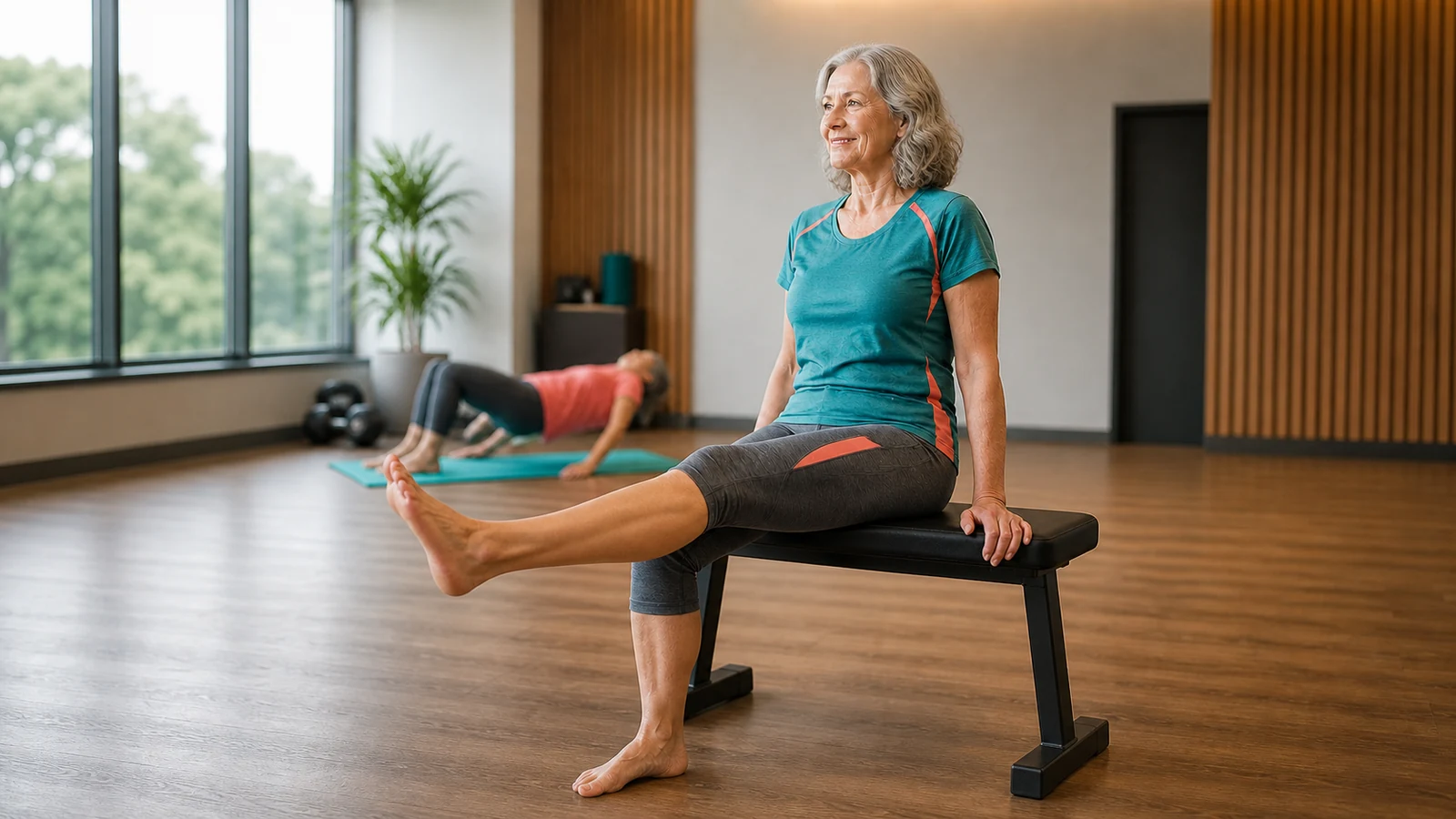
The featured studio scene is an editorial illustration matching our social creative, rather than a photograph of the video presenter or a treatment result.
The Three Moves Behind the Post
The matching three-move demonstration is by physical therapist David Middaugh, whose clinic publishes the video and its transcript (El Paso Manual Physical Therapy, n.d.).
His first move is a seated leg swing with the feet hanging free, using a gentle back-and-forth knee movement.
His second is a glute contraction while lying comfortably, without lifting the legs.
The third is a small bridge that begins with a glute squeeze, using a knee bend the person can tolerate.
The video also discusses gentle mobility and walking technique.
These descriptions identify the demonstration; they do not set your repetitions, hold times, or daily frequency.
The creator attributes benefits to joint-fluid movement and muscle balance, but the research reviewed below does not prove that this sequence regrows cartilage or reliably prevents surgery.
The channel also offers a longer five-exercise livestream from July 21, 2026, which is a separate presentation (El Paso Manual Physical Therapy, 2026).
The three-move video embedded near the end matches the specific exercises in this social post.
What Bone on Bone Means for Exercise
Bone on bone is commonly used to describe very advanced joint-space narrowing on an X-ray.
It is a description of a joint finding, rather than a complete exercise prescription.
NICE advises that osteoarthritis management should be guided by symptoms and physical function, with therapeutic exercise tailored to the person (National Institute for Health and Care Excellence [NICE], 2022).
That supports asking what movement you can manage, rather than deciding from the phrase alone that every activity is forbidden.
Bring the exact wording of your diagnosis to the appointment, especially if different clinicians have described your knee in different ways.
Ask whether your current problem is a stable arthritis pattern, a flare, an injury, or something that needs another assessment.
A useful goal might be walking to a nearby shop, getting out of a chair, or sleeping with less disturbance.
Write down the activity you want to regain so that the conversation stays connected to daily life.
The most useful exercise goal is an everyday task that matters to you, with a plan your knee can tolerate.
What the Updated Review Found
Lawford and colleagues updated the Cochrane review in 2024, including 139 trials with 12,468 participants (Lawford et al., 2024).
Against no treatment, usual care, or limited education, exercise improved pain by an average 13.1 points and physical function by 12.5 points on 100-point scales immediately after the programs.
Against attention control or placebo, the average changes were smaller: 8.7 points for pain and 11.3 for function.
Evidence certainty was low to moderate, and the clinical importance of the average benefits remained uncertain.
Adverse-event findings also varied by comparison, so exercise should not be described as risk-free.
The review covered different programs and participants, rather than a trial of these three moves in people all diagnosed with bone-on-bone knees.
For a reader, the practical interpretation is that exercise can be part of symptom management while expectations stay individual.
A pooled average is useful when weighing treatment options, but it cannot tell you what your first session will feel like.
What an Older Review Adds
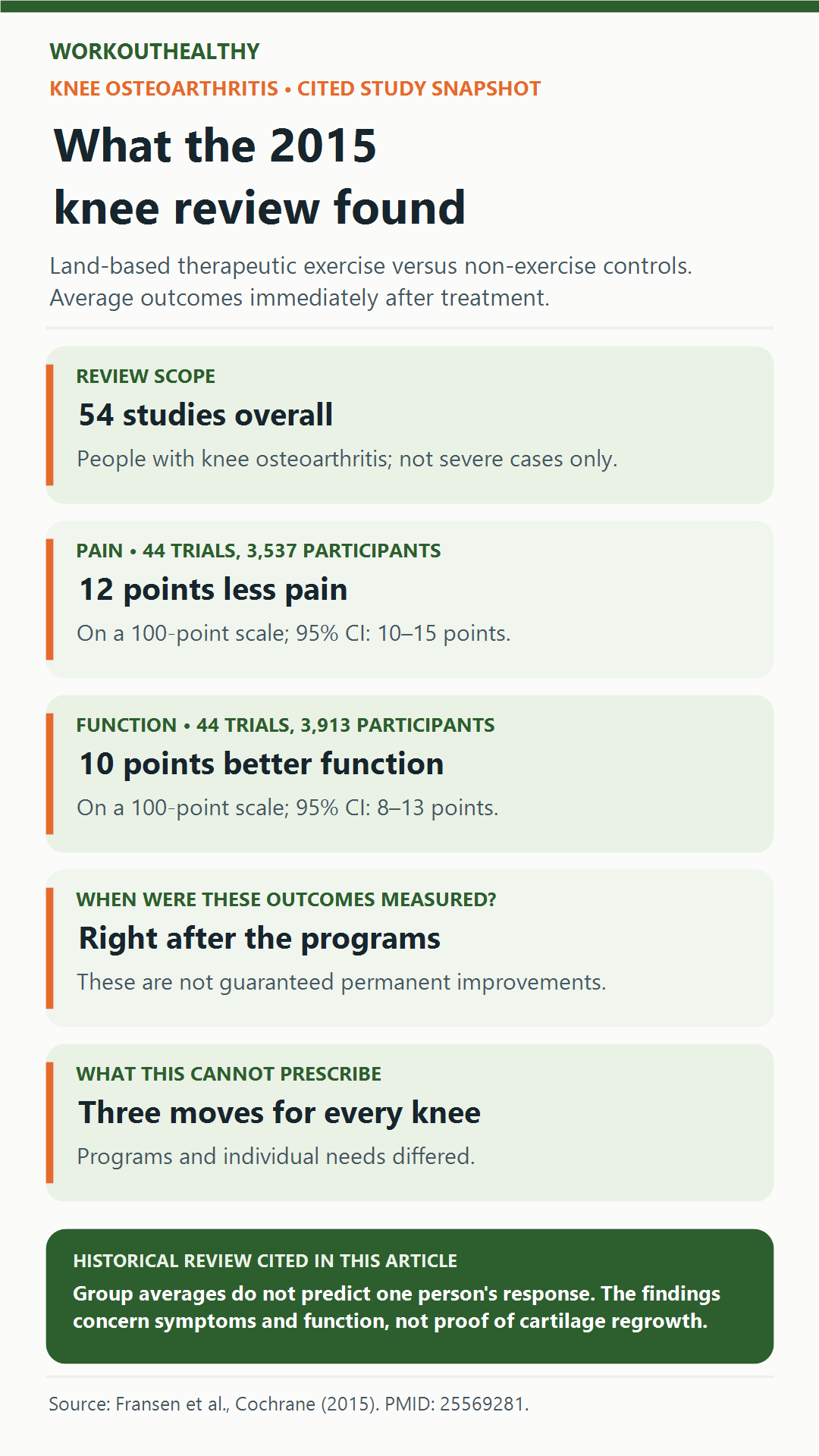
The historical infographic below summarizes the earlier Cochrane review, which included 54 studies overall (Fransen et al., 2015).
Immediately after treatment, pooled results from 44 trials estimated improvements of 12 pain points and 10 function points on 100-point scales.
The pain and function analyses involved 3,537 and 3,913 participants, respectively.
These are historical estimates from the 2015 review, not the updated 2024 results.
The older evidence gives context for why exercise became a common treatment recommendation, but it should not be used to advertise a guaranteed result.
Notice the differences between an outcome measured after a complete program and an outcome after one short home routine.
The infographic also identifies the population limit: these were knee osteoarthritis studies, rather than trials restricted to severe cases.
When reading a fitness graphic, look for the comparison group, when the result was measured, and who actually took part.
Exercise and Surgery in a Clinical Trial
A separate randomized trial enrolled 100 people with moderate-to-severe knee osteoarthritis who were eligible for replacement surgery (Skou et al., 2015).
One group received surgery followed by nonsurgical care; the other received nonsurgical care alone.
That care included exercise, education, dietary advice, insoles, and pain medication, so its results cannot be credited to exercise alone.
At 12 months, average improvement in the combined pain, symptom, daily-function, and quality-of-life score was 32.5 points with surgery and 16.0 without initially assigned surgery.
Serious adverse events numbered 24 and six, respectively, and 13 of 50 people initially assigned nonsurgical care had surgery within that year.
The trial shows a real tradeoff, rather than proof that a short routine replaces surgery.
It also excluded people reporting pain above 60 on a 100-point scale during the previous week, which limits generalization to the most painful situations.
If surgery has been suggested, ask how a supervised exercise plan fits with your treatment decisions and follow-up.
What the Three Moves Cannot Promise
The sources here do not establish that every arthritic knee is damaged mainly by overactive quadriceps or inactive glutes.
They also do not establish that feeling a bridge in the hamstrings means your joint is being harmed.
Muscle cues can help a clinician teach a movement, but they should not become a diagnosis you make from one sensation.
Similarly, feeling easier movement after a session would be a useful symptom observation, not evidence that lost cartilage has grown back.
A person may need several types of care, including an exercise plan, medicines, walking support, or a surgical discussion.
Do not change prescribed treatment because a video promises a single root cause.
Ask the clinician to explain which part of the plan targets symptoms, which part targets strength, and how each will be reviewed.
For general activity goals, our guide to step-count targets explains why a popular number should not be treated as a compulsory daily test.
Any walking target for an arthritic knee still needs to fit your current symptoms and professional advice.
Common Mistakes to Avoid
A common mistake is turning a gentle demonstration into a challenge to match the presenter immediately.
Do not force a knee bend, hold your breath to finish a bridge, or repeat a movement simply to reach a number on the screen.
Another mistake is assuming that no discomfort can ever occur.
NICE explains that joint pain can initially increase when therapeutic exercise begins, while recommending a tailored and consistent plan (NICE, 2022).
That advice does not mean pushing through escalating pain, major swelling, or new instability.
Ask your clinician what response is acceptable for you and what should trigger an adjustment.
Changing the exercises, walking volume, and other treatment all at once can also make your notes difficult to interpret.
Keep a clear record of the change your clinician asked you to make, rather than adding several online routines at the same time.
Our article on consistency and moderation offers a broader discussion of choosing a routine you can keep using.
Its general training lessons should not replace arthritis-specific guidance.
When to Get Medical Help
Seek urgent medical assessment if the knee becomes very painful, badly swollen, changes shape, or cannot bear weight.
A knee that locks or gives way also deserves prompt advice, particularly when this is a new change.
Fever or feeling hot and shivery together with redness or heat around the knee can indicate infection (National Health Service [NHS], 2023).
Those symptoms are reasons to get care, rather than test whether another set will loosen the joint.
People who have had a joint replacement should follow their surgical team’s rehabilitation instructions.
A general arthritis video may not reflect restrictions or goals for a recently operated knee.
If you are unsure whether getting onto the floor is safe, ask for a demonstration of an accessible position and a safe way to get up.
Bring information about other conditions and current treatment, so the professional can account for the full situation.
The aim is to leave with a plan you understand, including how to reach the team when symptoms change.
Plan Your Next Conversation
Use the following questions as an editorial appointment worksheet, rather than a validated test or a way to diagnose your knee.
- Name the task: Which everyday activity would you most like to make easier?
- Describe the pattern: When does the pain start, what stops it, and does swelling accompany it?
- Check the demonstration: Which of the three moves, if any, fits your diagnosis and current ability?
- Set the response rule: What symptoms should lead you to stop, reduce the movement, or contact the team?
- Agree on follow-up: When will the plan be reviewed, and what changes will the clinician look for?
If you already have a prescribed plan, take the video to your next visit and ask how it compares with that plan.
Do not replace the instructions you were given with the creator’s suggested hourly frequency or expected timeline.
Keep a brief note of what you did and how your usual activities felt afterward, using whatever tracking method your clinician recommends.
That note can be simple enough to write on paper or in your phone, with the movement name and the symptom change you noticed.
Ask for clarification when a cue is confusing, including where a bridge should feel effortful and what range of movement to use.
Your plan should also explain how to return to regular activity when a flare settles, rather than leaving you to guess from day to day.
A useful home plan includes a movement, a reason for choosing it, and a clear way to review the response.
The next step is a specific, shared plan that fits your knee and the activities you want to regain.
Watch the Original Video
Make sense of the fitness advice you see. Subscribe to WorkoutHealthy Insider for practical explanations behind popular fitness claims.
References
El Paso Manual Physical Therapy. (n.d.). 3 best exercises for painful bone on bone knee arthritis [Video and transcript]. Original demonstration and transcript.
El Paso Manual Physical Therapy. (2026, July 21). 5 best exercises for painful bone-on-bone knee arthritis [Video]. YouTube. Related five-exercise livestream.
Fransen, M., McConnell, S., Harmer, A. R., Van der Esch, M., Simic, M., & Bennell, K. L. (2015). Exercise for osteoarthritis of the knee. Cochrane Database of Systematic Reviews, 2015(1), CD004376. https://doi.org/10.1002/14651858.CD004376.pub3.
Lawford, B. J., Hall, M., Hinman, R. S., Van der Esch, M., Harmer, A. R., Spiers, L., Kimp, A., Dell’Isola, A., & Bennell, K. L. (2024). Exercise for osteoarthritis of the knee. Cochrane Database of Systematic Reviews, 2024(12), CD004376. https://doi.org/10.1002/14651858.CD004376.pub4.
National Health Service. (2023, December 21). Knee pain. https://www.nhs.uk/symptoms/knee-pain/.
National Institute for Health and Care Excellence. (2022). Osteoarthritis in over 16s: Diagnosis and management (NICE Guideline NG226). Recommendations.
Skou, S. T., Roos, E. M., Laursen, M. B., Rathleff, M. S., Arendt-Nielsen, L., Simonsen, O., & Rasmussen, S. (2015). A randomized, controlled trial of total knee replacement. New England Journal of Medicine, 373(17), 1597-1606. https://doi.org/10.1056/NEJMoa1505467.
This article is for general information only and is not medical advice. If you have an injury, ongoing pain, or a medical condition, talk to a doctor or physical therapist before you change how you train or eat.