
Alexander Ludwig’s most useful training insight is not a secret exercise. In a 2020 Men’s Health feature about his preparation for Vikings and Bad Boys for Life, the actor described a change in mindset: moderation and consistency mattered more to him than trying to exhaust himself every time he trained. The published interview gives a specific picture of his routine, but it also warns readers not to copy the listed moves as a stand-alone plan.
His point is worth examining because the Facebook post about Ludwig says consistency beats crushing every session. That is a fair summary of his stated outlook, but it is not proof that low-intensity exercise alone delivers every fitness goal. Here is what he reported, what exercise guidance supports, and how a regular person can use the principle without imitating a movie preparation schedule.
What Alexander Ludwig Actually Said
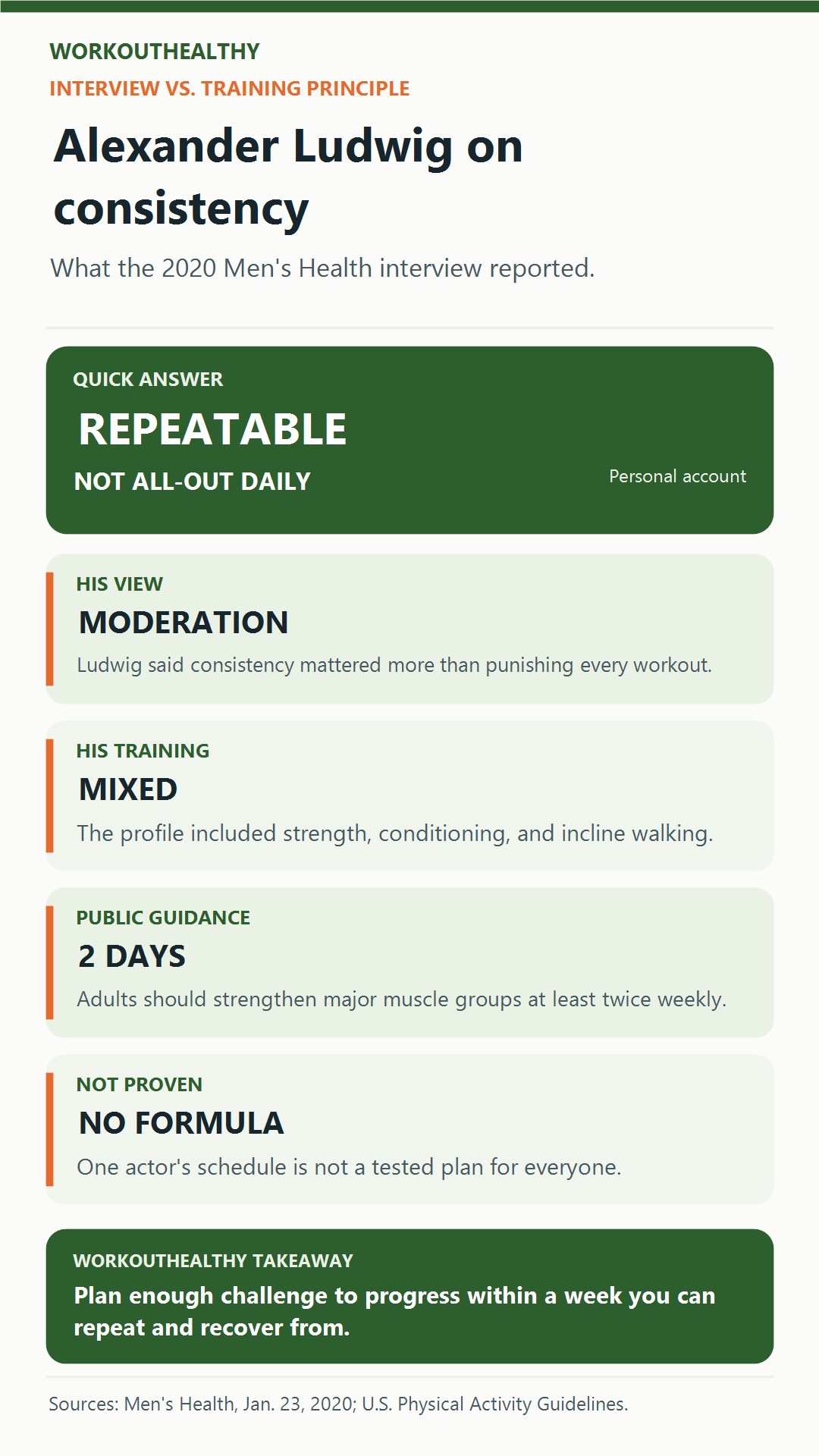
The Men’s Health article was published on January 23, 2020. Ludwig discussed the different demands of Vikings, where fight scenes required conditioning, and Bad Boys for Life, where he wanted a larger physique for his role. He said he had once approached training by trying to make every workout punishing. By the time of the interview, he emphasized “moderation is actually key, and consistency.” He described trying to get to the gym regularly, with some days off on weekends.
Those details are his account at that time, not a current daily training log. The source does not establish that he still uses the same weekly schedule in September 2026. It also does not specify that every session is moderate. The article includes challenging conditioning, strength exercises, and incline treadmill walking. That mixture makes the real message subtler than “never train hard”: he was looking for a pattern he could repeat while meeting role-specific demands.
A separate Men’s Health interview about Heels later described a particularly strenuous production regimen. Ludwig said a demanding filming schedule led him to adapt his training and build access to a home gym. Different roles required different work. Neither interview supplies a universal workout prescription.
Consistency Is a Schedule, Not a Single Intensity
Consistency means doing enough useful activity, often enough, over enough time to make progress. It is not the same as doing the exact same workout every day. A sustainable week may include strength sessions, aerobic activity, easier movement, and rest. The right mix changes with the person’s goal, training history, health, and schedule.
The U.S. Physical Activity Guidelines recommend that adults work toward 150 to 300 minutes of moderate-intensity aerobic activity per week and muscle-strengthening activity on at least two days. The guidance specifically tells inactive people to begin with small amounts and build gradually. These are public-health targets, not a promise that a celebrity’s split routine is optimal for everyone.
The American College of Sports Medicine’s 2026 resistance-training guidance similarly starts with training all major muscle groups at least twice weekly and building gradually. A two-day program can be a real program. For someone who can reliably train twice each week, it may be more useful than writing down six sessions and repeatedly missing four. Once that baseline is stable, a person can adjust the workload toward their goals.
Why “Harder Every Day” Can Undermine the Plan
A very hard session can be appropriate in a structured program. The trouble is treating maximum effort as the price of admission every time. If the only acceptable workout is the most difficult one, a busy or tired day may become a skipped day. Pushing every lift and conditioning session without room for recovery may also make it difficult to maintain performance and technique.
That does not mean a moderate-feeling workout is always superior. Strength and muscle gains depend on appropriate resistance, weekly workload, progression, and recovery. A large network meta-analysis of resistance-training trials found that multiple training prescriptions can improve strength and muscle size, with program variables affecting the size of gains. The evidence does not support one slogan replacing thoughtful programming.
The practical distinction is between planned challenge and automatic punishment. A strength set should be purposeful for the goal, but the entire week does not need to feel like a test. When effort is scaled to the day and progress is tracked over time, it is easier to repeat the training that actually drives adaptation.
What His Publicly Described Routine Included
The 2020 profile showed a sample rather than a complete weekly plan. It listed incline treadmill walking, weighted burpees, a shoulder sequence, and an abdominal circuit. Ludwig linked his conditioning to the physical demands of Vikings and his muscle-building efforts to Bad Boys for Life. The article’s own caution was that the exercises should not be followed to the letter as a stand-alone routine.
The incline walking segment illustrates a useful distinction: an exercise can be less dramatic than sprinting yet still contribute substantial aerobic work. The weighted burpees illustrate the opposite: a demanding movement can have a place without being the only kind of session. The ab circuit was something Ludwig felt comfortable repeating; it was not presented as a scientifically unique way to develop core strength.
There is also no evidence that a particular number of gym visits caused his on-screen appearance by itself. A film role brings unusual timelines, coaching, food planning, professional demands, and sometimes production support. Readers should not treat an actor’s visible transformation as a controlled experiment.
How to Build a Repeatable Week
If Ludwig’s shift in outlook resonates, start with a schedule you can actually keep. For a generally healthy beginner, two nonconsecutive full-body strength days and several walks or other aerobic sessions may be a reasonable starting structure. Pick a manageable amount of work, learn the movements, and add time or resistance gradually as recovery and confidence allow. People with a medical condition, recent injury, or exercise restrictions should tailor this with a qualified professional.
- Choose a realistic minimum. Put the sessions on a calendar that fits your life, including travel and work demands.
- Keep the exercise menu simple. Cover major movement patterns with options you can perform safely and repeat.
- Use a range of effort. Some days can be challenging; some can be easier or shorter while still preserving the habit.
- Track the useful signal. Record attendance, exercises, sets, loads, and how you recovered, rather than judging a session only by sweat or soreness.
- Make room for change. Illness, pain, and poor sleep can justify modifying or skipping a session.
This framework is an application of public exercise guidance, not Ludwig’s personal program. For an example of how enjoyment can also keep a routine going, see our Miley Cyrus running story. For the difference between an eye-catching feat and a sensible training load, see our Joe Mackey hack-squat analysis.
Consistency Does Not Mean Never Progressing
The phrase can be misunderstood as an argument for always staying comfortable. To improve a particular capacity, training normally needs to challenge it progressively. That progression can be small: an extra repetition with good form, a modest load increase, a longer walk, or an additional set after the current volume is manageable.
Progression also has to be judged across weeks, not just one workout. A person may train hard on Tuesday and use Thursday for a more controlled session. Someone returning after a break may need several weeks simply to reestablish regular attendance. The useful question is whether the plan provides enough stimulus and enough opportunity to recover so that it can continue.
A 2024 systematic review comparing split and full-body resistance programs found no meaningful difference in strength or muscle growth when training volume was equated. That does not prove all schedules are identical, but it suggests that the label on the split matters less than whether the total work is appropriate and consistently done. Choose a format you can sustain and then adjust the dose.
What the Quote Does—and Does Not—Prove
Ludwig’s statement is a personal account, not a trial. It supports reporting that he preferred a more repeatable approach at the time of the interview. It does not establish that every joint injury is prevented by moderate training, that high intensity is ineffective, or that all people should visit the gym nearly every day. The Facebook caption’s broader claim about less joint and connective-tissue strain is a plausible planning consideration, but the interview itself did not test that outcome.
His later description of demanding Heels preparation is a useful reminder that training goals and constraints change. For an actor, role preparation may require periods of higher effort. For most readers, the more transferable lesson is to set a realistic floor, plan harder work when it serves a goal, and avoid making every missed session a moral failure.
Our celebrity-fitness reporting policy explains why we separate what a public figure reported from a routine we can responsibly recommend.
The Bottom Line
Alexander Ludwig said moderation and consistency had become central to his approach after a period of trying to make workouts punishing. The verified 2020 interview shows a mix of conditioning and strength work, not an all-easy plan. For readers, the actionable idea is to design enough challenge to make progress within a week they can genuinely repeat. Public guidelines offer a starting point; individual goals and recovery determine the details.
References
- Williams B. How Alexander Ludwig Stayed Ripped from Vikings to Bad Boys for Life. Men’s Health. January 23, 2020.
- Alexander Ludwig on Heels preparation. Men’s Health. 2021.
- U.S. Office of Disease Prevention and Health Promotion. Physical Activity Guidelines Questions and Answers.
- American College of Sports Medicine. Resistance Training Position Stand infographic. 2026.
- Currier BS et al. Resistance training prescription for muscle strength and hypertrophy in healthy adults. British Journal of Sports Medicine. 2023.
- Efficacy of split versus full-body resistance training on strength and muscle growth. Journal of Strength and Conditioning Research. 2024.
This article is general fitness information, not individualized medical advice. Stop and seek professional advice for new pain, concerning symptoms, or exercise restrictions.