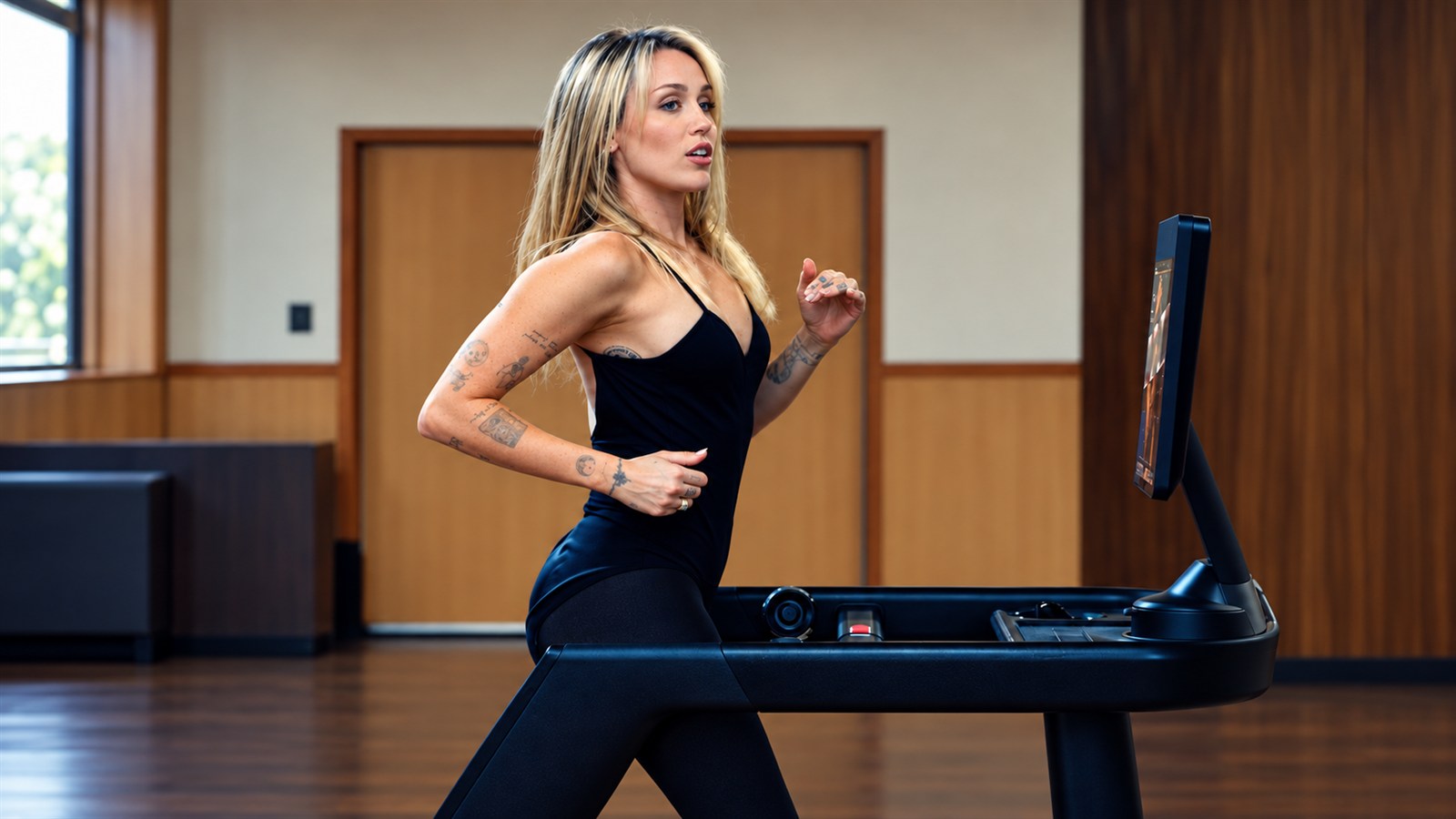

Miley Cyrus is running in a new Peloton campaign, but the most interesting part is not the treadmill.
It is her reason for moving.
In a September 2026 interview with ELLE, Cyrus described running and dancing as part of her everyday life and performance preparation.
She also spoke about moving simply to enjoy the present moment, without demanding a measurable result from every session.
The campaign promotes Peloton’s Tread Flex, its first foldable treadmill.
That equipment is not necessary to use the idea.
Walking outside, dancing at home, or taking a comfortable run can all create a session worth repeating.
A workout can be useful even when the only result you track is whether you want to do it again.
What Miley Actually Said
ELLE interviewed Cyrus as Peloton launched its Let Yourself Run campaign on September 22, 2026.
She described movement as something that supports her performances and said that exercising with Peloton is part of her daily practice.
She also made a different point: running, dancing, and moving can be valuable without an immediate reward or external goal.
Those statements are about her own relationship with movement.
They are not evidence that she follows a specific mileage target, runs every day, or uses one machine exclusively.
They do not reveal her complete training plan.
The interview mentions an earlier video of Cyrus singing while running on a Peloton treadmill before a 2021 performance.
That clip shows one form of performance preparation, not a prescription for anyone else to sing while exercising.
A singer may have different reasons to train endurance than a person seeking an easier walk around the neighborhood.
The useful common ground is choosing movement that fits a real life rather than imitating a celebrity schedule.
The Campaign and the Person
Peloton’s announcement describes the campaign as a promotion for the Tread Flex and a new running-focused chapter of its brand platform.
Cyrus appears alongside instructor Adrian Williams in a short film.
It combines music, running, and dance to make movement look expressive instead of purely numerical.
That is a marketing message, and the commercial relationship should be clear.
Cyrus’s comments about her own habits are separate from a proven outcome for buyers of the machine.
Nothing in the campaign establishes that owning a Tread Flex improves motivation, performance, or health more than another safe activity.
The product can make running at home convenient for some people.
Others might prefer an outdoor route, an accessible dance class, or a walking plan requiring no purchase.
The article is about the choice to move, not a treadmill review.
Readers comparing equipment need actual specifications and a buying guide, not a celebrity endorsement used as a substitute for testing.
Why Enjoyment Matters
Enjoyment is not a scientific guarantee that someone will keep exercising.
It is one factor that can make a routine easier to repeat.
A systematic review of self-determination research found that more autonomous reasons for exercise were associated with greater physical activity.
Intrinsic motivation, including interest in the activity itself, tended to relate more strongly to longer-term exercise adherence.
Much of that evidence is observational, so it cannot prove that telling someone to enjoy exercise will make them active.
It does suggest a practical question worth asking: which form of movement feels possible again tomorrow?
The researchers also distinguished starting a new habit from maintaining it.
A health goal can help someone begin, while interest in the activity may matter more after the novelty fades.
Neither pattern tells us why Cyrus personally exercises, and neither turns her campaign into a clinical experiment.
The evidence is a guide to designing your own routine, not a verdict on hers.
The answer might be a run with music for one person and a quiet walk for another.
It might change with the weather, available time, disability, childcare, or how a body feels that day.
There is no need to invent a perfect passion for fitness.
Sometimes the best option is simply the least unpleasant one that fits the day.
Our guide to standing cardio without jumping offers one lower-impact option when running does not appeal.
What Joyful Movement Does Not Mean
Enjoying a session does not mean ignoring effort, symptoms, or recovery.
A demanding workout can be satisfying, but it can also be the wrong choice on a particular day.
Likewise, a gentle walk can be worthwhile even if it never becomes an intense training session.
Public health guidance encourages adults to move more and sit less.
It also provides weekly targets for aerobic and muscle-strengthening activity, which remain useful for long-term planning.
The presence of a target does not require every workout to feel like a test.
People can build toward those totals through many smaller sessions.
A dance break, a short walk, and a planned strength session may serve different purposes in the same week.
Cyrus’s campaign is especially easy to misread as a promise that exercise must always feel joyful.
Real routines include ordinary days, missed sessions, and activities that feel better after they are done than while they are happening.
Making room for enjoyment is a design choice, not another standard to fail.
For a practical shorter session, see our 10-minute cardio routine.
The Two-Axis Movement Menu
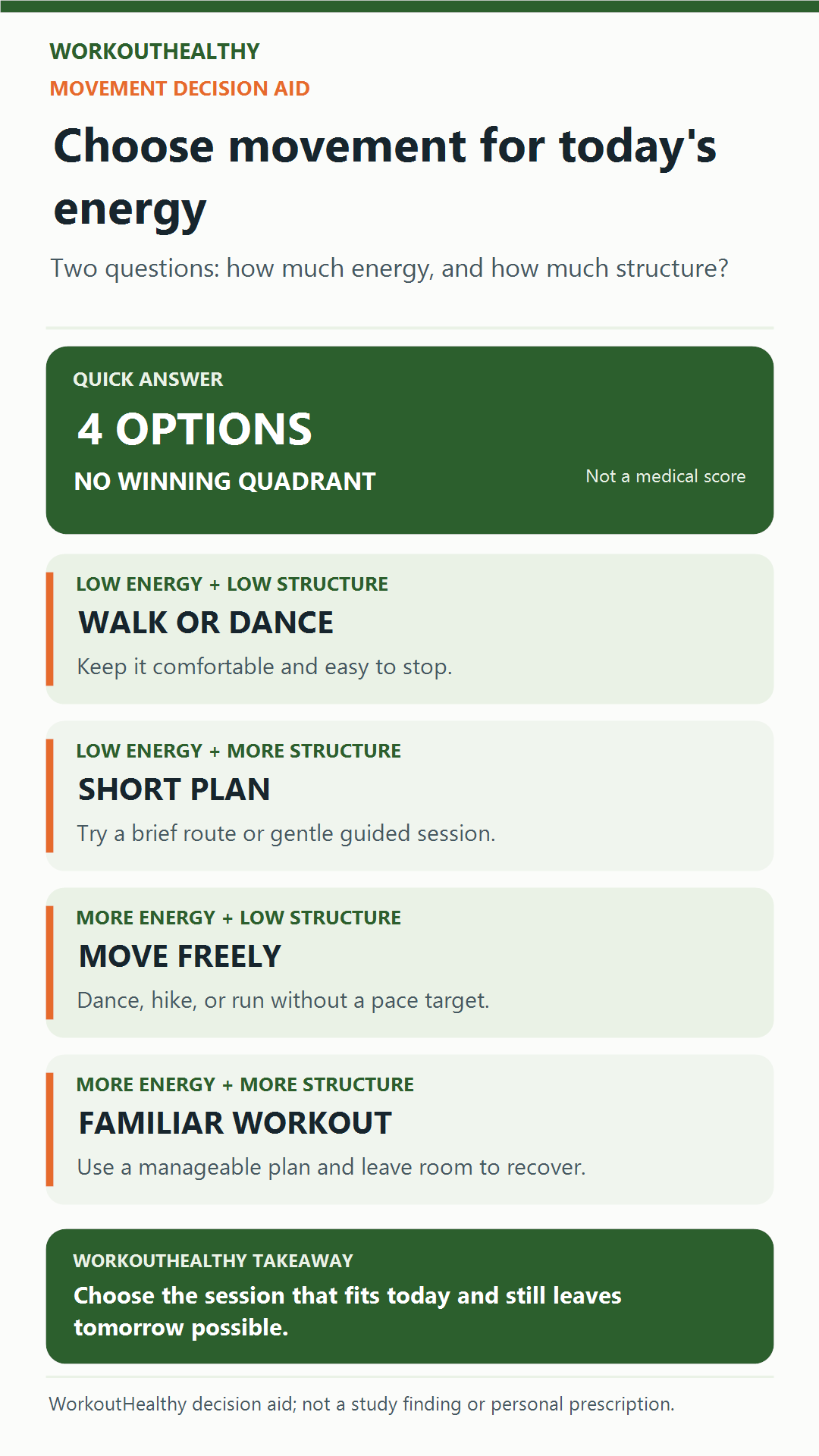
WorkoutHealthy’s Two-Axis Movement Menu is a simple way to select a session without copying Cyrus’s campaign.
It uses two questions: how much energy do you have, and how much structure do you want?
These are personal judgments, not a validated medical score.
When energy is low and structure sounds unappealing, try a short comfortable walk or a few songs of easy dancing.
When energy is low but structure helps, choose a brief planned route or a gentle guided session with a clear stopping point.
When energy is higher and structure sounds unappealing, move freely: dance, hike, or take a relaxed run without a pace target.
When energy is higher and a plan feels welcome, complete a familiar run or workout with manageable effort and recovery afterward.
The menu has no winning quadrant.
Its value is matching the session to the day so that the next session remains possible.
Start with five to ten minutes if you are unsure, then stop or continue based on comfort and any medical guidance you follow.
The infographic below turns the four choices into a quick reference.
It is a WorkoutHealthy decision aid, not a study finding or personalized training prescription.
How to Try It This Week
Begin by listing three kinds of movement that are accessible to you now.
They can be ordinary: walking, dancing in a room, or following a short exercise video.
Choose one for a low-energy day and one for a day when you want more effort.
Set a starting duration that feels small enough to begin without an argument with yourself.
For one person that may be five minutes; for another it may be twenty.
There is no universal starting number.
Afterward, note three things: whether you completed it, how you felt, and whether you would choose it again.
That last answer is as useful as the time or distance.
Over several sessions, it can reveal which activity survives busy days rather than only ideal days.
Keep a structured goal if it genuinely helps you.
Remove unnecessary scorekeeping when it turns a manageable session into pressure.
If walking is the easiest place to begin, our Marisa Tomei walking story gives another example of movement outside a gym routine.
The repeatable session usually matters more than the impressive session that you never want to repeat.
When the Plan Needs to Change
There are days when the best movement plan is rest or a conversation with a clinician.
Stop and seek medical guidance for chest pain, fainting, severe shortness of breath, or another concerning symptom.
People with a medical condition, recent injury, or movement restriction should follow individualized advice instead of a celebrity campaign.
Accessibility matters too.
Someone who cannot safely run can still find enjoyable movement through seated activity, water exercise, walking aids, or an adapted class.
What counts is not how closely an activity resembles a commercial.
It is whether the activity is appropriate, possible, and worth returning to.
Music can help some people enjoy movement, but it can distract others in traffic or unfamiliar spaces.
Choose a setting where you can hear and see what you need to stay safe.
Rest, strength work, and aerobic activity can all have a place in a balanced week.
No single scene from a campaign supplies the whole plan.
The Takeaway
Cyrus’s September 2026 Peloton campaign pairs a new treadmill with a broader idea about moving for the experience itself.
Her ELLE interview supports that reading, but it does not document a complete training program or prove the product is necessary.
Exercise research gives a cautious reason to take enjoyment seriously: self-directed motivation is associated with sticking to physical activity.
The practical test is personal.
Choose a safe activity, start at a manageable level, and notice whether you want to return.
You can still use goals when they help.
You can also let a song, a walk, or a few minutes of movement be enough for today.
Want evidence-aware fitness stories? Subscribe to WorkoutHealthy Insider for practical reporting without miracle claims.
Medical disclaimer: This article is general product information, not medical advice. The equipment described here is not a treatment for any condition. If you have an injury, ongoing pain, or a medical condition, talk to a doctor or physical therapist before using any of it.