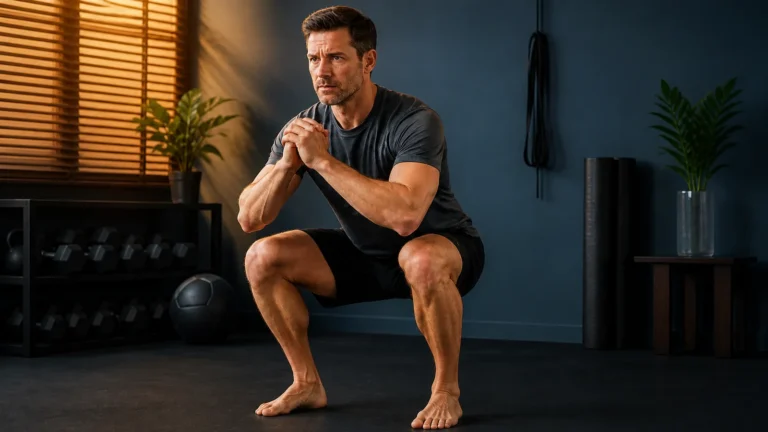

Can standing cardio without jumping work? Yes, a standing routine can count as aerobic activity when the movement raises your breathing and effort enough for you, even if both feet never leave the floor. Standing still or moving very gently is not automatically a cardio workout, so use the effort check and ten-minute routine below instead of assuming the label tells you the intensity.
The original Kaji Pm video is a separate 30-minute no-jump workout. Our shorter routine offers a clear starting point for a small space, with support and seated swaps when needed.
What makes standing movement cardio?
Cardio describes sustained activity that challenges your heart and lungs, not a requirement to jump. Marching, side steps and arm movement can be enough for one person but easy for another, depending on pace, range of motion and fitness.
Use the CDC talk test: at a moderate effort you can talk but not sing, and at a vigorous effort you can say only a few words before breathing again. That is a personal guide, not a promise that every movement in this routine reaches moderate intensity.
| If the routine feels… | Try this adjustment | Check again |
|---|---|---|
| Too easy to count as cardio | Use a slightly quicker comfortable pace, larger arm swings or another round. | Can you still talk but not sing? |
| Too breathless | Shorten the working interval, use smaller steps or hold a stable counter. | Can you speak comfortably again? |
| Unsteady or painful | Use the supported or seated choice, or stop that move. | Do not force a pace through pain or dizziness. |
An original ten-minute, no-jump standing routine
Clear a small space and keep a stable counter or sturdy chair nearby if you want support. The two-minute warm-up, six one-minute slots and two-minute cool-down add up to exactly ten minutes.
| Clock | Movement | Supported or easier option |
|---|---|---|
| 0:00 to 2:00 | Walk or march slowly, then add gentle arm swings. | Hold a counter, or march seated. |
| 2:00 to 3:00 | Heel digs with alternating arm pulls. | Touch one heel forward at a time with small arm movements. |
| 3:00 to 4:00 | Side step and reach at shoulder height. | Take smaller side steps or seated side toe taps. |
| 4:00 to 5:00 | Alternating short step-back taps with relaxed arm sweeps. | Hold support and tap one foot back without leaning. |
| 5:00 to 6:00 | March with an easy cross-body reach. | Reduce the reach or alternate foot lifts while seated. |
| 6:00 to 7:00 | Side toe taps followed by a comfortable heel raise. | Skip the heel raise or keep both hands on support. |
| 7:00 to 8:00 | Forward toe taps with a natural arm swing. | Use a smaller tap or move only the arms while seated. |
| 8:00 to 10:00 | Slow the walk or march and let your breathing settle. | Take a seated cool-down if preferred. |
For each one-minute slot from 2:00 to 8:00, move for about 45 seconds and use the last 15 seconds to transition or rest. You can pause the clock whenever you need more recovery; the printed times describe the uninterrupted version, not a requirement to keep moving through symptoms.
Keep each step low enough that one foot remains on the floor, and let your arms move without forcing the shoulders overhead. This is a general editorial routine rather than a tested protocol or a filmed demonstration of every option.
How to use the routine over a week
Begin with one round if it fits your comfort and recovery, then repeat on days that work for you. To progress, repeat the ten-minute sequence after an easy break, or choose a somewhat brisker comfortable pace while keeping the talk test in view.
The CDC advises adults to build toward weekly aerobic activity plus two days of muscle strengthening, and notes that some activity is better than none. Minutes in this routine count toward a moderate-intensity aerobic goal only when your effort actually reaches that level.
If you want a steadier alternative, our walking-goal guide explains how to choose a sustainable pace and duration without assuming one daily mileage target fits everyone. Both choices can be part of an activity week.
What the evidence does and does not show
The no-jump format makes it possible to move without hops, but it does not remove all load from knees, hips or ankles. Your actual effort, comfort and response matter more than a broad “joint friendly” label.
A 12-week study by Brill and colleagues compared a diet program alone with the same program plus 30 or 60 minutes of walking five days a week in 56 women who completed it. The walking groups improved some measured fitness and waist outcomes more than diet alone, while weight loss did not show a walking-dose response; this was not a test of standing cardio or our ten-minute routine.
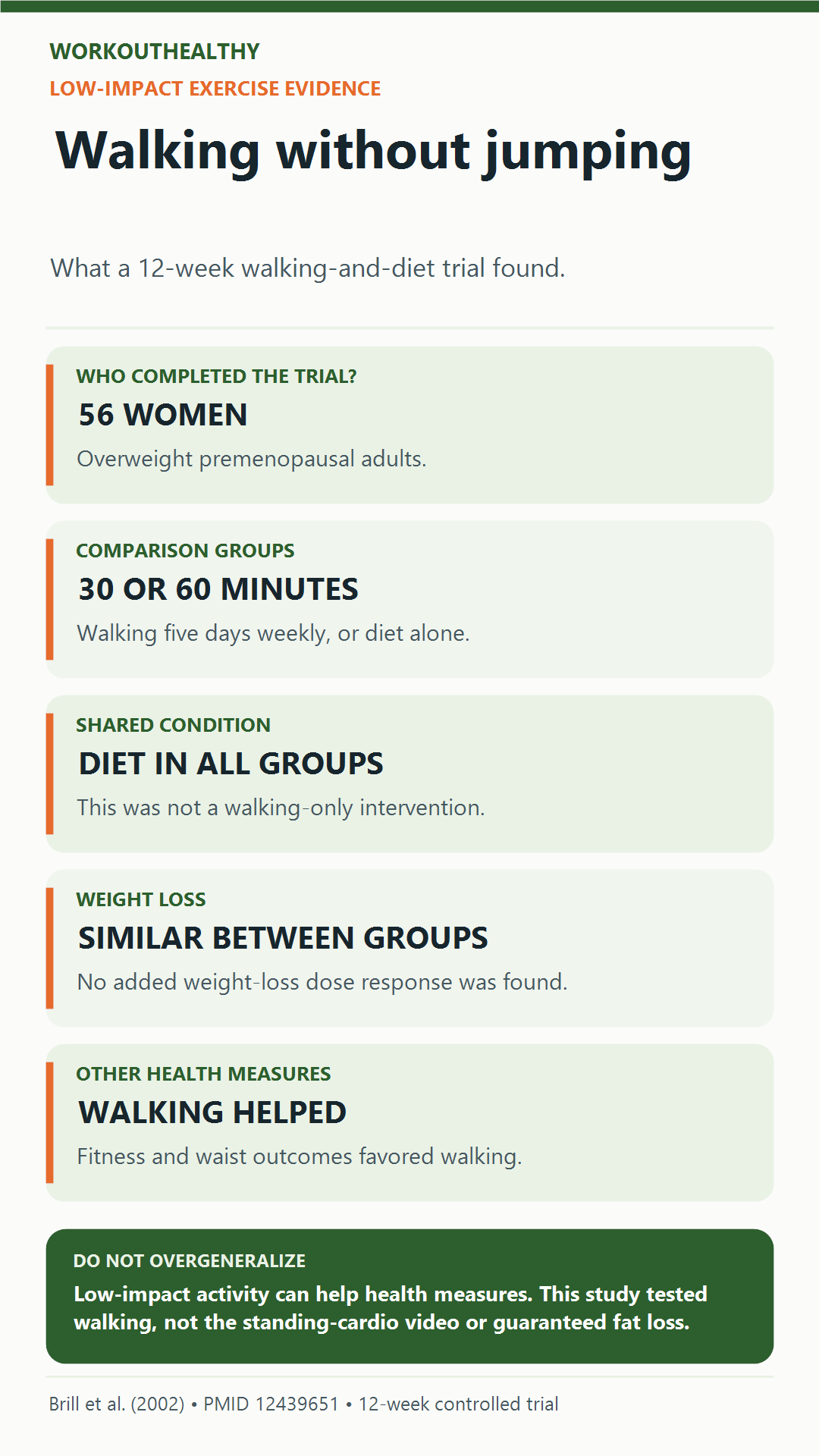
The infographic reports the walking study as context for the difference between fitness measures and scale weight. It does not establish that a short standing session produces those same changes.
Standing still, casual stepping and a brisk standing circuit may have very different energy costs. An individual’s body-composition change cannot be predicted from a ten-minute clock, so the practical first question is whether this format helps you move at a useful, repeatable effort.

Watch the source workout
Kaji Pm’s 30-minute video inspired the original article and remains below for readers who want a longer follow-along session. Its weight-loss claim is a video description, not a measured outcome for everyone who tries it.
Want more like this? Subscribe to WorkoutHealthy Insider for practical explanations behind popular fitness claims.
Sources
- CDC, How to Measure Physical Activity Intensity: relative effort and the talk test.
- CDC, Adding Physical Activity as an Adult: weekly activity guidance and gradual participation.
- Brill and colleagues, 2002: 12-week walking-and-diet comparison, not a standing-cardio trial.
This article offers general fitness information, not medical advice or a promise of weight change. If you have ongoing pain, balance concerns or a medical condition, ask a qualified clinician how to adapt activity to your needs.