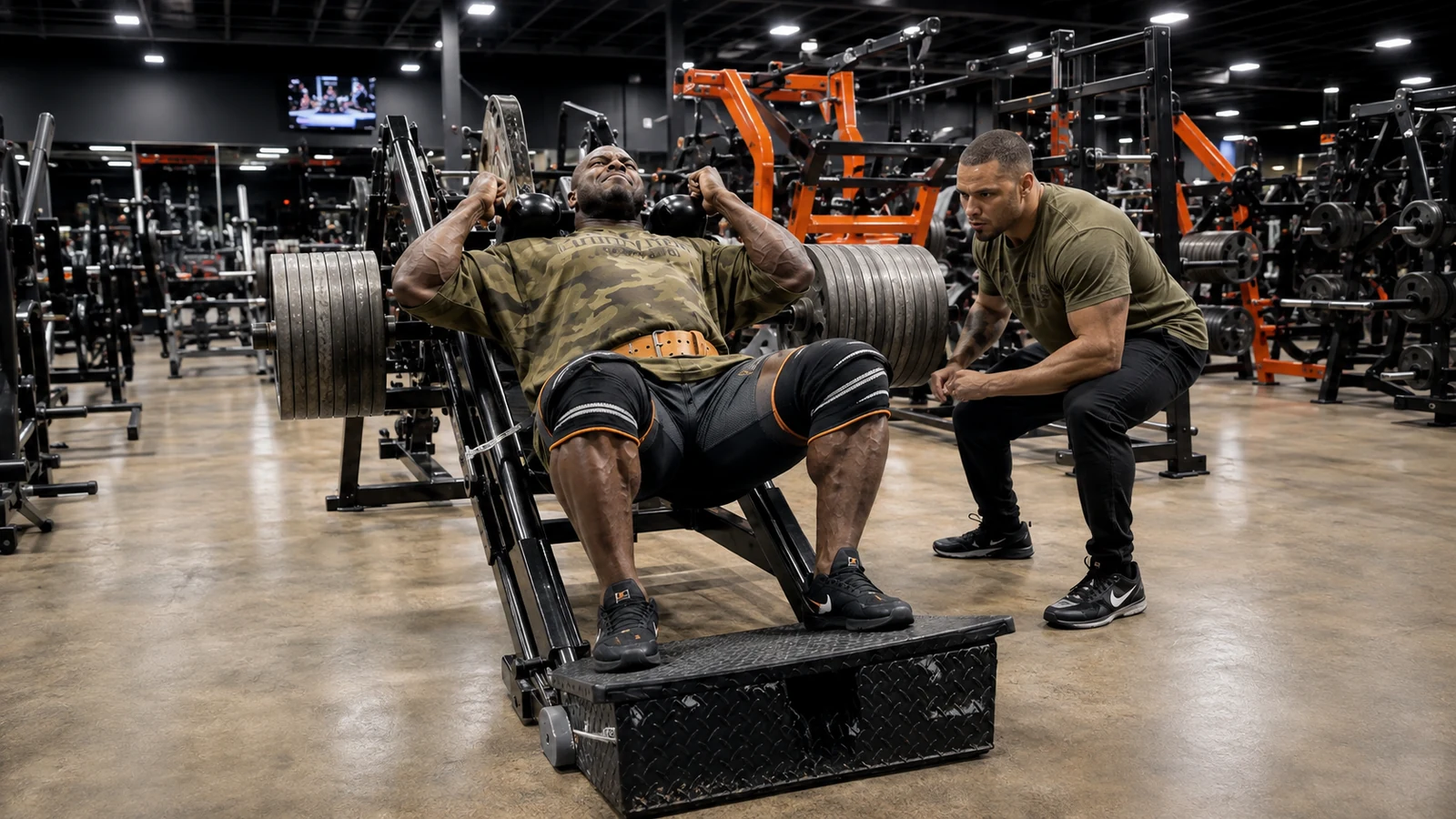

Joe Mackey loaded a hack squat machine with 990 pounds in March 2023.
Then he folded into a deep knee bend and drove the whole stack back up.
He did it five times, with no resistance bands and no help from anyone else in the room.
The clip spread fast because the number is almost impossible to picture.
Nearly half a ton of steel, moving through a full range of motion, powered entirely by two legs.
This was not a certified world record.
No federation sanctioned the attempt, no official judge signed off on the weight, and nobody has ever tried to submit it to Guinness or any other record-keeping body.
It is something else.
A real IFBB Pro bodybuilder, on video, moving an amount of weight that most lifters will never even see loaded onto a machine, let alone move through a real range of motion.
This article checks the claim against what is actually documented, explains why the hack squat lets strong lifters chase loads like this in the first place, and looks at what the science says about training this way.
What Actually Happened on March 27, 2023
Mackey posted the lift to his own Instagram account on March 27, 2023.
FitnessVolt covered it four days later, on March 31, 2023, and BreakingMuscle independently reported the same numbers.
The load was 449 kilograms, or roughly 990 pounds, on a plate-loaded hack squat machine.
He completed five repetitions.
Both outlets note that Mackey used no resistance bands on the set, a detail worth mentioning because bands are a common way lifters cheat the bottom portion of a heavy hack squat.
He wore a lifting belt and knee sleeves, standard support gear for a max-effort lower body set, but nothing that changes the actual mechanics of the lift.
FitnessVolt’s own description called the set “demolished,” a word choice that lines up with what the video shows: a lifter who looked like he had real reps left in reserve, not someone grinding out a one-rep max.
Half a ton of resistance for five controlled reps is not a grinding, ugly single. It is a strength reserve most lifters never build, shown off almost casually.
Who Joe Mackey Is
Mackey turned pro in 2017 after a standout performance at the Ferrigno Legacy Pro.
Since then he has competed at several IFBB Pro League shows, including the 2018 Indy Pro, the 2019 New York Pro, the 2020 Tampa Pro, and the 2021 Chicago Pro.
What sets him apart from most bodybuilders on that circuit is that he trains with genuine powerlifting intent alongside his physique work.
He has described chasing a 1,000-pound deadlift.
Earlier in 2023 he pulled a 910-pound raw deadlift at C.T. Fletcher’s Iron Wars VII, an event built specifically around extreme strength feats.
That combination, bodybuilder-level muscle mass paired with powerlifting-level absolute strength, is unusual even at the top of the sport.
Most competitive bodybuilders train for size and shape first, with strength as a byproduct.
Mackey trains for both directly, and his legs are the clearest evidence of what that approach can produce.
Other IFBB pros have built similarly extreme reputations around a single training obsession.
Jay Cutler’s well-documented eating habits during his competitive years show the same pattern, a very specific, very extreme practice that became part of an athlete’s identity, verified by real reporting rather than just repeated online.
Why the Hack Squat Lets Lifters Move This Much Weight
A hack squat machine fixes the bar path along an angled track instead of leaving it free, the way a barbell squat does.
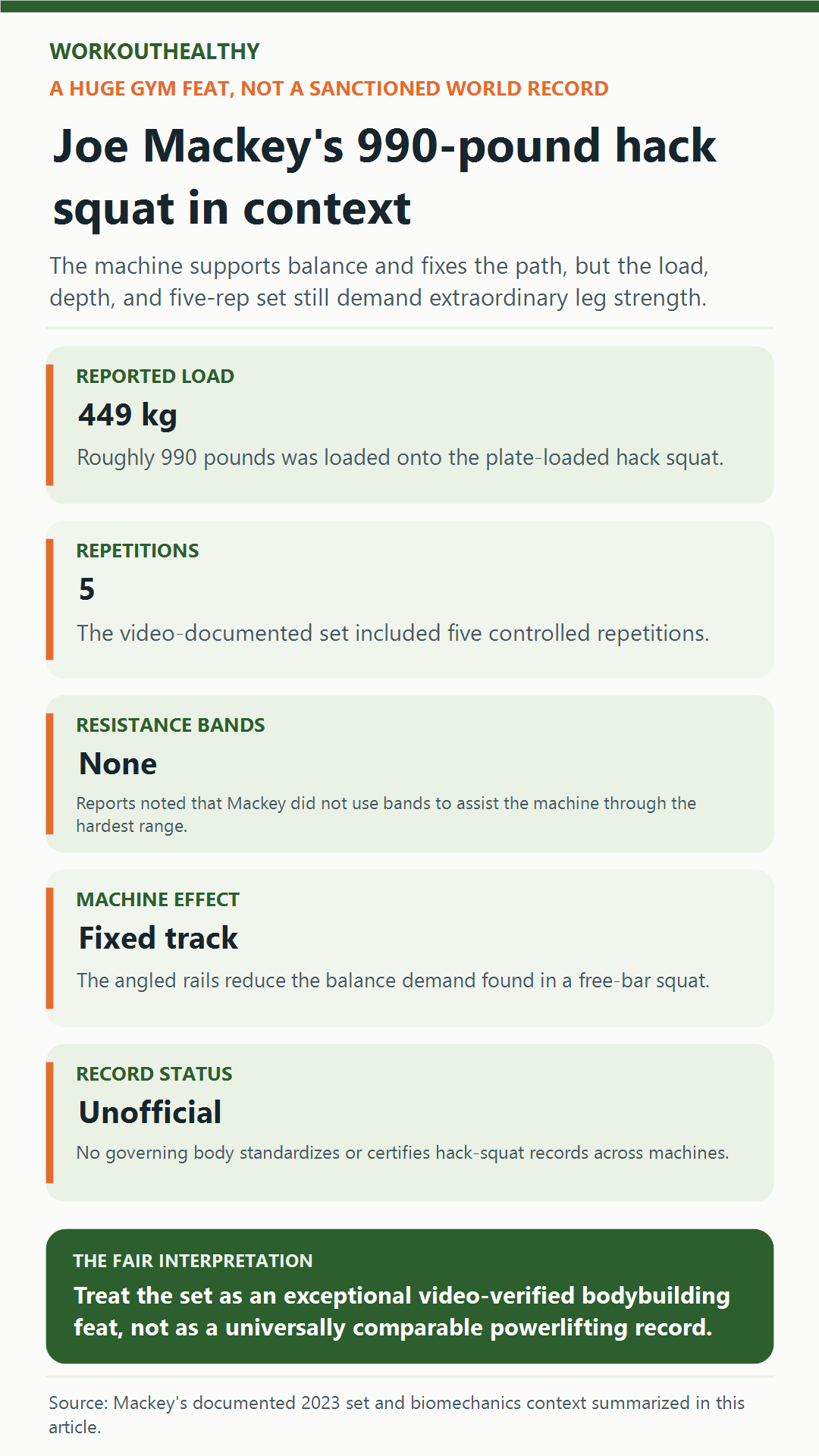
That single change removes most of the balance demand from the lift.
On a free barbell squat, a lifter has to control the bar over the base of support in three dimensions at once: forward and back, side to side, and through the vertical drive.
A hack squat locks two of those three dimensions in place.
The shoulder pads and back support also remove the need to brace a loaded bar across the upper back, which is often the first thing to fail on a heavy free squat, long before the legs actually give out.
With balance and upper-body bracing mostly solved by the machine, the legs become the only real limiting factor.
That is exactly why strong lifters can load a hack squat far beyond what they could ever safely handle as a free barbell squat.
The machine is not making the muscles work less.
It is removing the failure points that usually stop a lifter before the legs are actually maxed out.
What the Research Says About Knee Loading at Extreme Depth
The hack squat’s angled track typically allows a deeper range of motion than most lifters use on a free squat, and that depth matters mechanically.
A 2019 modeling study in the journal The Knee examined how knee flexion angle affects force at the patellofemoral joint, the surface where the kneecap tracks against the thigh bone (Takabayashi et al., 2019).
The researchers found that patellofemoral joint reaction force and stress both climb sharply as knee flexion angle increases, particularly past roughly 90 degrees.
In plain terms, the deeper the bend, the more force gets concentrated at that joint surface for a given amount of resistance.
This is not a reason to avoid deep knee flexion. Full range of motion training has real benefits for both strength and muscle growth.
It is a reason that extreme loads at full depth, like Mackey’s 990-pound set, are something built up to over years of progressive training, not attempted cold.
A lifter’s tendons, cartilage, and stabilizing muscles need years of accumulated loading to tolerate forces at that level without breaking down.
Hack Squat vs. Free Squat: What the Biomechanics Actually Show
A widely cited 2001 study in Medicine & Science in Sports & Exercise compared knee biomechanics across the squat and the leg press, the closest researched relative to the hack squat (Escamilla et al., 2001).
The researchers found that machine-based lower body pressing movements shift the joint demand compared to a free squat, changing how force is distributed between the hip, knee, and ankle across the lift.
A hack squat sits mechanically between a leg press and a free squat.
The back stays supported like a leg press, but the body still travels through space along the fixed track, closer to how a real squat moves.
That hybrid position is part of why the hack squat has such a strong reputation among bodybuilders specifically for isolating quad development.
It keeps much of the stability of a leg press while still asking the quads to control a longer, more squat-like range of motion.
Why This Kind of Loading Builds Serious Quad Size
Muscle growth from resistance training comes primarily from mechanical tension applied across a real range of motion, alongside metabolic stress and some muscle damage from the work itself (Schoenfeld, 2010).
A hack squat loaded near a lifter’s true capacity, through a genuinely deep range of motion, checks essentially every box that drives that kind of growth.
Heavy, full-depth reps like Mackey’s create high mechanical tension on the quadriceps at both long and short muscle lengths.
That is a meaningfully different stimulus than a lighter, shallower set, even one taken to a similar level of fatigue.
WorkoutHealthy has covered other movements where the mechanism behind visible results gets misunderstood.
Research on plyometric jump training and muscle growth found a real but smaller hypertrophy effect than traditional loaded training, a useful contrast to a set like Mackey’s, where near-maximal external load is doing most of the work.
Range of motion is also part of the story.
Research on partial versus full range of motion training suggests that training closer to a muscle’s longest length, deep in the bottom position, tends to produce a stronger local hypertrophy stimulus than shorter, partial-range reps at the same relative effort (Newmire & Willoughby, 2020).
A 990-pound hack squat taken to real depth is not just an impressive number.
It is a training stimulus stacked in almost every direction that predicts serious quad growth.
Has Anyone Topped This Since 2023?
There is no governing body tracking hack squat loads, so there is no formal record to check against.
Even so, it is worth asking whether anyone has posted a heavier video-documented hack squat since Mackey’s set.
The closest comparable moment came in May 2024, when IFBB Pro bodybuilder Derek Lunsford posted a 900-pound hack squat for 12 controlled repetitions during an off-season leg workout.
That is a genuinely huge set in its own right, and arguably a more demanding one in a different way, since holding 900 pounds under control for 12 reps taxes different systems than a heavier weight for five.
It is still 90 pounds lighter than Mackey’s top load.
No video-documented hack squat set found in researching this article exceeds 990 pounds for a comparable number of controlled repetitions.
As of this writing, Mackey’s set still appears to be the heaviest hack squat load with public video documentation, in the informal sense of the most weight moved on camera, not in the sense of any certified title.
Other verified strength feats WorkoutHealthy has documented, like DonnaJean Wilde’s Guinness-certified push-up record, go through a formal verification process with an official adjudicator.
Mackey’s hack squat never went through anything like that, and this article treats it accordingly.
Common Mistakes at Extreme Loads
The most common mistake on a heavy hack squat is cutting the range of motion short as the weight gets heavier.
A shallow, partial rep at a huge weight looks impressive but trains a much smaller portion of the strength curve than a full-depth rep at a lighter load.
Bouncing out of the bottom position is another frequent error.
It can momentarily feel like it helps move more weight, but it shifts stress onto connective tissue instead of muscle, and increases injury risk without actually building strength or size.
Loading a hack squat too aggressively, too soon, is probably the single biggest mistake among lifters chasing a number like Mackey’s.
Strength at extreme loads like this is typically built over years of progressive overload, not a handful of aggressive training cycles.
Skipping a real warm-up before near-maximal sets is another common shortcut that raises injury risk for very little time saved.
Who Should Be Extra Cautious
Anyone with existing knee pain, a prior ACL or meniscus injury, or diagnosed patellofemoral issues should approach heavy, deep hack squat work carefully.
Given how sharply patellofemoral force rises with knee flexion depth, that population has the most to gain from working with a physical therapist or qualified coach before loading the machine heavily.
Beginners should not use a hack squat’s supported position as a reason to skip learning real squat mechanics first.
Anyone training alone, without a spotter, should be especially conservative about attempting a true one-rep or near-max effort on any lower body machine.
A hack squat carriage can be genuinely difficult to bail out of safely if a lifter gets stuck at the bottom under a truly maximal load.
How to Build Toward Heavier Hack Squats Safely
Step 1: Master full range of motion first.
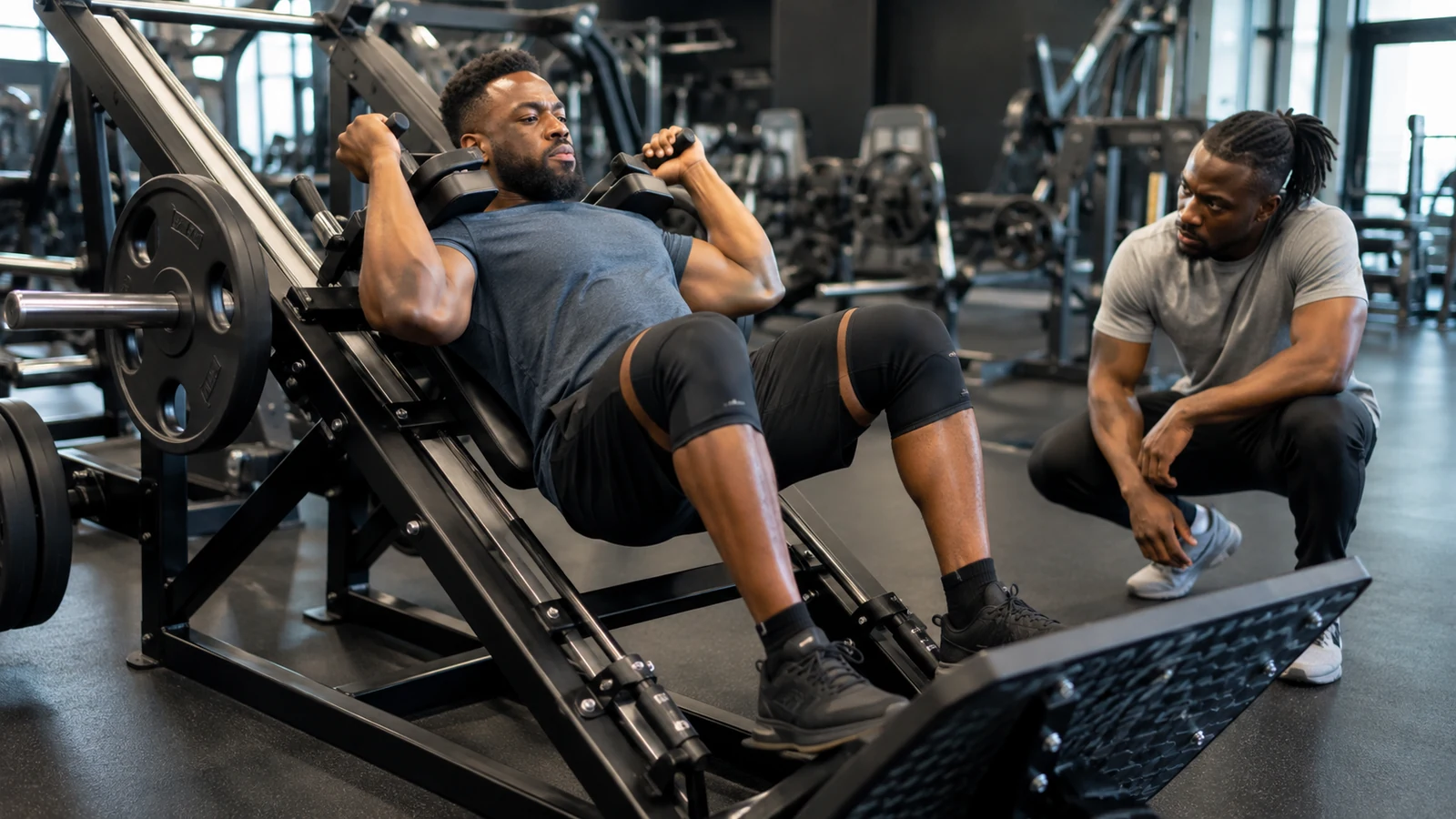
Build technique at a moderate weight before adding significant load, so the deep bottom position stays controlled rather than collapsed.
Step 2: Progress load gradually across months, not weeks.
Connective tissue adapts more slowly than muscle does, and rushing the load is how most machine-related injuries happen.
Step 3: Train close to failure, not always at failure.
High-intensity, low-frequency training has a long history in bodybuilding.
The debate over how often to push all the way to failure is still worth understanding before programming any near-max attempt.
Our look at Mike Mentzer’s Heavy Duty training system covers what still holds up about that approach, and where the research has moved past it.
Step 4: Use a belt and knee sleeves once the load is genuinely heavy.
Support gear does not replace technique, but it is standard practice at the loads this article is discussing.
Step 5: Never attempt a true near-max hack squat alone.
Have a spotter present, or use a facility with staff nearby, especially once the load approaches anything close to a personal best.
Step 6: Track real numbers over time.
Progressive overload only works when a lifter actually knows what was lifted last time, at what depth, and how many reps it took.
Watch the Original Video
Curious what it actually takes to move weight like this? Subscribe to WorkoutHealthy Insider for practical explanations behind popular fitness claims.
References
Escamilla, R. F., Fleisig, G. S., Zheng, N., Lander, J. E., Barrentine, S. W., Andrews, J. R., Bergemann, B. W., & Moorman, C. T., III. (2001). Effects of technique variations on knee biomechanics during the squat and leg press. Medicine & Science in Sports & Exercise, 33(9), 1552-1566. https://doi.org/10.1097/00005768-200109000-00020
Newmire, D. E., & Willoughby, D. S. (2020). Partial range of motion resistance training: A feasible bodybuilding training regiment for local or regional muscle hypertrophy? Strength & Conditioning Journal, 42(5), 87-93. https://doi.org/10.1519/ssc.0000000000000550
Schoenfeld, B. J. (2010). The mechanisms of muscle hypertrophy and their application to resistance training. Journal of Strength and Conditioning Research, 24(10), 2857-2872. https://doi.org/10.1519/JSC.0b013e3181e840f3
Takabayashi, T., Edama, M., Inai, T., Tokunaga, Y., & Kubo, M. (2019). A mathematical modelling study investigating the influence of knee joint flexion angle and extension moment on patellofemoral joint reaction force and stress. The Knee, 26(6), 1323-1329. https://doi.org/10.1016/j.knee.2019.10.010
This article is for general information only and is not medical advice. If you have an injury, ongoing pain, or a medical condition, talk to a doctor or physical therapist before you change how you train or eat.