
The ten thousand steps a day target is easy to remember. Its simplicity is also why it needs context: a round number on a watch cannot tell you whether your activity suits your health, schedule or starting point.
The familiar target is commonly traced to a Japanese pedometer name from 1965. Subsequent studies have found associations between lower step counts and better health outcomes. That history does not make 10,000 steps harmful or useless. It makes the idea of a universal minimum difficult to defend.
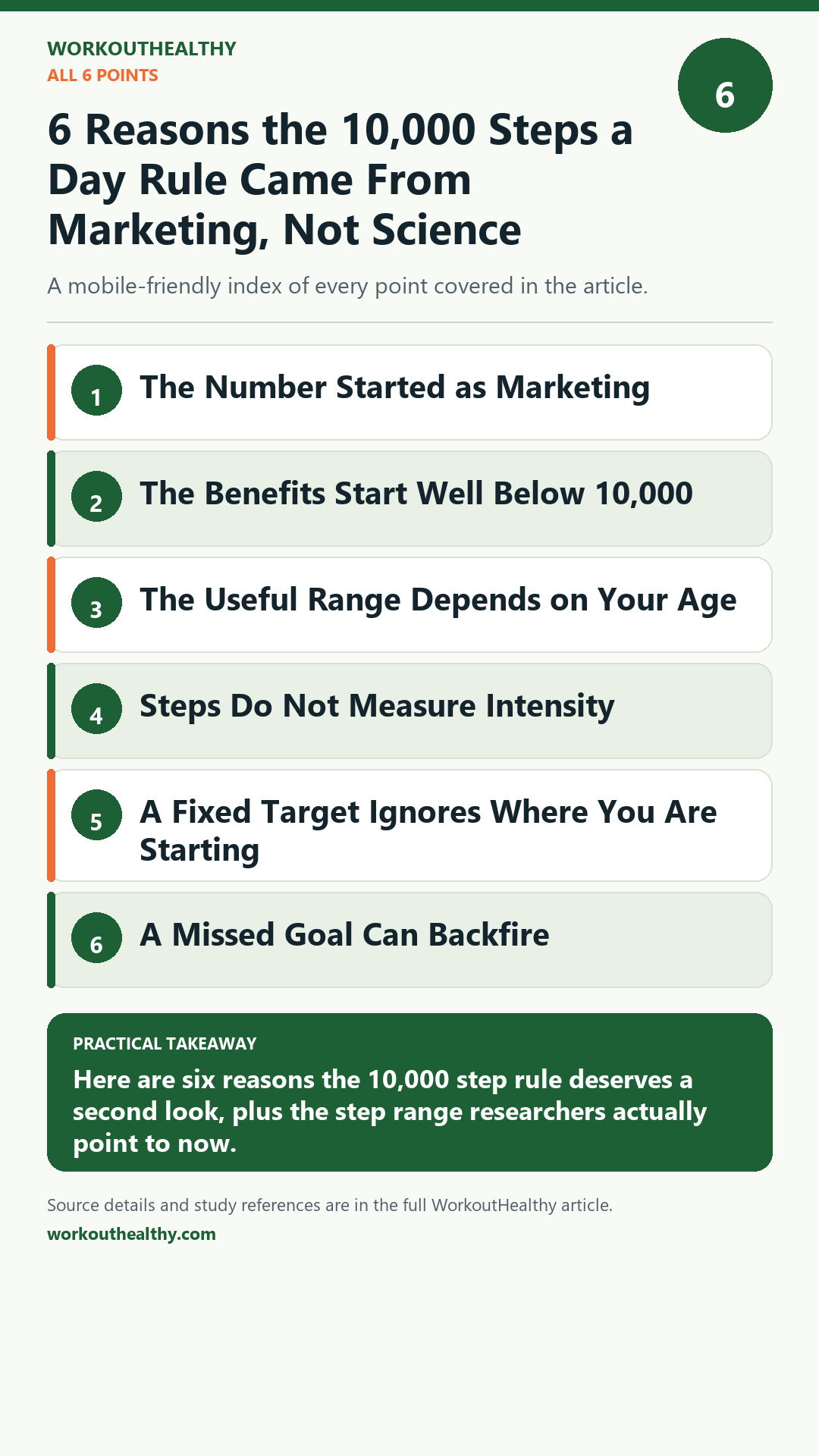
Here are six reasons to reconsider the rule, followed by a practical way to review your own walking routine. The research supports a broader range of movement than a single pass-or-fail daily number.
1. The Number Started as Marketing
Lee et al. (2019) describe the goal’s likely origin as the Manpo-kei, a pedometer sold by Yamasa Clock and Instrument Company in Japan in 1965. The name translates to a 10,000 steps meter. The researchers qualify that origin as likely rather than presenting an independently verified account of every step in its spread.
A product name is different from a recommendation developed by testing a particular dose of activity. A memorable target can still be useful, but its popularity does not establish a biological dividing line.
Ask a simple question when you encounter any exact health target: what outcome was measured, in whom, and how was the number chosen? That question is more useful than dismissing a goal solely because it began in marketing.
A memorable number can help you track movement without becoming a medical threshold.
2. The Benefits Start Well Below 10,000
In a cohort of 16,741 older women, with a mean age of 72, approximately 4,400 daily steps was associated with lower mortality than approximately 2,700. The observed association flattened around 7,500 steps. This was an observational comparison, not a trial prescribing those totals (Lee et al., 2019).
A 2025 review provides a newer perspective. It included 57 studies from 35 cohorts, with 31 studies contributing to meta-analyses. Compared with 2,000 steps, 7,000 was associated with a 47% lower relative risk of all-cause mortality; the authors discuss 7,000 as a potentially achievable target for some people (Ding et al., 2025).
That percentage describes a pooled association, not a promise that a particular person can reduce their own risk by the same amount. The practical message is that missing 10,000 does not make a day’s movement worthless.
3. The Useful Range Depends on Your Age
A meta-analysis of 15 cohorts, including 47,471 adults, found that the mortality association plateaued around 6,000 to 8,000 steps in adults aged 60 and older and around 8,000 to 10,000 in adults younger than 60 (Paluch et al., 2022).
These are ranges estimated from group data. They are not age-based prescriptions, limits on walking, or evidence that movement above the range has no value for other purposes.
The newer 2025 review considered several health outcomes but did not provide age-specific analyses. Its discussion of 7,000 steps therefore should not be treated as a replacement for every earlier age-specific finding (Ding et al., 2025).
Our guide to daily steps and mortality explains the study behind the earlier ranges. Keep the outcome and study population visible when comparing numbers from different papers.
4. Steps Do Not Measure Intensity
A total on your watch does not describe how demanding the walking felt. It also does not show your cycling, swimming or strength work. It is one measure of activity.
After accounting for total steps, the 2019 study found no clear independent mortality association for its intensity measures. The 2022 analysis was mixed: peak stepping rates over 30 or 60 minutes retained associations, while time above specific cadence thresholds generally did not (Lee et al., 2019; Paluch et al., 2022).
That is a reason to describe the evidence carefully. It does not establish that pace never matters. A daily total and a record of purposeful exercise answer different questions, so you can use both.
5. A Fixed Target Ignores Where You Are Starting
Moving from 3,000 steps to 10,000 means adding 7,000. Moving from 9,000 to 10,000 means adding 1,000. The same final number can represent very different changes in a person’s week.
Consider the context before choosing an increase. A desk worker, a parent doing school trips, and someone who walks throughout a shift may need different plans. Neither a busy job nor a low reading explains the whole picture.
Use your current record to describe the problem you want to solve. Perhaps you want a dependable lunch walk, fewer days with almost no movement, or an activity you enjoy with a friend. Those aims are more specific than copying an app’s default.
There is no need to choose an ambitious number before you know what is realistic. You can first make the activity easier to repeat, then review the record.
6. A Missed Goal Can Backfire
A target becomes less useful if falling short makes you abandon the activity you still could do. Treat that as a planning concern, rather than a claim that step-count studies tested everyone’s motivation.
For example, if a hypothetical person’s plan calls for an evening walk but their watch is far below 10,000, the planned walk still has value as participation. It does not have to close a ring to be recorded.
Decide in advance how to handle a disrupted day: shorten the route, move the walk to another convenient time, or resume the next day. Avoid making up missed totals as a punishment.
The aim is to keep a goal useful. A record can show what happened without grading your character or declaring the whole day lost.
Do Steps Replace Exercise Guidelines?
CDC guidance recommends at least 150 minutes of moderate-intensity aerobic activity or 75 minutes of vigorous activity a week, or an equivalent combination, plus muscle-strengthening activity on at least two days. The weekly activity can be divided into smaller amounts (Centers for Disease Control and Prevention, 2023).
Brisk walking can contribute to the aerobic part. A step total alone does not establish how much moderate activity you accumulated or whether you completed strength work. Keep those items visible in your plan.
CDC also says some activity is better than none. If the full recommendation is beyond your present capacity, you can consider a gradual approach that fits your situation. Seek individualized advice when a medical condition or difficulty walking affects your choices.
A counter is a useful companion to the guidance. It is not a complete exercise program or a clinical assessment.
What This Evidence Does Not Prove
The findings discussed here come from observational evidence. More active people can differ in health and other ways that statistical adjustments do not fully capture. Illness can also reduce activity, complicating the direction of the relationship.
The 2025 authors specifically flag residual confounding, limited studies for many outcomes and a lack of age-specific analysis. Certainty also varies across outcomes. A headline number should be read with those limitations (Ding et al., 2025).
None of these findings establishes an individual minimum, a personal prognosis, or the number of years a particular walking plan will add to a life. They also do not measure the success of every exercise goal.
Use the research to reconsider an overly rigid target. Use your own record to decide whether a practical change was manageable. Those are different tasks.
How to Set a Step Goal That Works
The following is an editorial planning framework, not a validated score or a medical prescription. It turns a vague aim into questions you can review.
- Describe a normal week. If you use a device, record its daily readings and whether you carried or wore it as usual. Keep workdays and days off in the record. A missing-device day should be marked as missing rather than treated as your true activity level.
- Choose one practical opportunity. Identify a route, time or daily task to which a manageable walk could be attached. Choose an amount you can comfortably attempt within your circumstances rather than assuming a fixed step increment suits everyone.
- Plan the fallback. Write an option for rain, a late workday or another predictable obstacle. That might be an indoor route or a shorter walk. It should be a usable choice, not an extra obligation.
- Keep other activity in view. Record purposeful aerobic sessions and strength work separately. If a step goal competes with those activities or needed rest, reconsider how you have scheduled it.
- Review the record. After a couple of ordinary weeks, ask what was repeated, what was missed and why. Keep a manageable choice, adjust an impractical one, or seek advice if symptoms or restrictions make the plan unclear.
The suggested review period is for organizing your record. It is not a claim that two weeks proves a health benefit. Likewise, an increase on a consumer device shows a change in its recorded steps, not a diagnosis or proof of longer life.
For a hypothetical example, someone could record a usual week, add a short lunch route on selected workdays, and review whether meetings repeatedly displaced it. Their next decision might be to move the route earlier. The useful outcome is a clearer plan, not a race to manufacture a high number.
If distance is easier to plan than steps, our guide to walking distance and stride length provides context. You do not need to convert every outing into a perfect calculation before going outside.
When to seek individual advice
If you have an injury, an ongoing symptom, balance difficulties or a medical restriction, discuss activity changes with a qualified clinician. A generic count cannot account for those circumstances. Choose an accessible route and conditions suited to your needs.
Keep the review simple
Choose a few things you can actually record: the reading, the planned walk and any reason it changed. Avoid judging the whole week by one exceptional day. If the goal repeatedly creates a problem, change the plan instead of hiding the problem in an average.
What the Step Goal Is Actually Good For
Step counting can make daily movement visible. The familiar 10,000 target can suit some active people, but the research does not make it a universal requirement. Lower totals can be associated with meaningful benefits, and useful ranges depend on the question being studied.
Keep the number in its proper role: a tool for describing activity and reviewing a manageable routine. Start with your circumstances, keep other exercise visible, and adjust the goal when your record gives you a reason.
A useful goal helps you choose the next walk, even when today’s number is imperfect.
Related video
Want more health targets checked against the research? Subscribe to WorkoutHealthy Insider for practical explanations behind popular fitness claims.
References
Centers for Disease Control and Prevention. (2023, December 20). Adult activity: An overview. https://www.cdc.gov/physical-activity-basics/guidelines/adults.html
Ding, D., Nguyen, B., Nau, T., Luo, M., del Pozo Cruz, B., Dempsey, P. C., Munn, Z., Jefferis, B. J., Sherrington, C., Calleja, E. A., Hau Chong, K., Davis, R., Francois, M. E., Tiedemann, A., Biddle, S. J. H., Okely, A., Bauman, A., Ekelund, U., Clare, P., & Owen, K. (2025). Daily steps and health outcomes in adults: A systematic review and dose-response meta-analysis. The Lancet Public Health, 10(8), e668-e681. https://doi.org/10.1016/S2468-2667(25)00164-1
Lee, I.-M., Shiroma, E. J., Kamada, M., Bassett, D. R., Matthews, C. E., & Buring, J. E. (2019). Association of step volume and intensity with all-cause mortality in older women. JAMA Internal Medicine, 179(8), 1105-1112. https://doi.org/10.1001/jamainternmed.2019.0899
Paluch, A. E., Bajpai, S., Bassett, D. R., Carnethon, M. R., Ekelund, U., Evenson, K. R., Galuska, D. A., Jefferis, B. J., Kraus, W. E., Lee, I.-M., Matthews, C. E., Omura, J. D., Patel, A. V., Pieper, C. F., Rees-Punia, E., Dallmeier, D., Klenk, J., Whincup, P. H., Dooley, E. E., … Fulton, J. E. (2022). Daily steps and all-cause mortality: A meta-analysis of 15 international cohorts. The Lancet Public Health, 7(3), e219 to e228. https://doi.org/10.1016/S2468-2667(21)00302-9
Medical disclaimer: This article is general product information, not medical advice. The equipment described here is not a treatment for any condition. If you have an injury, ongoing pain, or a medical condition, talk to a doctor or physical therapist before using any of it.