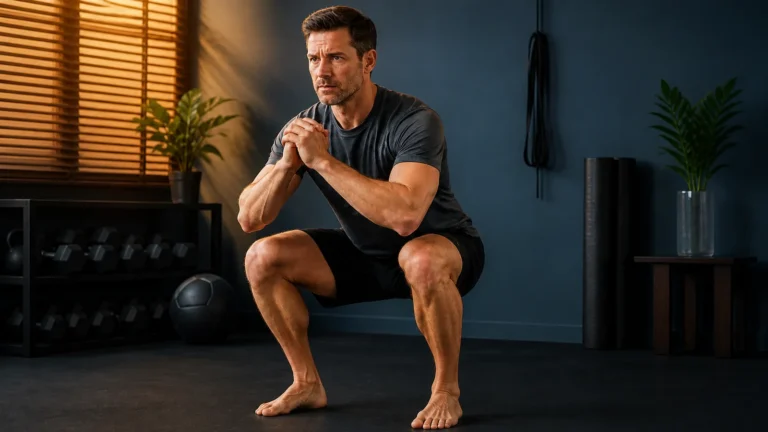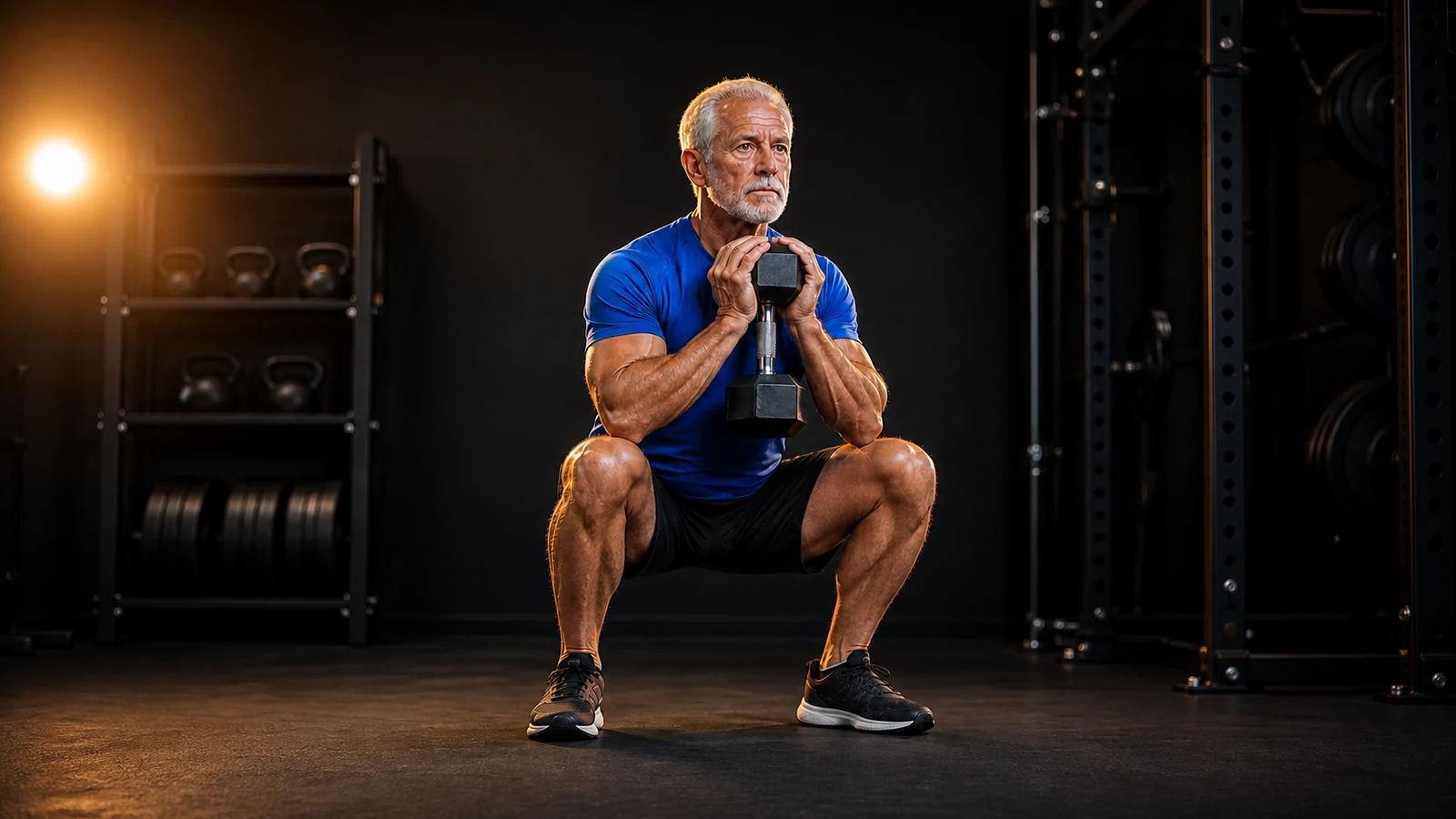

A podcast clip is making the rounds with a bold promise in the title.
It claims there is one exercise that matters most for staying physically independent as you age.
The guest making that case is Brad Schoenfeld, introduced as one of the world’s top strength training researchers.
That is a real credential to put behind a claim like this.
Schoenfeld holds a PhD and has coauthored dozens of peer reviewed studies on resistance training over the past two decades.
So we set out to check the actual published science behind the claim, not just the headline.
This question matters for a huge number of people, since lost mobility is one of the top reasons older adults lose their independence.
What the Video Claims
The video’s title promises “the number one exercise” for staying physically independent later in life.
It frames Brad Schoenfeld as a leading voice in strength training research, which lines up with his real publication record.
We were not able to pull a full transcript of this specific podcast episode.
That means we cannot quote Schoenfeld directly on which single exercise he names in the conversation.
Rather than guess at a quote, we are treating that specific claim as the video’s own framing, not as a verified statement.
What we can do is check that framing against Schoenfeld’s own published research and the wider science on aging and independence.
That turned out to be the more useful question anyway.
What the Real Research Shows About Strength and Independence
The strongest evidence does not point to one single exercise.
It points to resistance training as a category of training.
One of the most influential studies in this field trained frail nursing home residents who averaged 87 years old.
Researchers had them do high intensity leg strength training for 10 weeks.
Average leg strength increased by 113 percent, compared with just 3 percent in a non-exercising group (Fiatarone et al., 1994).
Walking speed increased by nearly 12 percent in the training group, while it slightly declined in the non-exercisers.
Stair climbing power jumped by more than 28 percent in the group that trained.
Stair-climbing power is a physical-function test. The study did not measure whether participants continued to live independently.
Resistance training remains one of the few interventions shown to restore lost physical function in adults in their late eighties and nineties, not just slow its decline.
A Second Study Confirms the Pattern in Very Elderly Adults
A 2020 systematic review looked specifically at adults age 75 and older.
It pooled results from multiple randomized controlled trials of resistance training in that age group.
Brad Schoenfeld was one of the coauthors on this review (Grgic et al., 2020).
The review found that resistance training builds real muscle strength and muscle size even among the oldest old.
Those gains held true in adults who started training well into their eighties and nineties.
This age group is often left out of exercise research altogether.
That gap matters, since adults this age are the group most at risk of losing independence.
Finding real, repeated gains in this specific population is stronger evidence than results drawn only from younger, healthier exercisers.
How Long These Changes Take to Show Up
The frail elderly adults in the 1994 trial trained for just 10 weeks before seeing major strength gains.
That is a surprisingly short window for such a large improvement in daily function.
The 2020 review of adults 75 and older pooled trials that ran from a few weeks to several months.
Across that range, strength gains showed up consistently, even in the shorter programs.
Muscle size tended to take longer to change than strength did.
That gap between quick strength gains and slower size gains is well documented in resistance training research generally.
The practical takeaway is that someone starting later in life does not need to wait a year to feel a difference.
Real, measurable strength gains can show up within the first two months of consistent training.
Why Muscle Power Matters as Much as Muscle Size
Muscle mass naturally declines with age, a process researchers call sarcopenia.
Muscle power, how fast a muscle can produce force, declines even faster than raw strength does.
Power is what lets someone catch their balance before a stumble turns into a fall.
It is also what gets a person out of a chair without pushing off with their hands.
A 2022 review compared power focused training to traditional strength training in older adults.
Schoenfeld was again a coauthor on this analysis (Balachandran et al., 2022).
It pooled 20 randomized trials covering more than 500 older adults.
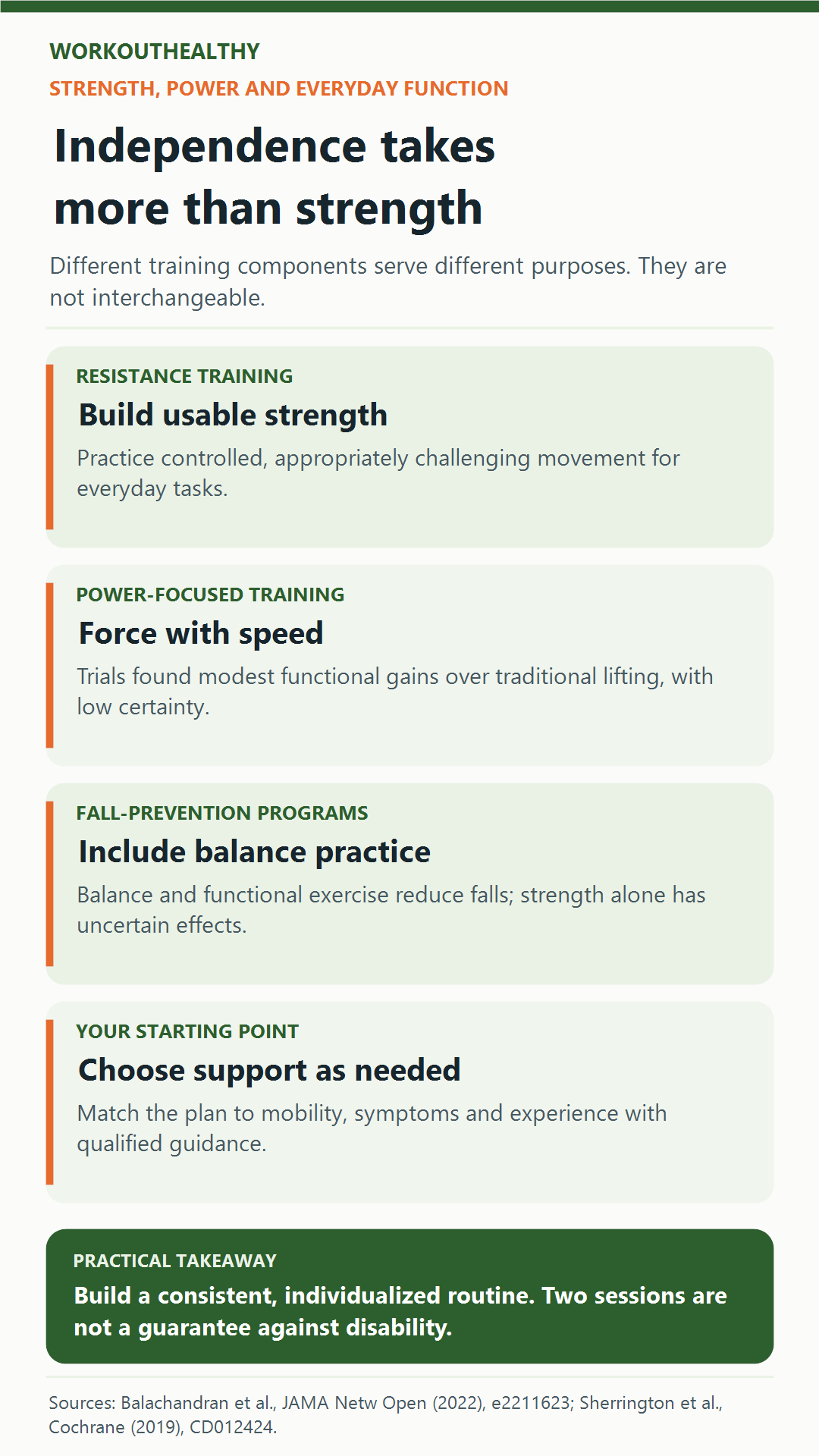
The review found that power training was linked to a modest improvement in physical function compared with traditional strength training.
The authors themselves described that evidence as low certainty, not a settled conclusion.
Even so, the comparison makes a useful point.
Catching your balance or stepping off a curb happens fast, not slowly under a heavy load.
A training style built only around slow, maximal strength may miss part of what daily independence actually requires.
Strength training also affects the brain and the nervous system, not only muscle tissue.
We covered that connection in more detail in our piece on whether lifting weights keeps your brain young.
Strength gains can involve changes in muscle and in how the nervous system coordinates movement.
The cited power-training review measured physical function, not actual falls, so it cannot show that neural changes alone prevent falls.
Fall Prevention Is Where Independence Is Actually Won or Lost
Falls are one of the biggest threats to independent living in older adults.
A single bad fall can lead to a hip fracture and a lasting loss of mobility.
A major Cochrane review looked at exercise programs built to prevent falls in community dwelling older adults.
Across the programs studied, exercise reduced the rate of falls by roughly 23 percent (Sherrington et al., 2019).
Programs focused on balance and everyday movements reduced falls; programs combining those elements with resistance work probably did too. The review could not establish that resistance training alone reduces falls.
These findings support a mix of strength, balance and functional practice. They do not identify one exercise or one proven pathway to independence.
What This Evidence Does Not Prove
None of this research proves that one specific exercise is the single key to independence.
Most of these studies test full training programs, not one movement in isolation.
The video’s framing of “the number one exercise” reads like a hook, not a finding from a specific trial.
Study populations also vary a great deal across this research.
Some trials use frail nursing home residents in their late eighties and nineties.
Others use healthier, more active adults in their sixties.
Results do not automatically transfer between those two groups.
Genetics, existing health conditions, and how much a person already trains all shape the outcome too.
No single study, including the ones cited here, proves that lifting weights alone guarantees independence into old age.
Common Mistakes People Make Starting Later in Life
Many people either do too little or try to do too much, too soon.
Some avoid resistance training entirely out of fear of getting hurt.
That fear usually backfires, since inactivity is what actually speeds up muscle loss.
Others jump straight into heavy lifting without any coaching on technique.
Poor form under a heavy load is a real way to get injured.
Some people also stop training the moment normal muscle soreness shows up after a first session.
Ordinary post workout soreness is not an injury, and it usually fades within a few days.
A more common mistake is skipping lower body training almost entirely.
Leg and hip strength matter more for daily independence than arm strength does.
Sitting to stand, climbing stairs, and getting up off the floor all depend on the legs and hips.
Another mistake is treating walking or cardio as a full substitute for strength work.
Walking supports the heart, but it does not replace loaded strength training for muscle and power.
Our guide on how many miles you should walk a day covers how the two fit together instead of competing.
Who Should Check With a Doctor First
Older adults without symptoms or a diagnosed chronic condition can generally start gradually without a medical visit. If you have symptoms, an injury, or a chronic condition, ask a clinician or physical activity specialist how to adapt training (National Institute on Aging).
This matters more for people with heart disease, uncontrolled high blood pressure, or a recent surgery.
People recovering from a joint replacement need a cleared timeline from their surgeon or physical therapist.
Our piece on Misty Copeland’s hip replacement recovery covers what a real recovery timeline actually looks like.
Anyone with osteoporosis or a history of fractures should also get guidance on how much load is safe.
People managing diabetes should loop in their care team too, since exercise can shift blood sugar levels.
A physical therapist can build a program around any existing pain or physical limitation.
None of this is a reason to avoid strength training altogether.
It is a reason to start it with the right guidance in place.
How to Start Strength Training for Long Term Independence
Start with movements that mirror real daily tasks.
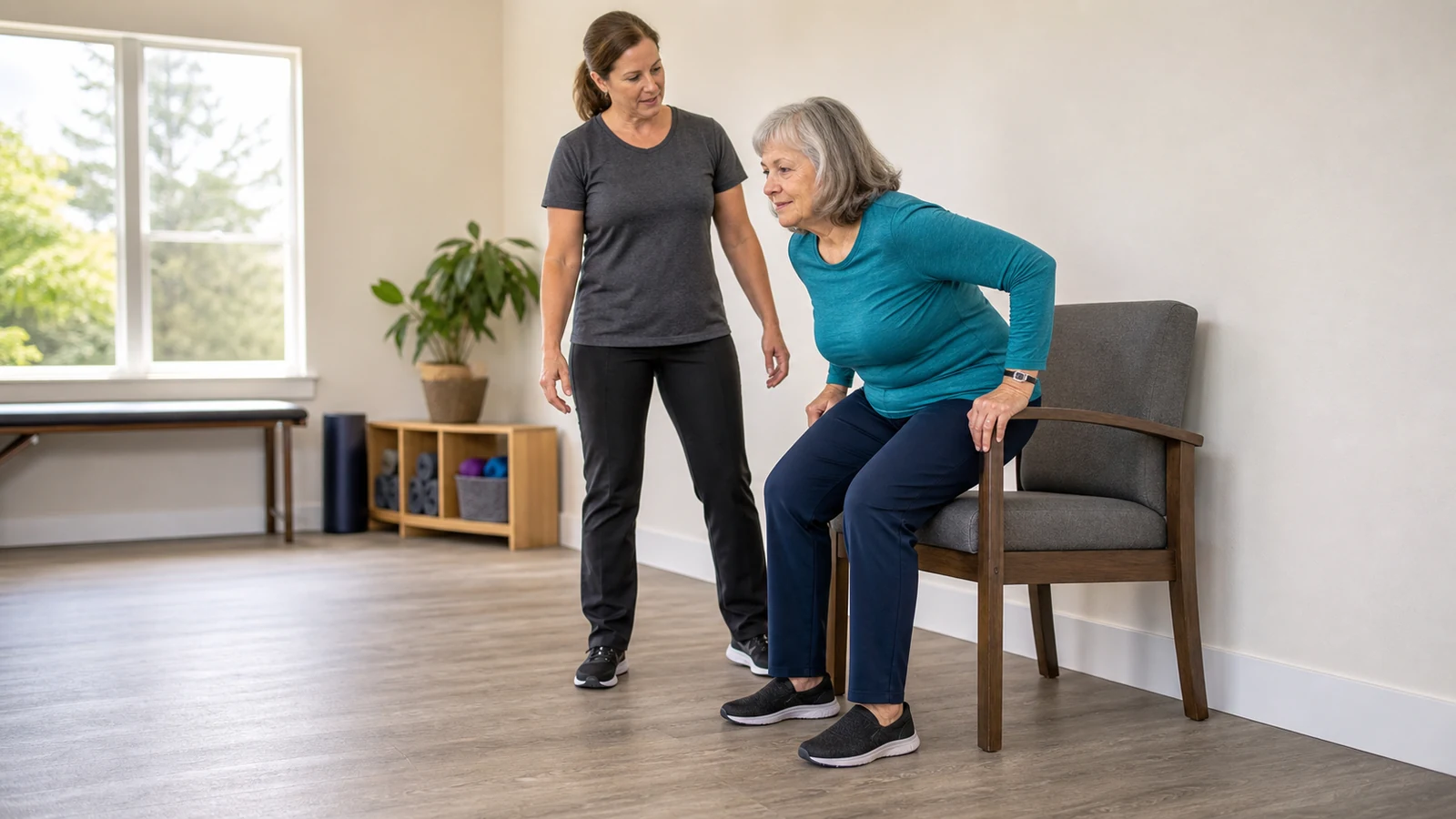
Squats and sit to stand exercises build the exact strength needed to get out of a chair.
Step ups build the strength needed for stairs and curbs.
Carrying exercises, like a loaded farmer’s walk, build grip strength and core stability at the same time.
Grip strength is one of the simplest markers researchers use to track overall physical decline.
Two to three sessions a week is enough to see real progress over a few months.
Add load slowly, in small steps, once a movement feels solid and controlled.
Consistency matters more than intensity when someone is just getting started.
Begin with a few minutes of easy movement and lighter practice repetitions so effort rises gradually before heavier sets.
Working with a certified trainer for the first few sessions helps lock in good form early.
Tracking sets, reps, and weight in a simple notebook makes real progress easy to see.
Research in older adults shows that strength can improve later in life, but each person’s starting point, conditions and response differ.
The research does not crown one single exercise as the answer to aging well. It points to consistent strength and balance training, kept up for years, as the real driver of independence later in life.
Watch the video
Want more like this? Subscribe to WorkoutHealthy Insider for practical explanations behind popular fitness claims.
References
Balachandran, A. T., Steele, J., Angielczyk, D., Belio, M., Schoenfeld, B. J., Quiles, N., Askin, N., & Abou-Setta, A. M. (2022). Comparison of power training vs traditional strength training on physical function in older adults: A systematic review and meta-analysis. JAMA Network Open, 5(5), e2211623. https://doi.org/10.1001/jamanetworkopen.2022.11623
Fiatarone, M. A., O’Neill, E. F., Ryan, N. D., Clements, K. M., Solares, G. R., Nelson, M. E., Roberts, S. B., Kehayias, J. J., Lipsitz, L. A., & Evans, W. J. (1994). Exercise training and nutritional supplementation for physical frailty in very elderly people. New England Journal of Medicine, 330(25), 1769 to 1775. https://doi.org/10.1056/NEJM199406233302501
Grgic, J., Garofolini, A., Orazem, J., Sabol, F., Schoenfeld, B. J., & Pedisic, Z. (2020). Effects of resistance training on muscle size and strength in very elderly adults: A systematic review and meta-analysis of randomized controlled trials. Sports Medicine, 50(11), 1983 to 1999. https://doi.org/10.1007/s40279-020-01331-7
Sherrington, C., Fairhall, N. J., Wallbank, G. K., Tiedemann, A., Michaleff, Z. A., Howard, K., Clemson, L., Hopewell, S., & Lamb, S. E. (2019). Exercise for preventing falls in older people living in the community. Cochrane Database of Systematic Reviews, 1(1), CD012424. https://doi.org/10.1002/14651858.CD012424.pub2
This article is for general information only and is not medical advice. If you have an injury, ongoing pain, or a medical condition, talk to a doctor or physical therapist before you change how you train or eat.