
A Popular Dumbbell Video, and a Bigger Question
A YouTube channel called fabulous50s posted a thirty minute full body dumbbell workout made for women over fifty.
The video walks through simple moves using light to moderate dumbbells, aimed at building strength through the whole body in one session.
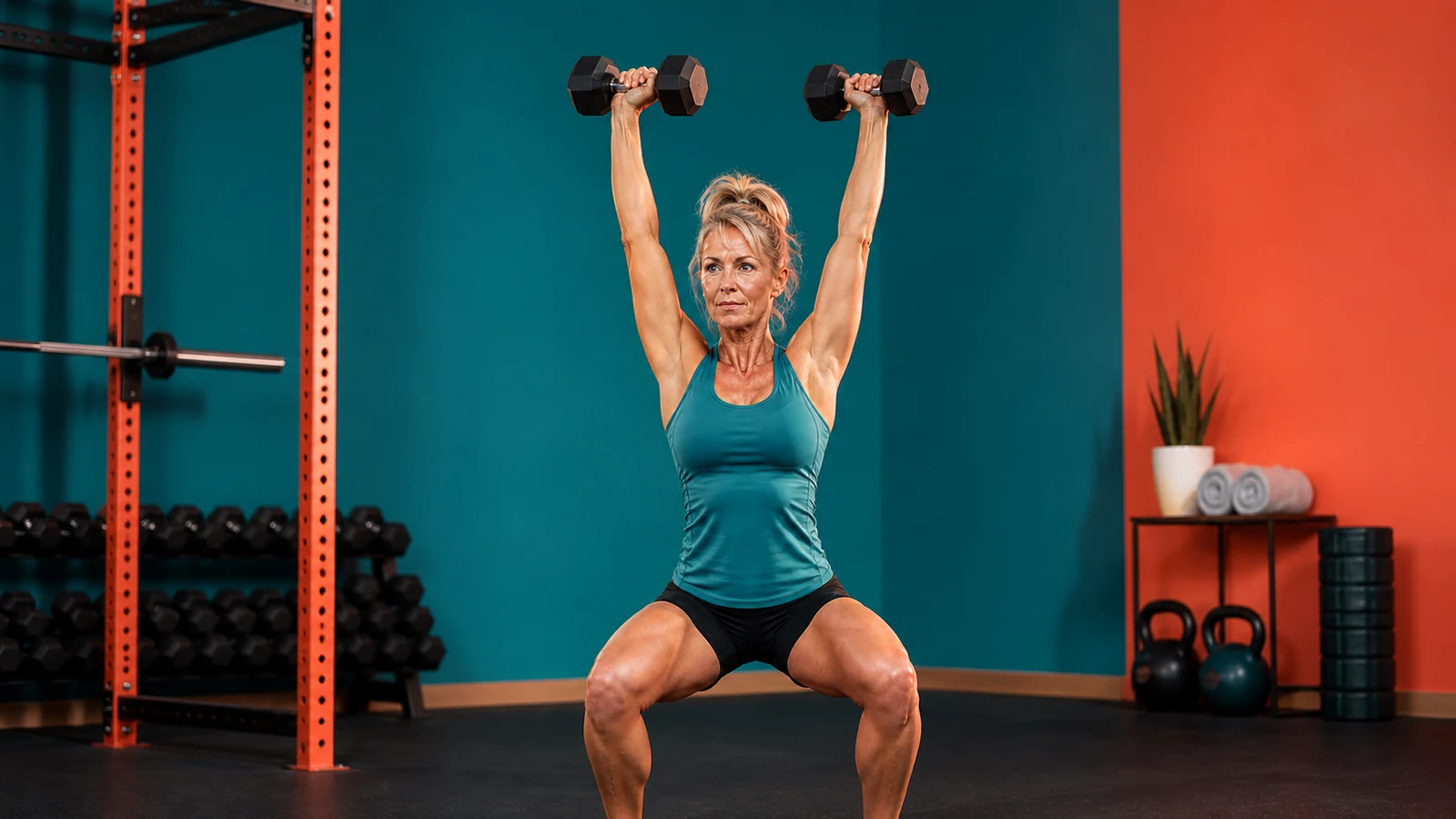
In the original fabulous50s routine, Schellea Fowler starts with a warm-up and then repeats a seven-move sequence for three rounds: squat to press, chest front raise, lateral raise, underhand row, hammer curl, tricep kickback, and a calf raise with front raise that challenges balance. The workout ends with a cool-down. Its chapter markers place the work after 3:20 and the cool-down at 24:49 in the approximately 28-minute video.
You can choose a weight and pace you can control and rest when needed; Fowler explicitly invites those adjustments in her video description. The research below supports resistance training more broadly, not a guarantee that this exact seven-move session produces the outcomes measured in studies using other programs.
Videos like this are everywhere right now, and for good reason.
Women over fifty are one of the fastest growing groups taking up strength training, often for the first time in their lives.
Real examples of this show up outside the research too, like Edith Connor, who holds the Guinness World Record as the oldest competing female bodybuilder and still trains with weights well past fifty.
But a home workout video is not a scientific study, and a creator’s advice is not the same as clinical evidence.
So this article asks a simple question: does the research actually back up what dumbbell training claims to do for women in this age group, and where does the evidence run out?
What This Kind of Workout Actually Targets
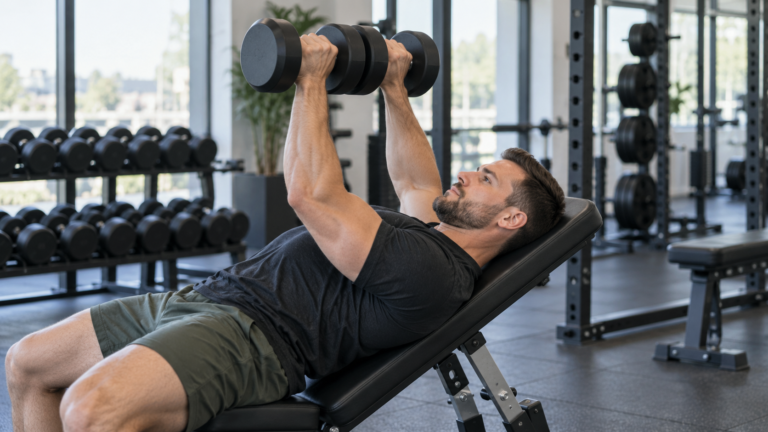
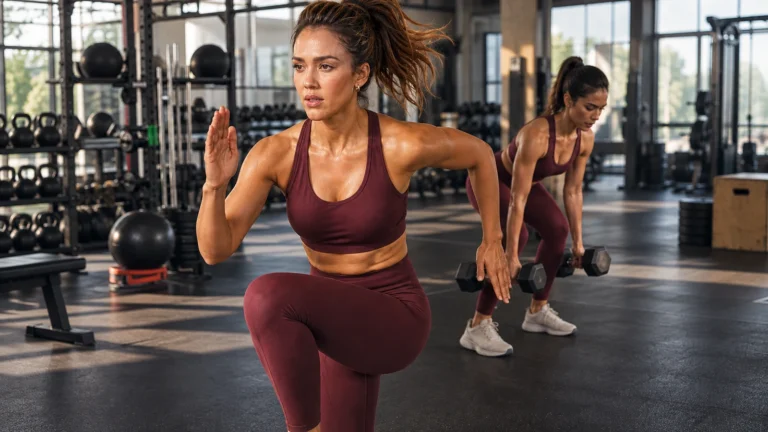
A full body dumbbell routine usually mixes a few movement types in one session.
That includes pressing moves for the chest and shoulders, pulling moves for the back, squats or lunges for the legs, and core work to tie it together.
The idea is to load major muscle groups with light hand weights instead of barbells or machines.
For women over fifty, the appeal is usually convenience and safety.
Dumbbells are cheap, they fit in a closet, and they let a beginner start light and add weight slowly.
That slow, steady increase in resistance has a real name in exercise science.
It is called progressive overload, and it is the basic mechanism behind almost every strength gain that research has measured.
Muscle loss after fifty is not automatic decline. In several trials, it is a training gap that responds to the right kind of loading.
What Real Research Actually Supports
Several studies point in the same direction as this video’s basic claim, though not always for the exact reasons the video gives.
The first has to do with muscle loss, sometimes called sarcopenia.
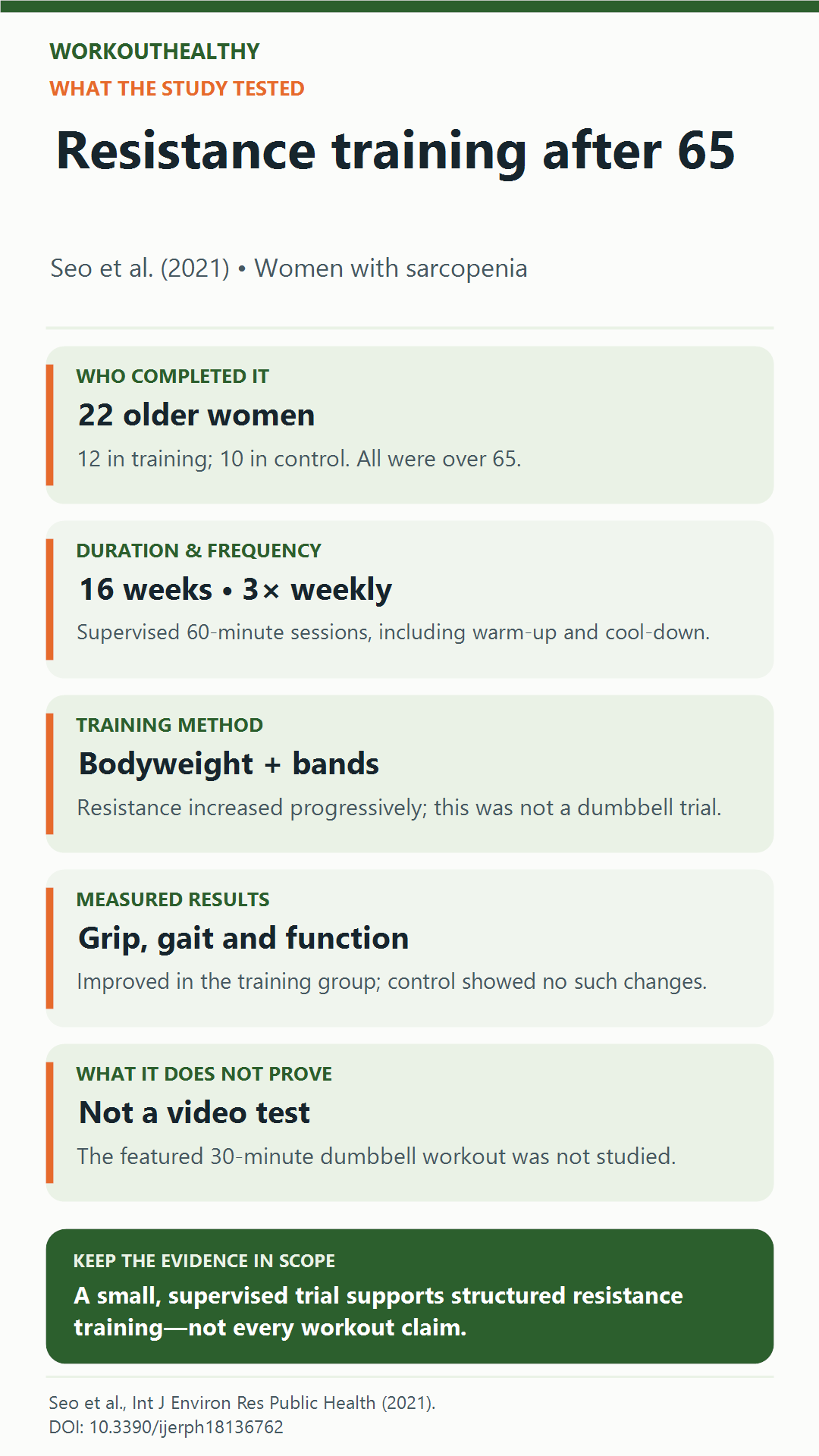
A 2021 randomized controlled trial followed 22 women over the age of 65 who had already been diagnosed with sarcopenia.
Twelve of them did resistance training three times a week for 16 weeks, using bodyweight moves and elastic resistance bands.
The other ten did not train and served as the comparison group.
By the end, the training group had significantly better grip strength, walking speed, and overall muscle function than the group that did not train.
Fat inside the muscle tissue increased only in the group that did nothing, which suggests the training slowed a decline that was already underway.
That study used bands and bodyweight, not dumbbells specifically.
But the training principle is the same one a dumbbell workout uses. Apply resistance the muscle has to work against, on a regular schedule.
Muscle loss has more than one cause after fifty, and our guide on losing weight and muscle mass walks through the biggest ones, from hormones to inactivity.
The second study looked at bone rather than muscle.
A 2023 trial split 45 postmenopausal women with osteopenia, a condition of lower than normal bone density, into three groups for 24 weeks.
One group did high intensity resistance training at about 80 percent of their one rep max.
Another did the same exercises at a lower intensity.
The higher intensity group saw larger gains in bone mineral density at the spine and hip than the lower intensity group.
Interestingly, the lower intensity approach still helped stabilize bone density rather than let it decline.
That matters because it means women who cannot tolerate heavier loads still get some protective benefit from lighter resistance work.
The third study is about everyday function, not a lab measurement.
A 2019 trial in Scientific Reports put women and men aged 65 to 75 through 12 weeks of progressive resistance circuit training, three sessions a week.
The load started at 60 percent of their one rep max and climbed toward 80 percent as they got stronger.
Afterward, the training group showed clear gains in functional autonomy, the tests that measure things like rising from a chair or climbing stairs without help.
The group that did not train showed no such improvement over the same period.
Taken together, these three trials support the general claim behind this kind of workout.
Structured resistance training, done consistently, appears to help older women hold onto muscle, protect bone, and keep doing daily tasks without assistance.
Muscle and bone are not the only systems that seem to respond.
Other research has also linked resistance training to brain health, a connection our article on whether lifting weights keeps your brain young looks at in more depth.
What This Evidence Does Not Prove
None of this means every claim in every dumbbell workout video is backed by a matching study.
A few real limits are worth naming here.
First, most of the trials above used bodyweight, bands, or gym equipment set to a precise percentage of a person’s max strength.
None of them tested a specific thirty minute dumbbell routine of the kind shown in this video.
The underlying principle, loading a muscle and progressing it over time, is well supported.
The exact format, exact exercises, and exact thirty minute length are not something a study has tested directly.
Second, one popular claim about strength training does not hold up as cleanly as people assume.
A 2021 systematic review pooled data from six trials and 543 older adults, most of them women, comparing strength training against other types of exercise for preventing falls.
The pooled result showed no meaningful difference between strength training and other exercise approaches for reducing falls.
The authors rated the certainty of that evidence as very low and called for more research.
That does not mean strength training is useless for balance or coordination.
It means the specific claim that lifting weights is the best or only way to prevent falls is not something the current evidence clearly supports.
Third, most trials in this area run for a matter of months, not years.
Bone and muscle changes measured after 16 or 24 weeks are real, but they are not the same as proof of what happens after five or ten years of consistent training.
Longer term outcomes are more assumed than directly measured in this body of research.
The useful question is not whether light dumbbells count. It is whether the effort can progress as your strength improves while your movements stay controlled.
Common Mistakes Women Over 50 Make With Dumbbell Training
The research points to a few practical mistakes that blunt the benefits described above.
One is picking weights that are too light for too long.
The bone and strength gains in these studies came from training that got progressively harder over weeks, not from repeating the same easy set forever.
Another is skipping the legs and back in favor of arm and shoulder moves.
Bigger muscle groups need loading too, and they matter more for the falls, balance, and daily function outcomes this article covers.
A third mistake is training so infrequently that the body never adapts.
The studies above used two to three sessions a week, spaced out with rest days, not one workout every couple of weeks.
A fourth is ignoring form to move faster through a video.
Poor form raises injury risk and can turn a strength building exercise into one that simply strains a joint.
Finally, some women stop as soon as a video series ends instead of treating strength training as an ongoing habit.
The benefits measured in these trials came from weeks and months of consistent work, not a single session.
Who Should Check With a Doctor or Physical Therapist First
Dumbbell training is generally safe for healthy adults, but a few situations call for a checkup first.
Women with osteoporosis, not just lower bone density but a full diagnosis, should ask a doctor which movements are safe, since certain bending or twisting positions can raise fracture risk at the spine.
Anyone with a hip, knee, or shoulder replacement should get clearance on load and range of motion before starting a new routine.
The same goes for anyone recovering from a recent fracture, sprain, or surgery of any kind.
Women with a heart condition, uncontrolled high blood pressure, or a history of chest pain during exertion should talk to a doctor before starting resistance work, since lifting can briefly raise blood pressure more than walking does.
Anyone with balance problems, a recent fall, or a diagnosed inner ear or neurological condition should consider working with a physical therapist at first.
A therapist can check form and catch problems a workout video simply cannot see.
None of this means these women cannot strength train.
It means the plan should be built around their specific situation instead of copied directly from a general video.
A Simple, Safer Way to Start
For a woman who is new to dumbbell training, a cautious start matters more than an intense one.
Begin with a weight that feels manageable for 10 to 12 repetitions, with a couple of reps left in reserve at the end of the set.
Cover the whole body in each session rather than isolating one area.
A simple structure is one push move, one pull move, one squat or lunge pattern, and one core exercise.
Aim for two to three sessions a week with at least one rest day between them, which matches the frequency used in the research above.
Add weight or repetitions gradually every couple of weeks once the current load starts to feel easy.
That gradual increase is the progressive overload principle again, and it is what actually drove the results in these studies.
Stop and reassess if a movement causes sharp pain, not the normal muscle fatigue of a hard set.
Anyone managing a condition listed above should have this plan reviewed by a doctor or physical therapist before starting.
Watch the Original Video
Want more like this? Subscribe to WorkoutHealthy Insider for practical explanations behind popular fitness claims.
References
Claudino, J. G., Afonso, J., Sarvestan, J., Lanza, M. B., Pennone, J., Cardoso Filho, C. A., Serrao, J. C., Espregueira-Mendes, J., Vasconcelos, A. L. V., de Andrade, M. P., Rocha-Rodrigues, S., Andrade, R., and Ramirez-Campillo, R. (2021). Strength training to prevent falls in older adults: A systematic review with meta-analysis of randomized controlled trials. Journal of Clinical Medicine, 10(14), Article 3184. https://doi.org/10.3390/jcm10143184
Eslamipour, F., Gheitasi, M., Hovanloo, F., and Yaghoubitajani, Z. (2023). High versus low intensity resistance training on bone mineral density and content acquisition by postmenopausal women with osteopenia: A randomized controlled trial. Medical Journal of the Islamic Republic of Iran, 37, pages 982 to 990. https://doi.org/10.47176/mjiri.37.126
Marcos-Pardo, P. J., Orquin-Castrillon, F. J., Gea-Garcia, G. M., Menayo-Antunez, R., Gonzalez-Galvez, N., Gomes de Souza Vale, R., and Martinez-Rodriguez, A. (2019). Effects of a moderate to high intensity resistance circuit training on fat mass, functional capacity, muscular strength, and quality of life in elderly: A randomized controlled trial. Scientific Reports, 9(1), Article 7830. https://doi.org/10.1038/s41598-019-44329-6
Seo, M. W., Jung, S. W., Kim, S. W., Lee, J. M., Jung, H. C., and Song, J. K. (2021). Effects of 16 weeks of resistance training on muscle quality and muscle growth factors in older adult women with sarcopenia: A randomized controlled trial. International Journal of Environmental Research and Public Health, 18(13), Article 6762. https://doi.org/10.3390/ijerph18136762
This article is for general information only and is not medical advice. If you have an injury, ongoing pain, or a medical condition, talk to a doctor or physical therapist before you change how you train or eat.