
A YouTube video titled “After Years Studying Exercise Scientists, I Was Wrong About Health” has been circulating on Facebook.
It comes from a channel called Huberman Explained.
That name sounds official.
It is not Andrew Huberman’s own channel.
We went straight to the peer reviewed research to check the video’s core claim.
Here is what the evidence actually shows about grip strength, the floor-rise test, body composition, and long-term health. Neither test can predict an individual’s lifespan.
What the Video Claims
The video comes from a channel called Huberman Explained, not from Andrew Huberman himself.
Andrew Huberman is a real Stanford neuroscientist who hosts the Huberman Lab podcast.
His own channel publishes long interviews and solo episodes about neuroscience and health.
Huberman Explained is a separate channel that reacts to and summarizes ideas connected to his name.
That distinction matters here more than usual.
The video is framed as a personal story about years spent studying exercise science.
It claims the presenter changed their mind about what actually predicts health.
We could not verify that personal framing against any primary Huberman Lab source.
So this article does not attribute the video’s claims directly to Andrew Huberman.
The video’s central claim is that muscle predicts long-term health better than body weight does. The Facebook caption goes further, calling strength the strongest predictor of lifespan; the studies cited here do not establish that ranking against every other predictor, such as age, disease history, or cardiorespiratory fitness.
That claim happens to touch a real and active area of research.
We checked it against the actual studies rather than taking the video’s word for it.
What Real Research Shows About Grip Strength and Mortality
Grip strength is a simple way to measure overall muscle function.
A person squeezes a handheld device called a dynamometer as hard as they can.
That single number turns out to predict a lot.
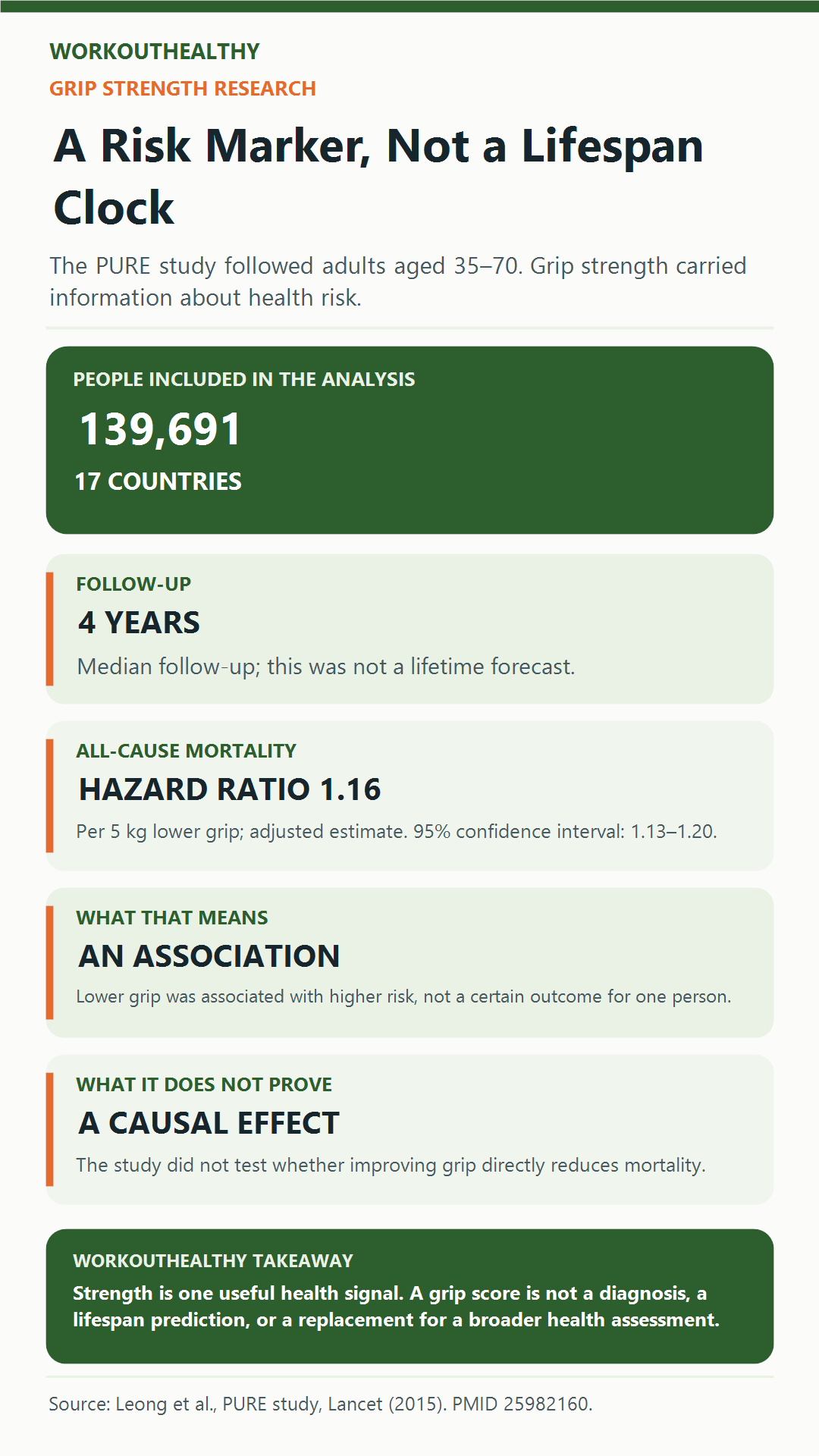
The Prospective Urban Rural Epidemiology study followed more than 139,000 adults across 17 countries (Leong et al., 2015).
Researchers tracked grip strength along with height, weight, and other health markers for about four years.
Grip strength predicted death from any cause more strongly than systolic blood pressure did.
That held true even after the researchers adjusted for body mass index.
In other words, two people with the same BMI can carry very different risk levels.
In the PURE cohort, lower measured grip strength was associated with higher mortality after adjustment for several other factors. That group-level association cannot predict which of two people with the same BMI will live longer.
This finding came from one of the largest cohort studies ever done on this exact question.
It spanned wealthy countries and lower income countries alike.
That is a hard result to dismiss as a fluke of one population.
Across seventeen countries and more than 139,000 adults, grip strength predicted death from any cause more strongly than blood pressure did, even after accounting for BMI.
What Real Research Shows About Muscle Mass and Body Fat Together
Grip strength captures function, but researchers also study body composition directly.
Body composition means how much of a person’s weight is muscle versus fat.
One well known study followed more than 4,000 older men in the United Kingdom (Wannamethee et al., 2007).
Researchers measured muscle mass and waist circumference separately from total body weight.
Men with lower muscle mass had a higher risk of death during the study period.
That risk showed up regardless of how much fat mass a man was carrying.
Central adiposity, meaning fat stored around the waist, added its own separate risk on top.
Both lower muscle measurements and greater central adiposity contributed independent statistical associations in this cohort; neither measure alone gives a personal prognosis.
A man could have a completely normal body weight and still carry this higher risk pattern.
Low muscle, high waist fat, and a normal number on the scale.
Researchers now have a name for that specific combination.
It is called sarcopenic obesity.
A bathroom scale alone cannot detect it.
What Real Research Shows About Strength Independent of Body Weight
A separate line of research asked a related but slightly different question.
Does overall muscular strength predict death independent of body weight and fitness level?
Researchers tracked more than 8,000 men for an average of about 18 years (Ruiz et al., 2008).
They measured strength using leg press and bench press tests, not grip strength alone.
Men in the lowest strength category had a higher death rate than stronger men.
That pattern held up after the researchers adjusted for body mass index.
It also held up after adjusting for cardiorespiratory fitness, a separate measure of aerobic health.
Strength was not simply standing in for a person’s fitness level or leanness.
It carried its own independent signal about long term risk.
What the Floor-Rise Test Actually Measures
The Facebook post also mentions rising from the floor without using the hands. Researchers call a standardized version the sitting–rising test, or SRT. It is not a grip-strength test: it combines lower-body strength, balance, flexibility, and coordination.
In a 2025 prospective cohort study, 4,282 adults aged 46–75 in Brazil sat down on the floor and rose again while researchers scored how many supports they used and whether they were unsteady. Over a median 12.3 years, lower scores were associated with more deaths from natural and cardiovascular causes. The analysis adjusted for age, sex, BMI, several diagnosed conditions, and reported health status.
This does not show that the SRT predicts a person’s exact lifespan, beats aerobic fitness or every other health marker, or that repeatedly practicing the test makes someone live longer. Joint pain, injury, disability, and other conditions can affect the score. It was one cohort, not a universal screening rule.
Do not attempt a floor test alone if getting down or up may be unsafe. A clinician or physical therapist can choose an appropriate functional assessment and help interpret it in context.
The Mechanism
The studies on grip, strength, body composition, and floor-rise ability raise a question: why do these measures carry information that a bathroom scale misses?
Both muscle and fat tissue are metabolically active, but they have different functions. Skeletal muscle helps dispose of glucose after meals and supports movement and recovery.
Less muscle mass is linked to worse insulin sensitivity over time.
Muscle also functions as a kind of reserve tank for the body.
During illness, surgery, or a hospital stay, the body draws on protein stores to heal.
People with more muscle mass going in tend to have more reserve to draw on.
Muscle strength is also tied directly to fall risk in older adults.
A fall that leads to a hip fracture can trigger a fast downward spiral in health.
Grip strength specifically correlates with strength throughout the rest of the body.
That is part of why it works so well as a quick, low cost health marker.
None of this means body weight is meaningless.
It means weight alone leaves out a variable that turns out to matter a great deal.
Strength and muscle can support function during aging and recovery, but a stronger grip is a risk marker, not a promise of longer life.
What This Evidence Does Not Prove
None of these studies prove that building muscle, improving a grip score, or practicing a floor-rise test by itself guarantees a longer life.
They are observational cohort studies, not controlled experiments.
An observational study can show a strong pattern without proving what actually causes it.
People with more muscle may also eat better, sleep better, or carry fewer underlying illnesses.
Researchers try to adjust for factors like that using statistics.
No statistical adjustment can account for every possible difference between two groups of people.
The studies also mostly measured muscle mass, strength, or physical function at a single point in time. The PURE study did not test whether stronger muscles directly improve immune function, bone density, or brain health, so those broader caption claims require separate evidence.
They say less about what happens when someone builds new muscle later in life.
Separate research on resistance training itself fills in part of that gap, though not all of it.
The video’s specific framing, a personal story about years spent studying scientists, is not itself a scientific claim.
We were not able to verify that framing happened the way the video describes it.
What we can confirm is that the underlying research question is real, active, and well studied.
Common Mistakes
The most common mistake is treating body weight as the only health number that matters.
A person can lose ten pounds and still end up worse off if most of that loss was muscle.
Rapid weight loss diets are especially prone to this problem.
Anyone actively trying to lose fat should pay close attention to the risk of losing muscle mass along with the weight.
Another mistake is assuming a normal BMI rules out the sarcopenic obesity pattern.
BMI cannot tell the difference between muscle and fat on a person’s frame.
Two people with an identical BMI can carry very different amounts of each.
A third mistake is treating strength training as optional once someone reaches a normal weight.
On average, muscle mass and strength tend to change with age, but the timing and pace differ greatly among individuals. Resistance training can help maintain function; the cohort studies cited above do not identify a universal decline starting in everyone’s thirties.
Skipping strength work because the scale looks fine ignores what the research above actually found.
Who Should Be Extra Careful
Older adults losing weight without trying should talk to a doctor before assuming it is a good sign.
Unintentional weight loss can sometimes mean muscle loss rather than fat loss.
Anyone recovering from a long illness, surgery, or hospital stay should ask about muscle preserving nutrition.
People starting a new resistance training program with an existing heart condition should get medical clearance first.
Anyone with joint pain should start with lighter loads and build up gradually.
People with a family history of osteoporosis should ask a doctor about combining strength training with bone density monitoring.
None of this is a reason to avoid strength training altogether.
It is a reason to start it thoughtfully, with guidance where it is needed.
A Practical Takeaway
Research-grade grip strength is measured with a hand dynamometer using a consistent protocol. A dead hang tests the ability to hold body weight and is not an interchangeable measure of maximal grip force; it can also be unsuitable for someone with shoulder, hand, or balance problems.
Building real muscle takes resistance training done consistently over months, not weeks.
Two to three sessions a week that challenge the major muscle groups is a reasonable starting point for most healthy adults.
Protein intake matters too, especially for anyone over 50.
If you are actively trying to lose weight, treat muscle preservation as part of the plan, not an afterthought.
Walking still matters for heart health and overall mortality risk tied to daily step counts.
It works alongside strength training rather than instead of it.
Resistance training may also support brain health as people age, a newer but growing area of research.
A simple stair climbing test is another low cost way to get a rough read on functional fitness.
Age is not the barrier people often assume it is.
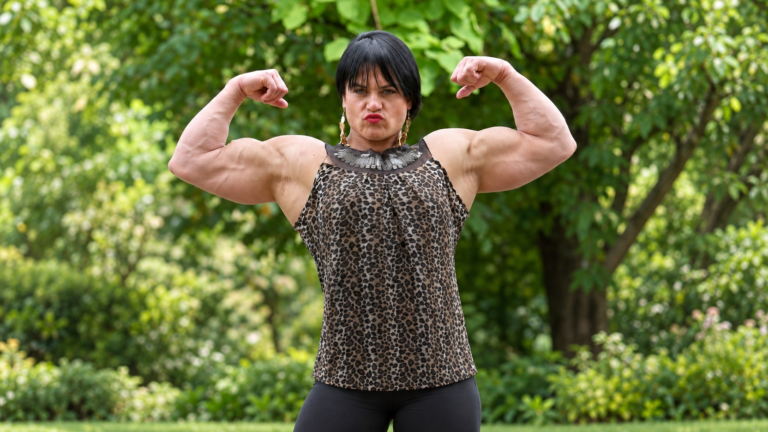
A Guinness World Record holder for oldest female bodybuilder is living proof of that.
None of this requires a gym membership or fancy equipment to start.
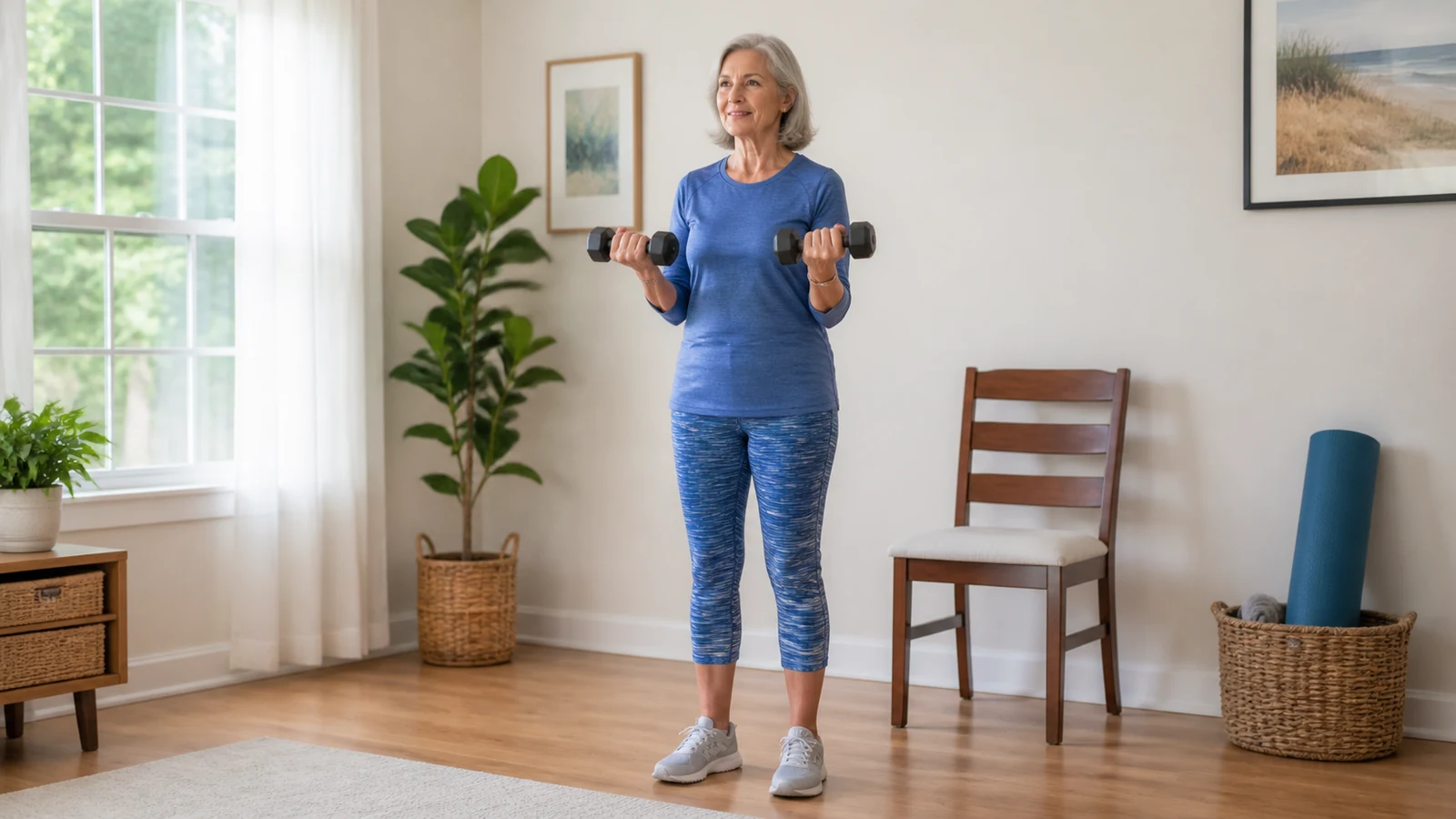
Bodyweight squats, push ups, and resistance bands can build real strength at home.
The goal is not to chase a lower number on a scale.
The goal is to keep the muscle that keeps you functional for decades.
Watch the video
Want more like this? Subscribe to WorkoutHealthy Insider for practical explanations behind popular fitness claims.
References
Araújo, C. G. S., et al. (2025). Sitting–rising test scores predict natural and cardiovascular causes of deaths in middle-aged and older men and women. European Journal of Preventive Cardiology. Original cohort study.
Leong, D. P., Teo, K. K., Rangarajan, S., Lopez-Jaramillo, P., Avezum, A., Orlandini, A., Seron, P., Ahmed, S. H., Rosengren, A., Kelishadi, R., Rahman, O., Swaminathan, S., Iqbal, R., Gupta, R., Lear, S. A., Oguz, A., Yusoff, K., Zatonska, K., Chifamba, J., … Yusuf, S. (2015). Prognostic value of grip strength: Findings from the Prospective Urban Rural Epidemiology (PURE) study. Lancet, 386(9990), 266 to 273. https://doi.org/10.1016/S0140-6736(14)62000-6
Ruiz, J. R., Sui, X., Lobelo, F., Morrow, J. R., Jackson, A. W., Sjöström, M., & Blair, S. N. (2008). Association between muscular strength and mortality in men: Prospective cohort study. BMJ, 337, Article a439. https://doi.org/10.1136/bmj.a439
Wannamethee, S. G., Shaper, A. G., Lennon, L., & Whincup, P. H. (2007). Decreased muscle mass and increased central adiposity are independently related to mortality in older men. American Journal of Clinical Nutrition, 86(5), 1339 to 1346. https://doi.org/10.1093/ajcn/86.5.1339
This article is for general information only and is not medical advice. If you have an injury, ongoing pain, or a medical condition, talk to a doctor or physical therapist before you change how you train or eat.