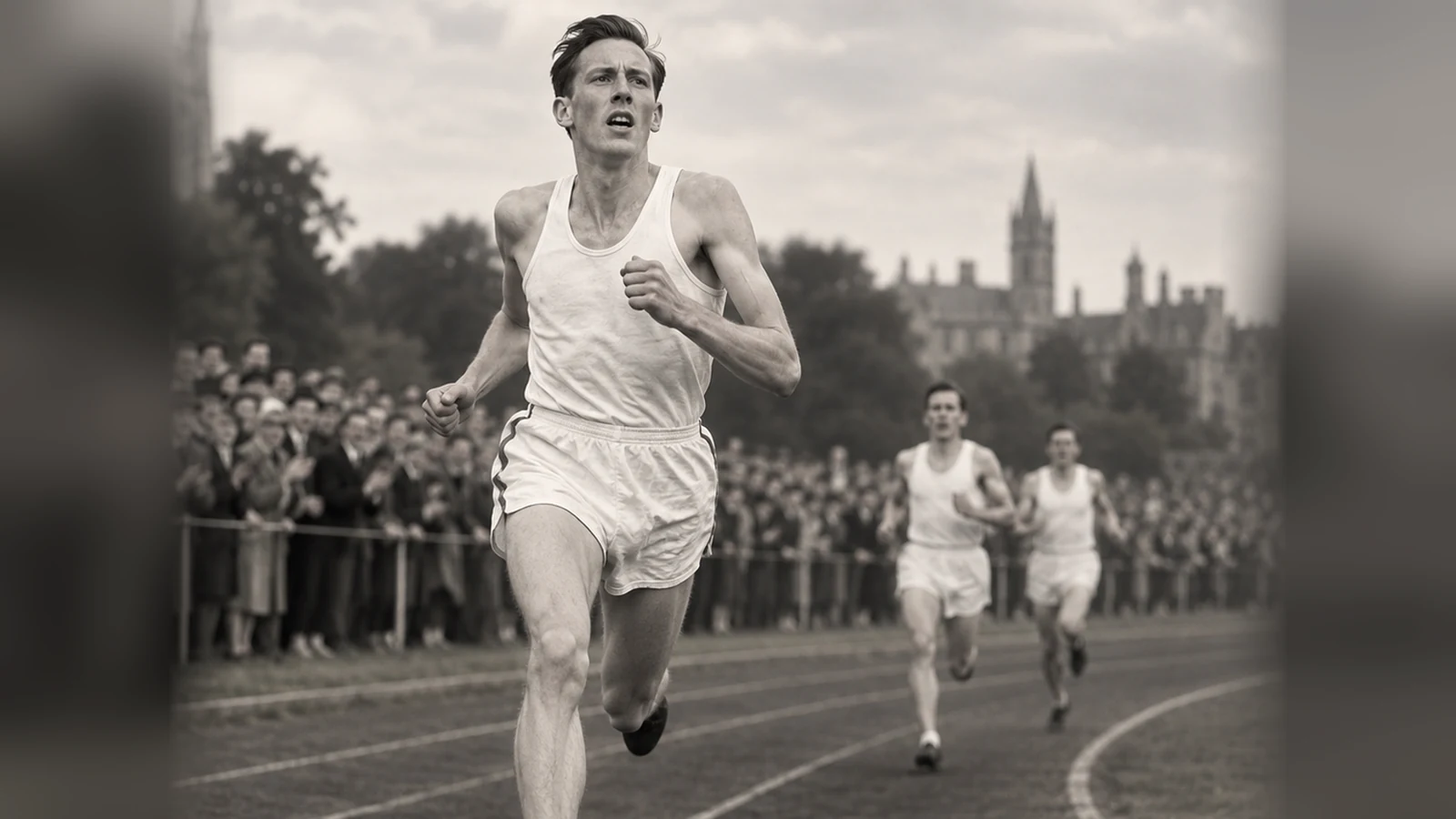

On May 6, 1954, Roger Bannister ran a mile in 3 minutes and 59.4 seconds.
It is one of the most famous moments in sports history.
A popular post uses it to make a bigger point: once someone proves a limit can be broken, others quickly break it too.
The story is inspiring. The history is more complicated, and the real lesson is still useful.
Here is what happened, what the numbers show, and what research says about belief and performance. The featured image is an illustration, not a photograph of Bannister or the May 1954 race.
The Run Itself
Bannister ran at the Iffley Road track in Oxford, England.
Fellow runners Chris Brasher and Chris Chataway served as pacemakers.
His time of 3:59.4 made him the first person on record to run a mile in under four minutes.
The record did not last long.
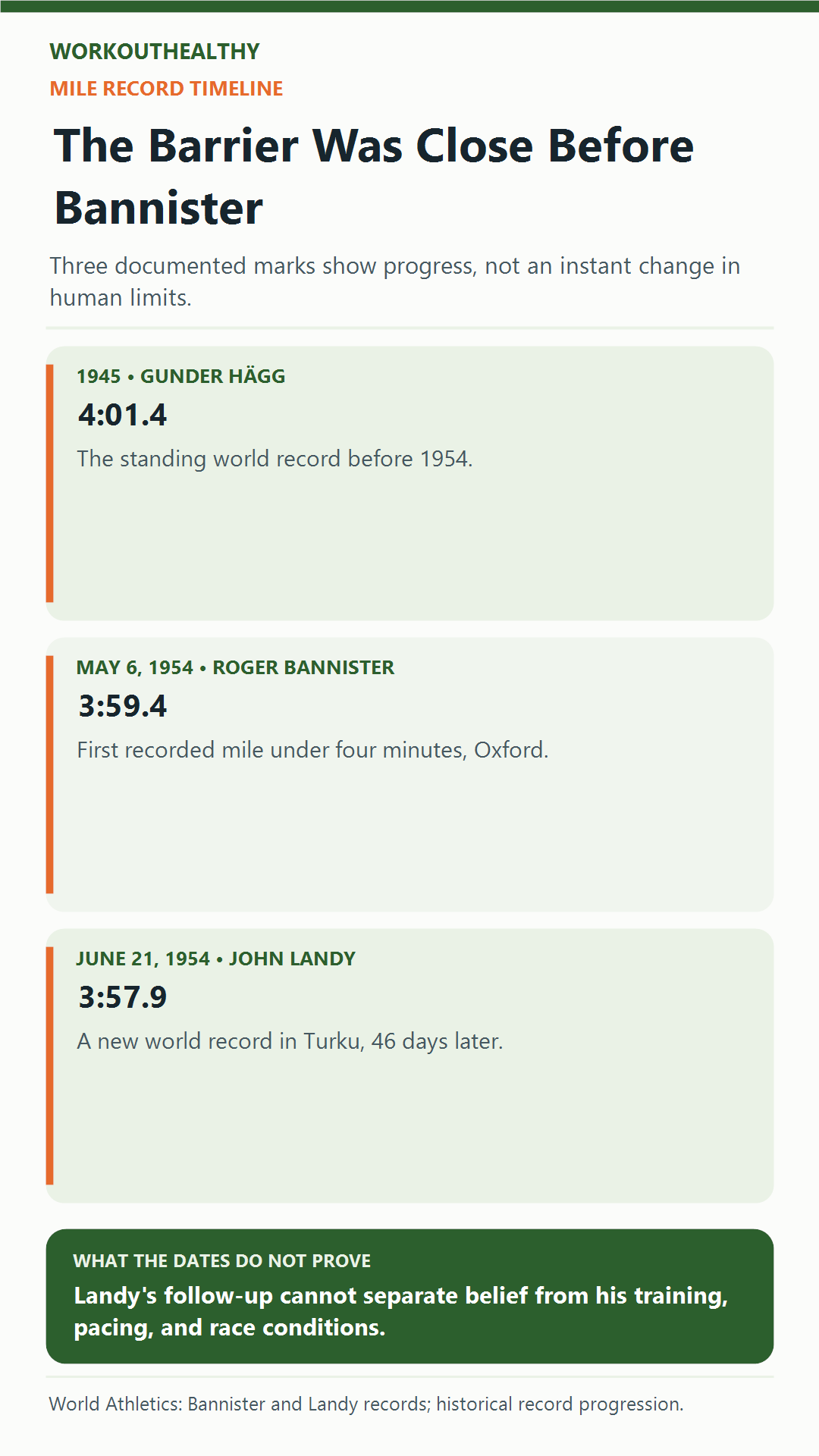
Only 46 days later, on June 21, 1954, Australian John Landy ran 3:57.9 in Turku, Finland.
Landy’s run set a new world record and made him the second man under four minutes.
Who Roger Bannister Was
Bannister was born in Harrow, England, in 1929.
He trained while studying medicine full-time. Oxford accounts describe fitting many sessions around his studies, including lunchtime running; an exact one-hour daily limit would oversimplify that schedule.
His training used interval work influenced by coach Franz Stampfl.
After retiring from running in 1954, he spent about forty years as a neurologist.
He said he would rather be remembered for his work in neurology than for his running.
He died in Oxford in 2018, at age 88.
Did Others Really Follow Quickly?
This is where the popular version needs correcting.
Running coach and writer Steve Magness looked closely at the record books in a 2017 analysis.
He found that only Landy broke four minutes during the rest of 1954.
By the end of 1955, three more runners had joined them, all in the same race.
It took about two and a half years for the total to reach ten runners.
So the barrier did not collapse overnight, even though Landy’s quick follow up is real.
Belief can open a door. Training is still what carries you through it.
Was It Ever Called Impossible?
Many retellings say experts once believed a four minute mile was beyond the human body.
Bannister himself pushed back on that idea in his memoir.
He described the four minute mark as a round number that stayed just out of reach, not a proven physical limit.
Magness also points out that Sweden’s Gunder Hägg had run 4:01.4 back in 1945.
That record then stood for about nine years.
Magness argues World War II stalled progress in many running events, not just the mile.
In his view, better coaching and the return of normal competition drove the breakthrough more than a sudden change in belief.
Training Around Medical Studies
One overlooked part of the story is how little time Bannister had.
As a medical student, he often fitted training around classes and hospital work. Accounts of his earlier preparation describe some brief lunchtime sessions, not a fixed one-hour daily formula.
His coach’s influence pushed him toward interval training, which packs hard running into short repeats with rest between.
His training changed over time, but assigning a later technical label such as “block periodization” to his exact 1954 plan would require more detailed contemporary training records than are available here.
The point for everyday runners is simple.
A limited schedule does not rule out real progress.
Focused sessions with a clear purpose can take you further than long, aimless ones.
Why the Breakthrough Was a Team Effort
The famous photograph centers on Bannister, but the attempt had a deliberate pacing plan. Oxford’s eyewitness account describes a target of roughly four even one-minute laps. Chris Brasher led the first two, Chris Chataway took over for the third, and Bannister had to finish the fourth without a pacer. The handoff mattered because a small slowdown before the final lap could have ended the attempt before his sprint began.
The race was also a response to a real competitive clock, not a vague wish to defeat a myth. World Athletics records that Landy and American runner Wes Santee had been pursuing the same mark. Earlier world-record holder Gunder Hägg had reached 4:01.4 in 1945. The remaining gap was narrow enough to invite specific training and pacing choices even if no one could guarantee who would cross it first.
Oxford’s university account recalls cool, uncertain weather on the day of the race. Bannister still had to decide whether to attempt the mark and then execute the plan under those conditions. That is a better model for a hard goal than the idea that confidence alone changes physiology: prepare the details, use capable partners, and act when the opportunity is real.
What Landy’s Follow-Up Can and Cannot Show
Landy’s June 21 run is important because he did not merely slip under four minutes; he lowered the record to 3:57.9. World Athletics notes that the time was rounded to 3:58.0 under the governing rules then in use. Different presentations of that mark do not describe different races.
He had already been one of the strongest candidates to break the barrier before Bannister’s Oxford run. His faster result six weeks later therefore cannot isolate a psychological effect from continued training, race conditions, pacing, and competition. It shows that the standard was within reach of more than one prepared runner.
The two finally raced each other later in 1954 at the British Empire Games in Vancouver. Bannister won their celebrated mile in 3:58.8, while Landy’s 3:57.9 remained the world record. The head-to-head result is a useful reminder that owning a record and winning a particular race are different achievements. It also gives the history a richer ending than the slogan that one breakthrough instantly made everyone faster.
What Research Says About Belief and Performance
Belief still matters, and sports science has measured part of it.
A 2009 review by Beedie and Foad looked at 12 studies where athletes received inert substances they thought would help.
Placebo effects of varying size showed up in sports from weightlifting to endurance cycling.
The authors pointed to motivation, expectancy, and conditioning as likely drivers.
A 2020 systematic review by Hurst and colleagues went further.
It pooled 32 studies with 1,513 participants.
Both placebo and nocebo effects on performance were small to moderate in size.
A nocebo effect is the opposite of a placebo, where negative expectations make performance worse.
So what you expect can nudge how well you perform, in either direction.
What This Does Not Prove
These studies show that expectations can shift performance by a modest amount.
They do not show that belief alone lets people break world records.
Bannister, Landy, and the runners who followed all trained hard for years.
The mile story is best read as a mix of fitness, coaching, timing, and confidence.
How to Use the Lesson
- Keep expectations realistic. Placebo and nocebo experiments show that expectations can influence performance in specific test settings; ordinary self-talk is not the same intervention.
- Find a real example. Seeing someone like you reach a goal can make it feel reachable.
- Break big goals into steps. A long plateau often ends with patient, specific training changes.
- Use pacing help. Bannister had pacemakers, and a training partner can help you too.
- Plan around limited time. Bannister trained while studying medicine, showing why focused sessions and thoughtful recovery matter when time is constrained.
- Check the facts behind limits. Many so called limits are just round numbers.
For another record that redefined speed, read about Usain Bolt’s 9.58 100 meter world record.
Distance runners can also look at Letesenbet Gidey’s half marathon world record.
And to turn a big goal into a daily plan, see what Bo Jackson’s goal setting advice really asks you to do.
Who Should Be Careful
Chasing a big time goal can tempt people to ramp up training too fast.
If you have heart disease, chest pain with effort, or a history of fainting, get checked before hard running.
Build speed work gradually, and back off if you have pain that changes how you run.
The Bottom Line
Roger Bannister did break four minutes in 1954, and John Landy followed just 46 days later.
After that, the pace of new sub four milers was slower than the popular story suggests.
Research shows beliefs and expectations can shift performance a modest amount.
Believe a goal is possible, then back that belief with smart, steady training.
Want more stories like this? Subscribe to WorkoutHealthy Insider for practical explanations behind popular fitness claims.
References
- World Athletics. (2004). 50 years on, John Landy reflects. Confirms the May and June 1954 mile times, pacers, and historical rounding.
- Oxford Alumni. (2024). 70 Years Since Bannister’s Sub-Four-Minute Mile. Eyewitness account of the pacing plan and race conditions at Iffley Road.
- Beedie, C. J., & Foad, A. J. (2009). The placebo effect in sports performance. Sports Medicine, 39(4), 313 to 329. https://doi.org/10.2165/00007256-200939040-00004
- Hurst, P., Schipof-Godart, L., Szabo, A., Raglin, J., Hettinga, F., Roelands, B., Lane, A., Foad, A., Coleman, D., & Beedie, C. (2020). The placebo and nocebo effect on sports performance: A systematic review. European Journal of Sport Science, 20, 279 to 292. https://doi.org/10.1080/17461391.2019.1655098
- Magness, S. (2017, May 16). The Roger Bannister effect: The myth of the psychological breakthrough. Science of Running. https://www.scienceofrunning.com/2017/05/the-roger-bannister-effect-the-myth-of-the-psychological-breakthrough.html
This article is for general information only and is not medical advice. If you have an injury, ongoing pain, or a medical condition, talk to a doctor or physical therapist before you change how you train or eat.