

On August 16, 2009, Usain Bolt stepped into the blocks in lane four at the Olympic Stadium in Berlin.
The event was the 100 meter final at the World Championships in Athletics.
Nine and fifty eight hundredths seconds later, he crossed the line as the fastest human being ever timed over that distance.
That mark has now stood for seventeen years.
No sprinter, including Bolt himself in any later race, has come within a tenth of a second of it since.
What makes the record stranger than most is the runner who set it.
At 6 foot 5, Bolt was built more like a high jumper than a sprinter, and conventional sprint coaching for decades held that a body his size was a disadvantage in the blocks, not an asset.
This article checks the specific numbers behind that night against primary sources, then explains what sprint science actually says about height, stride, and ground force, using Bolt’s own race as the case study.
The Record: 9.58 Seconds, Verified
World Athletics, the sport’s global governing body and the organization that succeeded the IAAF, confirmed the result directly on its own site.
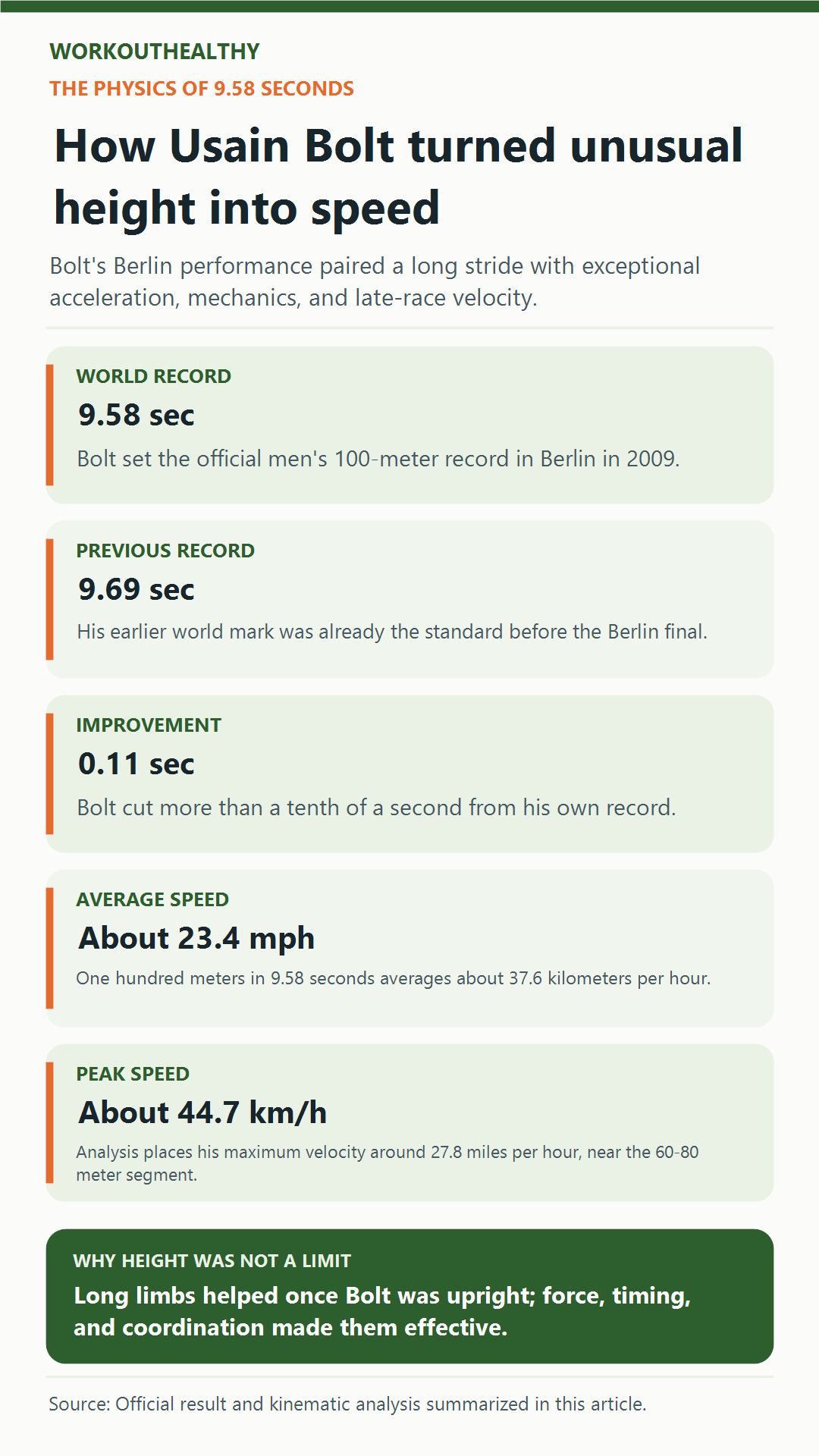
Bolt ran 9.58 seconds in the final of the men’s 100 meters at the 2009 World Championships in Berlin, breaking his own previous world record of 9.69 seconds, set one year earlier at the Beijing Olympics.
A 0.11 second improvement sounds small on paper.
In sprinting, where medals are decided by hundredths, it was described by World Athletics as the largest single improvement to the men’s 100 meter world record since fully automatic electronic timing began.
Tyson Gay finished second that night in 9.71 seconds, a new American record that would have been a world record itself just two years earlier.
Asafa Powell took third in 9.84 seconds.
Both of those times remain, to this day, faster than almost every sprinter in history has ever run.
Neither man came within a tenth of a second of Bolt.
It is worth naming the governing body carefully here.
World Athletics, not Guinness World Records, is the organization that actually ratifies and maintains athletics world records like this one.
Guinness sometimes lists sport records too, but for an official track and field mark, World Athletics’ own database is the primary source, and that is what this article checked directly.
What “Too Tall to Sprint” Was Supposed to Mean
Elite sprinters, historically, tend to run short.
A shorter, more compact frame carries less mass to accelerate and swings the limbs through a shorter arc, which sprint coaches have long linked to a quicker start out of the blocks.
Bolt, at 1.95 meters, was taller than almost every 100 meter finalist he ever raced against.
A 2009 biomechanics paper in the Journal of Experimental Biology modeled exactly this tradeoff, examining how a sprinter’s height and leg length interact with top speed across more than a century of athletics results (Charles & Bejan, 2009).
The researchers found that taller athletes with proportionally longer legs are, in principle, capable of higher top speeds once they reach full stride, because a longer limb covers more ground per step.
The tradeoff is time.
A longer limb also takes more time and more force to swing through each stride cycle, which is part of why taller sprinters have historically been seen as slower out of the blocks, where quick, short, high-frequency steps matter most.
That tradeoff is real, and it is not just an old coaching myth.
Bolt’s body was not built to be fast everywhere on the track. It was built to be the fastest one specific place: full stride, top speed, after the disadvantage of the start was already behind him.
Bolt never denied the slow start.
Across his career, race data consistently showed him reacting to the gun and clearing the first 20 to 30 meters slower than his shorter competitors.
What changed the outcome was everything that happened after that.
The Real Driver of Sprint Speed: Force Into the Ground
For decades, a common assumption held that the fastest sprinters simply moved their legs faster than everyone else, cycling through more steps per second.
A landmark study in the Journal of Applied Physiology tested that assumption directly, using a specialized treadmill that measured the actual force runners applied to the ground with each step (Weyand et al., 2000).
The researchers found that leg speed, meaning how quickly a runner’s limbs cycled, was remarkably similar across slower and faster runners.
What separated the fastest sprinters was not quicker legs.
It was the amount of force they could drive into the ground during the brief instant, well under a quarter of a second, that the foot was in contact with the track.
Faster top speeds, the study concluded, come from greater ground reaction force applied in that short contact window, not from a faster turnover of the legs.
That finding matters directly for a sprinter built like Bolt.
A taller frame with more muscle mass has the physical capacity to generate more absolute force against the ground with each contact, provided the neuromuscular system can apply it quickly enough.
Bolt’s career suggested his did.
His stride length at top speed was reported to be unusually long even relative to his height, letting him cover the same distance in noticeably fewer total steps than his rivals.
Counting the Steps: What Race Analysis Actually Found
A detailed kinematic analysis published in the Journal of Human Kinetics broke down Bolt’s Berlin race step by step, comparing it directly against the next two fastest 100 meter performances in history at the time (Mackala & Mero, 2013).
The researchers measured stride length and stride frequency across the full distance for Bolt, Gay, and Powell.
Their analysis credited Bolt with completing the race in noticeably fewer total strides than either of the other two finalists, consistent with his longer limbs and longer stride length.
Fewer strides, covering the same 100 meters, meant fewer total ground contacts.
Each one of those contacts still had to generate enough force to keep his speed climbing, which the study’s data showed he did more effectively than his competitors through the middle and late portions of the race.
That detail lines up with what casual viewers of the race often notice without realizing why.
Bolt appeared to be pulling away in the final third of the race, well past the point where a slow starter should theoretically still be catching up.
The step-count data offers a mechanical explanation instead of a mysterious one.
The Top Speed Everyone Quotes
A commonly cited figure for Bolt’s peak velocity during the Berlin race puts his top speed at roughly 44.7 kilometers per hour, or about 27.3 to 27.8 miles per hour, reached somewhere in the 60 to 80 meter segment of the race.
That figure traces back to segment-by-segment timing analysis of the race, the kind of breakdown World Athletics itself has published in its own biomechanics coverage of the event, and it has since been repeated across multiple independent sports science write-ups.
It is worth being precise about what that number does and does not describe.
It is not Bolt’s average speed across the full 100 meters.
His average speed, dividing 100 meters by 9.58 seconds, works out closer to 23.4 miles per hour.
The higher figure describes his instantaneous peak velocity during the fastest single stretch of the race, well after the slow start was behind him and before the very end, where even elite sprinters lose a small amount of speed.
Split-time analysis of the race showed every finalist reaching their fastest 20 meter segment somewhere in that same 60 to 80 meter window, but Bolt’s segment time through that stretch was the fastest of the field.
A longer runway to build speed, paired with a longer stride once he got there, is a big part of the mechanical story behind that peak number.
What This Record Does Not Prove
A verified world record confirms exactly one thing directly: that on one specific night, under governing-body-certified timing and conditions, one athlete ran 100 meters in 9.58 seconds.
It does not prove that height and long limbs are a guaranteed sprinting advantage.
The research on height and stride length describes a tradeoff, not a shortcut, and most of the tallest sprinters in history never approached Bolt’s times.
Bolt’s numbers make more sense as one exceptional case where a rare combination, unusual force production for his size, a still-elite start despite his height, and a long, efficient stride, all came together in the same athlete.
It also does not prove the record is unbreakable.
World Athletics’ own listing does not describe 9.58 as a physiological ceiling, only as the current verified best.
Records like it get broken by athletes who eventually combine similar or better physical traits with better technique, or simply by an outlier performance nobody predicted.
Seventeen years without a serious challenge is unusual, but it is a fact about history so far, not a law of biomechanics.
Why the Start Still Matters for Everyone Else
Most people reading about this record will never need to run a sub-10-second 100 meters.
The mechanics behind it still apply to anyone who sprints, jumps, or changes direction quickly in sport or training.
That includes people who think of themselves as lifters first, since force production off the ground is a strength quality as much as it is a running one, a point our own reader survey on weightlifting versus running touched on when so many respondents said they preferred building strength over logging miles.
Ground reaction force, the same quality the Weyand study identified as the real driver of top speed, is trainable through resistance work that builds the ability to produce force quickly rather than just producing a lot of force slowly.
Plyometric and jump-based training is one common way athletes build that quality, and it is worth noting that research on box jumps and other explosive jump training has found real, measurable strength and power benefits from that kind of work, separate from traditional weightlifting.
Stride mechanics can also be coached directly, and taller athletes in particular often benefit from deliberate work on their acceleration phase, since that is the portion of a sprint where their height works against them most.
Nobody needs Bolt’s genetics to benefit from Bolt’s mechanics. Force into the ground, applied quickly, is the same principle whether the goal is a personal best 100 meter time or just getting off the line faster in a weekend rec league game.
For most recreational athletes, the more useful takeaway is not the top speed number at all.
It is the reminder that speed is trainable through specific qualities like ground force production, not just something a person either has or does not have.
A Practical Starting Point for Building Real Sprint Speed
Coaches who train sprint mechanics generally start with the same handful of building blocks, regardless of an athlete’s height.

Building a base of general strength comes first, since a stronger athlete has a higher ceiling for the force they can eventually apply to the ground.
From there, plyometric work, like bounding, hopping, and jump variations, teaches the nervous system to apply that strength quickly rather than slowly.
Short, maximal-effort sprints, often 10 to 30 meters, train the acceleration phase specifically, which is exactly where taller athletes tend to need the most technical work.
Full recovery between sprint repetitions matters more than people expect, since true top-speed training depends on running each rep close to maximum effort, not on accumulating fatigue.
Anyone returning from a hamstring, knee, or ankle injury, or managing a chronic joint condition, should treat maximal sprint work as something to build back gradually, ideally with guidance rather than alone.
A qualified coach or trainer can also help correct stride mechanics that are hard to self-diagnose, which is one of the more common reasons working with a personal trainer pays off for someone serious about improving sprint performance specifically.
None of that training guarantees anything close to a 9.58.
It does reflect the same underlying physical qualities that made Bolt’s record possible in the first place.
Watch the Record
The full 2009 World Championships 100 meter final, including Bolt’s 9.58 second run, is available on video.
Curious what other verified world records actually reveal about training and the body. Subscribe to WorkoutHealthy Insider for practical explanations behind popular fitness claims.
References
Charles, J. D., & Bejan, A. (2009). The evolution of speed, size and shape in modern athletics. Journal of Experimental Biology, 212(15), 2419–2425. https://doi.org/10.1242/jeb.031161
Mackala, K., & Mero, A. (2013). A kinematics analysis of three best 100 m performances ever. Journal of Human Kinetics, 36, 149–160. https://doi.org/10.2478/hukin-2013-0015
Weyand, P. G., Sternlight, D. B., Bellizzi, M. J., & Wright, S. (2000). Faster top running speeds are achieved with greater ground forces, not more rapid leg movements. Journal of Applied Physiology, 89(5), 1991–1999. https://doi.org/10.1152/jappl.2000.89.5.1991
This article is for general information only and is not medical advice. If you have an injury, ongoing pain, or a medical condition, talk to a doctor or physical therapist before you change how you train or eat.