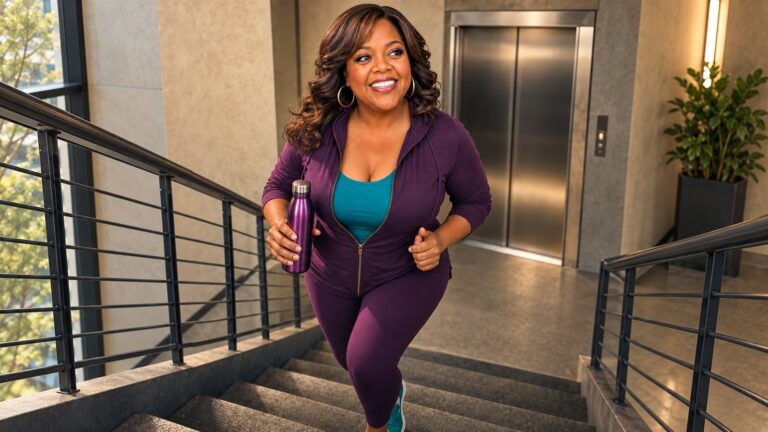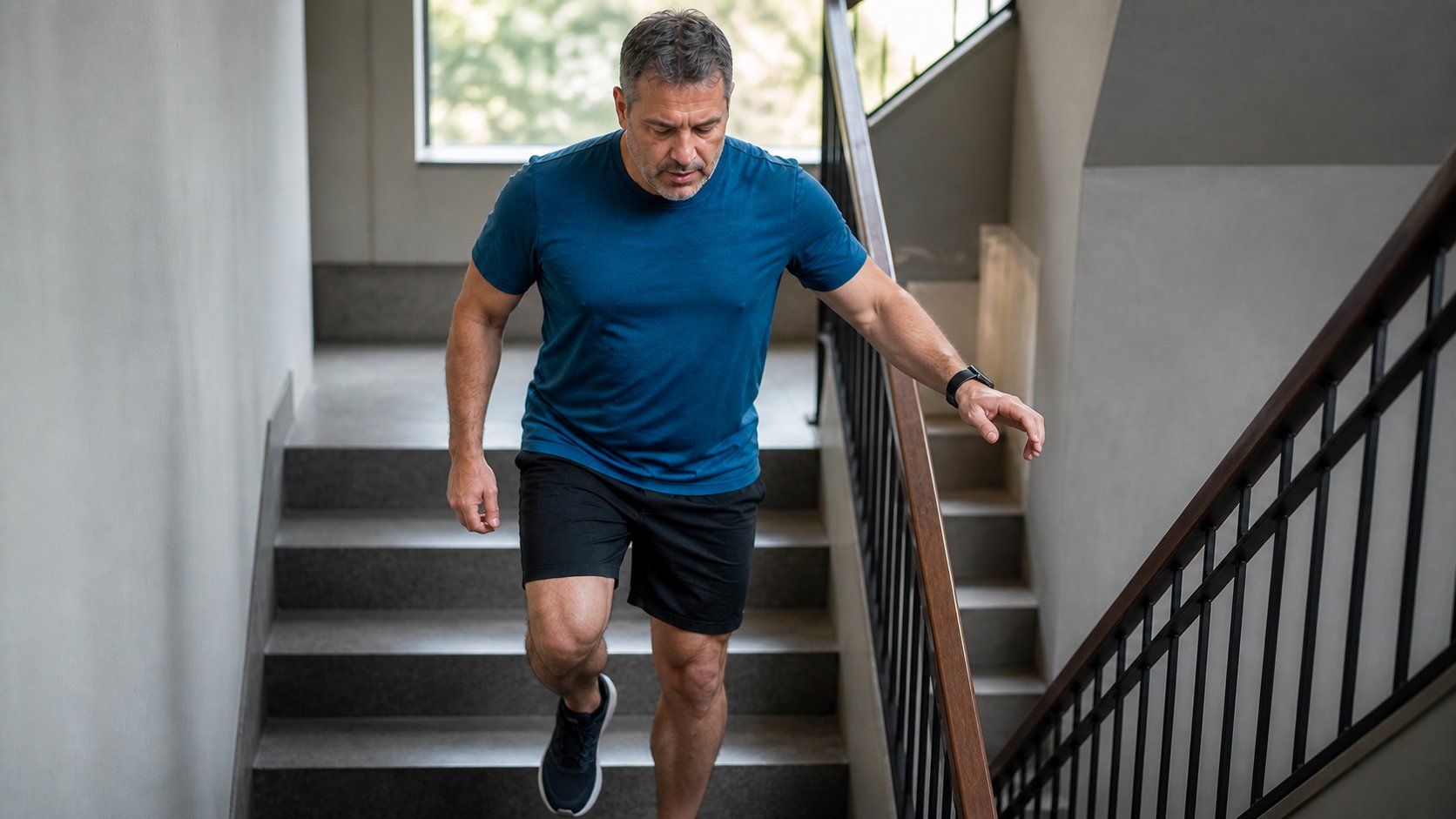

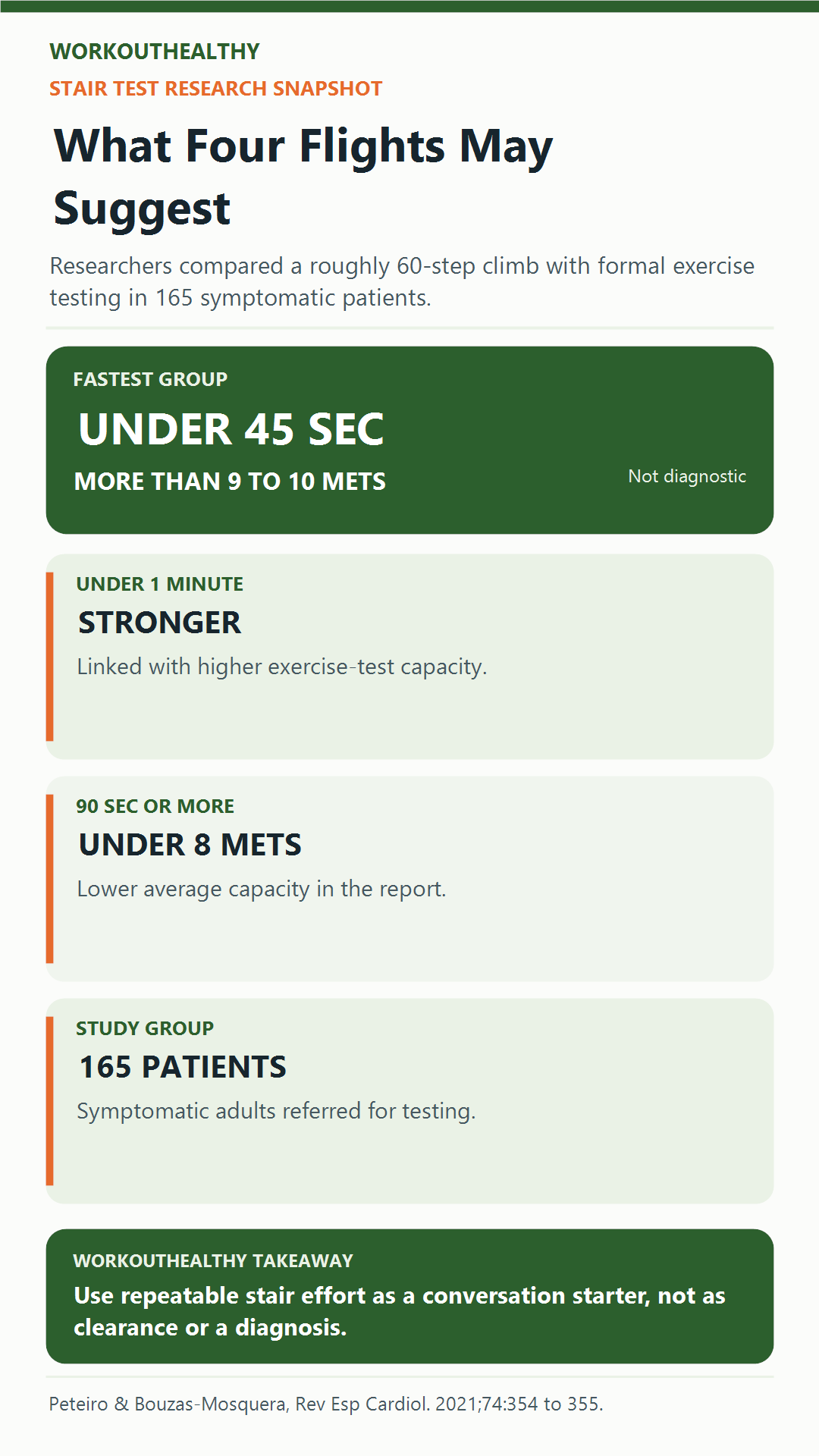
Climbing four flights of stairs can reveal how hard a familiar task feels, but it cannot diagnose heart disease. The viral time thresholds came from a small clinical study that compared a roughly 60-step climb with formal exercise testing in 165 symptomatic patients.
Participants who climbed in under 40 to 45 seconds generally reached more than 9 to 10 metabolic equivalents, or METs, on treadmill testing. Those who took 90 seconds or longer averaged under 8 METs (Peteiro & Bouzas-Mosquera, 2021).
A staircase can show you that effort has changed, but it cannot tell you why.
What the study actually tested
The researchers first performed exercise testing with heart imaging, then asked participants to climb four flights without running. They compared stair time with exercise capacity and imaging findings (Peteiro & Bouzas-Mosquera, 2021).
The group was not a random sample of healthy adults. These were patients with symptoms or another clinical reason for testing, so the thresholds should not be treated as universal screening cutoffs.
What METs mean in plain language
One MET is the conventional estimate of energy used at rest. Higher MET capacity during a clinical exercise test indicates that a person can sustain a greater workload.
A stair climb compresses a substantial demand into a short period because you are moving body mass upward. It is therefore sensitive to aerobic fitness, leg strength, balance, pacing, body size, joint comfort, and familiarity with stairs.
That mix is exactly why the result is not heart-specific. A slow climb could reflect knee pain, deconditioning, breathlessness, medication effects, fear of falling, or many other factors.
Why one minute is not a pass or fail line
The published letter says people who completed four flights in under one minute generally performed well on formal testing. It does not say everyone above one minute has heart disease, and it does not clear everyone below one minute.
Stair dimensions, landings, altitude, footwear, and whether someone uses the rail can change the result. Repeating a personal setup under similar conditions is more informative than comparing yourself with a stranger online.
For a gentler way to build volume, see our guide to setting a daily walking target. If your day involves long sitting blocks, regular movement breaks are another practical starting point.
The WorkoutHealthy stair-result rule
Record only one comparison: whether the same climb feels meaningfully harder than it did under similar conditions. A sudden or persistent decline deserves attention even if your time still looks “good” by an internet threshold.
Stop if you feel chest pressure, faintness, unusual shortness of breath, or symptoms that concern you. Do not repeat the test to prove something to yourself.
When comparison is useful
A repeat comparison makes the most sense when the staircase, number of flights, footwear, and pacing instructions stay the same. Even then, treat normal day-to-day variation as noise rather than a verdict.
Recent illness, poor sleep, heat, dehydration, a hard workout, or a large meal can make the same climb feel different. Note those conditions before deciding that fitness has changed.
Testing every day can turn a rough check into an anxiety ritual and adds little useful information. A consistent training routine and ordinary symptom awareness usually matter more than chasing a faster stair time.
People with known heart or lung disease, a recent procedure, significant balance problems, or medical restrictions should not use an online stair challenge as clearance. Follow the activity advice from the clinician who understands the condition.
If you want to improve the result, train the capacities behind it instead of rehearsing the test every day. Regular walking, appropriate strength work, and gradually increased aerobic exercise build a broader base than one repeated staircase.
The most useful stair signal is a meaningful change in your own normal effort.
The bottom line
Four flights in under a minute was linked with stronger exercise-test performance in a small symptomatic group. Treat the climb as a rough functional check and a conversation starter, never as medical clearance or a diagnosis.
Get the next evidence check.
Five practical fitness stories worth your time, every Friday.
One email a week. No product pitches. Unsubscribe in one click.
References
Peteiro, J., & Bouzas-Mosquera, A. (2021). Time to climb 4 flights of stairs provides relevant information on exercise testing performance and results. Revista Española de Cardiología (English Edition), 74(4), 354 to 355. https://doi.org/10.1016/j.rec.2020.09.017
Medical disclaimer: This article is general product information, not medical advice. The equipment described here is not a treatment for any condition. If you have an injury, ongoing pain, or a medical condition, talk to a doctor or physical therapist before using any of it.