
Damien Rooney spent years chasing chin-up records before one finally landed in the Guinness book.
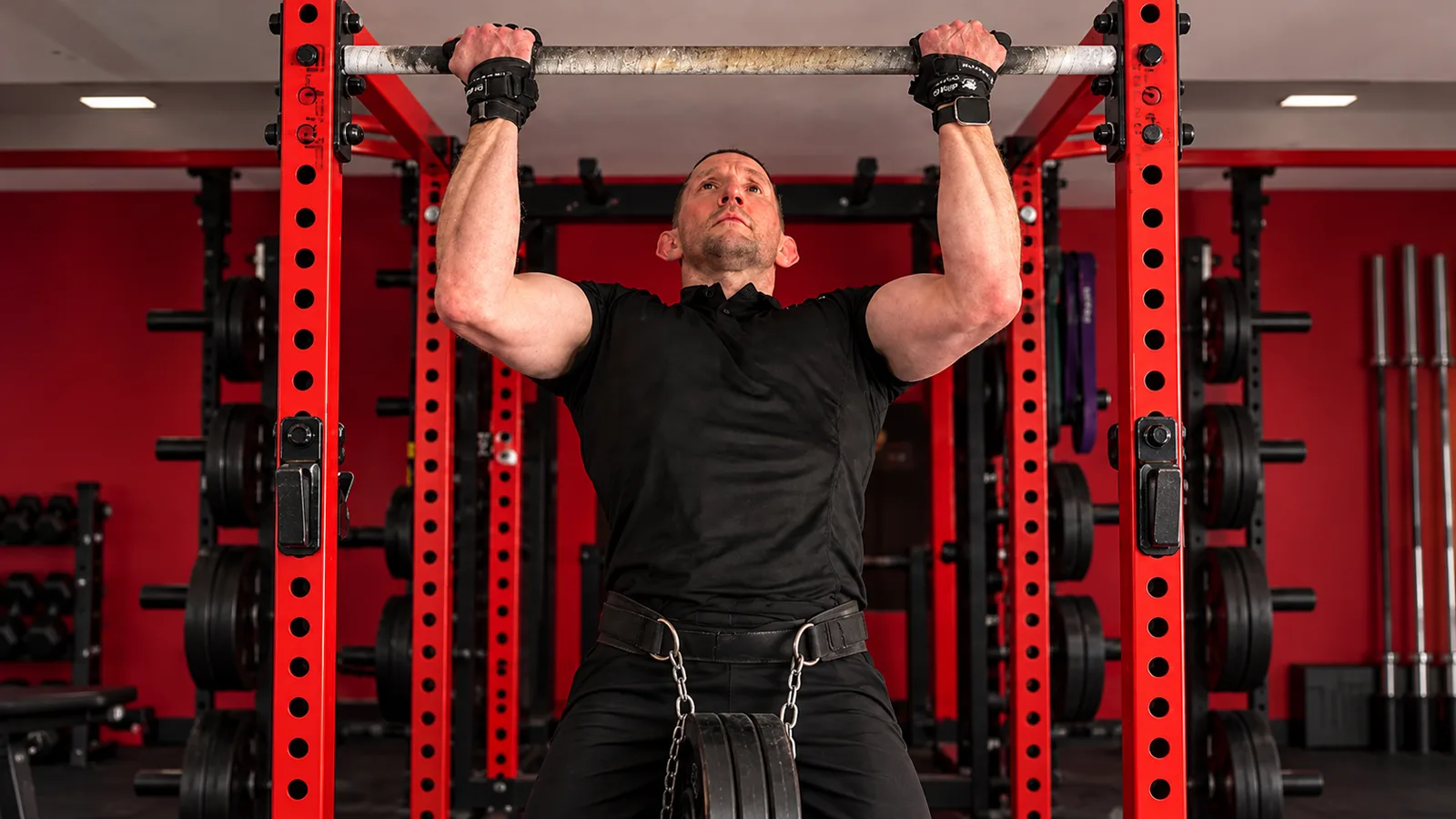
On June 1, 2026, the Newry fitness coach completed 499 chin-ups in one hour while carrying a 20-pound pack.
That was four more than the previous record of 495.
The headline number is impressive. The more useful story is how Rooney changed the challenge, paced the hour, and kept returning after four failed long-duration attempts.
The Exact Record Rooney Set
Guinness World Records lists Rooney as the holder of the men’s record for the most chin-ups in one hour while carrying a 20-pound pack.
The official total is 499, achieved in Newry, United Kingdom, on June 1, 2026.
Guinness also says he trained for six months for this specific attempt.
Rooney’s own account adds a longer timeline. He said the pursuit stretched across roughly eight years, included four official failures, and followed surgery in December 2025.
He estimated that he had accumulated close to 500,000 chin-ups during that wider period of preparation.
A record that moves by four repetitions can still represent years of failed attempts, injury setbacks, and rebuilt capacity.
Why the Category Matters
This was not the unweighted one-hour chin-up record.
Rooney wore a 20-pound pack for the full attempt. That added load changes the grip, elbow-flexor, shoulder, and trunk demands of every repetition.
It also means his 499 should not be compared directly with totals from bodyweight-only events.
The distinction is similar to the difference between ordinary calisthenics and the progressive overload discussed in our guide to adding weight to calisthenics.
Even the exercise name matters. A chin-up normally uses a palms-toward-you grip, while a pull-up uses a palms-away grip. Record organizations define the exact movement standard before judging a result.
The Pace Behind 499 Reps
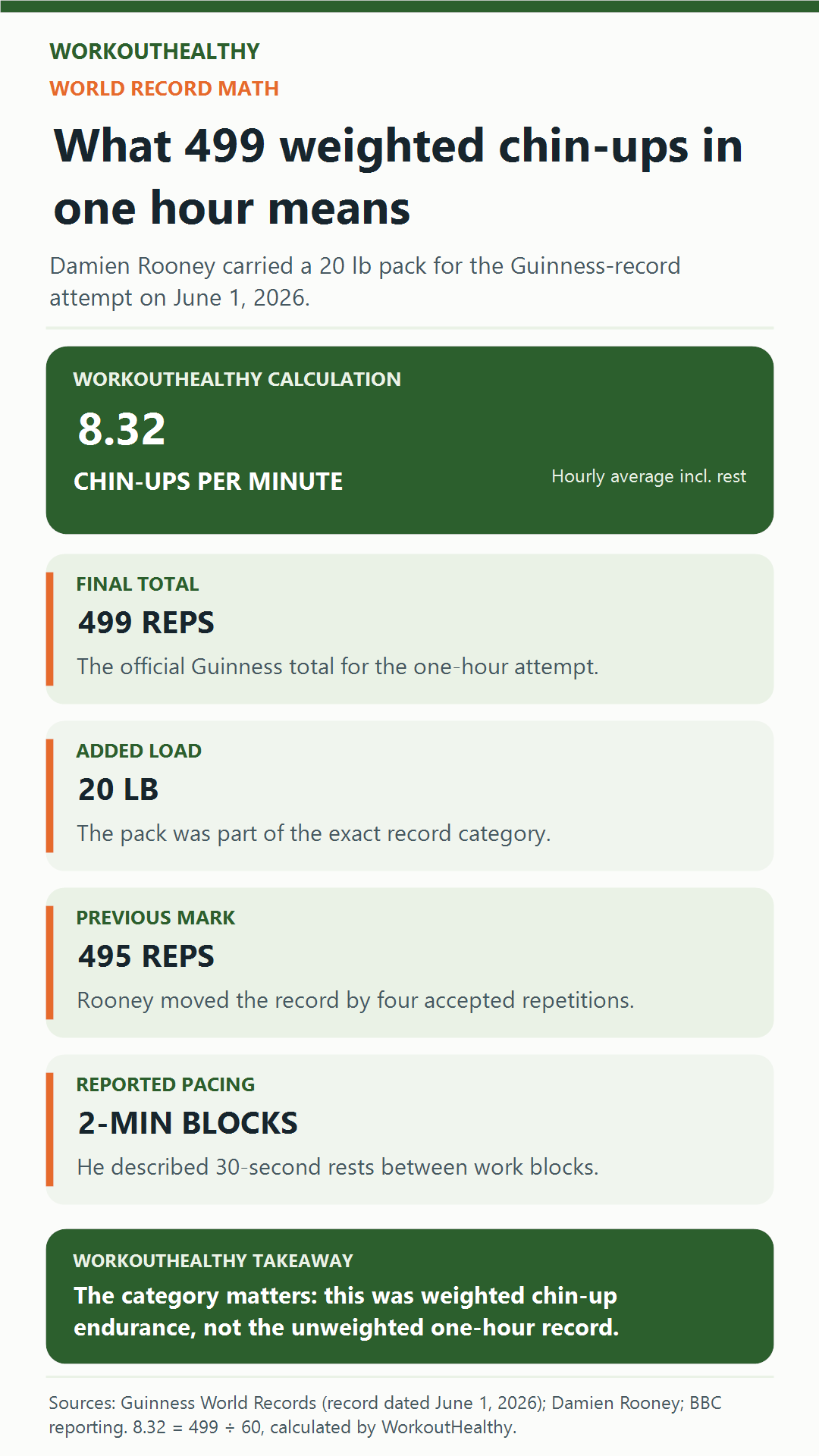
Divide 499 by 60 minutes and the average is 8.32 accepted chin-ups per minute.
That average includes all rest time. It does not mean Rooney performed one repetition every 7.2 seconds without stopping.
In coverage of the attempt, he described using two-minute work blocks followed by 30-second rests.
That type of structure protects the athlete from spending too much energy early, when the first few minutes can make an unsustainable pace feel easy.
A one-hour record rewards repeatable output, not the fastest possible opening set.
For comparison, a viral set of 100 pull-ups can be difficult without being the same event. Our breakdown of Bad Bunny’s 100 pull-ups shows why total reps, time, load, and standards all belong in the same sentence.
How He Changed His Training
Rooney originally pursued much longer chin-up records, including 12-hour and 24-hour attempts.
Those efforts ended with problems that included a torn biceps, a torn pectoral muscle, heat exhaustion, and severe forearm inflammation.
For the one-hour weighted record, he shifted the emphasis toward producing repetitions faster over a shorter window.
That was not simply “more chin-ups.” It was a more specific training problem.
The athlete needed enough strength to move the added load, enough local muscular endurance to repeat the motion, and enough pacing discipline to preserve both qualities for an hour.
This is also why a world-record performance should not be reverse-engineered into an everyday workout. The preparation was built around Rooney’s history, injuries, and exact event.
What Four Failed Attempts Reveal
Failure is easy to romanticize after someone succeeds.
Rooney’s record is more concrete than that. Each previous attempt exposed a different limit: tissue tolerance, heat management, grip function, or the ability to sustain the planned pace.
The useful response was not to repeat the same plan with more determination. It was to change the target and the preparation.
Persistence works best when every failed attempt changes the next plan.
His final result also belonged to a narrow margin.
The Irish News reported that he moved ahead of the old mark in the last minute. Four repetitions separated a verified record from another unsuccessful attempt.
What Lifters Can Apply
Most people should not copy Rooney’s volume. They can copy the logic behind it.
First, define the event. “Get better at chin-ups” is vague. “Complete five clean chin-ups with the same grip and full range of motion” is measurable.
Second, separate strength from endurance. If one repetition is near maximal, more volume may require an easier variation. If 12 clean repetitions are comfortable, a small external load may be a sensible progression.
Third, record rest as carefully as repetitions. A total completed in ten minutes is not the same test as the same total completed in three.
Finally, stop treating every session as a record attempt. Our review of Gabriel Peña’s axle deadlift record makes the same point in a different strength event: the equipment and rules shape the result.
Who Should Be Cautious
High-volume chin-ups place repeated stress on the hands, elbows, shoulders, and upper back.
Anyone with current pain, numbness, a recent upper-body injury, or a history of tendon problems should not use a record story as a reason to test an all-out hour.
Weighted chin-ups also require a secure loading method. A shifting backpack can change body position and make the load less predictable.
Newer lifters are usually better served by controlled sets, consistent technique, and gradual weekly progress. A qualified coach or physical therapist can help when pain, asymmetry, or a past injury changes the movement.
The Bottom Line
Damien Rooney’s 499 chin-ups earned a Guinness World Records title because the total was completed in one hour with a 20-pound pack under the organization’s category rules.
The math is striking: 8.32 accepted repetitions per minute across the entire hour.
The better lesson is narrower.
Rooney did not erase four failed attempts. He used them to change the event, the pace, and the training until the result finally matched the standard.