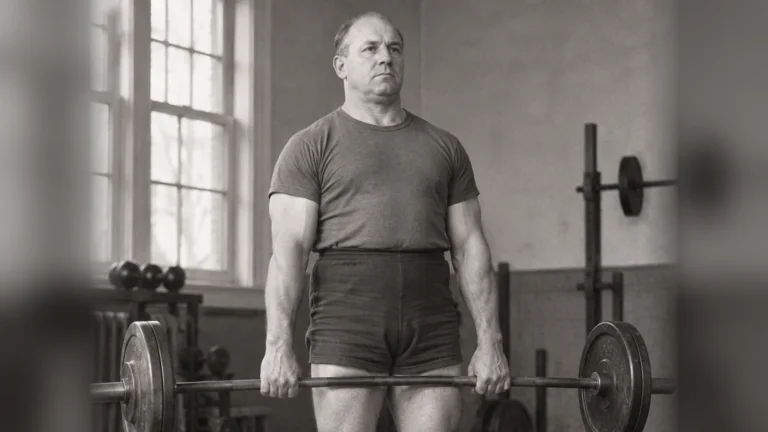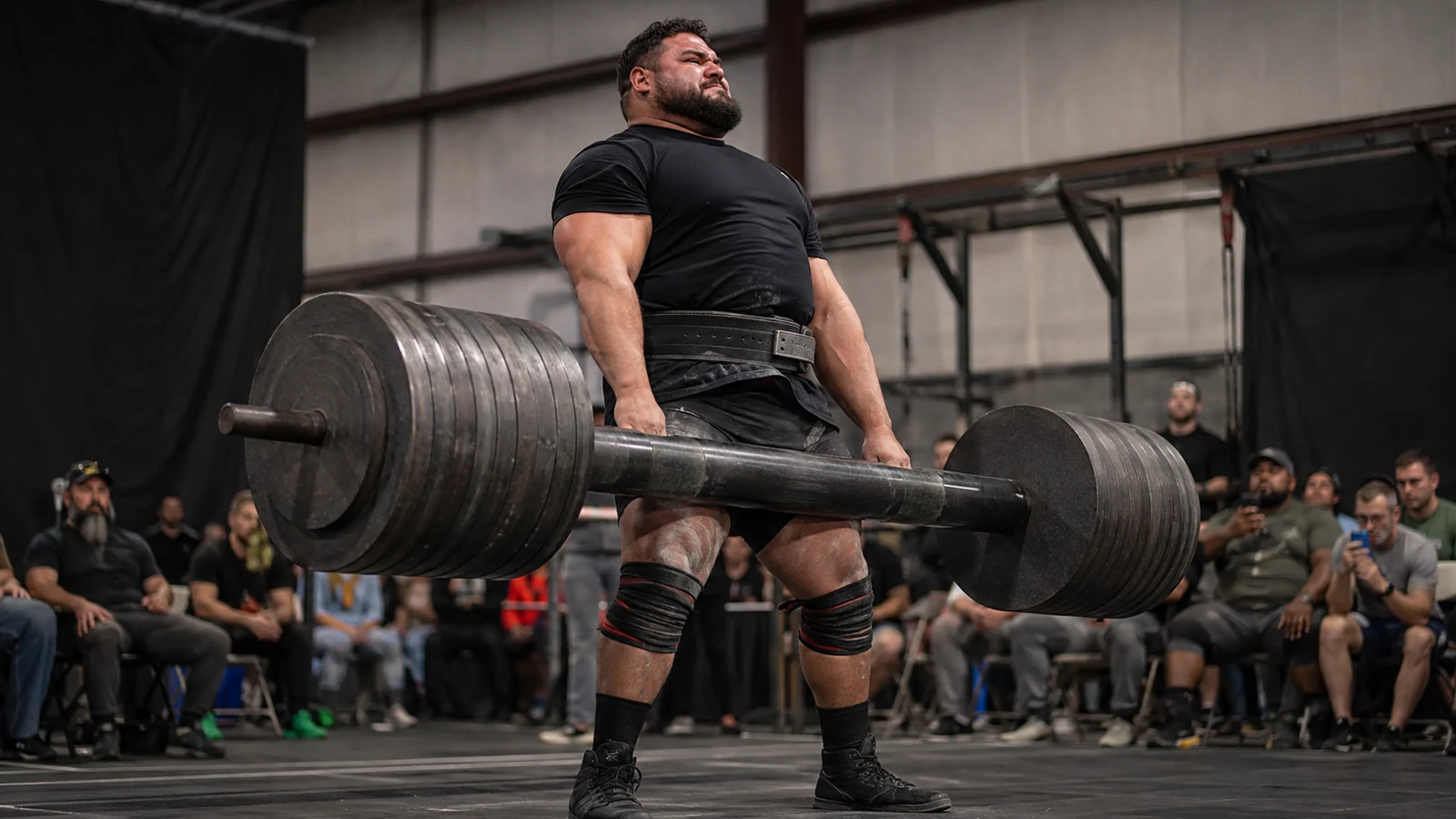

Gabriel Peña pulled 500 kilograms off the floor in October 2021, on a bar that does not spin.
That converts to 1,102.31 pounds.
It stands as the world record for the axle deadlift, a strongman lift built around one of the toughest bars in the sport.
Most heavy deadlift stories are really about the number.
This one is really about the bar.
An axle bar looks like a barbell from across a gym floor, but it behaves nothing like one once a lifter’s hands close around it.
Understanding why turns this from a headline number into something worth learning from, whether or not you will ever load a bar anywhere near 500 kilograms.
What Actually Happened at Static Monsters
Peña set the record at the 2021 Static Monsters Worldwide competition, held on October 23, 2021, in Harker Heights, Texas.
Fitness Volt covered the lift directly, reporting the exact weight, the event, and the date.
Peña completed the pull wearing wrist wraps, a lifting belt, and knee wraps, standard supportive gear in strongman competition.
He did not use a hitch, a technique some competitions allow in which a lifter bounces the bar off the thighs partway through the pull.
Pulling 500 kilograms in one continuous motion, without that assist, is part of why the lift drew so much attention inside the strongman community.
The lift did not come out of nowhere.
Peña had been building toward it for most of a year.
In January 2021 he pulled 481 kilograms in a partial axle deadlift off 18 inch blocks.
In June 2021 he deadlifted 900 pounds for three reps specifically to prepare for a heavier single attempt.
By October, that preparation turned into a full world record pull.
Why an Axle Bar Is a Completely Different Test
A standard Olympic barbell is roughly one inch thick where the hands grip it, and the sleeves on each end spin independently from the bar itself.
An axle bar is thicker, typically closer to two inches in diameter, and it does not spin at all.
Both of those changes matter, and they matter in different ways.
The extra thickness alone makes a hard grip harder, because fingers that would normally wrap most of the way around a barbell can only get partway around an axle.
The lack of spin removes a mechanism lifters rely on without ever thinking about it.
On a normal barbell, the sleeves rotate slightly as the bar rolls in the hands during a heavy pull, which bleeds off some twisting force before it ever reaches the fingers.
An axle bar has no sleeves that spin that way.
Every bit of torque the bar creates travels straight into the hands and forearms instead.
That is why strongman competitors often describe an axle deadlift as feeling far heavier than the number on the bar suggests, even at loads well below their best barbell pull.
An axle bar does not get harder to lift because of a rule written somewhere. It gets harder because a hand can only close so far around it.
The Grip Science Behind the Extra Difficulty
The idea that bar thickness changes how much force a hand can produce is not just competitor folklore.
It has been measured directly, in a laboratory rather than a gym.
A 2005 study in the International Journal of Industrial Ergonomics tested how much grip force people could produce on cylindrical handles of different diameters (Kong & Lowe, 2005).
The researchers found that grip force output changes meaningfully as handle diameter moves away from a person’s own optimal range, and that thicker handles generally demand more of the hand within the diameters they tested.
A standard barbell sits close to the diameter that tends to let most adult hands produce their strongest grip.
A roughly two inch axle bar sits well outside that range.
A follow-up study from some of the same researchers looked at what happens inside the forearm during repeated gripping on handles of different thicknesses (McGorry et al., 2009).
They tracked oxygenation in the forearm muscles during a repetitive power grip task.
Handle diameter changed how hard those muscles had to work to produce the same output.
Applied to a deadlift, the practical version of both findings is simple.
The same 500 kilograms asks far more of the forearms on an axle bar than it does on a standard barbell, before a lifter’s back, hips, or legs even factor in.
Was Peña Really the First to 1,102 Pounds?
Fitness Volt’s own coverage describes Peña as the first strongman to complete a 500 kilogram axle deadlift, and that claim is worth checking carefully rather than repeating on faith.
It holds up, with one important caveat.
There is no single governing body that certifies axle deadlift world records the way a national federation certifies a powerlifting total.
Strongman runs through multiple competing promotions, so an “axle deadlift world record” is really a claim tracked by strongman media consensus and competitor self-reporting, through outlets like Fitness Volt and BarBend, rather than one official record book.
That is a meaningfully different kind of verification than a Guinness World Record or an IPF powerlifting record, and it is worth being upfront about that difference.
It also matters which version of the axle deadlift a record refers to.
Some grip-focused competitions run a stricter, strap-free axle deadlift meant to test pure hand strength rather than total pulling strength.
Public deadlift record tracking lists a separate men’s mark in that strap-free category at 240 kilograms, about 529 pounds, roughly half of Peña’s total.
That gap is not a contradiction.
It shows how much of an axle deadlift’s difficulty comes from grip alone once straps are taken out of the equation entirely.
Peña’s 500 kilogram pull was performed with wrist wraps, which support the wrist joint, not straps, which would have taken most of the grip demand out of the lift.
Within that context, the claim that he was the first strongman to pull 500 kilograms on an axle bar is consistent with everything Fitness Volt and the wider strongman press reported at the time.
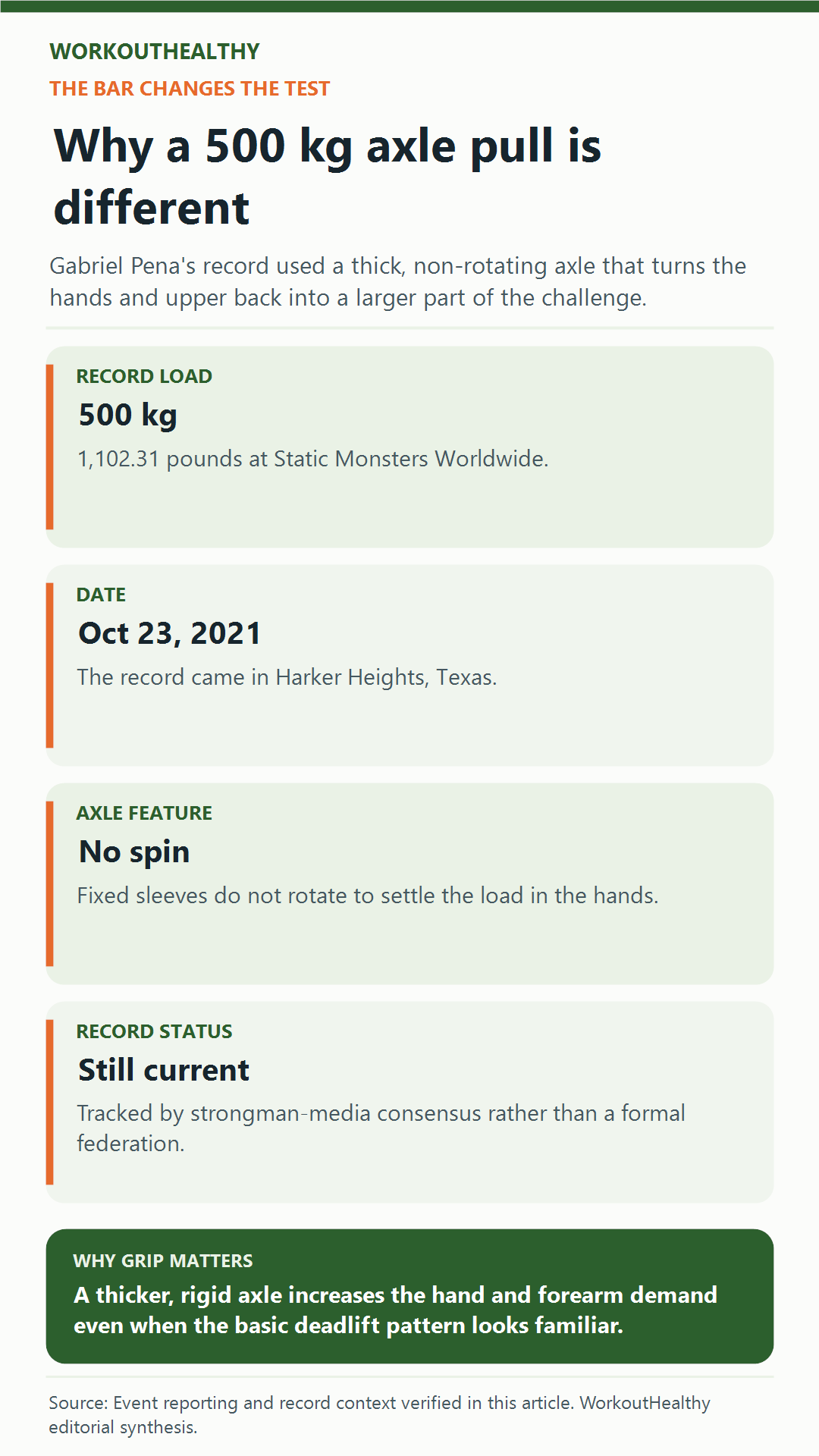
A record with no single official book to check is still a record. It just has to be checked against the actual reporting instead of taken on faith.
Has Anyone Come Close Since 2021?
A claim like “world record” is only useful if it is still current, so it is worth checking whether anyone has topped Peña’s mark in the years since.
Strongman press coverage of axle deadlifts since October 2021 has tracked several notable lifts, and none of them approach 500 kilograms.
Tom Stoltman pulled 340 kilograms for ten reps on an axle bar in February 2022, an impressive display of repeated strength rather than a single heavy attempt.
On the women’s side, Rhianon Lovelace set a 261.5 kilogram axle deadlift world record in September 2022.
Rebecca Roberts followed with two reps at 270 kilograms in September 2023, a new women’s mark at the time.
Both of those are remarkable lifts in their own right.
Both also remain well under half of Peña’s total.
Based on the most recent strongman press coverage available, Peña’s 500 kilogram axle deadlift has not been matched or broken since he set it in 2021.
Who Is Gabriel Peña, the “Texas Titan”?
Peña competes under the nickname “Texas Titan,” a name that shows up directly in his own Instagram handle.
It fits both his home state and the size of the numbers he puts up.
His competitive history stretches back well before the 2021 record.
In November 2020 he pulled 520 kilograms, about 1,145 pounds, off 18 inch blocks, a partial range deadlift used to build strength through the top portion of the lift.
That came shortly after he withdrew from the 2020 World’s Strongest Man.
The following month, he posted a 1,000 pound deadlift for a new personal record.
Through 2021 and 2022 he kept competing at a high level in professional strongman, including a joint deadlift training session with fellow competitor Brian Shaw ahead of the 2022 World’s Strongest Man.
That kind of steady, multi-year progression matters for how a record like this should be read.
A 500 kilogram axle deadlift was not a single lucky pull.
It was the product of years spent building the specific kind of grip and back strength a bar like this demands.
What This Kind of Grip Strength Actually Builds
Grip strength is not just a party trick for strongman athletes.
Researchers studying novice strongman competitors have looked directly at how different strength qualities relate to performance across strongman-specific events, including the pulling and carrying movements where grip plays a direct role (Winwood et al., 2012).
That kind of research reflects something coaches in the sport already treat as obvious.
An event like the farmer’s walk, the axle deadlift, or a heavy carry is rarely limited by how strong a competitor’s back or legs are.
It is limited by how long the hands can hold on.
That is also why axle work shows up in general strength programming, not just strongman training.
A lifter who can barely hold onto a thick bar for a set of deadlifts will eventually find that grip becomes the ceiling on pulling exercises generally, including a standard barbell deadlift or a heavy row.
Our comparison of the floor press and the bench press covers a similar idea on the pressing side, where one equipment change shifts which muscles actually limit the lift.
What This Record Doesn’t Prove
A 500 kilogram axle deadlift proves that Gabriel Peña, on one specific day, pulled that weight under strongman competition rules.
It does not prove that axle training is required for general strength gains, or that most lifters need anything close to a two inch bar in their own training.
It also does not prove that thick bar work is automatically safe at any load.
A grip that fails mid-pull on a heavy deadlift can drop a loaded bar suddenly, which is a real injury risk if a lifter is not prepared for that possibility.
Beginners sometimes assume that switching to a thick bar or a set of grip-training attachments means they should load it the same way they would load a normal barbell.
That is one of the most common mistakes with thick bar training.
The weight needs to come down substantially when the grip demand goes up, at least until grip strength catches up to the rest of the lift.
How to Train Grip Like This Safely
Nobody needs to chase 1,102 pounds to benefit from what made this lift possible.
For most lifters, thick bar training starts small, not with a full axle bar at all.
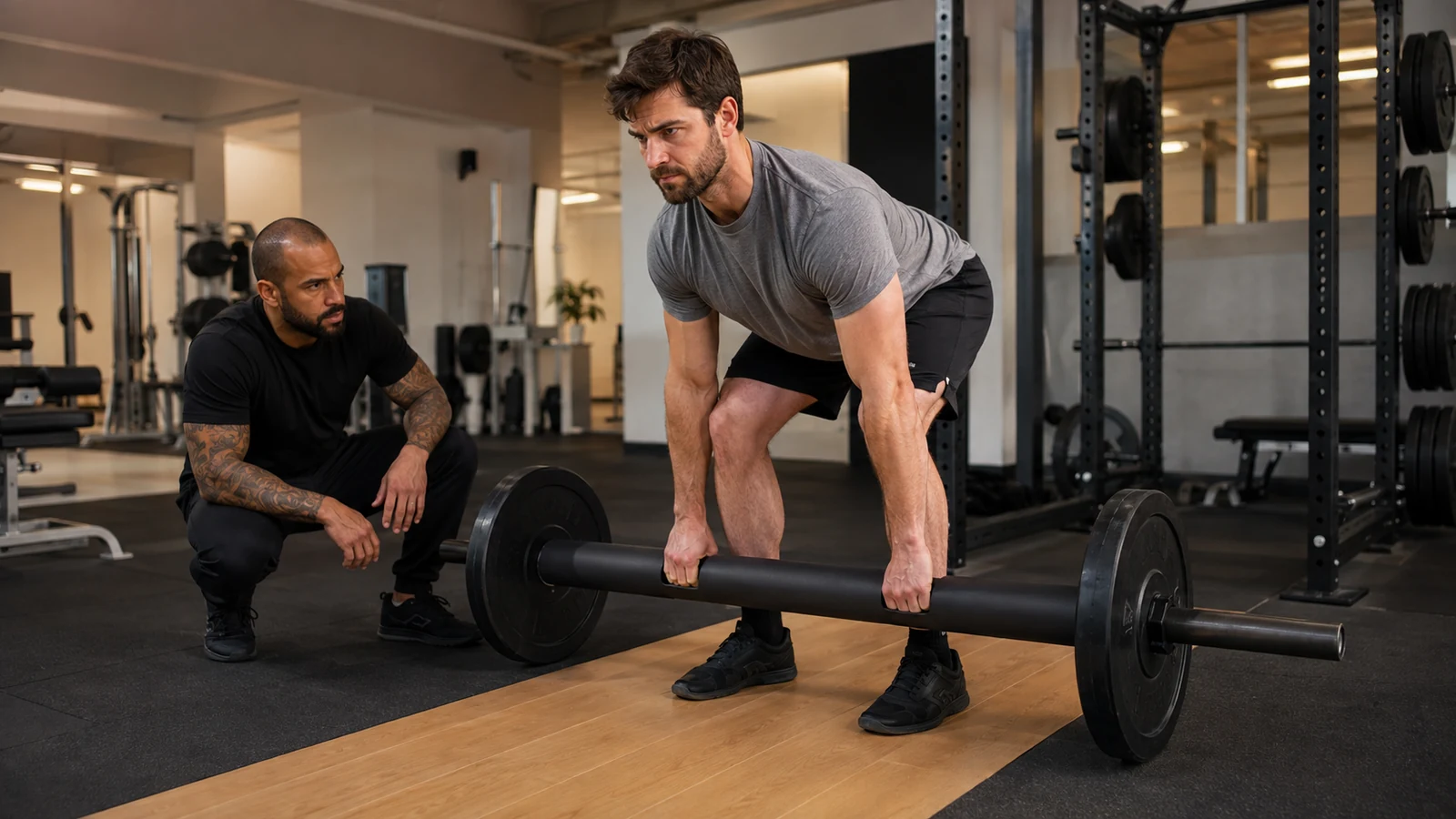
Fat grip attachments that slide over a standard barbell are a common, lower-risk starting point, since they add diameter without changing the total working weight by much.
Farmer’s walks with thick-handled implements build the same kind of grip endurance in a lower-risk, less technical setting than a maximal deadlift attempt.
Dead hangs from a thick bar, or a towel looped over a pull-up bar, train the same support grip without any spinal loading at all.
Progression should be slow and deliberate.
A reasonable approach is to keep the working weight well below a lifter’s normal deadlift for the first several weeks.
Add load only after grip stops being the obvious limiting factor in the set.
Anyone with a history of wrist, elbow, or hand injuries should talk to a doctor or physical therapist before adding heavy thick bar work, since the extra grip demand concentrates stress in those joints specifically.
The same caution applies to anyone currently managing arthritis or a prior tendon injury in the forearm or hand.
For a broader look at how record-setting athletes build the base for one big number, DonnaJean Wilde’s push-up world record shows a similar pattern of one training block quietly building the base for the next.
And for another example of how WorkoutHealthy checks a record claim against the available evidence before repeating it, see Edith Connor’s Guinness World Record for oldest female bodybuilder.
Watch the Original Lift
Want more record-verified strength stories like this one? Subscribe to WorkoutHealthy Insider for practical explanations behind popular fitness claims.
References
Kong, Y.-K., & Lowe, B. D. (2005). Optimal cylindrical handle diameter for grip force tasks. International Journal of Industrial Ergonomics, 35(6), 495-507. https://doi.org/10.1016/j.ergon.2004.11.003
McGorry, R. W., Maikala, R. V., Lin, J.-H., & Rivard, A. (2009). Oxygenation kinetics of forearm muscles as a function of handle diameter during a repetitive power grip force task. International Journal of Industrial Ergonomics, 39(2), 465-470. https://doi.org/10.1016/j.ergon.2008.10.014
Winwood, P. W., Keogh, J. W. L., & Harris, N. K. (2012). Interrelationships between strength, anthropometrics, and strongman performance in novice strongman athletes. Journal of Strength and Conditioning Research, 26(2), 513-522. https://doi.org/10.1519/JSC.0b013e318220db1a
This article is for general information only and is not medical advice. If you have an injury, ongoing pain, or a medical condition, talk to a doctor or physical therapist before you change how you train or eat.