
Bad Bunny spent February 8, 2026 doing something no solo Latino artist had ever done before.
He headlined the Super Bowl LX halftime show.
The performance drew roughly 128 million viewers, making it one of the most watched halftime shows in Super Bowl history.
It was also the first Super Bowl halftime show performed mostly in Spanish.
The choice of headliner drew plenty of attention before the show ever happened.
Bad Bunny called accepting the slot a form of protest, a way to celebrate Puerto Rican culture on one of the world’s biggest stages.
The show itself leaned into that message, built around Puerto Rican identity from start to finish.
Before any of that happened on stage, there is a smaller story about how he found out he had been chosen.
The Pull-Up Story
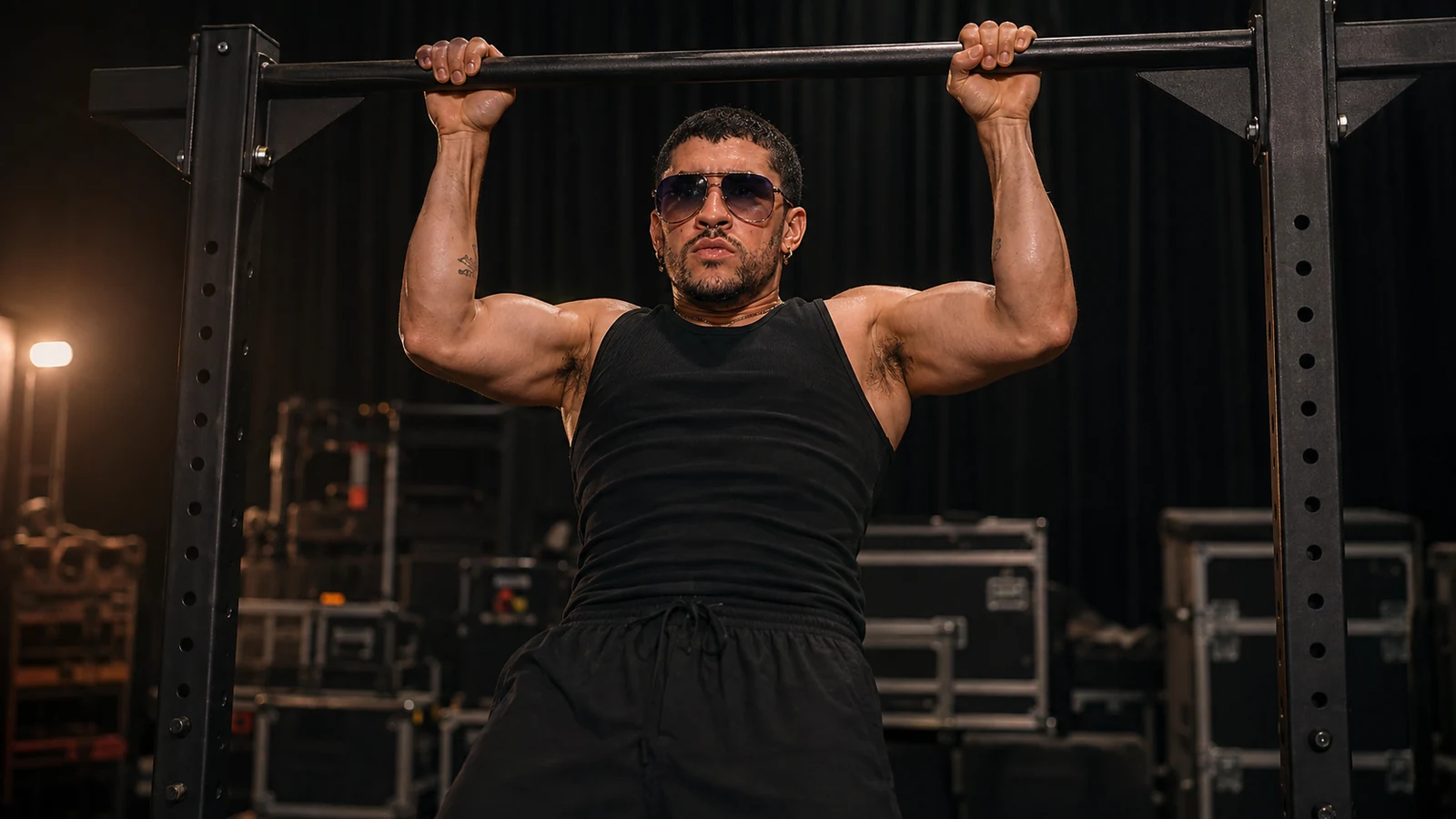
According to celebrity fitness reporting, Bad Bunny learned he had been chosen for the halftime show in the middle of a workout.
He has been described as reacting to the news by dropping into a set of pull-ups on the spot.
The number attached to that anecdote is 100 pull-ups, done right after the call.
That specific detail comes from celebrity fitness coverage rather than a source this article could independently confirm line by line.
What is well documented is the outcome it points to.
He did headline the Super Bowl.
He did become the first solo Latino artist to do it.
Whatever happened in that gym that day, it sits inside a much bigger, well confirmed story about a demanding year of preparation.
What Headlining a Super Bowl Actually Demands
A Super Bowl halftime show runs about 13 minutes.
Inside that window, an artist typically performs several songs back to back with almost no break.
Bad Bunny’s performance leaned on Puerto Rican cultural identity and heavy choreography, built for a stage seen by well over 100 million people at once.
That kind of set is physically closer to a short, maximal effort than to a relaxed concert.
It asks for full energy in short, repeated bursts, with almost no recovery time between them.
Reports have also pointed to a leaner physique and a more consistent training routine in recent years.
A stadium tour with high energy choreography, night after night, does not happen by accident.
It takes months of conditioning built up long before the first show.
Bad Bunny has built a career on exactly that kind of demanding touring schedule.
His world tours have sold out stadiums across multiple countries, often with dozens of dates back to back.
Each of those shows runs well over two hours, with dancing, choreography, and constant movement across a large stage.
A single high energy performance is demanding.
Doing that dozens of nights in a row, on a tight travel schedule, is a very different kind of physical test.
His Own Words
Bad Bunny has framed his choice to headline the show as more than a performance opportunity.
He has described accepting the slot as a statement, a way to represent Puerto Rican identity and culture on one of the largest stages in the world.
That framing matters for understanding the physical side too.
A performer carrying that much meaning into 13 minutes on stage is not just executing choreography.
He is performing under real pressure, in front of a global audience, while his body works close to its physical limit.
A workout interrupted by big news is a small moment. The training that comes before a stadium tour is the much bigger story.
What the Science Says About Bursts of Effort Under Excitement
There is a real physiological reason sudden excitement can trigger a burst of physical output.
A widely cited review in Nature Reviews Endocrinology described how the body’s stress response system works (Chrousos, 2009).
Big news, good or bad, activates the same basic pathway.
Adrenaline rises quickly, heart rate climbs, and muscles get a fast supply of glucose for energy.
That is the same system that makes a jump of joy or a sudden burst of energy feel almost automatic.
It does not require a conscious decision to “work out harder.”
The body is already primed for a short, intense physical response.
A spontaneous set of pull-ups after big news fits that pattern well, whether or not the exact number is confirmed.
Why Pull-Ups Are a Meaningful Benchmark
Pull-ups are not just a party trick.
A study using surface electromyography, a way of measuring muscle activation directly, compared several pull-up variations (Youdas et al., 2010).
It found that a standard pull-up strongly activates the muscles of the back, the arms, and the core all at once.
Very few single exercises recruit that much upper body muscle in one movement.
That is part of why coaches use pull-up numbers as a rough marker of upper body strength and endurance.
Being able to do a large number of them in a row also requires real cardiovascular conditioning, not just arm strength.
The muscles have to keep working under fatigue, which is a demand that echoes what a high energy stage show requires too.
How Interval Style Training Supports a Touring Schedule
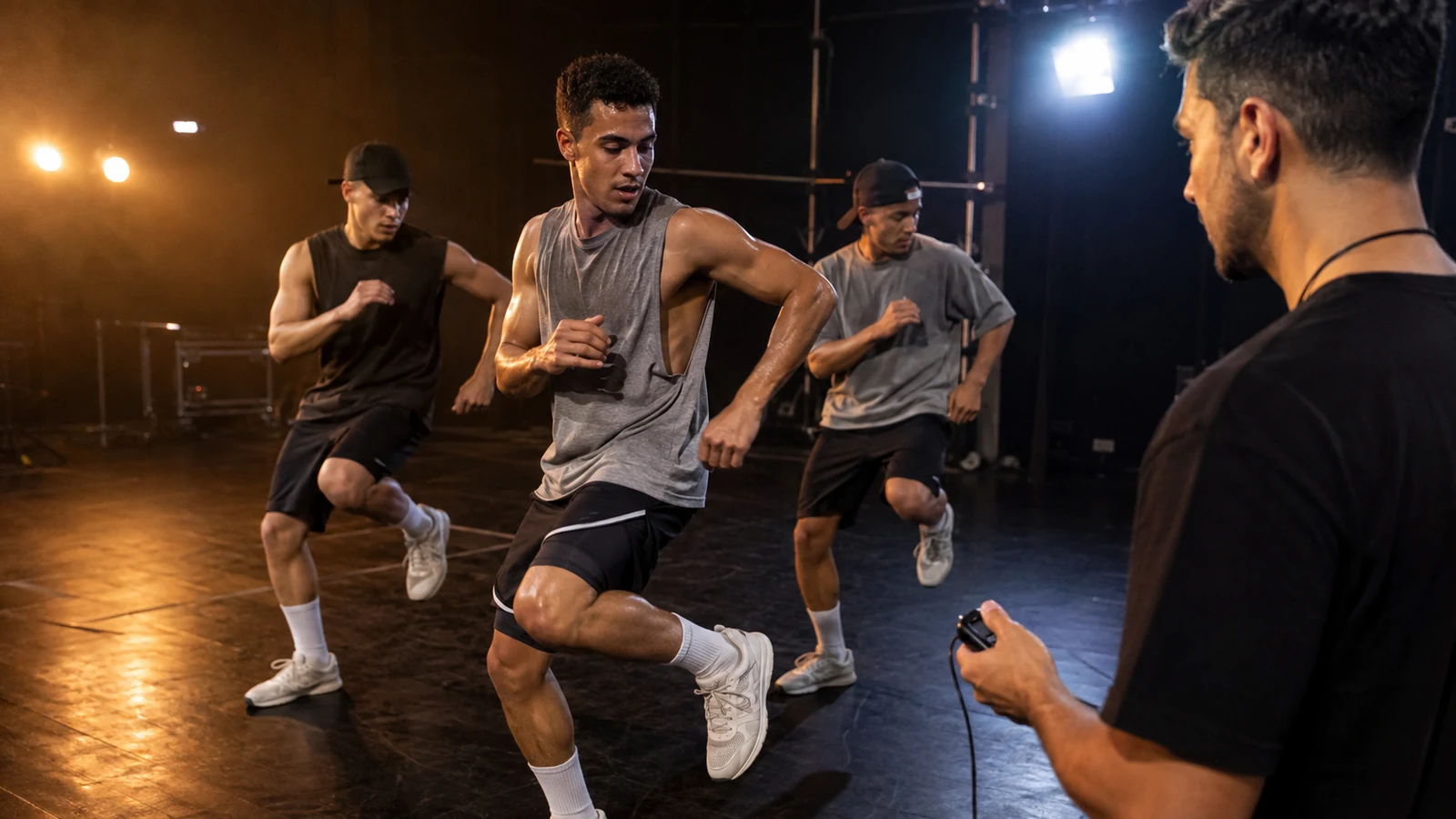
Touring artists face something similar to interval athletes.
Short, intense output on stage is followed by travel, rehearsal, and recovery, then another intense show.
Research on low volume, high intensity interval training has found it can build many of the same cardiovascular and metabolic benefits as longer, steadier workouts (Gibala et al., 2012).
It does this in less time, which matters for anyone with a packed tour schedule.
That kind of training builds the specific ability to recover fast between hard efforts.
That is exactly what a multi hour concert, or a tightly choreographed halftime show, actually demands from a performer’s body.
What This Evidence Does Not Prove
None of the research above was done on touring musicians specifically.
It comes from exercise physiology and combines with reasonable inference, not a direct study of Bad Bunny’s training log.
The exact “100 pull-ups” detail also remains an unconfirmed anecdote from celebrity fitness reporting, not a verified fact.
It is presented here as a widely reported story, not as something this article independently confirmed.
The broader picture, that touring at this level demands serious physical conditioning, is well supported by what is publicly known about his schedule and performances.
How This Compares to General Fitness Guidance
Most adults are not training for a stadium tour or a Super Bowl halftime show.
General fitness guidelines call for a mix of moderate cardio, strength training, and rest, not daily maximal output.
Bad Bunny’s training, at the level implied by his performance schedule, is built for a specific, demanding professional goal.
That does not make it a template for someone with a desk job and a normal week.
What does translate well is the underlying principle behind it.
Short, hard effort followed by real recovery builds real fitness, at almost any level of intensity.
Common Mistakes People Make Chasing This Kind of Fitness
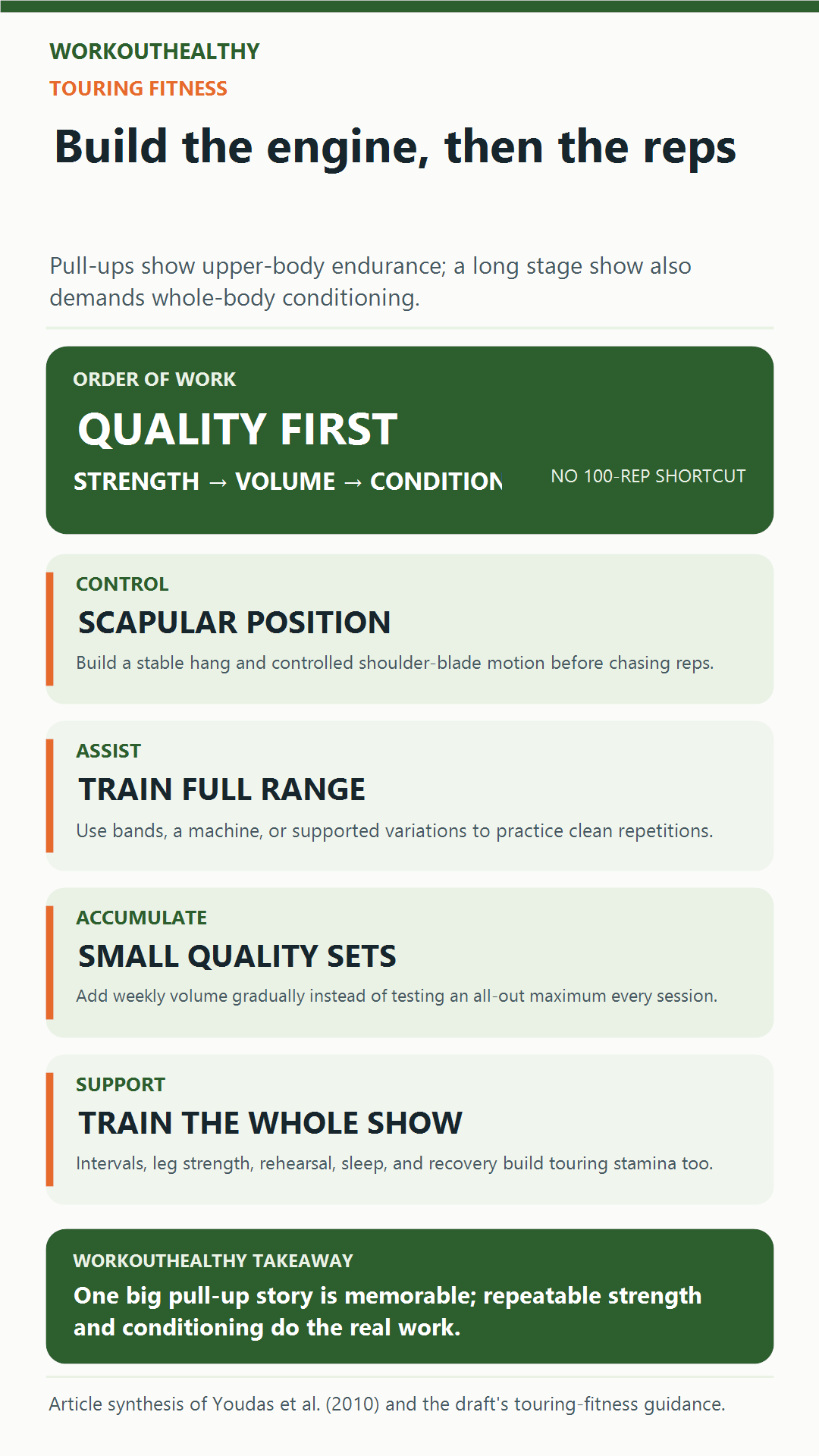
A common mistake is trying to jump straight to a high pull-up number without building a base first.
Pull-ups are demanding, and going from zero to dozens overnight is not realistic or safe.
Another mistake is copying the intensity of a professional performer’s schedule without any of the recovery support that comes with it.
Professional touring artists usually have trainers, physical therapists, and structured rest built into their schedule.
Skipping warmups before high intensity bursts is another frequent error, since cold muscles are more prone to strain.
Chasing a viral number, like a specific pull-up count, can also distract from building genuine, well rounded strength.
How to Build Toward More Pull-Ups Safely
Start by testing your current max with strict form, no kipping or swinging.
If a full pull-up is not yet possible, banded pull-ups or a lat pulldown machine build the same muscles.
Add pull-up focused training two to three times a week, not every day.
The back and arm muscles need real recovery time between sessions.
Mix in negative pull-ups, where you jump to the top position and lower slowly, to build strength through the full range.
Track your numbers over weeks, not single sessions.
Progress on pull-ups is usually slow and steady, not sudden.
Pair pull-up training with general conditioning work, since grip and shoulder fatigue often show up before back strength runs out.
A dead hang, simply holding the top or bottom position of a pull-up, is a useful building block on its own.
It builds grip and shoulder strength without demanding a full repetition yet.
Warm up the shoulders and upper back before any pull-up focused session.
Cold shoulder joints are more likely to get irritated under this kind of repeated overhead load.
If shoulder or elbow pain shows up during training, stop and rest rather than pushing through it.
Pull-ups show up in more than one celebrity fitness routine.
Vanna White’s fitness routine leans on pull-ups too.
Building real stamina for a live show takes real cardio conditioning.
Jump rope training is one efficient way to build that stamina.
References
- Chrousos, G. P. (2009). Stress and disorders of the stress system. Nature Reviews Endocrinology, 5(7), 374-381. https://doi.org/10.1038/nrendo.2009.106
- Youdas, J. W., Amundson, C. L., Cicero, K. S., Hahn, J. J., Harezlak, D. T., & Hollman, J. H. (2010). Surface electromyographic activation patterns and elbow joint motion during a pull-up, chin-up, or Perfect-Pullup rotational exercise. Journal of Strength and Conditioning Research, 24(12), 3404-3414. https://doi.org/10.1519/JSC.0b013e3181f1598c
- Gibala, M. J., Little, J. P., MacDonald, M. J., & Hawley, J. A. (2012). Physiological adaptations to low-volume, high-intensity interval training in health and disease. The Journal of Physiology, 590(5), 1077-1084. https://doi.org/10.1113/jphysiol.2011.224725
This article is for general educational purposes only.
It is not a substitute for individualized coaching or medical advice.
Talk to a doctor before starting a new high intensity exercise program, especially if you have a history of joint or heart problems.