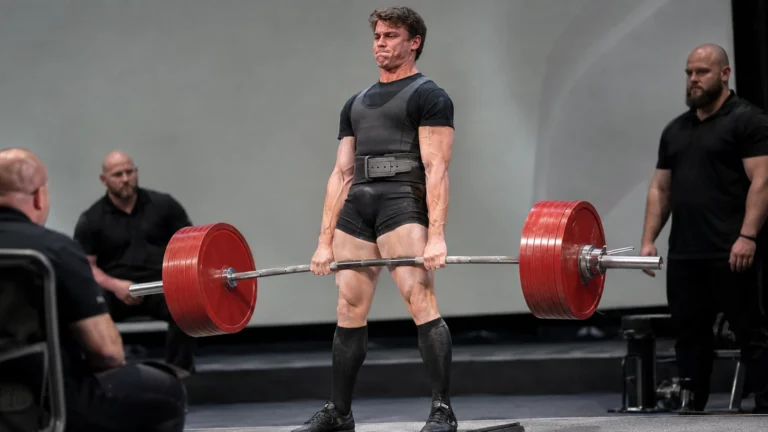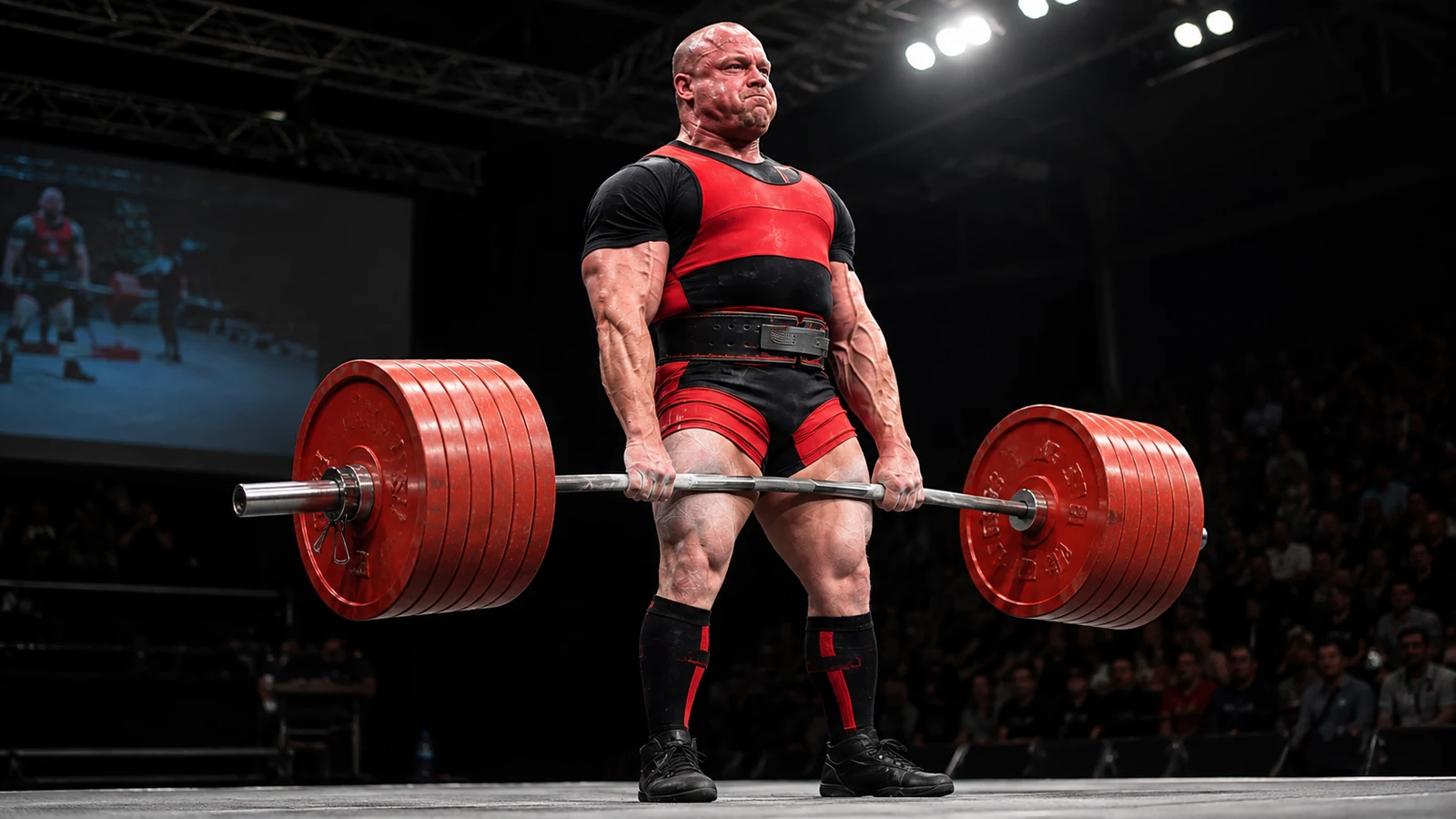

In November 2014, a Norwegian lifter named Carl Yngvar Christensen walked up to a barbell loaded to 390 kilograms inside a convention center in Aurora, Colorado.
That works out to 859.80 pounds.
He pulled it to full lockout at the 2014 IPF World Championships, wearing a single-ply deadlift suit in the Men’s Open division.
It stands as one of the heaviest equipped deadlifts the International Powerlifting Federation has ever recorded in competition.
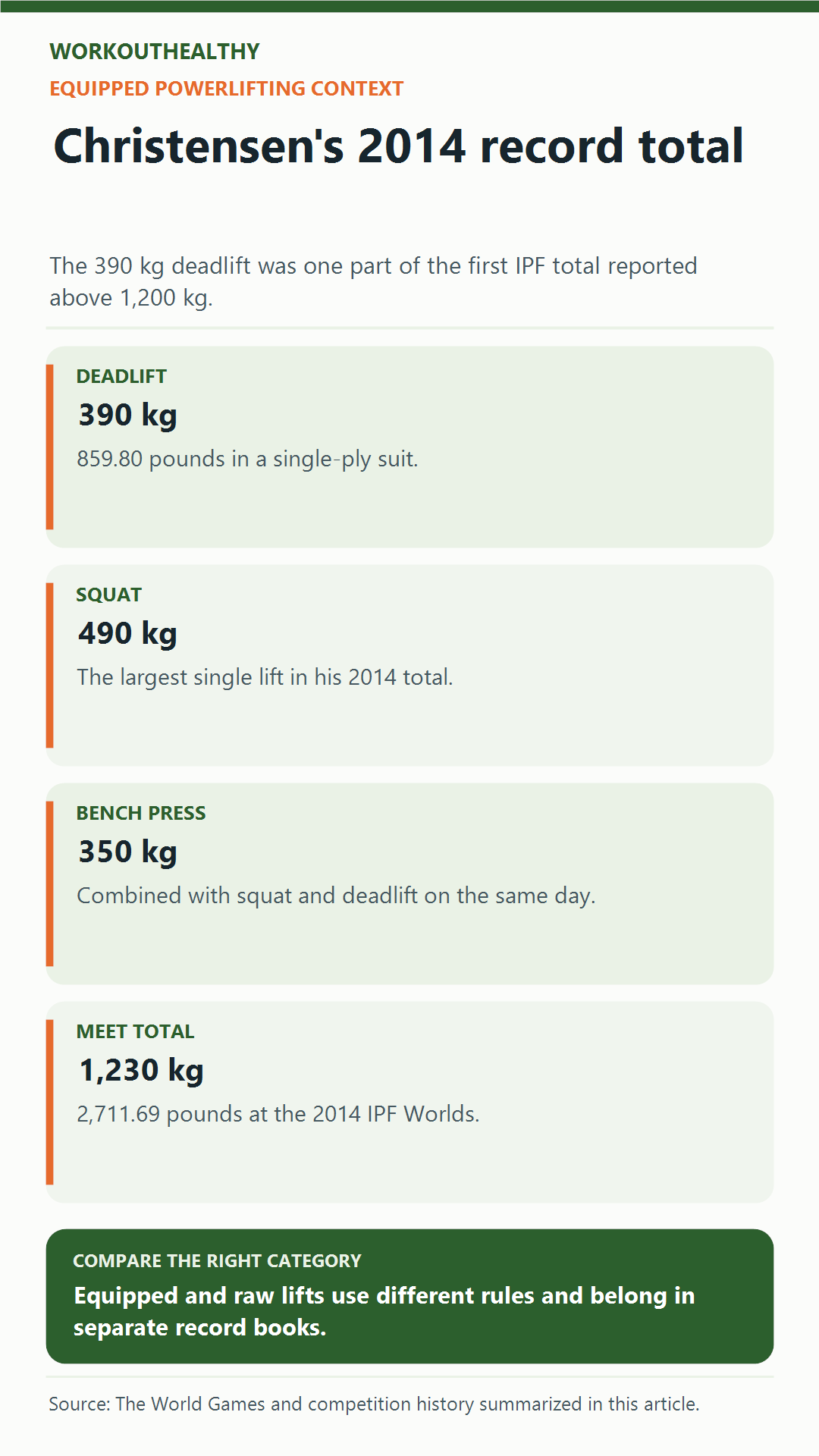
The deadlift was only part of the story that day. Christensen paired it with a 490 kilogram squat and a 350 kilogram bench press.
The result was a 1,230 kilogram total, worth roughly 2,711.69 pounds.
According to The World Games, which named Christensen its Athlete of the Month that November, it made him the first lifter in International Powerlifting Federation history to total more than 1,200 kilograms in a single sanctioned meet (The World Games, 2014).
This article breaks down what actually happened at that meet, what “equipped” powerlifting means for readers who have only ever seen raw lifting, and whether Christensen’s pull still holds up as one of the heaviest more than a decade later.
What Actually Happened in Aurora, Colorado
The 2014 IPF World Championships in Powerlifting took place in Aurora, Colorado, in November of that year.
Christensen competed in the super heavyweight class, the 120-plus kilogram division, in the Men’s Open category.
Open, in powerlifting, does not mean unequipped or unrestricted in weight lifted.
It refers to the age and experience division that includes adult lifters at their competitive peak, as opposed to junior, sub-junior, or masters divisions.
Records from his competition history show the same numbers The World Games reported: a 490 kilogram squat, a 350 kilogram bench press, and a 390 kilogram deadlift, all performed in single-ply equipment.
Those three lifts added up to a 1,230 kilogram total, which The World Games credited as a new world record total at the time.
Christensen was 24 years old that year, already a multiple time World, European, and Junior champion heading into the meet.
What “Equipped” Powerlifting Actually Means
Most fitness content online, including plenty of what WorkoutHealthy Insider has covered, focuses on raw lifting.
Raw powerlifting allows a lifter to use a belt, knee sleeves or wraps, and wrist wraps, but nothing that meaningfully changes how the bar moves.
Equipped powerlifting adds supportive garments that the federation approves for competition.
The IPF permits single-ply gear, which means a single layer of thick, tightly stitched fabric built into a squat suit, a bench shirt, and often a separate deadlift suit.
These suits are not loose clothing.
A lifter has to work their way into one, often with help from training partners, because the fit is deliberately tight through the hips, thighs, and lower back.
That tightness is the entire point.
The suit stores elastic energy as the lifter descends into a squat or bends into the starting position of a deadlift, then releases some of that energy back as the lifter drives up.
It also adds passive support around joints that would otherwise rely entirely on the lifter’s own muscles and connective tissue to stay stable under maximum load.
Equipped gear supports the hips and back off the floor, which lets elite lifters chase numbers raw pulling cannot reach.
That line, taken from how this lift has been described to fans, captures the basic idea correctly.
The suit does not lift the bar for the athlete.
It changes the leverage and support around the joints enough that a well trained lifter can move more weight than they could without it.
How a Single-Ply Suit Changes the Lift
The clearest research on this comes from squat studies using knee wraps, a smaller and simpler piece of supportive equipment than a full suit.
A 2012 study in the Journal of Strength and Conditioning Research had trained lifters perform back squats with and without knee wraps.
Wearing the wraps measurably increased peak force, peak power, and bar velocity compared to the same lift performed without them (Lake et al., 2012).
The wraps did this by storing energy at the bottom of the squat and returning it during the ascent, in a way similar to a very stiff, form fitting spring wrapped around the joint.
A full single-ply suit works on a larger scale.
It wraps the hips, glutes, and lower back rather than just the knees, and it is built from thicker, less forgiving material.
For a deadlift specifically, that support matters most in the first few inches off the floor, which is typically the hardest part of the lift for most lifters to complete.
A suit built for deadlifting compresses the hips into a position that helps a lifter maintain a strong starting angle, and it resists stretching as the lifter pulls, which returns some of that stored tension back into the pull.
This is also why equipped and raw numbers should never be compared directly.
A raw deadlift world record and an equipped deadlift world record are answering two different questions about human strength, not the same question with different gear.
Research on how squat, bench, and deadlift each contribute to a competitive total has found that this balance shifts once a lifter moves from classic to equipped competition.
Supportive gear tends to add more percentage strength to the squat and the bench than it adds to the deadlift (Hernández Ugalde, 2023).
That pattern shows up in Christensen’s own numbers.
His squat and bench combined for 840 kilograms, while his deadlift, the lift equipment tends to help the least, still had to carry 390 of the 1,230 kilogram total on its own.
Open Division, No Weight Class Ceiling
The 120-plus kilogram class Christensen competed in is sometimes called super heavyweight.
It is an open ended weight class.
There is no upper bodyweight limit, unlike every lighter class below it, which caps how much a competitor can weigh and still qualify.
That distinction matters for a specific reason.
A weight class record only compares lifters within a narrow bodyweight band, so a record in the 74 kilogram class says something different than a record in the 120-plus kilogram class.
An open class record, by contrast, is really a contest for the single heaviest lift regardless of bodyweight, which is part of why super heavyweight totals tend to produce the biggest raw numbers in the sport.
It does not automatically mean the strongest lifter pound for pound.
Federations also use bodyweight adjusted scoring systems, commonly Wilks or newer formulas, to compare lifters of different sizes fairly.
The World Games’ own profile of Christensen credited him with the highest Wilks score in IPF history at the time of that meet (The World Games, 2014).
WorkoutHealthy Insider could not independently confirm that specific superlative still holds today, since scoring formulas and record books have both changed since 2014, and readers should treat it as accurate for that moment rather than a permanent claim.
The Total That Made IPF History
A 1,230 kilogram total across squat, bench, and deadlift is difficult to picture in everyday terms.
It is roughly the combined weight of two adult grizzly bears, moved through three separate maximal lifts in the space of a single competition day.
The World Games credited Christensen as the first IPF competitor to break 1,200 kilograms in a sanctioned total, calling his total a new world record at the time (The World Games, 2014).
Breaking a round number barrier like that tends to matter more symbolically than mechanically. There is nothing special about 1,200 kilograms as a physical threshold.
What made it significant was that no one in the federation’s competitive history, across every weight class and every meet, had assembled all three lifts at that combined level before.
His bench press alone, at 350 kilograms, deserves a mention here too.
Readers curious about how equipment and even bar path change a press can see a related breakdown in Floor Press vs Bench Press: What Actually Changes, which covers how removing the bench changes leverage in a related pressing movement.
Does This Record Still Stand Today?
The most accurate way to describe this lift is “among the heaviest” IPF equipped pulls in history, not outright the single heaviest ever recorded.
That hedge holds up under closer research.
Equipped powerlifting today is a smaller, less publicized branch of the sport than raw lifting, and public tracking of equipped records is far less centralized than it is for raw lifts.
Searches of publicly available competition databases, including OpenPowerlifting’s archive of Christensen’s own results, did not surface a heavier IPF-sanctioned single-ply deadlift in the men’s open super heavyweight class after 2014.
That absence is not the same as proof.
It is possible a heavier equipped pull happened in a meet that is harder to find in public records, and WorkoutHealthy Insider could not rule that out with certainty.
What can be said with confidence is narrower and still notable.
More than a decade later, a 390 kilogram single-ply deadlift remains an extremely rare feat in IPF competition, and few equipped lifters have matched it since.
Readers should treat “heaviest ever” claims about equipped lifting the way they would treat any record without a single certifying body tracking every meet worldwide.
That is different from how a body like Guinness World Records handles a single specific feat.
Our earlier piece on Edith Connor’s Guinness record for oldest female bodybuilder shows what that kind of formal, single-feat certification looks like by comparison.
Norway’s Long History in Strength Sports
Christensen’s pull did not come out of nowhere.
Norway has produced a disproportionate number of elite strength athletes relative to its population of about 5.5 million people.
The country’s strongman and powerlifting scene has a long, active competitive tradition, with well established federations and a culture that treats heavy training as a mainstream pursuit rather than a fringe hobby.
Christensen himself came up through junior and sub-junior competition in Norway before reaching the senior international stage, winning multiple national, European, and world titles across his career.
That progression, junior ranks to European titles to a world record total, is the normal path for an elite equipped lifter, and it usually takes close to a decade of consistent competition to complete.
His coaching setup reportedly included a primary and an assistant trainer working with him specifically on squat, bench, and deadlift programming in the run up to the 2014 championships.
That kind of dedicated coaching structure is common at the top of equipped powerlifting, where suit fit, technique with the gear, and raw strength all need separate attention.
What This Means If You Are Not Chasing a World Record
Almost no one reading this will ever wear a competition deadlift suit, and that is completely fine.
The lessons underneath Christensen’s lift still apply to an ordinary training deadlift.
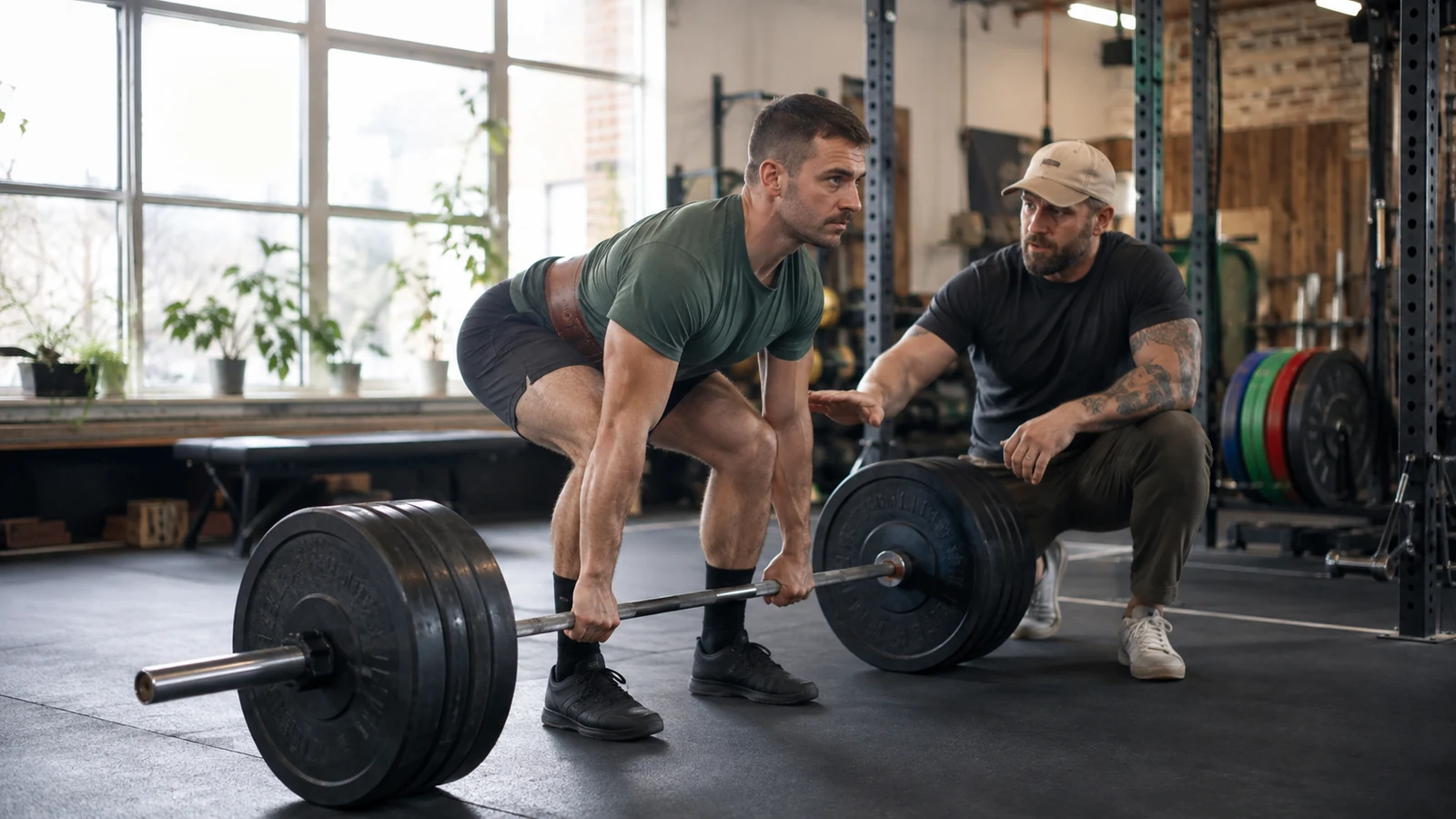
The first few inches off the floor are the hardest part of a deadlift for most lifters, equipped or raw, because that is where the bar is farthest from a strong pulling angle.
Research comparing conventional and sumo deadlift technique found that a conventional pull relies more heavily on the hip extensors and posterior chain through that early phase, while a sumo stance shifts more work toward the front of the leg (Hanen et al., 2025).
That is a useful thing to know if your own deadlift consistently stalls near the floor.
It may be a hip extension and back strength issue rather than a grip or leg drive issue, and the fix is usually more posterior chain work, not just pulling more often.
A weightlifting belt, which almost any raw lifter can use, works on a related principle to a suit, just far less dramatically.
It gives the core something firm to brace against, which can help maintain a stronger spinal position under heavy load.
None of this means gear is required to lift heavy safely.
Christensen’s own early competitions were raw before he moved into equipped lifting as his career progressed, which is the typical order most competitive lifters follow.
Who Should Be Cautious With Heavy Deadlifting
Heavy deadlifting, equipped or raw, puts real load on the lower back, hips, and cardiovascular system, and it is not the right training tool for everyone.
Anyone with a history of disc injuries, uncontrolled high blood pressure, or a recent abdominal or hip surgery should talk to a doctor or physical therapist before attempting maximal or near maximal deadlifts.
New lifters in particular should build up gradually, starting with lighter loads and clean technique long before adding any near maximal attempts.
Straining hard against a heavy bar briefly raises blood pressure, which is a real consideration for anyone managing a cardiovascular condition, even if the activity is otherwise safe for most healthy adults.
Working with a qualified coach matters even more once supportive gear like belts, wraps, or suits enters the picture, since each piece changes how a lift should be cued and executed.
Progress that looks slow and boring on a spreadsheet is still the same progress that eventually produces lifts like Christensen’s.
Records like his are the visible tip of years of unglamorous, consistent training.
Watch the Original Video
Not every fitness world record gets verified and paced out the same way.
For a very different kind of record math, see how we broke down DonnaJean Wilde’s push-up world record, an endurance feat measured by volume in a fixed hour rather than by a single maximal attempt.
Want more verified strength records explained in plain language? Subscribe to WorkoutHealthy Insider for practical explanations behind popular fitness claims.
References
Hanen, N. C., Ben Mansour, K., Ertel, G. N., Duchene, Y., & Gauchard, G. C. (2025). Biomechanical analysis of conventional and sumo deadlift. Frontiers in Bioengineering and Biotechnology, 13, Article 1597209. https://doi.org/10.3389/fbioe.2025.1597209
Hernández Ugalde, J. A. (2023). Powerlifting balance of SBD disciplines (squat, bench press and deadlift) ratio to total score. International Journal of Strength and Conditioning, 3(1). https://doi.org/10.47206/ijsc.v3i1.198
Lake, J. P., Carden, P. J. C., & Shorter, K. A. (2012). Wearing knee wraps affects mechanical output and performance characteristics of back squat exercise. Journal of Strength and Conditioning Research, 26(10), 2844-2849. https://doi.org/10.1519/JSC.0b013e3182429840
The World Games. (2014, November). IWGA Athlete of the Month: November 2014, Carl Yngvar Christensen. https://www.theworldgames.org/news/IWGA-Athlete-of-the-Month-November-2014-1377
This article is for general information only and is not medical advice. If you have an injury, ongoing pain, or a medical condition, talk to a doctor or physical therapist before you change how you train or eat.