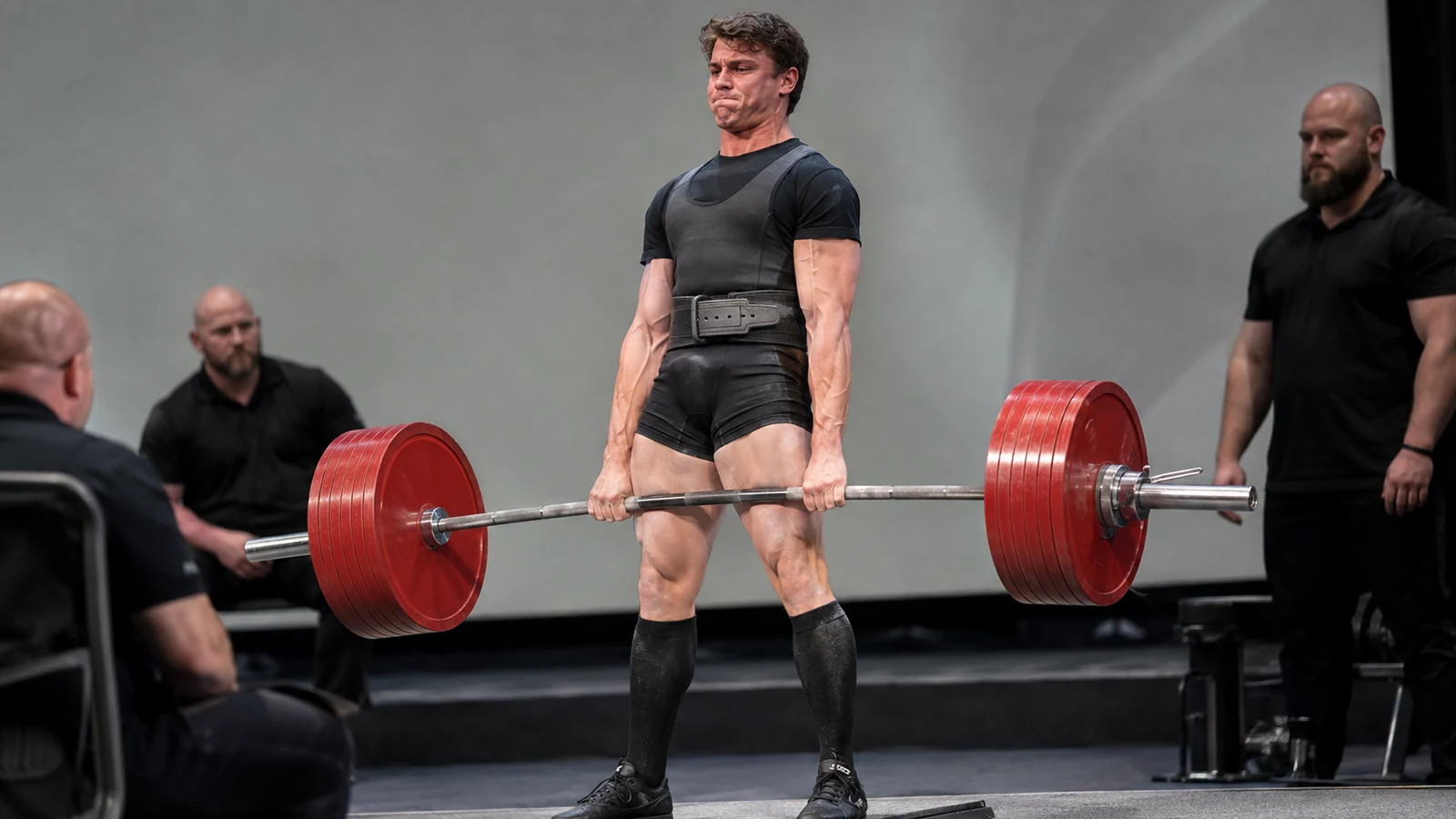

Alexis Maher walked away from the 2024 IPF World Open Equipped Powerlifting Championships without a gold medal.
He also walked away with a new world record.
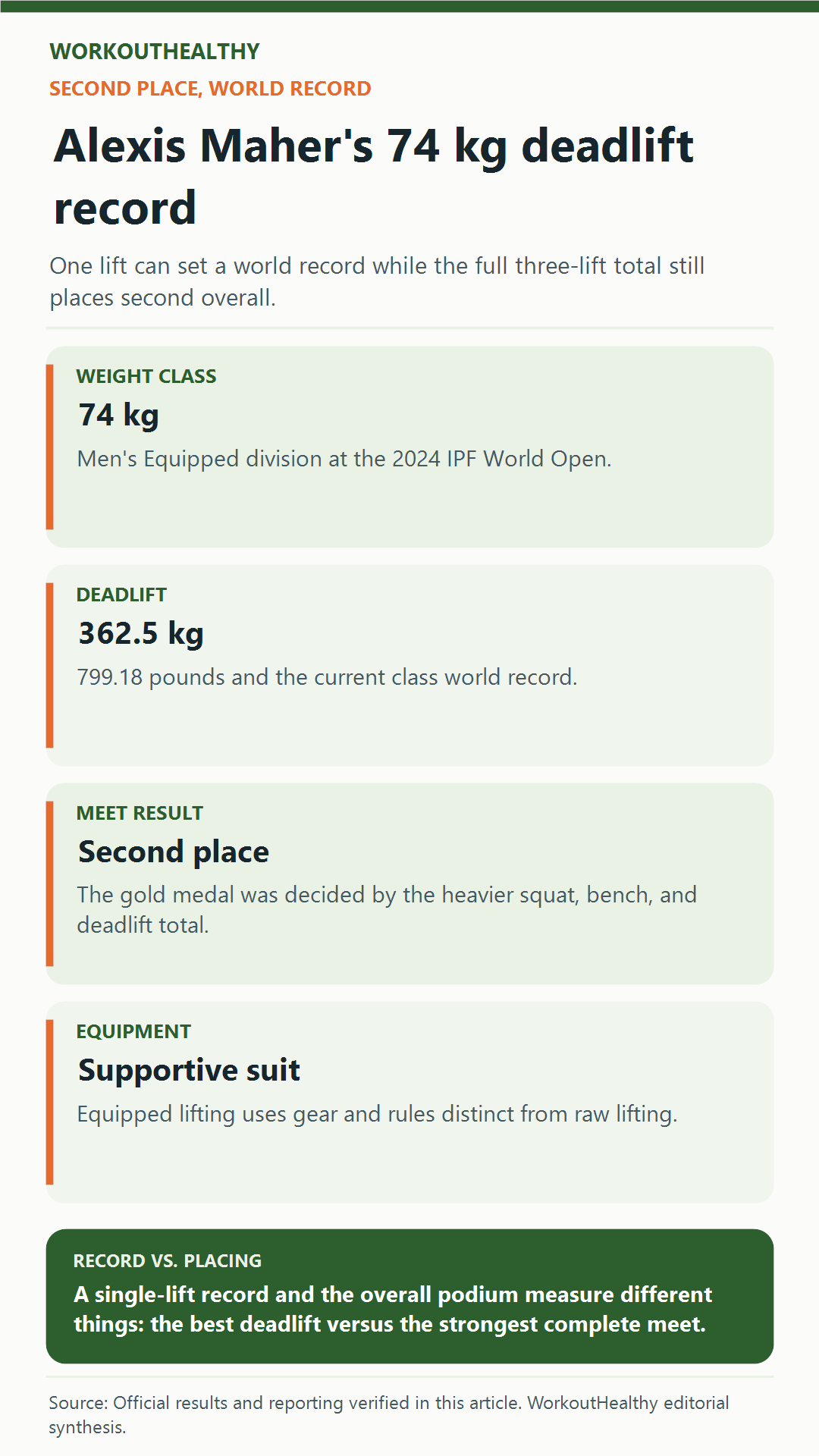
In the men’s 74 kilogram equipped division, competing in Reykjanesbær, Iceland, Maher pulled 362.5 kilograms off the platform.
That converts to 799.18 pounds.
The lift finished second overall on the day, behind a lifter with a heavier three lift total.
But on the official IPF results sheet, his deadlift carries a small “w” next to it.
That letter means world record, and as of this writing it is still there.
This is one of two equipped deadlift world records covered in recent WorkoutHealthy Insider coverage.
The other belongs to Carl Yngvar Christensen, a Men’s Open record with no weight class ceiling, set more than a decade ago.
Maher’s record works differently in two important ways.
It is capped to a single weight class, the 74 kilogram division, rather than open to any bodyweight.
And it is current, set in November 2024 and still standing today.
What Happened at the 2024 IPF Worlds
The event was the World Open Men’s Equipped Powerlifting Championships 2024, held in Reykjanesbær, Iceland, from November 11 to 16.
Maher competed in the 74 kilogram class, equipped division.
That means he lifted in IPF sanctioned supportive gear rather than the belt and sleeves setup used in classic, or raw, competition.
He weighed in at 73.30 kilograms on the day of competition.
That works out to about 161.6 pounds, just under the 74 kilogram class ceiling.
His three competition lifts were a 307.5 kilogram squat, a 177.5 kilogram bench press, and a 362.5 kilogram deadlift.
Combined, those totaled 847.5 kilograms.
Another lifter in the same class posted a heavier three lift total that day and took the win.
Maher finished second overall on total.
The deadlift number stood apart from the placing.
It is listed as the current IPF world record for the men’s 74 kilogram equipped deadlift, confirmed on the federation’s own records database as of this writing.
It is a reminder that a world record and a meet win are not the same accomplishment.
A lifter can lose the overall competition and still own the single heaviest lift anyone has completed under a given rule set.
Other verified feats covered on this site follow a similar pattern.
DonnaJean Wilde’s push-up world record came down to pacing math as much as raw effort.
Edith Connor’s Guinness record for oldest female bodybuilder makes a similar point, that records are not only about the biggest number in the room.
Who Is Alexis Maher
Maher is an American powerlifter who has competed since at least 2013, based on competition records tracked by OpenPowerlifting.org.
His early meets were modest by his own later standards.
In December 2013, lifting raw in the 75 kilogram class, he totaled 515 kilograms across squat, bench, and deadlift.
He moved into equipped competition by 2016.
That year, in a meet held under IPF rules, he recorded a 302.5 kilogram deadlift and a 750 kilogram total in the 74 kilogram class.
From there his numbers rose gradually across nearly a decade of competition.
That stretch spanned USA Powerlifting, the American Powerlifting Committee, and IPF sanctioned meets.
His deadlift climbed from the low 300 kilogram range in 2016 and 2017 to the 355 to 365 kilogram range by 2022 and 2023.
The November 2024 world record pull did not appear out of nowhere.
It came after roughly eleven years of small increases stacked one competition at a time.
He kept competing after setting the record, too.
In August 2025, weighing in heavier at 75.7 kilograms and moving up into the 83 kilogram class, he pulled 365 kilograms, his heaviest deadlift on record.
That later pull happened in a different, heavier weight class, so it did not touch the 74 kilogram mark.
The world record from November 2024 still belongs to that specific 74 kilogram performance.
What “Equipped” Actually Means in Powerlifting
The IPF runs two separate equipment categories at its world championships, classic and equipped.
Classic lifters compete with a belt, knee sleeves, and wrist wraps.
Equipped lifters add a supportive squat suit, a bench shirt, and a deadlift suit, all made from dense, tightly woven fabric.
A deadlift suit does not lift the bar for the athlete.
It stores elastic tension in the fabric as the lifter bends into the starting position.
That stored tension helps the lifter drive up and off the floor, which is normally the hardest part of a heavy deadlift.
This is exactly why equipped deadlift numbers run higher than classic numbers in the same weight class.
The equipment is doing real, measurable mechanical work.
None of that makes Maher’s pull less impressive within its own category.
Every lifter on that platform wore comparable equipment under the same IPF rules.
Equipped and classic are simply two different sports wearing the same name, each with its own record book.
The Bodyweight Math Behind an Equipped 799 Pound Pull
Maher weighed 73.30 kilograms, about 161.6 pounds, on the day he pulled 362.5 kilograms.
Divide the two and the deadlift comes out to just under 4.95 times his bodyweight.
That is not quite five times bodyweight, but it is close enough that the comparison is worth making plainly.
Formal relative strength formulas like Wilks or DOTS exist for comparing lifters across weight classes.
Those coefficients are built and calibrated around raw, classic competition data.
Applying them directly to an equipped lift risks comparing numbers that were never designed to line up.
This article sticks to the simple bodyweight ratio instead of forcing a formula that was not built for equipped lifting.
The plain ratio still makes the point.
A lift close to five times bodyweight, in any equipment category, sits well outside what almost anyone in a commercial gym will ever produce.
A lifter can finish second on the platform and still own the single heaviest lift anyone has completed under a given rule set. Those are two different records, and only one of them shows up on the scoreboard.
The Mechanics Behind a Deadlift This Heavy
A deadlift this heavy is not only a strength number.
It is also a leverage number.
A 2023 study in the International Journal of Exercise Science examined how body proportions predict deadlift performance and movement patterns in trained lifters (Keith et al., 2023).
The researchers measured limb lengths, torso length, and joint angles at the start of the pull.
They then compared those measurements against how much weight lifters could move and how their bar path and joint angles changed under load.
Lifters with proportionally shorter arms relative to their torso and legs tended to travel a shorter bar path to lock out the lift.
A shorter bar path generally means less total work to complete the same lift.
This is part of why elite deadlifters at a given bodyweight can look so different from each other in build.
It is also why coaching cues that work well for one lifter’s proportions can feel wrong for another’s.
Setup position interacts directly with those proportions.
Getting the hips, shins, and shoulders into the right starting relationship to the bar is what lets a lifter use their particular leverage instead of fighting it.
How Technique Changes as the Bar Gets Heavier
The Facebook caption tied to this record put it simply. Position beats ego every time a lifter sets up over a bar.
That framing lines up with what researchers have found when they study lifters under increasingly heavy loads.
A 2015 study in the Journal of Human Sport and Exercise tracked how squat and deadlift form changed as powerlifters moved from light warm up weights toward their competition maximums (Spencer & Croiss, 2015).
Movement form was not static across that range.
As load increased toward a lifter’s limit, technique shifted in measurable ways, including changes in trunk angle and how consistently lifters could repeat their setup position.
The practical takeaway is not that heavier weight automatically means worse form.
It means a setup that looks fine at a moderate weight can break down at a true maximum, unless a lifter has drilled that exact position under load many times before meet day.
That is a large part of what separates a lifter who can grind out a personal best from one who misses it.
The heaviest attempt of the day rewards whoever built the most boring, repeatable setup in training.
What This Record Does Not Prove
A world record deadlift, equipped or otherwise, is not proof that any single technique or program is the correct one for every lifter.
It reflects one competitor, on one platform, on one day, wearing IPF regulated equipment under IPF judging standards.
It also does not mean equipped numbers translate directly to classic, or raw, deadlift capacity.
A lifter’s equipped deadlift and their raw deadlift are related but separate numbers, and the gap between them varies from person to person.
Finally, a single record does not establish that 4.95 times bodyweight is some kind of ceiling.
Records exist specifically because someone eventually breaks them, in this weight class or another.
Common Mistakes Lifters Make Setting Up a Heavy Deadlift
Standing too far from the bar is one of the most common errors.
It forces the bar path away from the body, which turns a straightforward pull into extra, unnecessary work.
Rounding the lower back to reach the bar is another frequent mistake.
It is often caused by starting the hips too low or too high relative to the shoulders.
Letting the bar drift forward during the pull, instead of staying close to the shins and thighs, is a third common issue.
Once the bar moves away from the body, leverage gets worse with every inch of travel.
Rushing the setup under a heavy load is a subtler mistake.
A rushed brace and a rushed grip rarely hold up once real weight is on the bar.
None of these are exotic errors.
They are the same handful of issues that show up at every level of the sport, from a first gym pull to a world record attempt.
Who Should Be Cautious With Heavy Deadlifting
Anyone with a current low back injury, a recent disc issue, or uncontrolled high blood pressure should talk with a doctor or physical therapist before loading a barbell deadlift heavily.
People who are new to the deadlift pattern altogether should spend real time building technique with lighter loads before chasing bigger numbers.
Working with a qualified coach can shorten that learning curve considerably.
A second set of eyes on setup position catches problems a lifter cannot always feel from the inside.
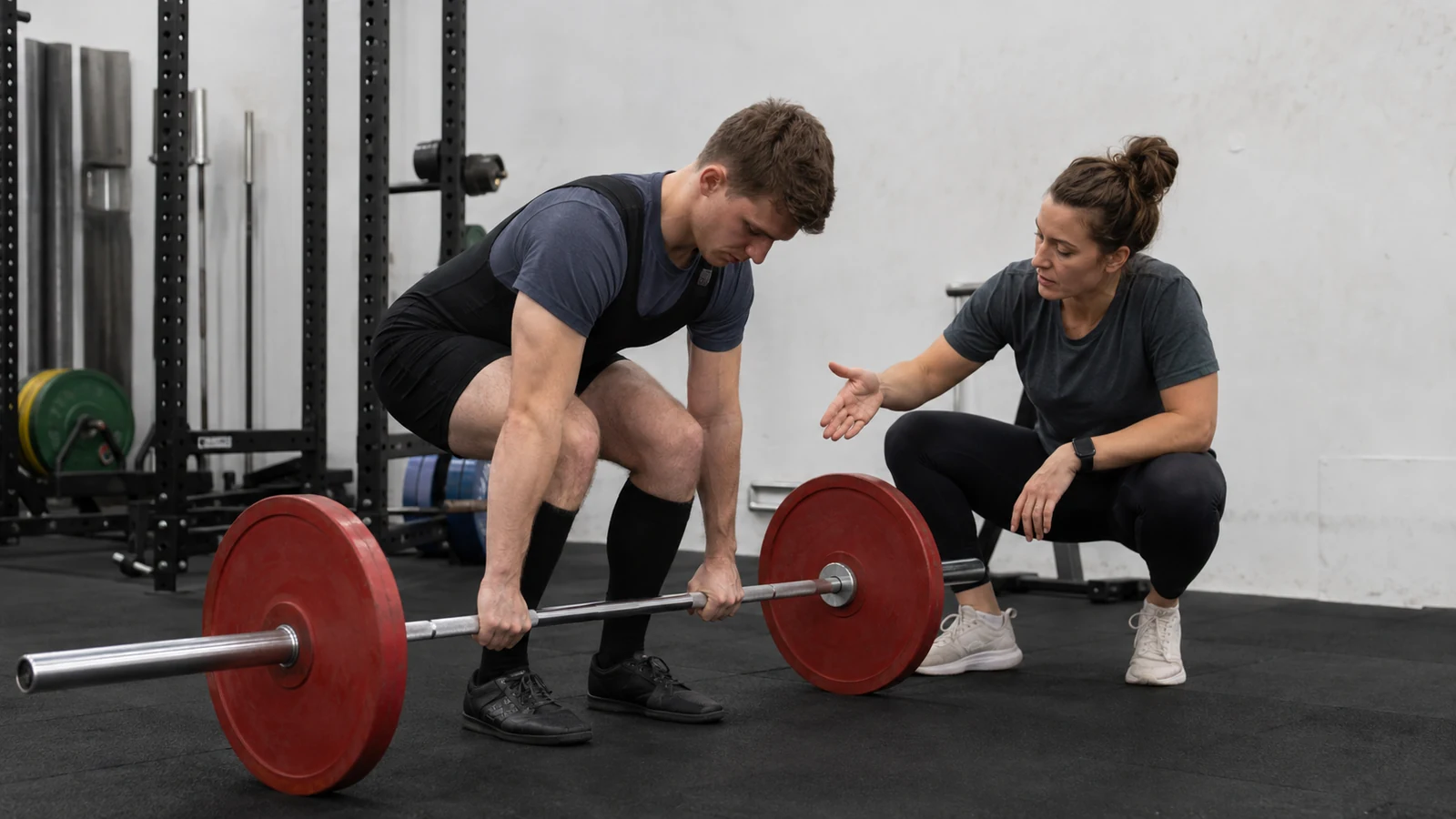
Progressing the weight gradually protects the lower back over the long run.
So does treating grinding, ugly reps as a warning sign rather than a badge of honor.
Watch the Original Video
Want more verified strength feats like this one? Subscribe to WorkoutHealthy Insider for practical explanations behind popular fitness claims.
References
Keith, D. S., Scherrer, D., Nunley, B., Boykin, J. R., Green, J. J., Siedler, M. R., Rodriguez, C., Harty, P. S., Stratton, M. T., Harry, J. R., & Tinsley, G. M. (2023). Anthropometric predictors of conventional deadlift kinematics and kinetics: A preliminary study. International Journal of Exercise Science, 16(1), 429–447. https://doi.org/10.70252/cvqh8240
Spencer, K., & Croiss, M. (2015). The effect of increasing loading on powerlifting movement form during the squat and deadlift. Journal of Human Sport and Exercise, 10(3). https://doi.org/10.14198/jhse.2015.103.02
This article is for general information only and is not medical advice. If you have an injury, ongoing pain, or a medical condition, talk to a doctor or physical therapist before you change how you train or eat.