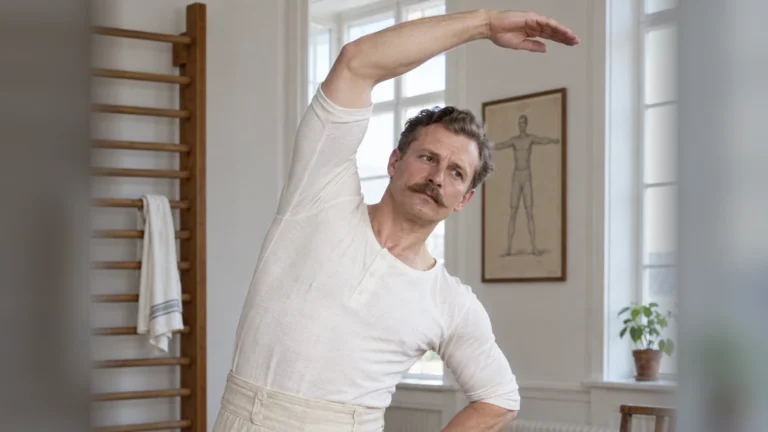

Illustration note: The opening image is an illustrative scene of group exercise in period clothing, not an authenticated photograph of Jahn or an original training session.
Turnen is a German word for gymnastics. In a historical discussion, it can also refer to the organized gymnastics movement associated with Friedrich Ludwig Jahn, physical education and ideas about civic responsibility.
That difference matters when you encounter the word on a club website, in a gymnastics lesson or in an account of fitness history. A modern apparatus class and Jahn’s vision of national preparation share a vocabulary, but the name alone does not establish the same exercises, membership rules or political purpose.
This guide separates those meanings, examines the original connection between group training and citizenship, and gives you a practical way to read a present-day club’s description. Modern community-exercise research adds another perspective, with clear limits on what it can tell us about Turnen.
What does Turnen mean?
For an English reader, gymnastics is the useful starting translation. The German dictionary Duden lists das Turnen as a sport or school subject, while its verb entry includes exercising on apparatus and performing a gymnastic movement.
Capitalization helps: Turnen is the noun and turnen is the verb. A school timetable, an apparatus lesson and a historical book can therefore use related wording while discussing different aspects of the activity.
Look for the surrounding words before deciding what a page offers. Equipment names, skill levels and a competition program point toward gymnastics instruction; references to national education, citizenship or Jahn point toward the historical movement.
A short translation also leaves something unresolved: is the writer naming an activity, a particular organization or a philosophy? Answering that question prevents a familiar training mistake, assuming that a shared label means a shared program.
Four related terms that are easy to confuse
| Term or context | What it identifies | What to check next |
|---|---|---|
| Turnen | The gymnastics activity or subject. | The specific discipline, lesson or skill being discussed. |
| Turnverein | An association of gymnasts; the plural is Turnvereine. | That organization’s actual membership and activity information. |
| The historical Turnen movement | An organized physical-education tradition with social and political purposes. | The place, period, organization and viewpoint of the source. |
| Gerätturnen | Apparatus gymnastics, practiced recreationally and competitively in today’s German federation. | The apparatus, entry level, supervision and competition requirements. |
Duden’s Turnverein entry identifies an association, rather than a prescribed workout. For modern apparatus gymnastics, the Deutscher Turner-Bund’s discipline page describes both recreational and performance pathways.
Those distinctions let you ask a more useful question than whether a class is authentic Turnen. Ask what its participants actually do and which version of the tradition the organization means.
Why Jahn connected gymnastics with civic fitness
In Jahn’s early nineteenth-century setting, group exercise was tied to national preparation, rather than simply personal recreation. Historian Horst Ueberhorst’s analysis of the movement describes patriotic education and preparation for military service as central purposes.
The organizing idea was that bodily education could prepare people for a shared public role. Recognizing that aim helps explain the civic-duty language, without treating military readiness as the purpose of every modern gymnastics class.
A primary source makes the connection between training and identity especially clear. In the language chapter of their 1816 Die Deutsche Turnkunst, Jahn and Ernst Eiselen argue for German terminology and describe a vocabulary spanning exercise grounds, teachers, rules, equipment, communities and festivals.
The chapter’s terminology shows an organized social practice, not a single exercise sequence. Its insistence on national linguistic identity also shows why the history cannot be reduced to a neutral account of people keeping fit together.
For a present-day reader, the useful distinction is between organization and ideology. Regular meetings, shared instruction and a common purpose can be considered separately from the national belonging that Jahn attached to them.
One tradition did not produce one unchanging set of values
The movement’s later organizations followed different political and social paths. Ueberhorst describes democratic and workers’ organizations alongside nationalist strands, so a single founder-centered account misses important differences.
Exclusion is also part of that history. In their research on Jewish sport and antisemitism, Lasse Müller and Jan Haut describe changing opportunities for Jewish participation, followed by renewed antisemitic barriers in parts of the club movement.
The present German federation’s remembrance page acknowledges the Deutsche Turnerschaft’s adoption of an exclusionary rule in 1933. That historical organization and today’s Deutscher Turner-Bund should be identified accurately, rather than treated as interchangeable names.
Today’s DTB states a commitment to diversity and opposition to discrimination. That is a published organizational commitment; the experience of joining a particular local group still depends on its actual practices.
A name can carry a history without telling you everything about its current members. Read both the history and the present organization’s own rules before assigning it a purpose or a set of beliefs.
What the club tradition can mean today
Modern gymnastics can involve recreational participation, performance development or competition. The DTB’s apparatus page describes floor and apparatus disciplines and programs at different levels, rather than one standard session that every participant follows.
A Turner organization can also combine physical activity with cultural and community purposes. For example, the Los Angeles Turners’ mission connects fitness with learning, German-American culture and helping people in need.
That is an example of a society’s stated mission, not a guarantee of currently available classes or facilities. Check a group’s current activity information before planning a visit or assuming that its historical description is a booking page.
The practical lesson is to separate three things: the organization’s heritage, the program being offered and your reason for attending. You might be interested in apparatus skills, recreation or community participation, and each calls for different information.
How to read a Turnen class or club description
Use the following questions to turn an unfamiliar label into a concrete description. This is an editorial comparison tool, not a tested exercise program or a rating of any named club.
- What is the activity? Look for a named discipline, apparatus or class format, rather than relying on Turnen alone. Ask whether the session teaches gymnastics skills, offers general recreation or serves a competitive team.
- Who is the session designed for? Check its age group, entry skills and experience requirements. A welcoming mission statement does not establish that an advanced lesson is suitable for a first session.
- How is instruction organized? Ask who teaches, how participants are grouped and what progression the lesson follows. A list of impressive skills gives less practical information than an explanation of how a newcomer enters the program.
- What does participation involve? Separate the training schedule from competitions, performances, volunteering and cultural activities. Ask which commitments are required and which are optional.
- How does the group put inclusion into practice? Ask about access needs, available adaptations, conduct expectations and whom to contact about concerns. Use specific answers, rather than a historical label or a broad slogan, to judge whether the setting fits you.
For example, an adult seeking a first gymnastics class needs the entry level and instruction details before a list of competition results. Someone researching civic associations needs the mission and membership information before deciding what the organization’s fitness activities represent.
Neither reader needs to reconstruct a nineteenth-century training session to answer that question. The relevant comparison is the actual program and community in front of them.
What modern community-exercise research adds
Research can help examine questions raised by civic fitness, including participation and readiness. The two sources below concern different modern settings; neither tested Turnen, Jahn’s methods or a nationalist philosophy.
| Source and setting | What it examined | What it cannot establish |
|---|---|---|
| Stevinson and Hickson, 2014: parkrun | 7,308 adults reported activity and perceived benefits; attendance and 5-kilometer performance came from the event database. A quarter described themselves as non-runners when registering. | An observational survey cannot show that community participation alone caused improvements or that gymnastics clubs produce the same results. |
| Molloy and colleagues, 2020: United States Army | A review of noncombat injuries and readiness documented the substantial burden of musculoskeletal injuries on soldiers’ availability for duty. | These injury findings cannot establish whether Turnen outperforms other programs, prescribe civilian training, or show that harder group exercise prevents injury. |
The parkrun study is relevant to participation because it combined people’s accounts with attendance and performance records. Its findings invite further investigation of community exercise; they do not validate the political ideas attached to a historical movement.
The Army review addresses readiness from an injury perspective. Using its findings to promote a particular club routine would require evidence that the review did not provide.
Keeping those boundaries makes the comparison useful. A shared purpose can be something to examine in a group, while any claim about improved fitness, reduced injury or better adherence still needs evidence for the actual participants and program.
Understanding Turnen without flattening its history
Start with the meaning of the word, then identify the activity or organization being described. Turnen can name gymnastics, while a historical discussion may focus on a broader movement connecting physical education with public life.
Jahn’s civic-fitness vision helps explain that connection, including the nationalism built into it. Later organizations and current programs need their own descriptions, rather than a presumption that every club repeats the same philosophy.
If you are considering a class, find its level, instruction and participation requirements. If you are reading history, identify the source, period and organization before carrying a claim into the present.
References
Dudenredaktion. (n.d.). Turnen; turnen; Turnverein. Duden online. Retrieved October 26, 2026, from noun entry, verb entry and club entry.
Jahn, F. L., & Eiselen, E. (1816). Über die Turnsprache. In Die Deutsche Turnkunst zur Einrichtung der Turnplätze (pp. XIX to XLV). Realschulbuchhandlung. Thomas Gloning’s electronic transcription (2000).
Ueberhorst, H. (1978, July 15). Deutsche Turnbewegung und deutsche Geschichte: Friedrich Ludwig Jahn und die Folgen. Aus Politik und Zeitgeschichte, 28/1978. Article.
Müller, L., & Haut, J. (2021, October 29). Jüdischer Sport und Antisemitismus: Geschichte und Gegenwart. Aus Politik und Zeitgeschichte. Article.
Deutscher Turner-Bund. (n.d.). Gerätturnen; Diversität im DTB; Es darf kein Vergessen geben. Retrieved October 26, 2026, from apparatus gymnastics, diversity policy and remembrance page.
Los Angeles Turners. (n.d.). About us. Retrieved October 26, 2026, from organization’s mission page.
Stevinson, C., & Hickson, M. (2014). Exploring the public health potential of a mass community participation event. Journal of Public Health, 36(2), 268 to 274. doi:10.1093/pubmed/fdt082.
Molloy, J. M., Pendergrass, T. L., Lee, I. E., Chervak, M. C., Hauret, K. G., & Rhon, D. I. (2020). Musculoskeletal injuries and United States Army readiness part I: Overview of injuries and their strategic impact. Military Medicine, 185(9 to 10), e1461 to e1471. doi:10.1093/milmed/usaa027.
Medical disclaimer: This article is general fitness information, not medical advice. If you have an injury, ongoing pain or a medical condition, talk to a doctor or physical therapist before changing how you train.