
A still position can require considerable effort, which helps explain why isometric training attracts attention alongside more visible lifting and cardio.
Shape reported in 2023 that trainer Jason Walsh includes isometric work in Zoe Saldaña’s training.
That is a dated account of one method, rather than proof of her complete current routine or a program every reader should follow.
The useful next step is to understand what a hold trains and how to keep the exercise appropriate to the person doing it.
The quality of a hold matters before the length of a hold.
A useful exercise earns its place through a clear purpose.
The verified detail behind the headline
The trainer account gives the celebrity connection a source and a date, while leaving plenty of her wider schedule unspecified.
It does not establish what she trains every day in 2026, how every session is organized, or what another person should copy.
Treat the connection as a reason to explore the method, with the same questions you would ask about any exercise.
What position are you holding, which task are you practicing, and how will you decide whether the version is manageable?
Those questions keep the discussion useful even when a social caption compresses a complicated routine into a few lines.
What an isometric hold actually trains
Mayo Clinic describes an isometric exercise as a muscle contraction in which the muscle’s length and the joint’s position do not noticeably change.
A plank is one familiar example, while the effort required depends on the position and the task.
Static does not mean inactive: muscles still produce force to maintain the position.
Research reviewed by Oranchuk and colleagues examined how loading parameters influence longer-term isometric adaptations, rather than treating every hold as interchangeable.
Their review covered 26 research outputs and considered muscle length, intensity, and intent among the factors affecting the response.
That supports asking how a hold is performed, rather than assuming the label alone tells you what it will achieve.
Stillness does not make every hold easy
Two people can appear equally still while facing very different demands, especially when their positions, leverage, and training experience differ.
A wall-supported option and a floor position should not be treated as the same challenge merely because neither involves repeated movement.
Mayo Clinic notes that isometrics can support stabilization, while strength improvements are influenced by the position being trained.
The research review likewise found that the details of the training mattered for muscular and performance adaptations.
A practical description therefore needs more than a dramatic photograph or the longest possible stopwatch reading.
Keep the exercise’s purpose specific, and avoid treating a visible struggle as proof that a position is the right choice.
Choose a hold by position, control, and recovery
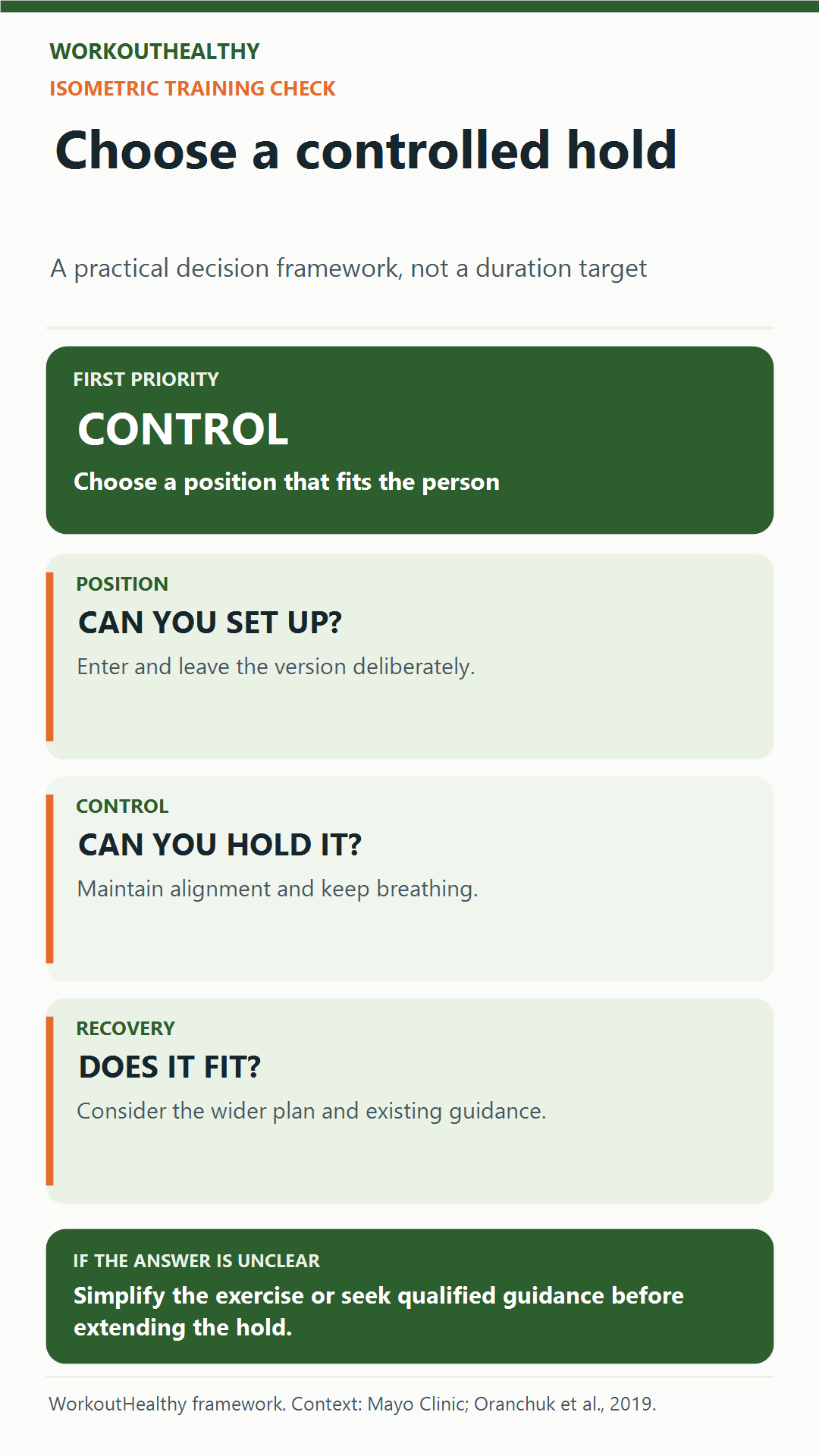
WorkoutHealthy’s editorial decision rule uses three questions before adding duration.
Position: can you enter and leave the chosen setup deliberately, using a version appropriate to your experience?
Control: can you maintain the intended alignment while continuing to breathe, rather than staying in place through uncontrolled strain?
Recovery: does the exercise fit the rest of your training and any guidance you already follow?
If a question has no clear answer, simplify the version or seek qualified help before making the hold longer.
This framework does not assign a universal number of seconds, because a single duration cannot describe every position or person.
For example, keeping a well-controlled supported position can be a clearer practice goal than repeatedly losing alignment in a harder variation.
Record the version you used, so a later comparison is about the same task rather than a different exercise with the same name.
Use simple positions before chasing duration
Mayo Clinic advises avoiding breath-holding and straining during weight training, particularly because of the blood-pressure response.
People with high blood pressure or heart problems should discuss isometric exercise with their health care provider before beginning.
Those cautions apply even when a movement requires little equipment or looks quiet on a screen.
Choose a familiar setup, understand the intended position, and stop treating time alone as a sufficient measure of quality.
A short note about alignment, breathing, and the variation used can be more informative than a single best duration.
If a position causes pain or brings an existing condition into the exercise, seek individualized guidance rather than improvising rehabilitation.
Keep moving work in the wider routine
An isometric hold is one training tool, and its usefulness depends on the goal and the surrounding plan.
Oranchuk and colleagues found that muscle length and intent affected adaptations, including transfer to dynamic performance.
That does not show that one celebrity-associated routine can replace every kind of strength, movement, or conditioning work.
Our guide to choosing a push-up progression by goal offers a similar way to distinguish tasks that look related but serve different purposes.
Our review of isometric handgrip and blood-pressure research also explains why findings from one protocol should not be stretched into universal health promises.
Keep claims tied to the exercise and evidence that actually produced them.
What Saldaña’s example can reasonably offer
The celebrity connection makes the method interesting, while the practical value comes from understanding the task.
You do not need to infer a private schedule, imitate a film-preparation workload, or assume that a polished image proves a health outcome.
Start with a clear purpose for the hold and a version you can control.
Review whether it fits your wider routine before adding another challenge simply because it looks impressive.
Use the position, control, and recovery questions to make your next conversation with a qualified trainer more specific.
Medical disclaimer: This article is general product information, not medical advice. The equipment described here is not a treatment for any condition. If you have an injury, ongoing pain, or a medical condition, talk to a doctor or physical therapist before using any of it.