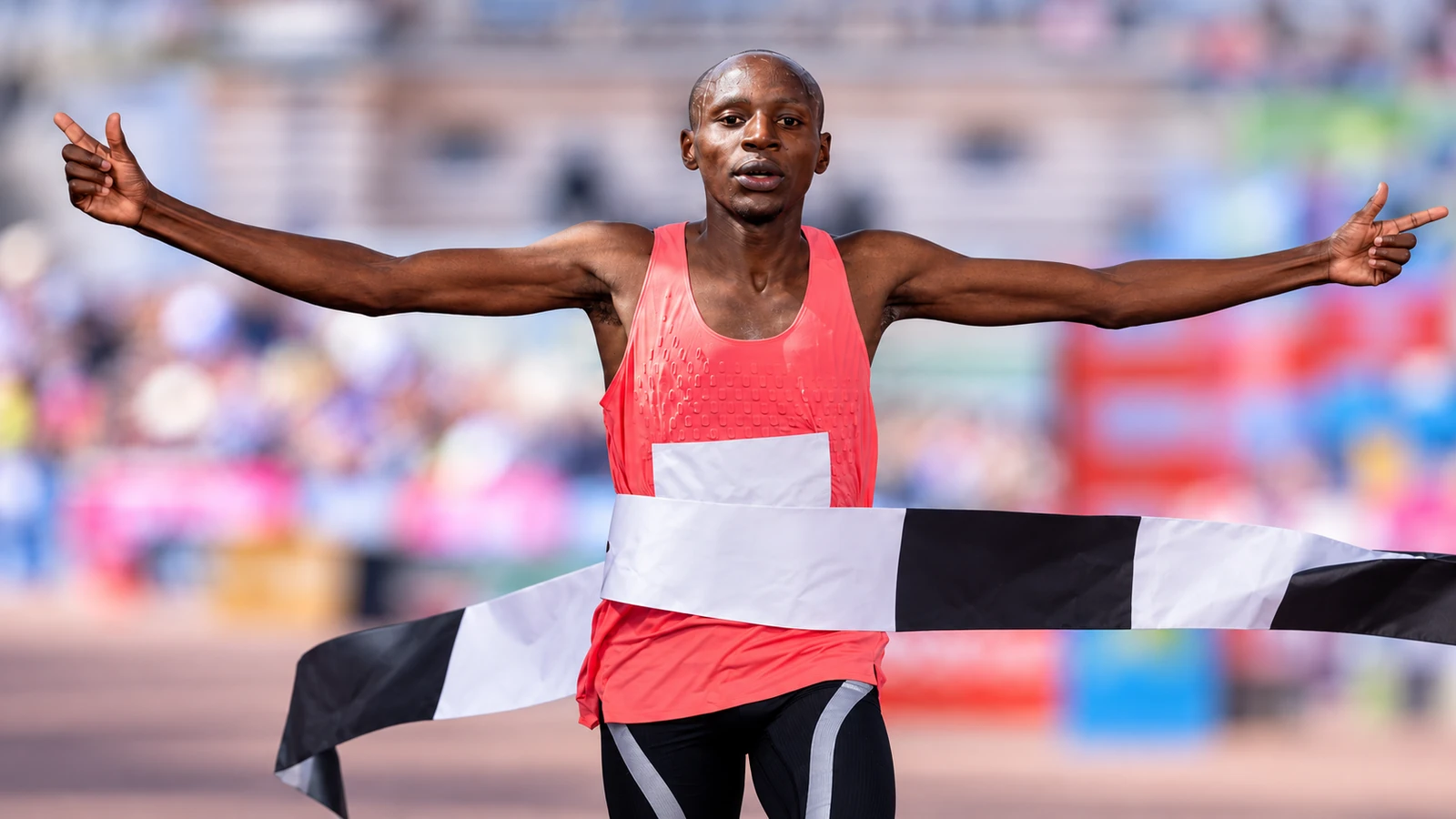

Sabastian Sawe won the London Marathon on April 26, 2026, in 1:59:30, then had the men’s world record ratified by World Athletics.
The governing body announced that ratification on July 23, distinguishing an official record from the initial race-day report (World Athletics, 2026a).
The result made him the first man to break two hours in a record-eligible marathon.
Understanding that achievement means keeping the competition category, the clock, and the comparison with earlier sub-two-hour running in the same frame.
A barrier becomes an official record through both performance and verification.
Pace calculations explain a result without prescribing someone else’s next workout.
The race and the ratified result
World Athletics lists Sawe’s 1:59:30 in London as the ratified men’s marathon world record, replacing Kelvin Kiptum’s 2:00:35 (World Athletics, 2026a).
The improvement was 65 seconds, a small-looking difference on a clock that carried enormous significance for the event.
Separating the April performance from the July ratification makes the reporting precise without diminishing the race-day achievement.
It also avoids leaving the story permanently framed as an unconfirmed world-record performance after the governing body has completed its process.
When sharing the result, keep the event, date, and official status attached to the time.
How the field reached the finish
World Athletics’ race report describes a lead group reaching halfway in 1:00:29 before the decisive late stages (World Athletics, 2026b).
Sawe finished ahead of Yomif Kejelcha, who also broke two hours with 1:59:41, while Jacob Kiplimo ran 2:00:28.
The finishing order matters because the barrier was crossed inside a race with other athletes pursuing their own performances.
Sawe’s result was the winning time and the record, while Kejelcha’s time shows how extraordinary the competition around him had become.
That is a richer account than treating the event as one isolated number detached from the field.
A pace comparison you can check
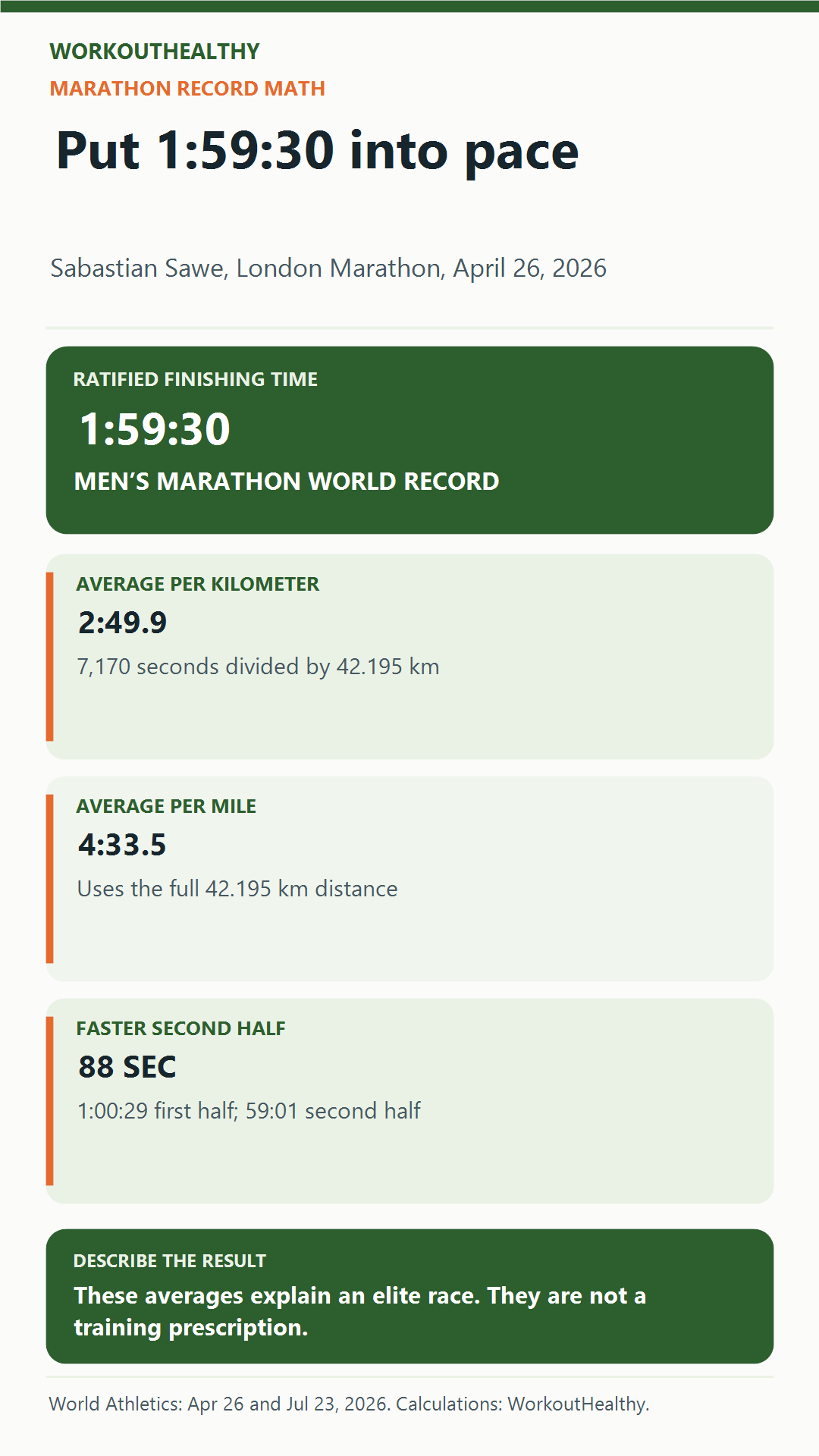
WorkoutHealthy’s calculations use a finishing time of 7,170 seconds and the marathon distance of 42.195 kilometers.
Dividing time by distance gives approximately 169.9 seconds per kilometer, or 2 minutes and 49.9 seconds.
Using 1 mile = 1.609344 kilometers gives approximately 26.219 miles and an average of 4 minutes and 33.5 seconds per mile.
These are whole-race averages, with the full distance used before rounding, rather than a claim that every segment was identical.
The reported halves were 1:00:29 and 59:01, so the second half was 88 seconds faster (World Athletics, 2026b).
The subtraction is 3,629 − 3,541 = 88 seconds, while adding the two halves returns the official 7,170-second total.
Using a shortened distance such as 26.2 miles changes the rounded pace slightly, which explains why casual summaries can differ by a fraction of a second.
The numbers are context for an elite performance, not a suggested training pace or evidence about an individual reader’s fitness.
Why Kipchoge’s earlier run is a separate category
Eliud Kipchoge had already covered the marathon distance in 1:59:40.2 in Vienna on October 12, 2019.
World Athletics reported the achievement while explaining that it would not be ratified as a world record (World Athletics, 2019a).
Its later account described a collaborative exhibition with rotating pacemakers and support arrangements, rather than a record-eligible competitive race (World Athletics, 2019b).
Sawe’s distinction is therefore specific: the first sub-two-hour men’s marathon within the official record category.
Kipchoge’s earlier milestone remains part of the history, while the two performances should not be presented as interchangeable entries in the record list.
What the split times do and do not tell us
A faster second half is a description of the recorded splits, not a complete explanation of how the performance became possible.
The figures alone cannot establish how much came from preparation, race tactics, conditions, footwear, or any other factor.
Claims that assign a precise share of the improvement to one product or technique need evidence beyond a finishing time.
The athlete’s own account can add context, which is why the related post-race interview appears below.
Keep a distinction between an observed result, a participant’s explanation, and a causal claim that would require a different kind of study.
Use the comparison as context for your own running
An elite pace can be fascinating without becoming the most useful reference for every runner.
A clearer personal comparison keeps the distance, setting, and purpose of your own efforts visible.
Our account of Cynthia Erivo’s London Marathon explores a different relationship with the same event, where a personal result and experience carry the story.
Our review of T.J. Holmes’s Marathon Majors results likewise shows why the exact event and outcome matter when describing a running achievement.
Use those differences to ask what you want a result to represent, rather than borrowing a goal simply because its headline is memorable.
Why this version of the barrier matters
Sawe’s London result brought the time barrier and the official record category together in a competitive marathon.
The verification status, the other finishers, and the split calculation each explain a different part of that achievement.
Keeping them separate makes the story easier to check and harder to exaggerate.
Save the pace comparison if you enjoy the arithmetic, then compare your own running with a goal appropriate to your experience and circumstances.
The historic result stands on its documented terms without needing an invented training secret.
Sawe explains his historic London run
ITV News’ source interview adds Sawe’s own account of the race. The official record status is established by World Athletics (ITV News, n.d.).
References
ITV News. (n.d.). Sabastian Sawe explains his historic London marathon run [Video]. YouTube. Watch the source interview.
World Athletics. (2019a, October 12). Kipchoge breaks two-hour barrier in Vienna. World Athletics.
World Athletics. (2019b, November 25). With second World Athlete of the Year honour, Kipchoge shows there’s no limit. World Athletics.
World Athletics. (2026a, July 23). Ratified: World records for Sawe, Ehammer, Charlton and more. World Athletics.
World Athletics. (2026b, April 26). Sawe breaks two-hour barrier with 1:59:30 world record at London Marathon. World Athletics.
Medical disclaimer: This article is general product information, not medical advice. The equipment described here is not a treatment for any condition. If you have an injury, ongoing pain, or a medical condition, talk to a doctor or physical therapist before using any of it.