
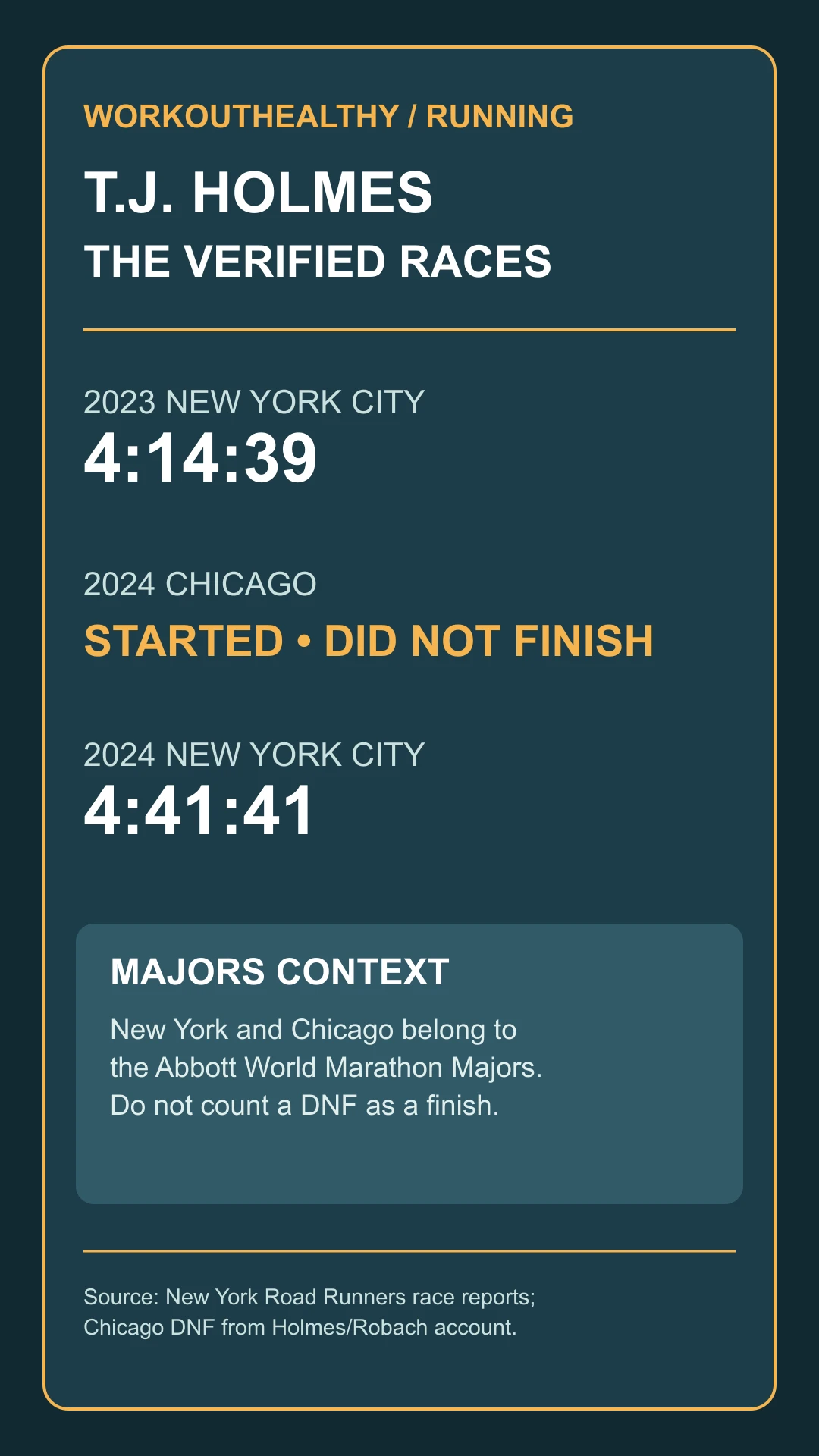
T.J. Holmes has returned to the New York City Marathon, an Abbott World Marathon Major, but his public race history is more nuanced than “he keeps finishing the Majors.” New York Road Runners lists him at 4:14:39 in 2023 and 4:41:41 in 2024. He and Amy Robach also started the 2024 Chicago Marathon, another Major, but their firsthand account says they did not reach the finish. The accurate story is about repeated participation, a difficult setback, and the distinction between starting and completing a race.
That distinction matters for any runner setting a long-term goal. Marathon culture prizes finish lines, but the preparation, logistics, recovery, and occasional interruption are part of a truthful account too. Holmes’s documented results provide a way to explain the Majors without inflating an athlete’s résumé or turning one famous runner’s experience into a training formula.
The verified New York finishes
In its 2023 New York City Marathon report, race organizer New York Road Runners listed Holmes among notable finishers at 4:14:39. Amy Robach appeared at the same time. Its 2024 race report listed Holmes at 4:41:41 and Robach at 4:41:40. Those are organizer-published results, not estimates from social-media photos.
The time difference does not by itself tell us that Holmes became less fit. Marathon results reflect pacing, weather, course day, recovery, injury history, and goals. In 2024, the New York finish came just weeks after a difficult Chicago outing. We cannot isolate which factors affected either race, and a pair of times is not a scientific trend line.
What the records do establish is that he returned to the same Major and completed it on more than one occasion. Repeating a marathon can be meaningful even when the clock moves in the “wrong” direction. The 26.2-mile distance remains demanding, and the story is not improved by pretending every attempt is a personal best.
Chicago was an attempt, not a finish
Holmes and Robach addressed their 2024 Chicago Marathon in an episode of their own podcast, Morning Run: Marathon Edition. The episode description says they ended up in an ambulance instead of crossing the finish line. That is the most direct evidence for how to categorize the outing: they started a Major, but it should not be counted as a completed one.
A did-not-finish result can happen for many reasons. It is not a moral judgment and does not erase the training that led to the start. It is simply different from an official finish. Anyone writing about an athlete’s Majors record should keep those categories separate. Holmes’s later New York finish is notable partly because it came after that interrupted Chicago attempt, but even that sequence should not be spun into a universal “push through any pain” lesson.
When a runner has symptoms serious enough to stop and seek medical attention, the safe takeaway is to respond to the situation—not to preserve a finish streak at all costs. A celebrity race narrative cannot diagnose what another runner should do mid-race. Race medical staff and a clinician are the appropriate resources for concerning symptoms.
What “World Marathon Majors” means now
The Publer post originally called the Abbott World Marathon Majors a series of six races. That describes the longstanding original Six Star challenge, not the complete current set. The organizer’s current Stars page lists Tokyo, Boston, London, Cape Town, Sydney, Berlin, Chicago, and New York—eight locations. The familiar Six Star Medal remains tied to the original six races, while the series has expanded. Because the roster has changed, short evergreen claims about “the six Majors” can be outdated.
New York and Chicago both belong to the series. Holmes’s verified New York finishes and Chicago attempt demonstrate participation in Major events. They do not establish that he has run all eight, earned a Six Star Medal, or finished Chicago. No such claim is needed to make his running commitment interesting.
Marathon Majors attract elite competitors and a broad field of nonprofessional runners. Entry routes and qualification requirements differ by race, and access can be difficult. For someone inspired by the circuit, an initial goal might be a local road race, a half marathon, or one carefully chosen Major. The brand name is not the only valid measure of a runner’s progress.
Running with a partner—and managing real life
Holmes and Robach have spoken about running together. New York Road Runners featured them in its Set the Pace podcast, describing their race history and how they fit training around demanding schedules. Their paired finish times in 2023 and 2024 show they crossed the New York finish line together or nearly together, but the public record does not tell us every training decision they made.
A running partner can make an appointment harder to skip and a long run more social. But shared training only works if both people can adjust for different paces, recovery needs, and goals. One runner should not feel obliged to match the other’s mileage or ignore an injury. Communication is more useful than copying somebody else’s plan.
The marathon itself also involves travel, entry logistics, fueling, and recovery. Public celebrity coverage often compresses months of preparation into a photo at the finish. Holmes’s Chicago and New York sequence is a reminder that real race calendars are not tidy highlight reels.
What a recreational runner can learn
Verify the finish, not just the start. If you are tracking your own goals, note completed races separately from attempts and deferrals. This is honest, and it helps you learn from the whole process. Build for your own schedule. Long-distance running requires a repeatable progression with room to recover. Work demands, sleep, and prior injuries matter. A plan that fits one public figure may not fit you.
Have a race-day plan, but allow it to change. Practice hydration and fueling during training, learn the event’s aid-station setup, and know when to seek help. Unusual chest pain, fainting, severe dizziness, or other concerning symptoms warrant medical attention, not a motivational slogan. Let a slower finish still count. An official finish can reflect resilience and smart pacing even if the clock is slower than last time. It can also signal a need to review training or recovery before the next attempt.
For a first marathon, gradually increase training and consider qualified coaching or medical advice if you have a relevant condition or recurring pain. It is sensible to choose shorter races first. There is no requirement to chase a Major to become a serious runner.
Why the distinction matters for the original post
A caption saying Holmes “keeps showing up” can be fair if it is grounded in the organizer’s New York results and his documented Chicago attempt. Saying he repeatedly completed Majors, toured the whole circuit, or ran “six of six” would go beyond those sources. The most accurate angle is narrower and stronger: two verified New York finishes, an interrupted Chicago start, and continued participation in distance running.
Accuracy also protects the lesson for readers. If a DNF is quietly recast as a finish, the audience loses the more realistic story of how unpredictable endurance events can be. A runner can be committed and still have to stop. A later finish does not make the earlier stop a failure; it places both events in a fuller timeline.
How to make a Majors goal manageable
If the international series appeals to you, start with the requirements of one race rather than assuming every city has the same entry path. Check the event’s official site for its current ballot, time standard, charity, or travel options, and build a realistic budget for travel and time away. Those requirements can change. For training, work backward from the race date and give yourself enough weeks for gradual long-run progression, lighter recovery periods, and rehearsal of food and fluids. A qualified coach can help adapt the plan when your work or family calendar changes.
It is also okay to decide that a local marathon, a shorter distance, or a season without racing better matches your life. The purpose of a race calendar is to support a durable relationship with movement, not to collect credentials at the expense of health. Holmes’s public timeline illustrates that an attempt and a finish can both teach something, provided the two are described honestly.
Takeaway
T.J. Holmes finished the New York City Marathon in 2023 and 2024 according to New York Road Runners. He and Amy Robach started, but did not finish, the 2024 Chicago Marathon according to their own podcast. Those are the substantiated Major-related facts here. The broader Abbott series currently lists eight cities, even as the original Six Star challenge continues. His story is best read as a realistic example of returning to distance running, not as evidence of a completed world tour of Majors.