
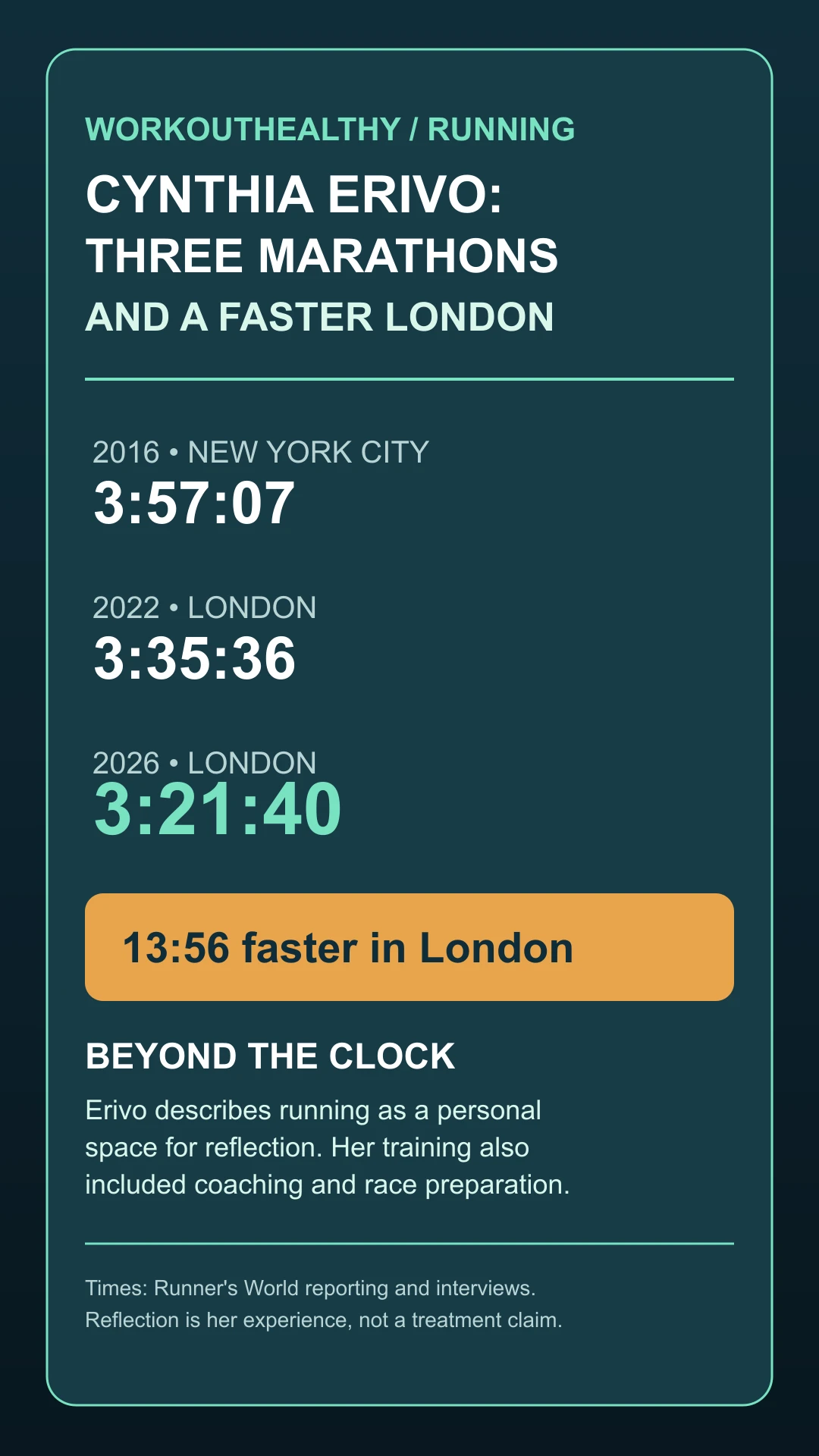
Cynthia Erivo’s 2026 London Marathon was faster than her previous London finish, but the stopwatch is only part of this running story. Reporting from the race put her at 3:21:40, compared with 3:35:36 in London in 2022—a 13-minute, 56-second improvement. In interviews before the 2026 race, the performer described running as a kind of meditation and a place to process emotions. Those are her descriptions of her own experience, not a clinical promise that marathon training treats mental-health conditions.
That distinction makes her story more useful. Erivo trained for a demanding race while maintaining a demanding performance schedule. She worked with a coach, modified the training emphasis, and gave long runs practical attention. At the same time, she gave the miles a personal meaning that no pace chart could capture. Here is what is documented, what is not, and what an everyday runner can reasonably take from it.
The result: a faster London Marathon
Runner’s World reported Erivo’s 2026 London Marathon finish as 3:21:40. Its pre-race interview listed her earlier marathon finishes as 3:57:07 at the 2016 New York City Marathon and 3:35:36 at the 2022 London Marathon. Subtracting the two London times gives a 13:56 improvement. The sequence shows a runner with years of experience; it does not prove that any single workout, coach, supplement, or psychological technique caused the change.
The time is impressive, particularly alongside a professional calendar that demands physical energy. But a celebrity result should not become a prescription. We do not have her complete training log, recovery record, injury history, or race-day conditions. The public interviews show selected elements of preparation, not a controlled experiment.
What Erivo meant by running as meditation
In her firsthand conversation with Runner’s World, Erivo connected running with space to think and process feelings during a demanding chapter of her career. She described it in meditative terms. That is a description of attention and experience during movement, not a claim that she spent every mile in formal meditation or that the activity works identically for everyone.
For some runners, a repetitive rhythm, familiar route, and time away from interruptions make thoughts easier to notice. Others prefer the social connection of a group run, the focus of a workout, or simply the pleasure of being outside. There is no need to copy a public figure’s emotional experience to get value from physical activity. And if exercise begins to feel compulsory, distressing, or like the only way to manage severe symptoms, professional support matters more than adding mileage.
Erivo’s story is compelling because it holds two truths at once: she cared about how she felt while running, and she also trained for a measurable athletic goal. The psychological meaning did not replace the practical work of preparing for 26.2 miles.
A coached plan behind the personal story
Erivo’s 2026 preparations were not presented as a vague “just run and believe” formula. Runner’s World reported that she worked with professional runner and coach Erika Kemp. In their joint firsthand conversation with Outside Run, the pair discussed shifting from a volume-heavy emphasis toward speed work, with short pickups and goal-pace segments among the tools. They also discussed practicing nutrition on long runs.
Those details matter more than a single headline about meditation. A coach can adjust the mix of easy running, quality sessions, long runs, and recovery around an individual’s history and schedule. A brief faster segment has a different training purpose from a long easy run. Nutrition practice matters because what works at rest may not work after hours of running. We do not know which adjustment mattered most for Erivo’s finish, and the high-mileage figures mentioned in interviews should not be copied by a recreational runner.
Outside Run also described how she made training fit around a demanding stage role. The lesson is not that everyone should squeeze marathon mileage into an already exhausting calendar. It is that real schedules shape training. The best plan is the one a runner can recover from and repeat safely, not a celebrity’s most extreme week.
Why the previous races need correct dates
It is easy to blur race years in a short social-media caption. The timeline here is specific: the earlier London benchmark reported in the pre-race interview was in 2022, and the faster London result was in 2026. Her 2016 New York City finish is a separate marathon. A source discussing a different year or a generic “previous London” without a date can distort the comparison.
The arithmetic is straightforward: 3:35:36 minus 3:21:40 equals 13 minutes and 56 seconds. That is a comparison of two recorded finish times, not an estimate of fitness change. Course conditions, pacing, fueling, training status, and countless other variables differ between races. It is fair to say she ran faster at London this time; it is not fair to attribute every second to one training intervention.
What a regular runner can actually borrow
Protect a repeatable time slot. Erivo told Runner’s World that morning running helped her make training a priority. An everyday runner might choose mornings, lunch breaks, or evenings. The useful principle is an appointment that survives normal work and family demands, not a requirement to wake before dawn.
Give easy days a job. A training plan needs room to build aerobic capacity without turning every outing into a test. If a run is meant to be easy, being able to talk in sentences is a practical cue for many people. Individual heart-rate zones and pace targets require more context; no celebrity split automatically becomes your training pace.
Use faster work selectively. Short pickups or goal-pace segments can help a prepared runner practice running quicker. They add stress, so they belong inside a balanced week. Someone returning from an injury or beginning to run may need consistency first and structured speed later.
Rehearse race logistics. Long runs can be used to test hydration, food, clothing, and pacing well before race day. The appropriate fueling amount varies with duration, conditions, tolerance, and individual needs. If you are unsure, a sports dietitian or qualified coach can make the advice specific.
Notice how the run feels. Some people find unhurried movement reflective; others do better with a podcast, company, or a clear training task. There is no universal psychological response. Try a few minutes without distractions if it feels helpful, but do not force a mood that is not there.
The boundary between inspiration and evidence
A marathon finish can inspire action, but it cannot validate a health claim by itself. Erivo is one person with unusual professional demands, substantial marathon experience, and individual coaching. Her description of running as meditative is personal testimony. It does not show that running is a substitute for therapy, medication, or medical assessment when those are needed.
Nor does a faster finish prove that higher mileage is always better. Training load has to be weighed against recovery and injury risk. A runner whose schedule or health differs from Erivo’s may need a much smaller plan or a different activity. Walking, cycling, strength training, and other forms of movement can also be meaningful; the marathon is not the entry fee for an emotionally useful workout.
If you are considering a first marathon, build gradually, make room for rest, and seek individualized guidance when you have a medical condition, recurring pain, or a history of injury. The broad takeaway is consistency with purpose, not replication of somebody else’s exact mileage.
Why this story resonates
Erivo’s interviews resist a false choice between performance and reflection. She had a race time, a coach, and specific preparation. She also spoke about the run as a personal space to work through feelings. For many people, both dimensions make physical activity sustainable: a concrete goal gives structure, while the experience itself gives a reason to return.
Her faster London finish is verifiable. The inner experience belongs to her. Readers can appreciate both without turning either into a one-size-fits-all claim. A good training plan meets the runner where they are, and a good reason to run does not have to fit on a stopwatch.
Takeaway
Cynthia Erivo reportedly finished the 2026 London Marathon in 3:21:40, 13:56 faster than her 2022 London time. In firsthand interviews she described running as meditative, while she and coach Erika Kemp also discussed concrete training adjustments. The practical lesson is to build a repeatable, recoverable plan and let the activity serve your own life—not to copy elite-level mileage or expect a race to solve a mental-health problem.