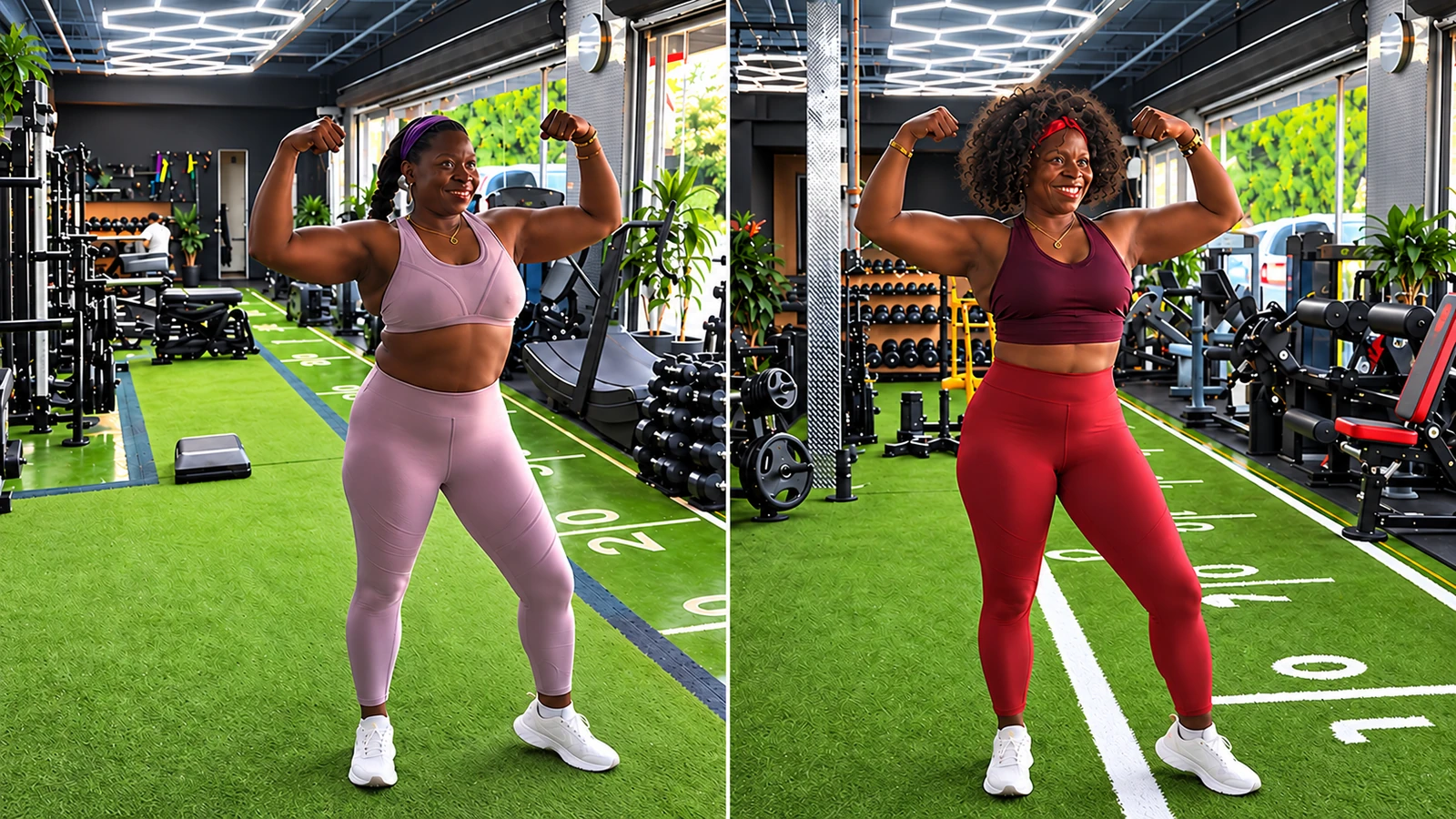

Leslie Jones, 59, has put the focus of her public fitness message on her muscles and finding training support that suits her now.
In an October 20 Instagram post, she credited trainer Ronnie Czar and Fulhaus Club while reflecting on her earlier athletic experience.
The post carries an AI content label, so its images should not be treated as measurements of her physique or independent proof of progress.
Her words still raise a useful question: what makes a training approach fit the person you are today?
A useful training fit starts with the person’s present abilities and priorities.
Progress deserves a description that goes beyond a photograph.
What Jones shared about her training
Jones described a better experience after focusing on suitable workouts and a trainer she valued.
She identified Czar as a physical therapist turned trainer with an interest in clients over 40 and movement across life.
Those statements describe her experience and her view of the coaching relationship.
They do not provide a complete exercise list, a weekly training volume, or a medical explanation of any visible change.
Keeping the account at that level allows readers to appreciate her message without inventing a private program.
It also avoids turning her endorsement of a particular relationship into a promise that the same arrangement will produce the same outcome for someone else.
Why past athletic experience is not a current program
Jones reflected on being an athlete earlier in life, which provides context for why a changing approach stood out to her.
Past experience can help someone describe what they enjoy, but it does not fill in the details of their present schedule or support needs.
A useful conversation starts with current priorities, available time, familiar movements, and any restrictions already identified by a clinician.
Ask what you want to do more comfortably or consistently, rather than assuming an old routine should remain the benchmark.
That makes the goal concrete without using another person’s public image as a standard you must match.
Strength can matter without a makeover deadline
The National Institute on Aging describes research on strength training and older adults that includes muscle mass, mobility, and physical function.
Those are reasons to consider what training helps a person do, alongside any appearance-related goals they may choose.
The research is general evidence, not a measurement of Jones’s own progress or proof of what caused a particular change.
A photograph cannot establish all the factors behind someone’s fitness, and the AI label makes that limitation especially relevant here.
Our coverage of strength training after 70 similarly separates a public figure’s story from findings that apply to broader groups.
A realistic goal needs its own starting point and a way to assess the task it describes.
Four questions for choosing a training fit
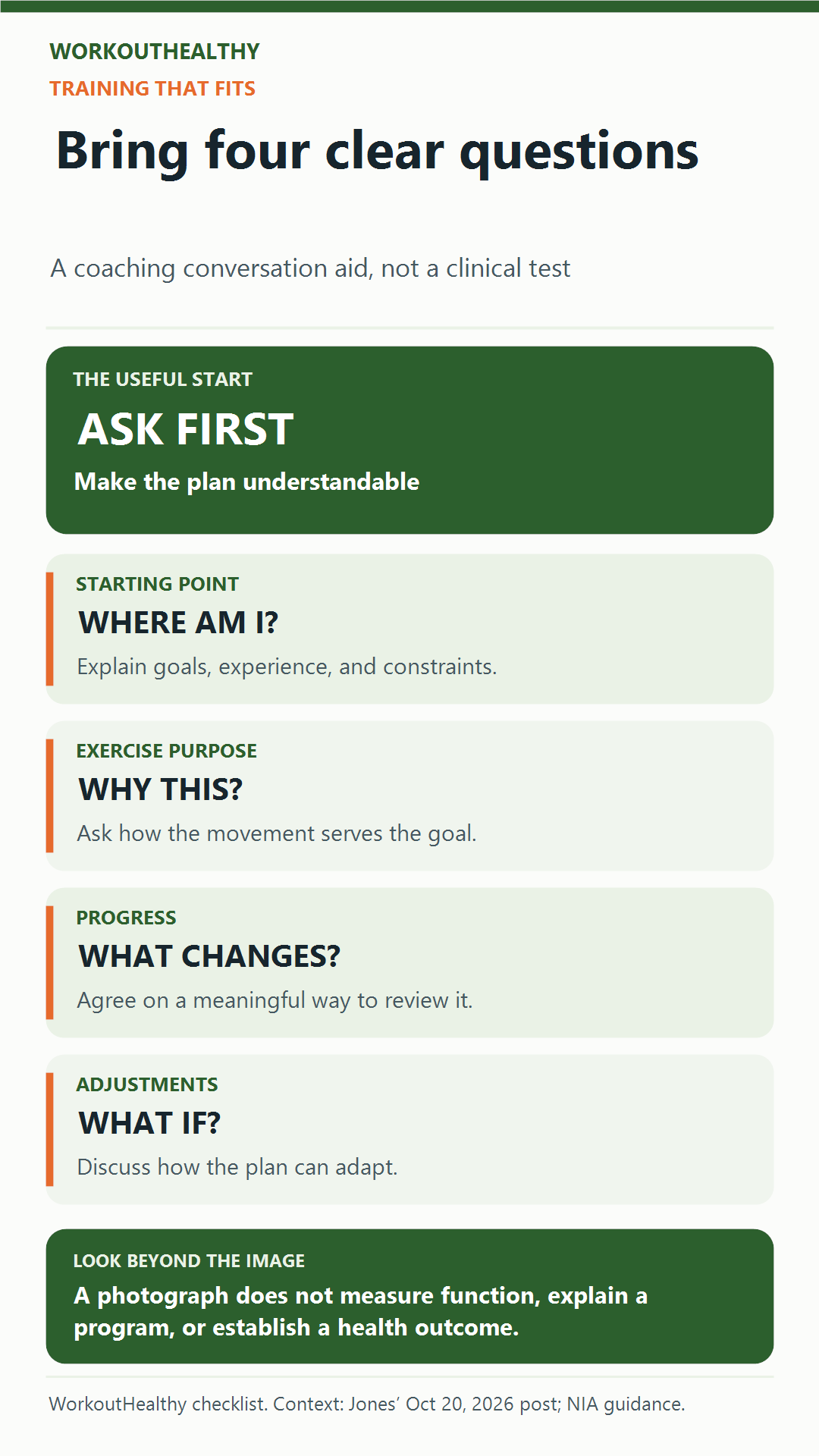
WorkoutHealthy’s editorial checklist turns the idea of a better fit into four questions you can discuss with a qualified coach.
What is the starting point?
Explain your goals, current experience, available time, and any guidance you already have.
Why this exercise?
Ask what a movement is intended to practice and how the choice relates to your goal.
How will progress be recognized?
Agree on an appropriate measure, rather than leaving success dependent on a flattering image.
What changes when circumstances change?
Ask how the plan can respond to limited time, uncertainty, or a need for professional advice.
This checklist is an editorial conversation aid, not a clinical assessment or a claim about Czar’s exact coaching process.
An answer can be simple and still be specific, such as explaining how a familiar movement will be practiced consistently before it becomes more demanding.
Track changes a photograph cannot show
A training note can record what you practiced, what assistance you needed, and whether you understood the purpose of the session.
If a goal concerns an everyday task, describe the task clearly enough that a later comparison means something.
Examples might include carrying a familiar bag, getting up from a usual chair, or completing a planned activity with appropriate support.
These are possible discussion topics, not diagnostic tests or promises that a particular workout will produce a particular result.
Keep the setup comparable and avoid treating an unusually easy or difficult day as the whole story.
Your own notes can then give a coach more useful information than an assumption drawn from someone else’s post.
Leave room for the rest of fitness
The CDC’s general adult guidance includes aerobic activity and muscle-strengthening activity, with activity spread across the week.
The National Institute on Aging also emphasizes a broader mix of exercise and describes strength work as one part of maintaining physical ability.
That context keeps a muscle-focused headline from becoming a claim that every other kind of movement no longer matters.
How someone combines those activities depends on their circumstances and any individualized professional advice.
Before choosing a coach, our guide to questions personal trainers may not answer up front can help you ask about expectations and the reasoning behind a plan.
The aim is an approach you understand well enough to discuss and adapt.
Keep the headline in proportion
Jones’s account offers a personal message about finding support and changing the focus of her training.
It does not establish a universal age at which everyone’s needs change in the same way.
It also does not justify a deadline for a body transformation, a guessed workload, or a conclusion about health based on photographs.
The more useful takeaway is to bring specific questions to the next conversation about your own goals.
Use the four-question checklist to make that discussion practical, with a clear starting point and an agreed way to review the plan.
Medical disclaimer: This article is general product information, not medical advice. The equipment described here is not a treatment for any condition. If you have an injury, ongoing pain, or a medical condition, talk to a doctor or physical therapist before using any of it.