
A handgrip device looks too small to matter for cardiovascular health. Yet research on isometric handgrip training—squeezing against resistance without moving the joint—suggests that repeated sessions can lower resting blood pressure in some adults with hypertension. The effect is promising, but the evidence is narrower than a viral “15-point drop” claim makes it sound.
The important distinction is between a program practiced over weeks and a single squeeze. The latter has not shown the same benefit. Handgrip work also does not replace prescribed medication, aerobic activity, or an individualized plan from a clinician.
What exactly is isometric handgrip training?
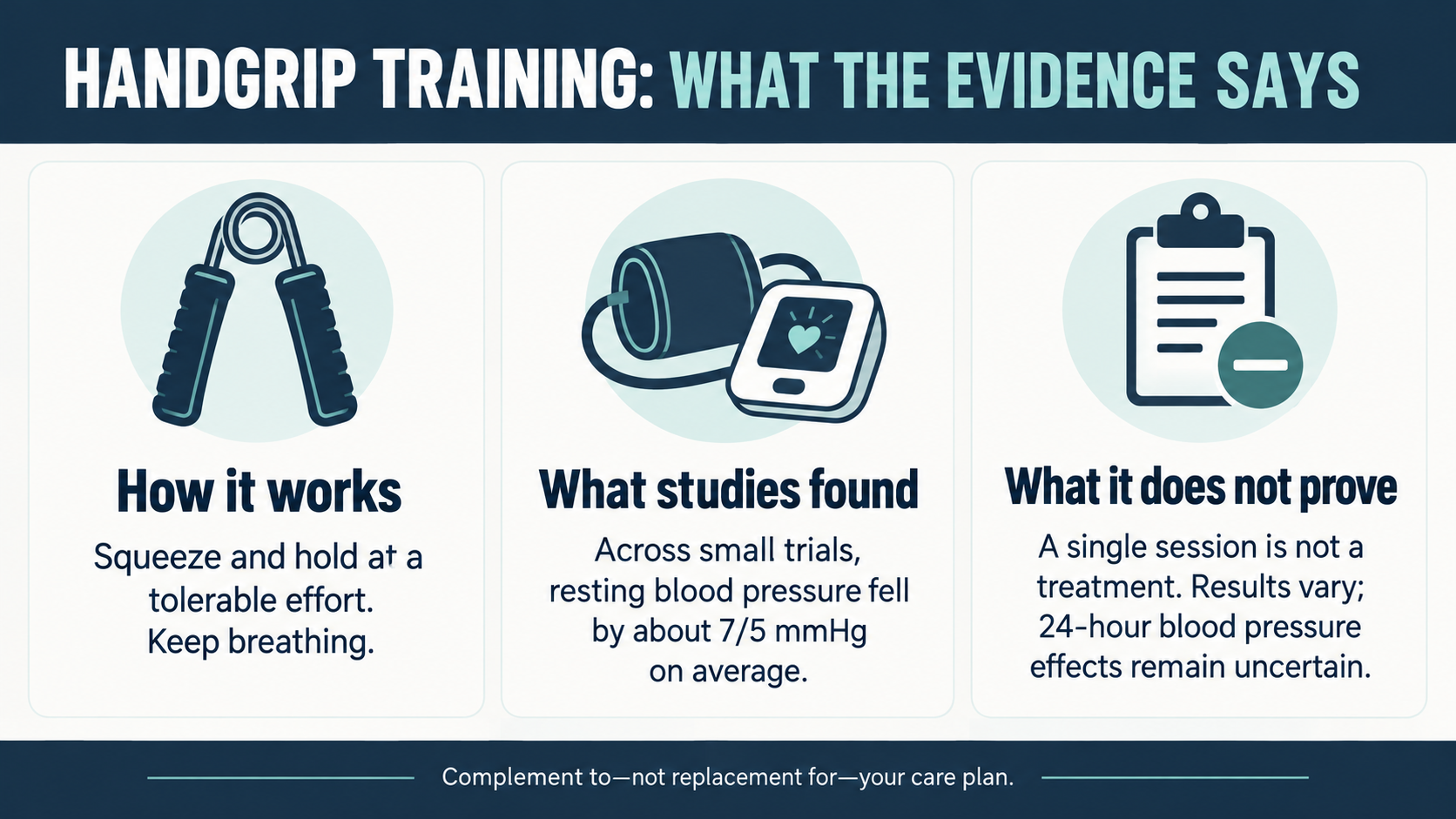
An isometric contraction creates muscle tension while the joint stays approximately still. In a handgrip session, a person holds a calibrated gripper or dynamometer at a chosen fraction of their maximal voluntary grip. This differs from rapidly pumping a spring gripper to fatigue. The training question is whether a repeated, controlled stimulus alters resting blood pressure over time.
The method is appealing because equipment is compact and a session can be short. But a short session is not the same as a universally safe or effective one. Effort level, breath control, session frequency, baseline blood pressure, medication, and the way pressure is measured all matter. The studies also typically used controlled protocols rather than an arbitrary gripper squeezed as hard as possible.
What the handgrip-specific review found
A 2023 systematic review by Oliveira and colleagues assembled nine randomized controlled trials in adults with hypertension and no comorbid conditions. Seven studied a training program; two looked at a single session. In the training trials, the pooled difference versus control was approximately 6.7 mmHg lower systolic pressure and 4.5 mmHg lower diastolic pressure. The single-session analysis found no meaningful reduction. Those are group averages, not a forecast for an individual reader.
The review’s prediction interval is another reason for restraint: while the systolic estimate remained below zero, the diastolic interval extended above zero. A future setting or participant group could see a smaller diastolic effect. Study size, protocol variation, and who was eligible limit how widely the pooled numbers should be generalized. The researchers’ participants were not a stand-in for everyone with heart disease, kidney disease, diabetes, or complex medication regimens.
Bottom line: Repeated handgrip training has shown a modest average reduction in resting blood pressure in selected adults with hypertension; one squeeze session is not a quick blood-pressure treatment.
Where the bigger isometric numbers come from
A broader 2023 network meta-analysis by Edwards and colleagues compared many exercise modes across 270 randomized trials. Its pooled estimate for isometric exercise was roughly 8 mmHg systolic and 4 mmHg diastolic. But “isometric exercise” included more than handgrip, including wall-sit and leg-extension protocols. It is therefore inaccurate to paste that pooled figure onto a handgrip device or promise a 15-point result to everyone.
Blood pressure is also reported in several ways. Office readings, home readings, and 24-hour ambulatory monitoring do not capture identical phenomena. A lower resting office reading can be meaningful, but it does not automatically establish a sustained around-the-clock effect. Reviews examining ambulatory outcomes have not established a clear, uniform 24-hour reduction from handgrip training. That gap deserves attention before turning an interesting intervention into an absolute claim.
Why might repeated holds affect blood pressure?
Researchers have proposed changes in autonomic regulation and blood-vessel function. A brief contraction alters local circulation; with repeated training, the vascular system might adapt. Nitric-oxide signaling is one proposed pathway, but the available clinical trials do not prove that one mechanism explains the observed blood-pressure changes in every participant. A social-media caption can make a mechanistic story sound settled when it is still being studied.
It is also possible for any exercise habit to improve routines around sleep, stress, or other activity. Randomized comparisons help separate training from those influences, but small trials cannot answer every long-term question. The practical takeaway is not to chase a single biochemical explanation. It is to treat handgrip work as one optional, measurable addition to a larger health plan.
A cautious, clinician-informed starting framework
If a clinician says isometric work is suitable for you, ask what intensity and monitoring fit your situation. Research protocols often use several sustained holds of approximately two minutes, repeated on multiple days each week, with rest between efforts. That is a description of studied protocols, not a one-size-fits-all prescription. Some people should use a lower effort or avoid the practice altogether.
Begin with a device that permits repeatable resistance. Sit comfortably, keep the shoulder relaxed, and breathe throughout the hold. Do not clamp down at maximal effort or hold your breath: straining can sharply raise blood pressure during a contraction, even if a longer training program may improve resting readings. Stop if you develop chest discomfort, severe headache, dizziness, unusual breathlessness, or other concerning symptoms, and seek appropriate medical help.
Build regularity before intensity. A simple log of device setting, hold duration, perceived effort, and symptoms is more useful than chasing the hardest squeeze. If a structured session is difficult, discuss modifications with your clinician rather than improvising a more strenuous version. The purpose is a sustainable intervention with a clear safety boundary.
Measure change rather than guessing
One isolated blood-pressure reading can move because of timing, caffeine, exercise, stress, talking, posture, or cuff fit. For useful home readings, follow the technique and schedule recommended by your care team, use a validated upper-arm cuff, rest quietly beforehand, and record multiple readings over time. Compare like with like: a morning baseline versus later morning readings under similar conditions, rather than a single best number after a workout.
Share the log with the clinician managing your blood pressure. If readings change, do not independently stop or reduce medication. A clinician can decide whether the change is durable, whether the cuff is accurate, and whether medication adjustments are appropriate. The same principle applies if you are taking medication that affects heart rate or exercise tolerance.
Practical test: The useful question is not “Did one squeeze drop my number?” but “Does a safe, consistent program change repeated resting readings without displacing proven care?”
What should stay in the plan?
The American Heart Association continues to recommend regular aerobic activity as a foundation of blood-pressure management. It also recognizes resistance activity as part of an overall exercise approach. Handgrip training may be an accessible extra option, not an excuse to abandon walking, cycling, strength training, nutrition changes, sleep, or prescribed treatment. If time is limited, prioritize the pieces of a plan with the strongest fit to your needs and abilities.
For readers deciding among exercise claims, our related guide on personalizing exercise for chronic disease explains why one generic program rarely works for every diagnosis. The broader story of regular workouts and muscle aging also shows why consistency usually matters more than a dramatic single session.
Who should seek individual advice first?
Anyone with diagnosed hypertension should consider discussing a new isometric routine with the clinician overseeing their care, especially if readings are not controlled, medication is changing, or cardiovascular symptoms are present. The handgrip-specific meta-analysis focused on adults without comorbid conditions, so its pooled effect should not be assumed for people with more complex disease. Pregnancy, recent cardiac events, or instructions to avoid straining call for individualized guidance.
If you experience symptoms during exertion, stop the activity. If you are unsure whether a reading or symptom needs urgent attention, follow your care team’s emergency plan or seek prompt medical evaluation. An article cannot diagnose an individual or decide whether a given blood-pressure number requires treatment.
The evidence-based takeaway
Isometric handgrip training is more credible than a gimmick, but less certain than a guarantee. In selected adults with hypertension, repeated training produced a modest average reduction in resting blood pressure across small trials. One session did not. The best next step is to discuss whether a controlled program fits your health situation, keep breathing through the holds, track repeated readings correctly, and maintain the rest of your care plan.
The social post’s strongest claim is not that a small device can replace medicine; it is that an overlooked form of resistance exercise may offer an additional tool. That is useful precisely when its limits are made clear.
Sources
Oliveira, P. C., Silva, M. R., Lehnen, A. M., & Waclawovsky, G. (2023). Isometric handgrip training, but not a single session, reduces blood pressure in individuals with hypertension: A systematic review and meta-analysis. Journal of Human Hypertension, 37, 844–853. Study record.
Edwards, J. J., et al. (2023). Exercise training and resting blood pressure: A large-scale pairwise and network meta-analysis of randomised controlled trials. British Journal of Sports Medicine. Study.
American Heart Association. (2025). Getting active to control high blood pressure. Guidance.
Medical note: This article is educational and is not individualized medical advice. Do not change prescribed medication or begin strenuous exercise without guidance from your qualified care team.