

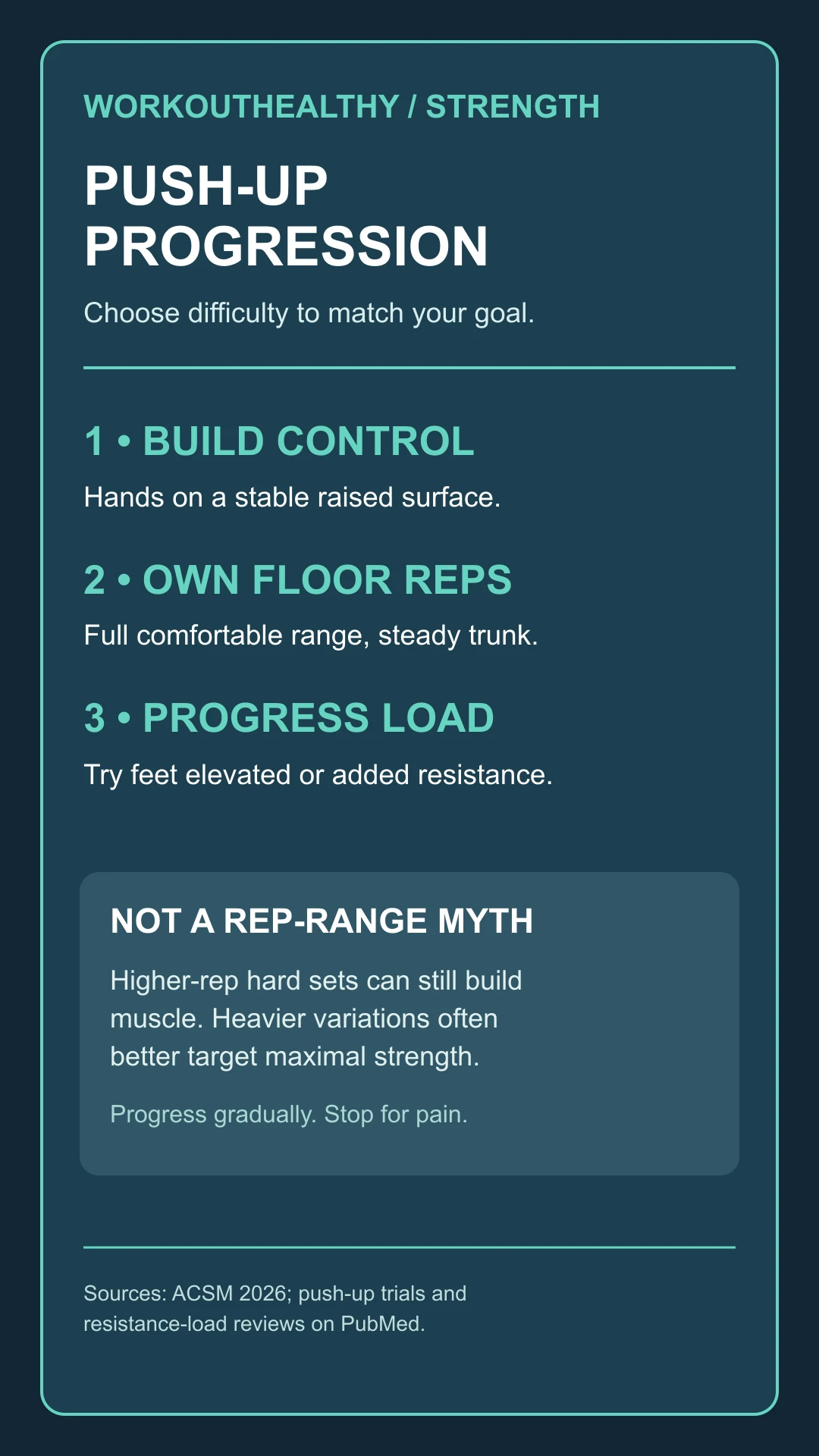
A useful push up progression changes the challenge as your strength and control improve. One practical route is wall, higher incline, lower incline and floor push-ups, followed by a goal-specific choice of more repetitions, a harder variation or extra resistance.
You do not have to reach the floor by a particular week or complete a magic number before progressing. Choose a version you can repeat, record the setup and change one demand at a time.
Choose your starting push-up version
Start with a version that lets you lower and press through a repeatable, comfortable range. The table gives options, not a compulsory ladder that everyone must follow from the first row.
| Option | Setup | What to record |
|---|---|---|
| Wall | Hands against a wall, feet on the floor and body held steady while the elbows bend and straighten. | Foot distance from the wall, hand height and repeatable range. |
| Higher incline | Hands on a fixed high counter or anchored bar, with feet on the floor. | The exact support and hand height. |
| Lower incline | Hands on a lower fixed support that cannot slide or tip. | Support height, body position and depth. |
| Floor | Hands and feet on the floor, lowering and pressing with a steady trunk. | Repetitions and whether the last one resembles the first. |
In a force-platform study of 23 recreationally fit adults, the two tested hands-elevated variations produced lower peak force than regular floor push-ups. This supports using an incline to reduce loading, but it did not test this entire progression or the right starting height for you.
Knee push-ups are another option. They are not a mandatory bridge between an incline and the floor, and you do not need a low hold or a negative-only repetition to earn permission to practice a different version.
Mayo Clinic’s modified-push-up page provides its own demonstration and transcript for knee and wall versions. Its basic cues are a steady body, engaged abdominal muscles and smooth movement, without sagging or arching.
A trainer can help you learn an unfamiliar setup and choose a suitable challenge. A written progression is a planning tool, not an individual technique assessment.
When should you move to a harder version?
Use repeated sessions at the same setup to judge whether it has become manageable. Look at depth, body position and effort along with the number of repetitions.
There is no universal ten-repetition threshold that makes the next version appropriate for every person. A different support height can change the task substantially, so a new version may require fewer repetitions.
| What happens | Useful next decision |
|---|---|
| The same version feels more manageable with consistent range. | Consider a small increase in repetitions or a modestly lower fixed support. Change one variable so you can assess it. |
| A lower support makes every repetition shorter or less controlled. | Use the previous height for your main work rather than counting altered repetitions as the same task. |
| You can do a floor repetition but cannot yet repeat floor sets well. | Floor practice and incline work can coexist; one floor rep does not mean every set has to move there. |
| Performance falls while the whole week becomes harder. | Review recovery and other pressing work before adding more sets or harder variations. |
| Pain appears. | Stop the provoking exercise and seek individual advice. A more difficult variation is not a way to work through pain. |
These are general decision examples, not a tested treatment or a fixed training prescription. If you are uncertain about sets, repetitions or rest, have a qualified trainer help you select them for your starting level and weekly routine.
Copy this push-up session log
The number “twenty push-ups” leaves out whether your hands were on a counter, a bench or the floor. Record the task as well as the result.
| Field | Your note |
|---|---|
| Goal: first floor rep, strength, muscle growth or repeated reps | ____ |
| Version and exact support height | ____ |
| Repetitions in each set | ____ |
| Range and body position compared with last time | ____ |
| Effort, rest and any discomfort | ____ |
| One choice for next time: repeat, add reps or change version | ____ |
For example, a lower support with fewer controlled repetitions can be useful progress even when the day’s rep total falls. This is an illustrative comparison, not a client’s result or a promise about your next session.
What comes after floor push-ups?
There is no single next exercise. Choose the next demand according to what you want to improve.
- More repeated push-ups: keep regular floor repetitions as the task you are practicing and build repeatable work over time.
- Greater pressing strength: a harder variation or suitable added resistance may be more useful than endlessly extending easy sets.
- Muscle growth: choose a progressive challenge and enough recoverable work; a higher rep count is not automatically ineffective.
- A specific skill: learn that skill’s technique rather than treating every advanced social-media variation as the next compulsory step.
A systematic review of resistance-training loads found similar average muscle growth with higher and lower loads, while higher loads produced greater maximal-strength gains. That finding helps distinguish goals, but it does not validate every push-up variation or equate a casual daily challenge with a studied training program.
Feet-elevated push-ups and added resistance can increase demand, but neither is mandatory. Learn the setup and use a version appropriate to your ability before treating extra difficulty as useful progression.
An incline push-up places the hands higher to reduce the loading demand. A deficit push-up uses hand supports to permit extra depth below hand level; simply elevating the hands does not make an exercise a deficit.
What do push-up studies actually show?
In a four-week randomized study of 23 moderately trained men, progressive push-up and bench-press groups both improved bench-press strength and push-up progression. Neither group had a statistically significant change in muscle thickness.
A separate eight-week trial of 18 young men compared load-adjusted push-ups with bench pressing at about 40% of one-repetition maximum. Both groups increased pectoral and triceps thickness and bench-press strength, without significant between-group differences in those outcomes.
The studies used different participants and programs. Neither tested this planning guide or a promise to reach the floor within four weeks.
The 2026 ACSM resistance-training overview separates outcomes such as strength, muscle growth, power and endurance. That distinction is useful when a push-up routine has become an effort to beat yesterday’s rep total without a clear goal.
Are 100 push-ups a day pointless?
A rep total alone cannot establish whether a program is useful. The same total can represent demanding work for one person and easy practice for another.
Higher-repetition resistance training can build muscle under studied conditions, so “high reps are only endurance” is too absolute. Equally, the studies above do not show that one hundred casual daily repetitions are a superior plan.
Ask whether the work serves your goal, becomes appropriately challenging and leaves room to recover. Do not replace one arbitrary daily number with another arbitrary rule about ten perfect repetitions.
Check support, movement and comfort
Use a fixed support that cannot roll, tip or slide. Do not choose a lightweight chair merely because its height seems convenient.
Keep repetitions smooth and your body position repeatable. Stop when pain occurs, and get individual clinical guidance if an injury, ongoing symptoms or a medical condition affects exercise.
This guide does not prescribe wrist or shoulder rehabilitation, a universal elbow angle or a return-to-training schedule. A clinician’s plan takes priority when those issues apply.
Push-ups are one part of training. Use our complete training program audit to consider pulling work, lower-body training and the rest of your week.
Your next training decision
Choose a repeatable version, log the setup and judge progress by more than the day’s total. Lower the hand support or change the demand when the current work has become manageable, then keep the next step tied to your goal.
Get the next evidence check.
Five practical fitness stories worth your time, every Friday.
One email a week. No product pitches. Unsubscribe in one click.
Sources
- Ebben et al. (2011): force-platform comparison of push-up variations.
- Kotarsky et al. (2018): progressive calisthenic push-up training.
- Kikuchi and Nakazato (2017): low-load push-up and bench-press comparison.
- Refalo et al. (2021): higher- and lower-load resistance-training review.
- ACSM (2026): resistance-training position-stand overview.
- Mayo Clinic: modified-push-up instructions, demonstration and transcript.
Medical disclaimer: This article is general fitness information, not medical advice. If you have an injury, ongoing pain or a medical condition, talk to a doctor or physical therapist before changing how you train.