
In April 1899, Theodore Roosevelt stood before a Chicago audience and made a bold request.
He asked Americans to choose hard effort over easy comfort.
A widely shared version of his message turns it into simple fitness advice. Pick the strenuous life, not the soft one.
The speech was about much more than exercise, though, and that context matters.
What Roosevelt Actually Said
The speech is known as “The Strenuous Life.” Roosevelt gave it at the Hamilton Club in Chicago on April 10, 1899.
He was governor of New York at the time.
His best known line opens the speech.
“I wish to preach, not the doctrine of ignoble ease, but the doctrine of the strenuous life, the life of toil and effort…”
Later, he urged listeners to “shrink from no strife, moral or physical.”
So the attribution is solid. Roosevelt really did preach effort over ease, in public and in those words.
The Part the Fitness Version Leaves Out
The speech was not a workout guide.
Much of it argued for national greatness and for American expansion overseas.
Roosevelt defended U.S. rule over the Philippines and mocked people who opposed it as timid.
Those political views are part of the record, and many readers today find them troubling.
It is fair to borrow the personal lesson about effort. It is not fair to pretend the speech was only about hiking and boxing.
How He Lived the Idea
Roosevelt did practice what he preached in his own life.
He boxed, rowed, hiked, rode horses, and played tennis.
He kept boxing while he was governor and president.
He stopped after a detached retina left him blind in one eye.
He also practiced jujitsu, and he was known for swimming outdoors in winter.
His habit of hard play started young and carried on into his busy adult life.
For him, effort was not a phase. It was a daily choice he kept making for decades.
That eye injury is a useful reminder. Chosen hardship can carry real costs.
What Research Says About Choosing Effort
Modern studies do not test “the strenuous life” directly.
They do test what happens when people move more, and when they add short bursts of hard effort.
A 2018 study by Chekroud and colleagues looked at 1.2 million adults in the United States.
People who exercised reported 1.49 fewer days of poor mental health in the past month than people who did not.
That was a 43.2 percent difference.
Team sports, cycling, and gym or aerobic activity showed the largest links.
The authors also noted that more exercise was not always better.
Sessions of about 45 minutes, three to five times per week, showed the strongest associations.
Small Doses of Hard Effort Count
You do not need to box daily to get some of the benefit.
A 2022 study by Stamatakis and colleagues tracked 25,241 adults who said they did not exercise.
Wrist devices picked up short bursts of vigorous movement during daily life, outside of formal exercise.
A median of 4.4 minutes per day of these bursts was linked to a 26 to 30 percent lower risk of death from any cause and from cancer.
The same amount was linked to a 32 to 34 percent lower risk of death from heart disease.
This was an observational study, so it shows a link, not proof of cause.
Still, it suggests that choosing the harder option a few times a day may add up.
What the Evidence Does Not Say
Neither study shows that suffering itself is healthy.
The benefits come from regular movement and some hard effort, not from pain or exhaustion.
The mental health study also found limits. More exercise was not always better.
And neither study can tell you what counts as “strenuous” for your body.
A brisk flight of stairs is hard work for some people and a warm up for others.
How to Choose the Harder Path Today
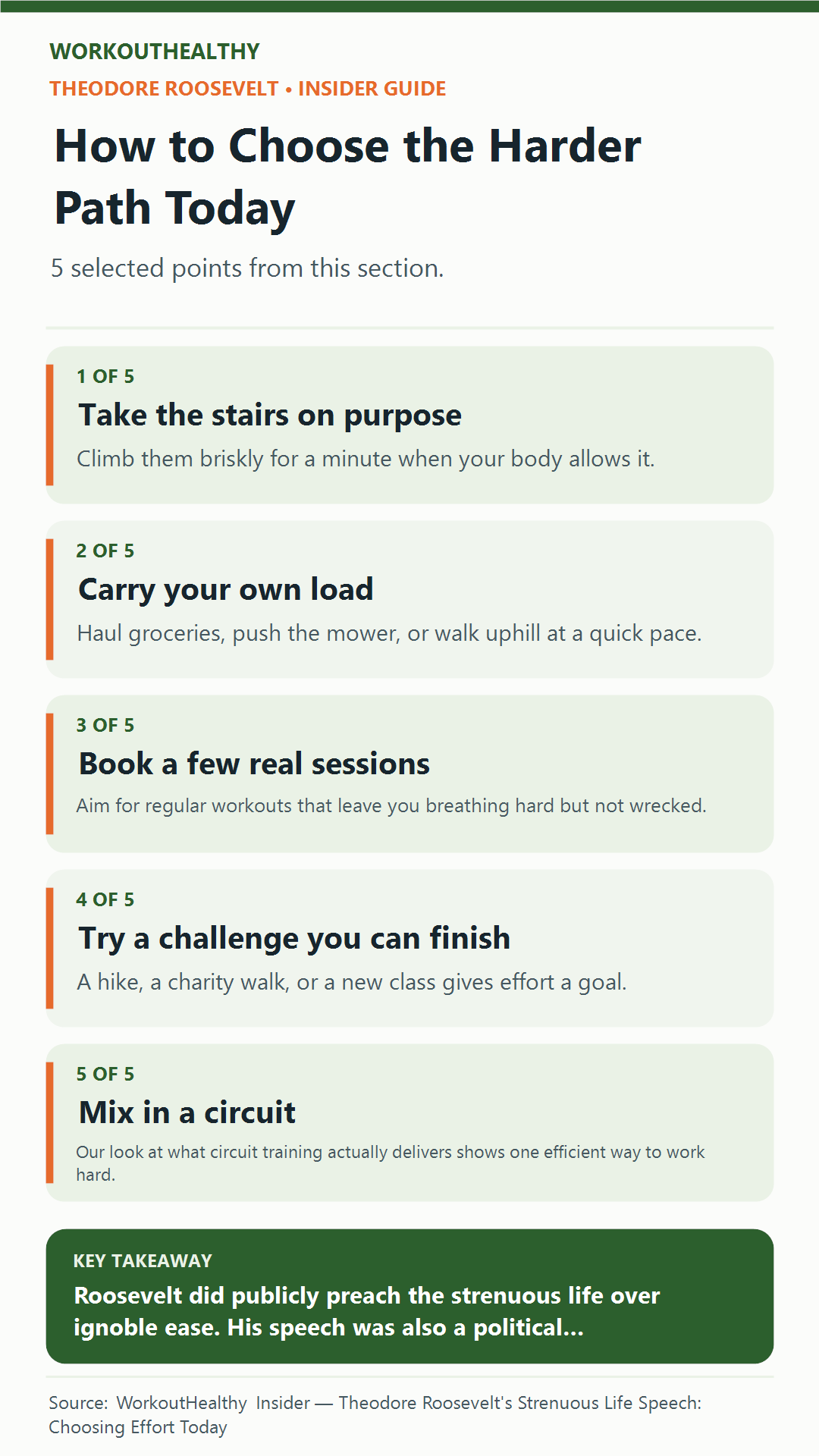
- Take the stairs on purpose. Climb them briskly for a minute when your body allows it.
- Carry your own load. Haul groceries, push the mower, or walk uphill at a quick pace.
- Book a few real sessions. Aim for regular workouts that leave you breathing hard but not wrecked.
- Try a challenge you can finish. A hike, a charity walk, or a new class gives effort a goal.
- Mix in a circuit. Our look at what circuit training actually delivers shows one efficient way to work hard.
- Keep easy days easy. Hard effort works best when rest days let you recover.
Even a short test of effort can be useful. See our piece on whether a one minute wall sit can work like cardio.
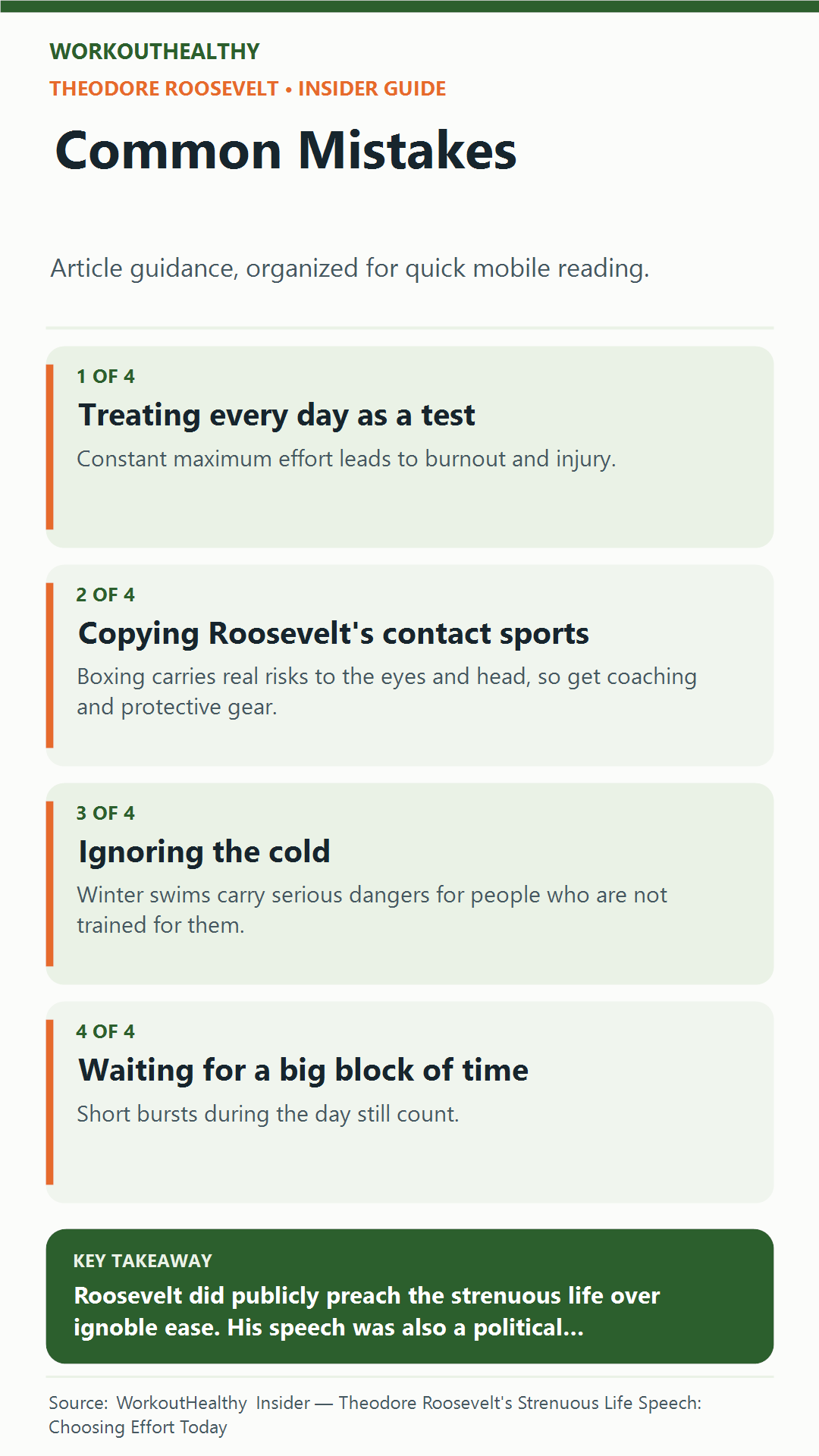
Common Mistakes
- Treating every day as a test. Constant maximum effort leads to burnout and injury.
- Copying Roosevelt’s contact sports. Boxing carries real risks to the eyes and head, so get coaching and protective gear.
- Ignoring the cold. Winter swims carry serious dangers for people who are not trained for them.
- Waiting for a big block of time. Short bursts during the day still count.
Who Should Be Careful
People with heart disease, high blood pressure, or chest pain should get medical advice before adding vigorous effort.
The same goes for anyone who is new to exercise after a long break.
If you are recovering from an illness, build up slowly rather than jumping into hard sessions.
Older adults can still benefit from harder efforts. They just need a longer warm up and a slower build.
The Bottom Line
Roosevelt did publicly preach the strenuous life over ignoble ease.
His speech was also a political argument, and that part does not translate into fitness advice.
The personal lesson holds up well.
Regular exercise and small, repeated bursts of hard effort are linked to better mental health and longer life.
Choose the harder option often, but keep it within what your body can recover from.
Want more stories like this? Subscribe to WorkoutHealthy Insider for practical explanations behind popular fitness claims.
References
- Chekroud, S. R., Gueorguieva, R., Zheutlin, A. B., Paulus, M., Krumholz, H. M., Krystal, J. H., & Chekroud, A. M. (2018). Association between physical exercise and mental health in 1.2 million individuals in the USA between 2011 and 2015: A cross-sectional study. The Lancet Psychiatry, 5(9), 739 to 746. https://doi.org/10.1016/S2215-0366(18)30227-X
- Roosevelt, T. (1899, April 10). The strenuous life [Speech]. Hamilton Club, Chicago, IL.
- Stamatakis, E., Ahmadi, M. N., Gill, J. M. R., Thøgersen-Ntoumani, C., Gibala, M. J., Doherty, A., & Hamer, M. (2022). Association of wearable device-measured vigorous intermittent lifestyle physical activity with mortality. Nature Medicine, 28(12), 2521 to 2529. https://doi.org/10.1038/s41591-022-02100-x
This article is for general information only and is not medical advice. If you have an injury, ongoing pain, or a medical condition, talk to a doctor or physical therapist before you change how you train or eat.