
Choking under pressure is performing below expected skill when success feels important. A miss alone does not establish it.
Worries can distract, while excessive monitoring can disrupt a familiar movement. Describe what changed rather than judge the athlete.
This guide pairs research comparisons with an athlete-coach practice example and a discussion record.
The featured illustration’s pulse-style lines are decorative. They are not a heart recording or a measurement of calmness.
Describe what changed under pressure
Roy Baumeister’s 1984 paper proposed that pressure can increase conscious attention to the process of performing a skill and disrupt its normally automatic execution. Six experiments produced findings consistent with that account.
This account does not diagnose every error. Mesagno and Beckmann’s 2017 review notes definition disagreements.
Compare the task, opponent, distance and technical demands before choosing an explanation.
A basketball player can miss while using a familiar routine, and a team can lose while playing well. Calling either result “choking” without more information hides the question that might actually help the next practice.
A useful starting description is specific: what the athlete attempted, what changed in the setting and what they noticed. “I started checking my wrist position before every shot” gives a coach more to discuss than “I am bad under pressure.”
Different attention problems need different questions
Mesagno and Beckmann discuss self-presentation, distraction and self-focus models. These do not form a diagnostic checklist.
| Possible pattern | An athlete might describe | A useful follow-up question |
|---|---|---|
| Distraction | Thinking about the score or consequences instead of the next action. | What information did the task require at that moment? |
| Excessive movement monitoring | Trying to control every part of an already familiar movement. | Was a new technical checklist replacing the usual cue? |
| Concern about evaluation | Worrying about how others would judge the performance. | What did the audience or evaluation mean to the athlete? |
The examples are discussion prompts, not validated assessment items. More than one description may fit, and an athlete may not know what happened during a fast action.
“Focus harder” is therefore an incomplete instruction. It leaves open what the athlete should attend to and whether that instruction matches a new skill or a well-practiced one.
Why the task and its familiarity matter
Beilock and Carr’s 2001 experiments found pressure disrupted trained golf putting, but not an alphabet arithmetic task.
Camera-observed practice changed later laboratory putting responses, showing preparation and task can interact.
The pressure tests included trained novices, not simply experienced young athletes. Laboratory putting does not recreate opponents, fatigue and tactical decisions in matches.
Technical instruction still has a place in learning. The question is when and how it is used, especially if a detailed correction is introduced just before an athlete performs a familiar action.
A coach can separate a technical learning session from a competition rehearsal. That makes it easier to discuss whether the immediate aim is learning a change or using something the athlete already knows.
What self-talk and mental training studies found
Hatzigeorgiadis and colleagues’ 2011 meta-analysis included 32 studies and 62 effect sizes. It reported a moderate positive effect of self-talk on sport task performance, with an overall effect size of 0.48.
Effects varied with the task: they were larger for fine motor demands and novel tasks, and interventions that included self-talk training worked better than those without that training. Instructional cues were more effective than motivational self-talk for fine tasks, which does not make instructional cues the winner for every sport or situation.
Brown and Fletcher’s 2017 meta-analysis combined 35 studies and 997 sport participants: a moderate postintervention Hedges’ g of 0.57, with a 95 percent confidence interval of 0.22 to 0.92.
These standardized effects are not 48 or 57 percent score gains. Interventions, sports and performance measures varied substantially.
Brown and Fletcher’s prediction interval included positive, null and negative effects. Only eight studies supplied follow-up data, one to four weeks after the intervention ended.
Neither review establishes an ideal cue, universal duration or championship guarantee.
Reappraising nerves is different from proving sport performance
Jamieson, Nock and Mendes recruited 50 adults, averaging about 22 years, for stressful speech and arithmetic followed by an attention test.
Reappraisal taught arousal could help without making the task easy; cardiac-output reactivity was higher and vascular-resistance reactivity lower versus controls.
Attention bias was lower versus attention reorientation (p = 0.013), but the comparison with no instructions was not conventionally significant (p = 0.055).
The study tested neither sport results nor youth teams, and did not establish that complete calmness was necessary.
Explore interpretations in practice without dismissing concerning physical symptoms as harmless nerves.
Build one small rehearsal around a familiar task
The following is an editorial practice example, not a tested training package. Its purpose is to make an athlete-coach conversation concrete without prescribing a psychological treatment.
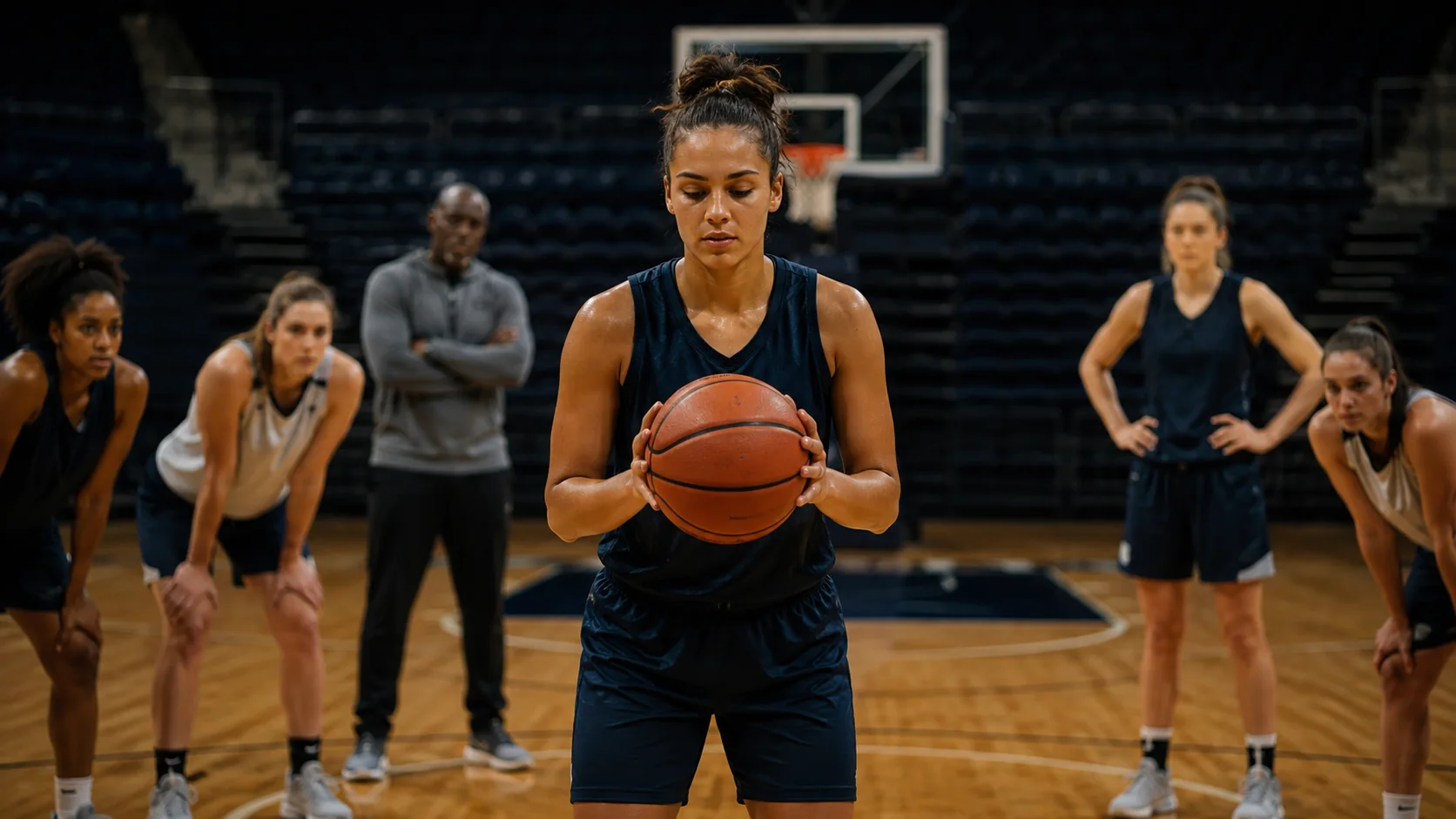
Imagine a basketball player who already knows their free-throw routine but starts adding technical instructions when people watch. The coach and player could agree to rehearse the familiar routine with a teammate observing, while keeping the shooting task otherwise comparable.
They would choose one cue the player understands and has practiced, rather than add several new corrections. An example might be “target,” if that word has a clear task meaning for that player.
The example cue is a discussion candidate, not the tested intervention.
- Name the task: identify a familiar skill and the part of performance being observed.
- Agree on the setting: choose a manageable, ordinary practice condition, such as a teammate watching or keeping the usual score.
- Keep one response consistent: rehearse the agreed cue or familiar preparation routine.
- Review both result and experience: discuss what happened and where attention went.
- Choose one next question: decide whether to keep the approach, simplify it or seek more support.
Participation should be collaborative, especially with young athletes. Humiliation, surprise punishments or extra exercise for mistakes are not necessary parts of this example.
Do not copy the same arrangement into an unfamiliar or hazardous physical task just to create pressure. Keep the sport’s normal safety rules and the athlete’s existing training restrictions.
Keep a practice record with context
A result and an explanation are separate entries. Recording both helps keep a successful attempt from becoming proof of a theory and a missed attempt from becoming a judgment about the athlete.
| Record | Example or question |
|---|---|
| Task and conditions | What stayed the same, and what changed? |
| Response rehearsed | Which familiar cue or routine was used? |
| Observed performance | Use the task’s normal measure, keeping attempts and successes identifiable. |
| Athlete’s experience | Where did attention go? Was the instruction clear? |
| Other possible influences | Was the task harder, the player tired or the equipment different? |
| Next discussion | What single change or question is worth considering? |
This record is not a validated choking scale or a controlled experiment. A small practice sample cannot separate learning, fatigue, chance and the effect of a new cue.
Still, it can reveal useful practical details. “The cue made sense in practice but I forgot it when the score changed” identifies a different question from “I used the cue and it distracted me.”
For coaches and parents, an opening such as “What did you notice before that attempt?” invites a description. The alternative of demanding an explanation for a personal failure can make it harder to learn anything specific.
These conversation examples are suggestions, not scripts tested in the cited trials. Discussing them outside the immediate competitive moment gives the athlete room to respond.
Know when performance support is not enough
The Association for Applied Sport Psychology distinguishes mental performance support from licensed mental health care. Someone can perform well in sport while struggling elsewhere, or have a performance problem without a broader mental health problem.
If distress is persistent or affecting life beyond sport, seek an appropriately licensed healthcare professional rather than relying on a cue-word worksheet. A performance consultant’s title alone does not establish a mental health treatment qualification.
Ask prospective support providers about their training, scope and experience with the athlete’s age and sport. A collaborative plan should make clear what is being practiced and how it will be reviewed.
Bring the task, observations and next question to practice rather than judge the athlete by one result.
Medical disclaimer: This article provides general sport and health education, not a diagnosis or a personalized mental health treatment plan. Seek appropriate professional guidance for persistent distress, health symptoms or concerns about participating in sport.
References
Association for Applied Sport Psychology. (n.d.). How to identify the right provider: The mental health and mental performance services continuum. Read the provider guide.
Baumeister, R. F. (1984). Choking under pressure: Self-consciousness and paradoxical effects of incentives on skillful performance. Journal of Personality and Social Psychology, 46(3), 610 to 620. Read the study abstract.
Beilock, S. L., & Carr, T. H. (2001). On the fragility of skilled performance: What governs choking under pressure? Journal of Experimental Psychology: General, 130(4), 701 to 725. Read the paper.
Brown, D. J., & Fletcher, D. (2017). Effects of psychological and psychosocial interventions on sport performance: A meta-analysis. Sports Medicine, 47(1), 77 to 99. Read the accepted manuscript.
Hatzigeorgiadis, A., Zourbanos, N., Galanis, E., & Theodorakis, Y. (2011). Self-talk and sports performance: A meta-analysis. Perspectives on Psychological Science, 6(4), 348 to 356. Read the review abstract.
Jamieson, J. P., Nock, M. K., & Mendes, W. B. (2012). Mind over matter: Reappraising arousal improves cardiovascular and cognitive responses to stress. Journal of Experimental Psychology: General, 141(3), 417 to 422. Read the study.
Mesagno, C., & Beckmann, J. (2017). Choking under pressure: Theoretical models and interventions. Current Opinion in Psychology, 16, 170 to 175. Read the review abstract and preview.