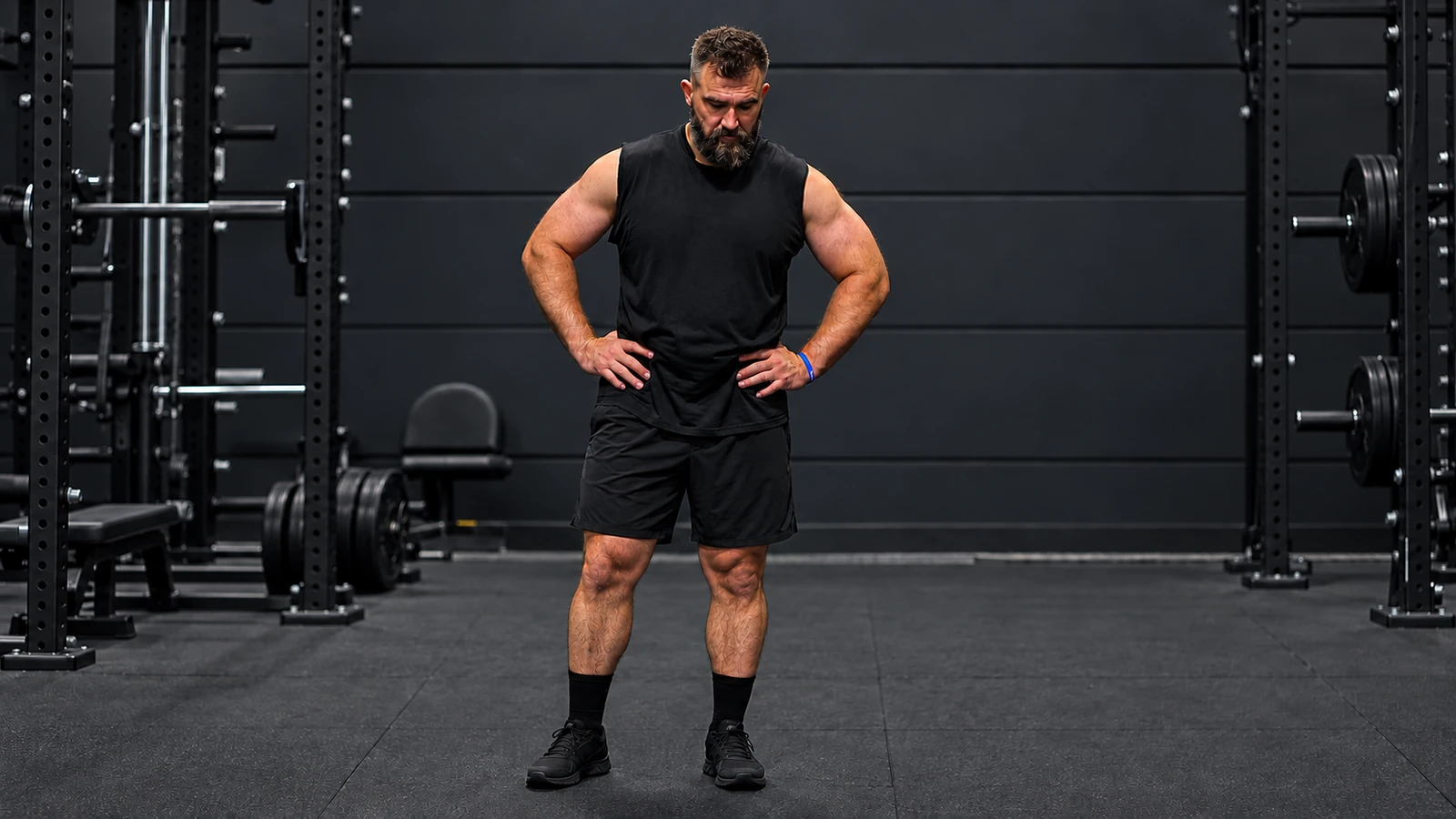

Jason Kelce’s Squatober story includes an unusual piece of luggage: two 25-pound weight plates taken on a visit to Kansas City.
The Kelce brothers discussed the trip on the October 21 episode of New Heights, including an early call for help with a bench press.
The useful part is the preparation behind the joke, because traveling often changes the time, space, and assistance available for a workout.
Treat the account as a story about planning around constraints, rather than a complete program to reproduce.
Preparation makes a travel workout easier to adapt.
A workable backup protects the purpose of the session.
What the Kelce brothers actually described
On New Heights, Travis described Jason asking how much weight was available before visiting, then bringing additional plates.
Jason confirmed that the extra load consisted of two separate 25-pound plates, giving the travel story its memorable detail.
The early phone call was a request for a spot on the bench press, even though the broader conversation concerned Squatober.
That distinction matters because a themed challenge can include more than the movement in its name.
The account does not establish every exercise, load, set, or rest day in Jason’s schedule.
It supports a specific conclusion: he checked the available setup and arranged help when he wanted it.
Why checking the room matters
A travel plan becomes more useful when it identifies the conditions a session actually needs.
Ask what space is available, when you can use it, and whether the movements you know are practical there.
Checking those details before departure gives you time to choose a realistic alternative.
You might discover that a familiar routine fits, that a shorter version is more practical, or that another day works better.
None of those choices requires copying a professional athlete’s equipment or travel habits.
Our coverage of Alessandra Ambrosio’s travel yoga habit makes a related point: an adaptable practice can fit a trip without becoming its main logistical project.
The difference between a story and a program
A podcast anecdote is a narrow view of one person’s training, even when the speaker is an experienced athlete.
Missing details can include recent workload, the reason for a particular session, and how the plan changes when recovery is limited.
Filling those gaps with an invented routine would make the story sound more complete while making it less accurate.
Mayo Clinic’s general strength-training guidance emphasizes technique, recovery between sessions for the same muscle group, and stopping an exercise that causes pain.
Those principles provide a broader foundation than an assumption that a daily challenge requires every reader to lift hard every day.
A four-check travel workout plan
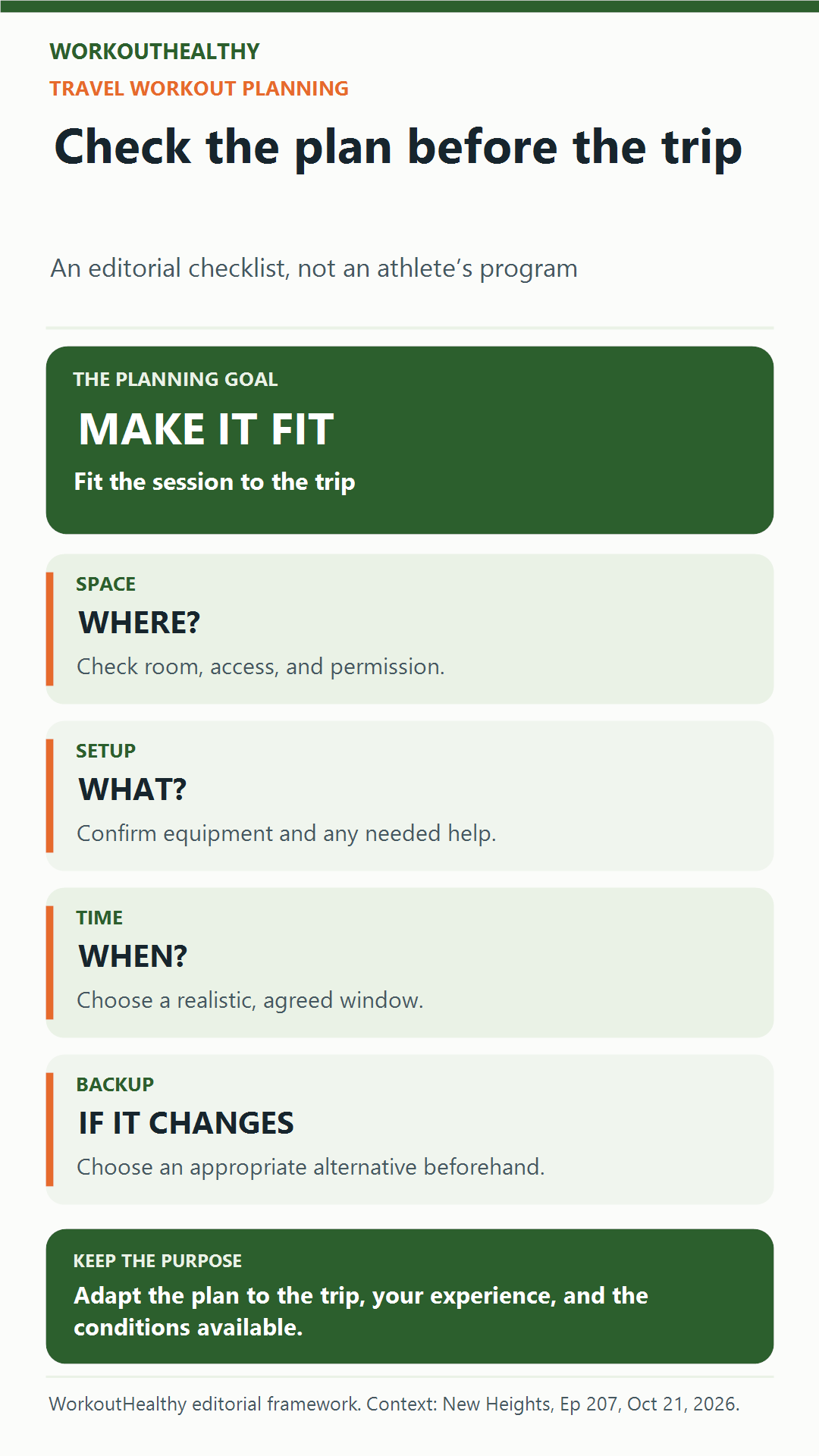
WorkoutHealthy’s editorial planning framework uses four checks: space, setup, time, and backup.
Space: confirm that the area is appropriate for the movement, with enough room and permission to use it.
Setup: identify the equipment and assistance the session depends on, rather than assuming a room has everything you usually use.
Time: choose a window that fits the visit and the people sharing the space, including any help you need.
Backup: decide beforehand what changes if access, energy, or assistance is unavailable.
This is a decision framework, not Jason’s personal program or a scored test of how committed someone is.
For example, a strength-focused traveler might move a demanding session to a better-equipped day and choose a familiar, manageable option during the trip.
The plan succeeds when it preserves a clear purpose without asking an unsuitable setting to do a job it cannot support.
Make the backup match the purpose
Start by naming what you wanted from the session: practice, strength work, movement during a long day, or simply keeping a scheduled appointment with yourself.
Different purposes can support different alternatives, so the backup should follow the goal.
A short walk can provide movement during a travel day, but it should not be described as an identical replacement for a specific strength session.
Likewise, doing an unfamiliar lift in an improvised setup does not automatically preserve the quality of your usual training.
The CDC notes that adult physical activity can be spread through the week and divided into smaller chunks.
That offers room to plan across several days, rather than judging an entire routine by one disrupted morning.
Ask for help before a lift needs it
The reported bench-press call is a reminder to identify assistance before starting a session that depends on it.
A willing friend and an appropriate setup are separate questions, so discuss what help is needed rather than assuming experience.
If you are uncertain about technique or a safe arrangement, get qualified instruction or choose a movement you already know how to manage.
Mayo Clinic recommends working with a knowledgeable fitness or sports-medicine professional when learning proper weight-training technique.
Our guide to questions to ask a personal trainer can help turn vague reassurance into a more concrete conversation.
The useful standard is a session you can carry out appropriately in the conditions available.
Keep the habit flexible
Kelce’s story is entertaining because his solution was unusually specific, but the planning lesson is easy to recognize.
You can check access, communicate with the people involved, and decide how to adapt before the trip begins.
A useful routine has enough structure to guide decisions and enough flexibility to survive a change in location.
Review the result afterward: what was available, what you actually did, and what you would arrange differently next time.
Use the four checks before your next trip, then choose a plan that matches your own experience, goals, and circumstances.
The Kelce brothers discuss the travel workout
The official New Heights episode opens near the reported discussion at 2:25. The full episode includes other topics.
Medical disclaimer: This article is general product information, not medical advice. The equipment described here is not a treatment for any condition. If you have an injury, ongoing pain, or a medical condition, talk to a doctor or physical therapist before using any of it.