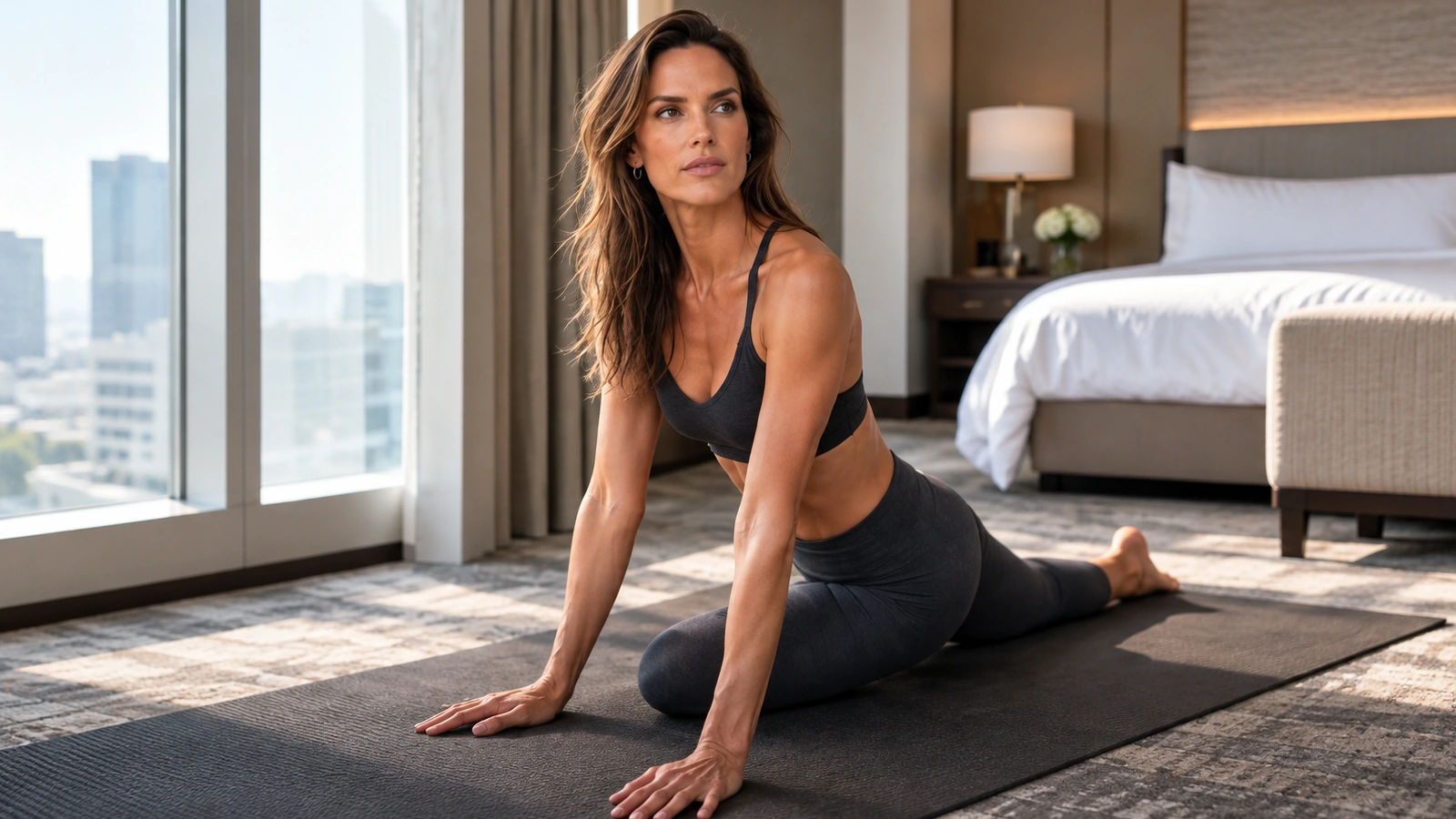

Alessandra Ambrosio has described yoga as a portable part of her routine, not as a secret event-week transformation. In a Vogue Singapore interview, the model said she likes yoga and travels with a mat. Earlier, she described fitting short morning yoga sessions into travel days. Those firsthand accounts support a modest, useful idea: a practice that can move with your schedule may be easier to keep than one that requires a perfect block of time or a specific studio.
A scheduled social post about Ambrosio may imply that she is currently posting yoga through a particular busy week. Public interviews cited here do not verify her exact present schedule, the frequency of recent posts, or what she did during any specific event. What they do document is a longstanding interest in yoga and flexibility in how she fits it around work. That distinction is worth keeping: inspiration should not be dressed up as surveillance of a celebrity’s daily routine.
What Ambrosio has actually said
In the Vogue Singapore conversation, Ambrosio discussed building mindfulness into busy travel. She said she takes a yoga mat with her and finds that a little movement, stretching, and breathing can help clear her mind. This is a personal habit, not a research claim that one mat or one sequence can treat stress or produce a certain body. It is also not an account of a specific September 2026 event.
A 2015 Vogue interview offered a more concrete example of a travel-day routine: she described doing about 15 minutes of yoga in her room on many mornings and stretching regularly. In another interview about fashion-show preparation, she described mixing yoga with other forms of activity rather than relying on a single workout. These accounts span different years. They should not be combined into a rigid weekly timetable that she has never publicly promised to follow.
For a reader, the interesting feature is the low-friction setup. A mat can fit in luggage, a short practice can happen in a small room, and breathing or gentle mobility can still be useful on days when there is no time for a full class. The point is not that yoga is uniquely magical; it is that a habit with fewer logistical barriers is easier to repeat.
What research can—and cannot—add
The National Center for Complementary and Integrative Health describes yoga as a broad family of practices involving postures, breathing, and often meditation. Styles differ from gentle sessions to vigorous classes. That variation means research findings cannot be converted into a single promise for every person and every routine. Studies suggest benefits for perceived stress, sleep, balance, and some types of pain, but effects vary and evidence quality differs by outcome.
For example, NCCIH summarizes reviews in which yoga programs reduced perceived stress among healthy adults. It also notes evidence for benefits to general wellness and mental health. Those are group-level findings, not proof that Ambrosio’s particular practice had a measured effect. Her interviews tell us what she enjoys; research tells us what has been observed in study populations. Keeping the two kinds of evidence separate prevents the familiar celebrity-health leap from anecdote to cure.
Yoga can contribute to physical activity, yet it should not automatically be counted as a replacement for all other exercise. A very gentle breathing session may offer relaxation with little cardiovascular demand. A stronger flow can be more physically challenging, but its effect depends on duration and intensity. Someone seeking cardiovascular fitness, strength, or bone-loading may benefit from adding walking, resistance training, or other suitable exercise. A flexible routine can include yoga without asking it to do every job.
Why a portable habit survives travel
Busy weeks can disrupt routines because they remove predictable cues. An early flight changes wake time; a hotel changes the environment; work dinners claim the evening. A portable habit reduces the number of conditions that must be met before activity begins. You do not have to find a particular machine, class time, or route. That makes a small session a practical fallback, not a moral victory over a calendar.
A sensible travel plan has levels. On a spacious day, someone may attend a full class. On a crowded day, ten minutes of gentle movement may be enough to keep the habit familiar. On a day of illness, exhaustion, or pain, rest may be the better choice. Consistency is not an unbroken streak of maximum effort. It is the ability to return to a safe, useful pattern after normal interruptions.
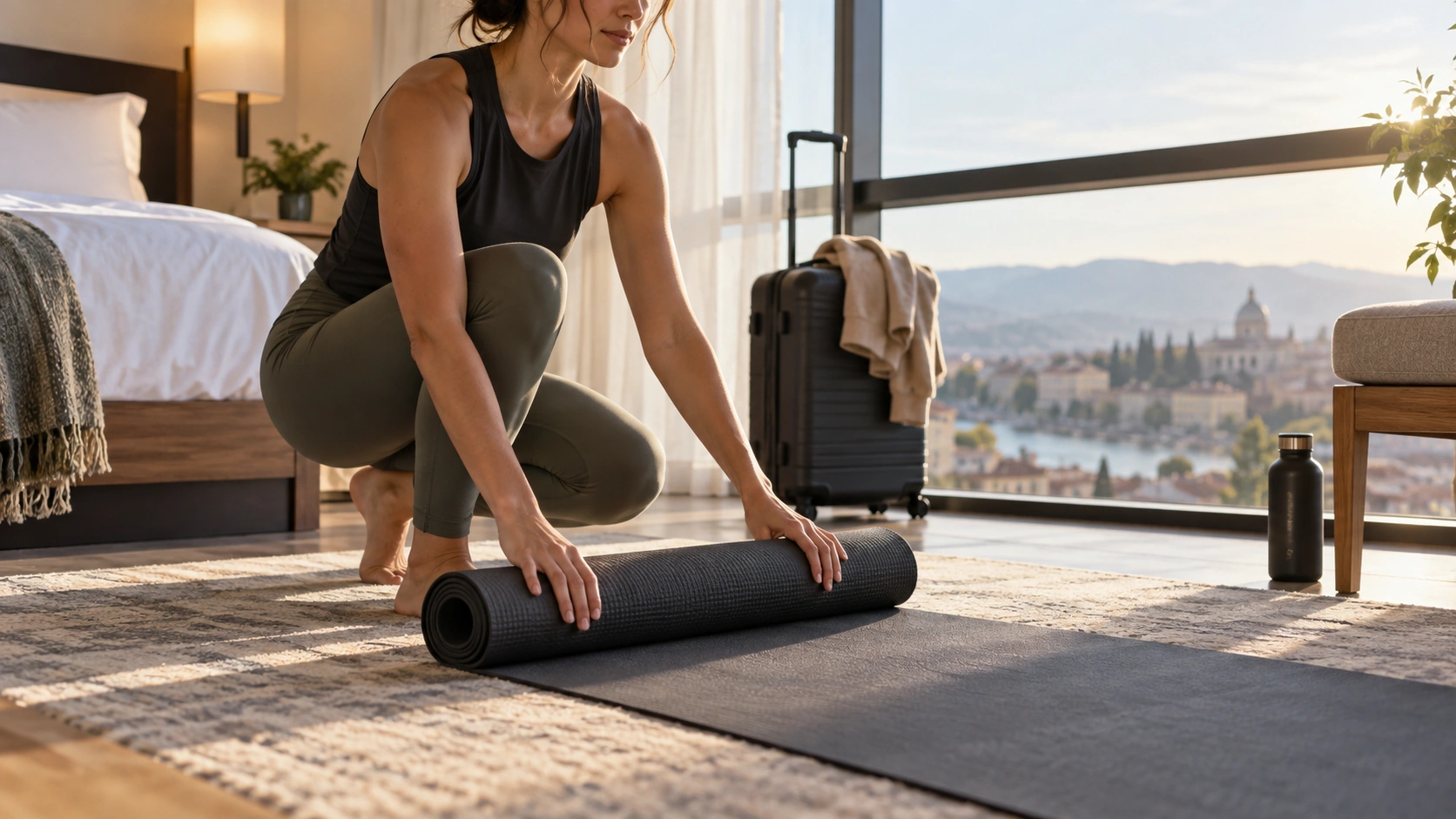
The mat itself is a cue, not a requirement. A clear patch of floor and a towel may work for simple mobility. A quiet walk can play a similar role for someone who dislikes yoga. The broader lesson from Ambrosio’s interviews is not “everyone should pack a mat”; it is “choose a form of movement that travels well in your life.” The best habit is often the one you can repeat without a large negotiation with your schedule.
How to build a realistic short practice
Start by choosing an anchor that already exists, such as after waking, before a shower, or after returning to a hotel room. Decide in advance what a minimum session looks like. Five to ten minutes can include comfortable breathing, a few gentle movements, and a pause to notice how the body feels. It is better to finish a modest session with room to spare than force a difficult sequence when rushed.
A beginner might start standing or seated: breathe normally, rotate the shoulders gently, move the spine through a comfortable range, and practice an easy balance with support nearby. A qualified instructor can help select poses and modify them for individual needs. There is no prize for deep stretches, inversions, or a photograph-worthy shape. If a pose causes sharp pain, dizziness, or numbness, stop and reassess rather than push through.
The planned minimum should be so small that a disrupted day does not make it impossible. That does not mean every session must remain short. When time and energy allow, a longer class may be enjoyable and challenging. The minimum simply keeps the practice available. It is an approach to scheduling, not a claim that a few minutes reproduce all the benefits of a full exercise program.
Safety matters more than social-media poses
NCCIH considers yoga generally safe for healthy people when practiced appropriately, but sprains and strains can occur. Beginners should be cautious with headstands, shoulder stands, lotus position, and forceful breathing. Heated classes raise concerns about overheating and dehydration. Older adults, pregnant people, and those with injuries or conditions such as severe high blood pressure or glaucoma may need modifications and a conversation with a health professional.
Social images often show a polished endpoint without the warm-up, instructor feedback, or modifications behind it. A reader should not attempt a difficult pose because a model appears to do it. Controlled movement and comfort matter more than imitation. If the point is to maintain a habit during demanding weeks, an injury caused by chasing an aesthetic pose defeats the purpose.
The part worth borrowing
Ambrosio’s public comments are most useful as a reminder to design around real life. She has described bringing a mat on trips and using manageable stretches and breathing to reset. That is a more grounded lesson than an unsupported claim about exactly what she did this week or a promise that yoga alone explains her appearance or career.
For many people, a reliable plan has three pieces: a convenient trigger, an easy version, and permission to adjust. Put the mat where it can be seen. Pick a short sequence that feels good and can be done safely. If the day collapses, swap in a brief walk or rest. The goal is not to make a busy week look effortless; it is to make useful movement possible within it.
Questions readers often ask
Does a 15-minute yoga session count? It counts as movement and practice. Its exact health effect depends on style and intensity, and it may not replace recommended aerobic and strength activity. Still, a manageable session can be valuable for routine, mobility, or relaxation.
Is yoga enough for strength? Some styles challenge muscles and balance, but progressive resistance training offers a more direct way to build strength. A person can combine both according to goals and medical circumstances.
Do you need to travel with a mat? No. The mat is convenient for grip and cushioning, but the principle is portability. Walking, gentle mobility, or a qualified instructor’s short routine may be more suitable for another person.
Can yoga cure stress or pain? Research suggests it can help some outcomes, but it is not a guaranteed cure and should not replace evaluation or treatment when symptoms persist. Choose practices and modifications that fit your condition.