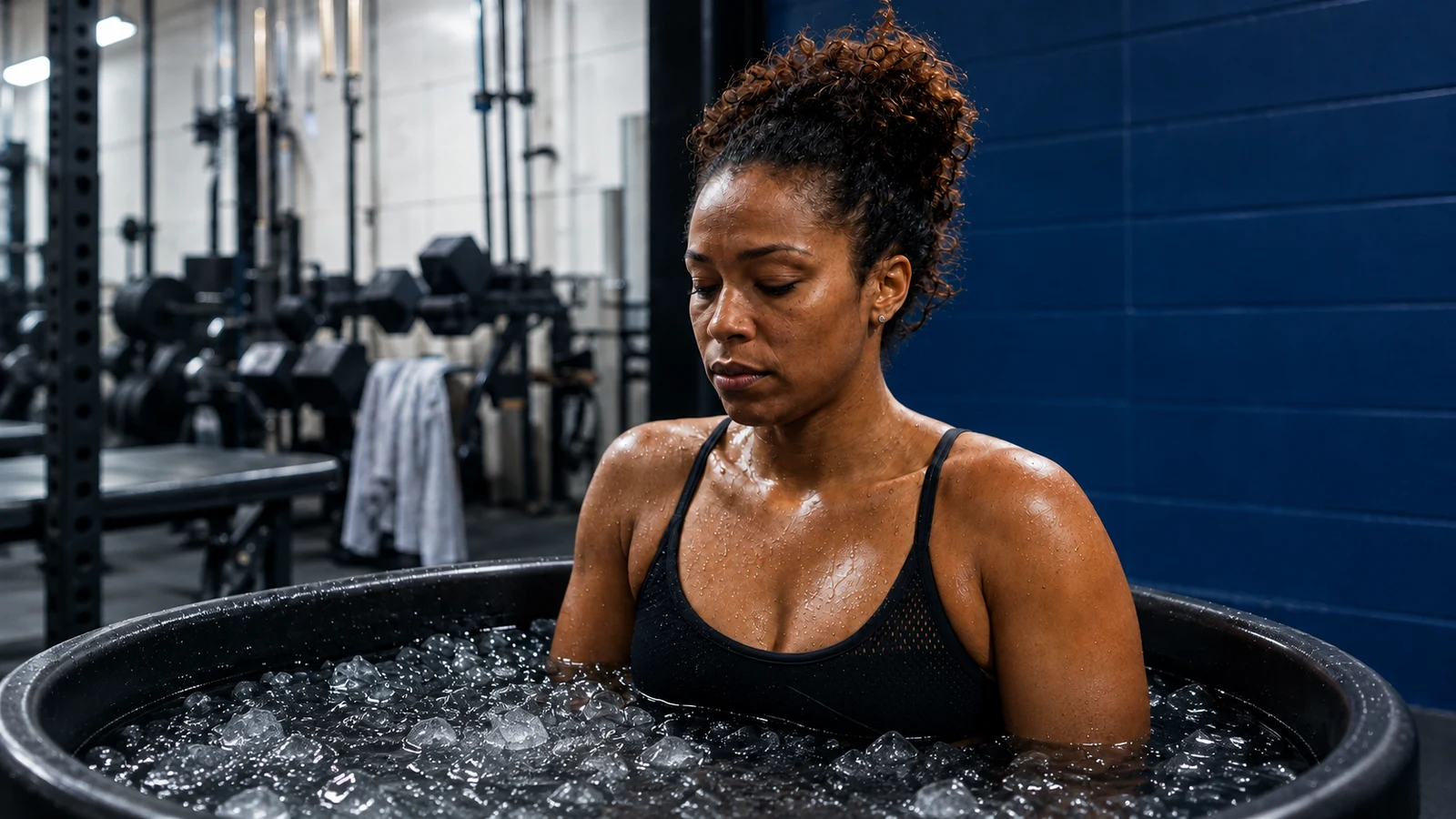

An ice bath after lifting can feel like a reset. But if your goal is to build muscle, repeatedly using cold-water immersion immediately after resistance training may work against some of the adaptation you are trying to earn. That is the trade-off behind the WorkoutHealthy Facebook post about cold plunges and muscle growth.
The science is not “cold is bad” or “one plunge erases your gains.” It asks a narrower question: what happens when cold immersion is used consistently after strength sessions, compared with a different recovery method? A 12-week trial and later evidence synthesis suggest caution for hypertrophy. The popular instruction to “wait several hours” is more of a pragmatic guess than a validated safe cutoff, so this article separates what is known from what is not.
The 12-week strength trial
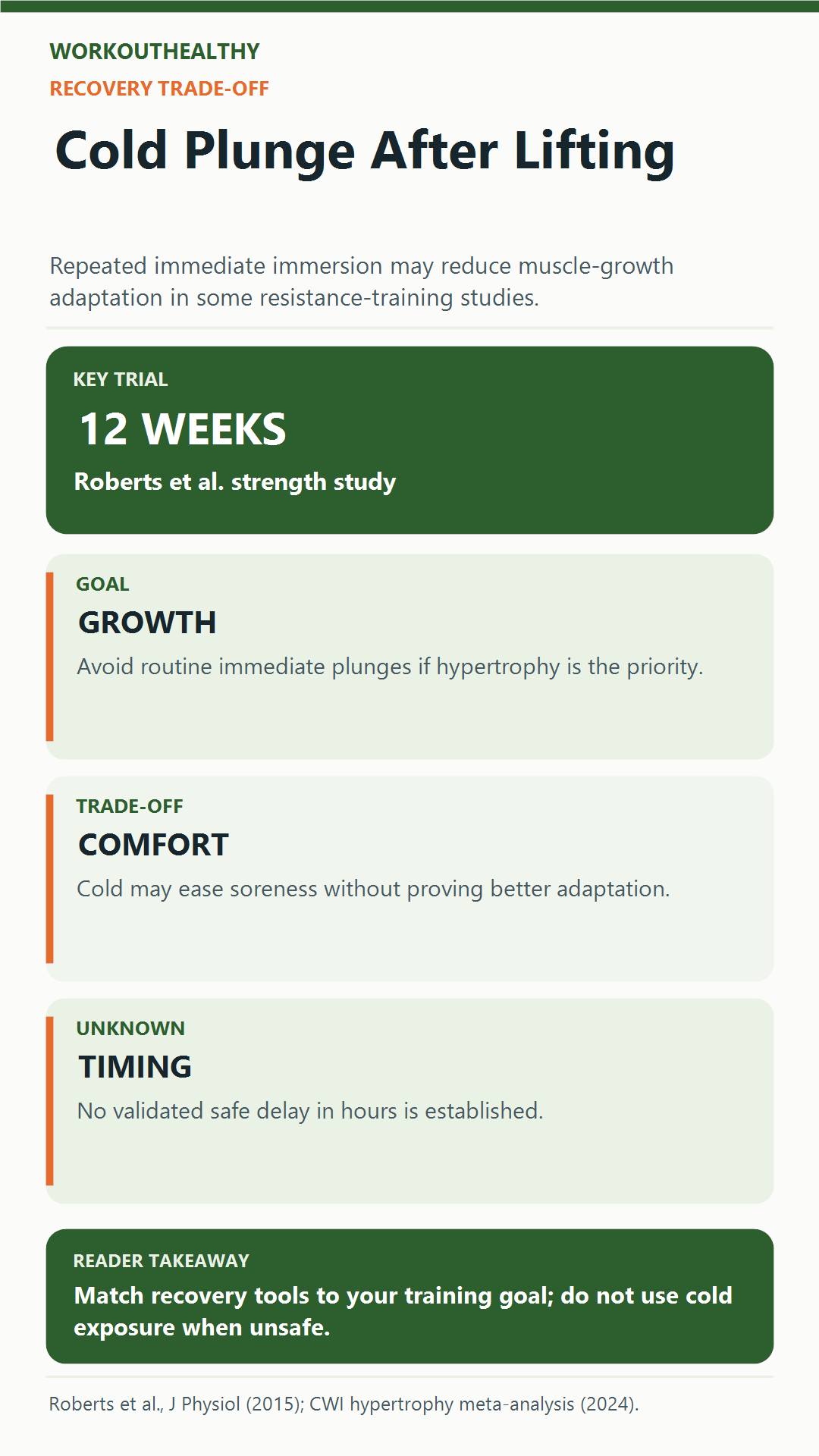
In the often-cited Roberts and colleagues study, 21 physically active men strength trained twice a week for 12 weeks. After sessions, one group used 10 minutes of cold-water immersion and the other used active recovery. Both groups trained, but measured strength and muscle-mass gains were larger in the active-recovery group. In a separate acute experiment, nine men performed single-leg strength exercise followed by the two recovery conditions on different days, allowing researchers to examine muscle tissue responses.
The second part found differences in satellite-cell responses and signaling proteins connected with muscle adaptation. It offers a plausible biological explanation for the longer-term result. Yet the sample was small and limited to active men under a particular protocol. It does not tell us the effect of a brief cold shower, a single cold plunge, or a session done many hours later. Nor does it mean the cold-water group gained nothing: the outcome was a smaller gain relative to the comparison group in selected measures.
Another controlled trial reported that repeated cold immersion after whole-body resistance work blunted muscle-fiber hypertrophy without preventing strength gain. This is one reason it is inaccurate to say ice baths always “kill your gains.” Muscle size and strength are related but not identical. The answer depends partly on which outcome is measured and how the cold intervention is used.
Repeated immediate plunges after lifting deserve caution when maximizing muscle size is the priority; one plunge is not a reset button on your progress.
Muscle signals and protein building
Resistance exercise creates a stimulus that the body responds to through coordinated signaling, repair and protein turnover. Cooling a trained muscle soon afterward changes temperature and blood flow and may affect parts of that response. Roberts and colleagues observed smaller acute satellite-cell and kinase responses after cold immersion than after active recovery. Other studies have investigated muscle protein synthesis under cold recovery conditions.
It is tempting to say cold “shuts down” muscle growth. That is too strong. Biological pathways do not operate as simple on/off switches, and a single marker does not perfectly predict what will happen after months of training. The stronger case comes when mechanistic findings and longitudinal training studies point in the same direction: routine immediate immersion can attenuate some hypertrophic adaptations under the tested conditions.
The Facebook caption also mentions reduced soreness, and that is a different outcome. Feeling better after a session can be valuable, especially when an athlete has to compete or train again soon. But a reduction in perceived discomfort does not prove the muscle adapted better. Recovery is multidimensional: short-term comfort, next-day performance, long-term strength and long-term size can move differently.
What the wider evidence suggests
A systematic review and meta-analysis of studies on post-exercise cold-water immersion and resistance-training hypertrophy concluded that the available evidence suggests a small attenuation of muscle growth. The authors also emphasized limitations: few studies, varying methods and imperfect study quality. This is a pattern worth taking seriously, not a precise estimate for every athlete.
Some evidence on strength outcomes is mixed because strength depends on neural skill, training specificity and other factors besides fiber size. A person may gain strength while gaining somewhat less muscle size. The Roberts trial found differences in several strength measures; another study did not see the same strength penalty. That is why the clearest practical statement is about hypertrophy priority rather than a claim that every cold exposure cancels all benefits.
Context matters further for endurance athletes and team-sport competitors. Cooling might offer short-term comfort or help manage heat after demanding events. Those situations have different goals from a person whose primary aim is to maximize muscle growth from three weekly lifting sessions. One recovery tool cannot be judged without knowing the job it is supposed to do.
For a broader view of recovery choices, see our article on workout recovery tools and their evidence. If you use soreness as the main judge of a session, our guide to why soreness is a poor progress scoreboard may help distinguish comfort from adaptation.
There is a measurement issue worth keeping in mind. A person can feel dramatically less sore after cold exposure, but subjective soreness does not directly measure the muscle protein being added over weeks. Likewise, a blood marker or biopsy snapshot may show a change without specifying the eventual size of a muscle. Training studies that track actual hypertrophy over time are therefore especially useful, though they also have limits such as small samples and different measurement techniques. The safest reading of the whole evidence is a modest, goal-dependent trade-off—not a blanket condemnation of cold water.
Different recovery goals
Ask what you want from the next few hours and the next few months. If you have a competition tomorrow, reducing heat stress or perceived soreness may be more important than squeezing every possible hypertrophy signal from today’s workout. If muscle size is your main long-term goal, routine immediate immersion after lifting is easier to avoid. Both are legitimate decisions in different contexts.
Many recovery basics have fewer trade-offs: enough sleep, adequate energy and protein intake, training loads you can recover from, and time between hard sessions. Those do not require extreme temperature exposure. Gentle movement, a comfortable shower or simply resting may be sufficient after an ordinary gym workout. The best recovery plan supports the training you can repeat.
Cold exposure is not suitable for everyone. People with heart or circulatory conditions, cold sensitivity, Raynaud’s phenomenon, pregnancy-related concerns or medication effects should seek medical advice before using intense cold. Sudden immersion can stress breathing and circulation; do not plunge alone or treat discomfort as a badge of commitment. This article is not a safety protocol for cold-water immersion.
Choose a recovery method for the outcome you care about, not because a dramatic ritual looks impressive.
What we do not know about timing
The social caption suggests waiting several hours after lifting or moving cold exposure to a rest day. That is a reasonable precautionary idea if someone still wants to plunge, but the literature has not established a specific number of hours that fully protects muscle adaptation. Most of the key studies tested cold water immediately after exercise. A six-hour delay, for example, has not been validated as a universal “safe” threshold.
Separate days could reduce direct overlap with the early post-lifting response, but frequency, temperature, duration and total training load may still matter. Without a direct trial comparing those schedules, we should avoid guaranteeing that a later plunge preserves every benefit. The most evidence-aligned choice for hypertrophy-focused lifters is simpler: do not make immediate cold immersion a routine post-lifting habit. If you use cold for other reasons, make it occasional and recognize the uncertainty.
Also distinguish water temperature and exposure type. A short cool shower is not the same intervention as ten minutes in a cold tub at a defined temperature. It is an error to apply the trial’s result mechanically to every shower, winter walk, or cold drink. Keep the research question matched to the actual protocol.
Bottom line
Repeated cold-water immersion immediately after resistance training may modestly blunt muscle growth in some studied settings. It can still provide short-term relief or serve a different goal, and a single plunge does not undo a workout. Evidence has not defined a precise “wait X hours” rule. For a person prioritizing hypertrophy, the prudent move is to skip routine immediate plunges and rely on proven basics: sufficient food, sleep, sensible training and time. Discuss intense cold exposure with a clinician if you have cardiovascular or other relevant risks.
References
- Roberts LA, et al. Post-exercise cold water immersion attenuates acute anabolic signalling and long-term adaptations in muscle to strength training. Journal of Physiology. 2015. PubMed.
- Throwing cold water on muscle growth: systematic review and meta-analysis of postexercise cold-water immersion and resistance-training hypertrophy. European Journal of Sport Science. 2024. Full text.
- Cold-water immersion and muscle-fiber hypertrophy without loss of strength gain following whole-body resistance training. PubMed commentary/source.
- Effects of regular cold-water immersion on training-induced strength and endurance changes: meta-analysis. PubMed.