

A few drops in a milk carton can sound like a trick, but lactase is a real enzyme that acts on a real sugar. The important questions are what it breaks down, how long the product needs to work, and when digestive symptoms require a different explanation.
For lactose intolerance, enzyme drops can be useful. They are not a guarantee, and they do not make milk safe for someone with a milk-protein allergy. Here is the mechanism and a careful way to use it.
Lactase changes the lactose in milk; it does not change the milk protein or diagnose the cause of every stomach symptom.
What lactose intolerance actually is
Lactose is the main sugar in cow’s milk. Chemically it is a pair of smaller sugars, glucose and galactose. The small intestine normally produces lactase, an enzyme that breaks that pair apart so the resulting sugars can be absorbed. When a person makes too little lactase for the amount of lactose eaten, some lactose travels onward rather than being digested where it should be.
In the colon, bacteria can ferment undigested lactose. Water is also drawn into the bowel. The combination can produce gas, bloating, abdominal discomfort, or diarrhea. The timing and severity vary. A symptom after one glass of milk does not mean every dairy product or every amount will cause the same response, and persistent symptoms should not be self-diagnosed solely from a social-media graphic.
The U.S. National Institute of Diabetes and Digestive and Kidney Diseases distinguishes lactose malabsorption from lactose intolerance: malabsorption describes reduced digestion; intolerance requires symptoms. That distinction explains why a test result and a person’s lived experience do not always align perfectly.
How enzyme drops change milk before drinking
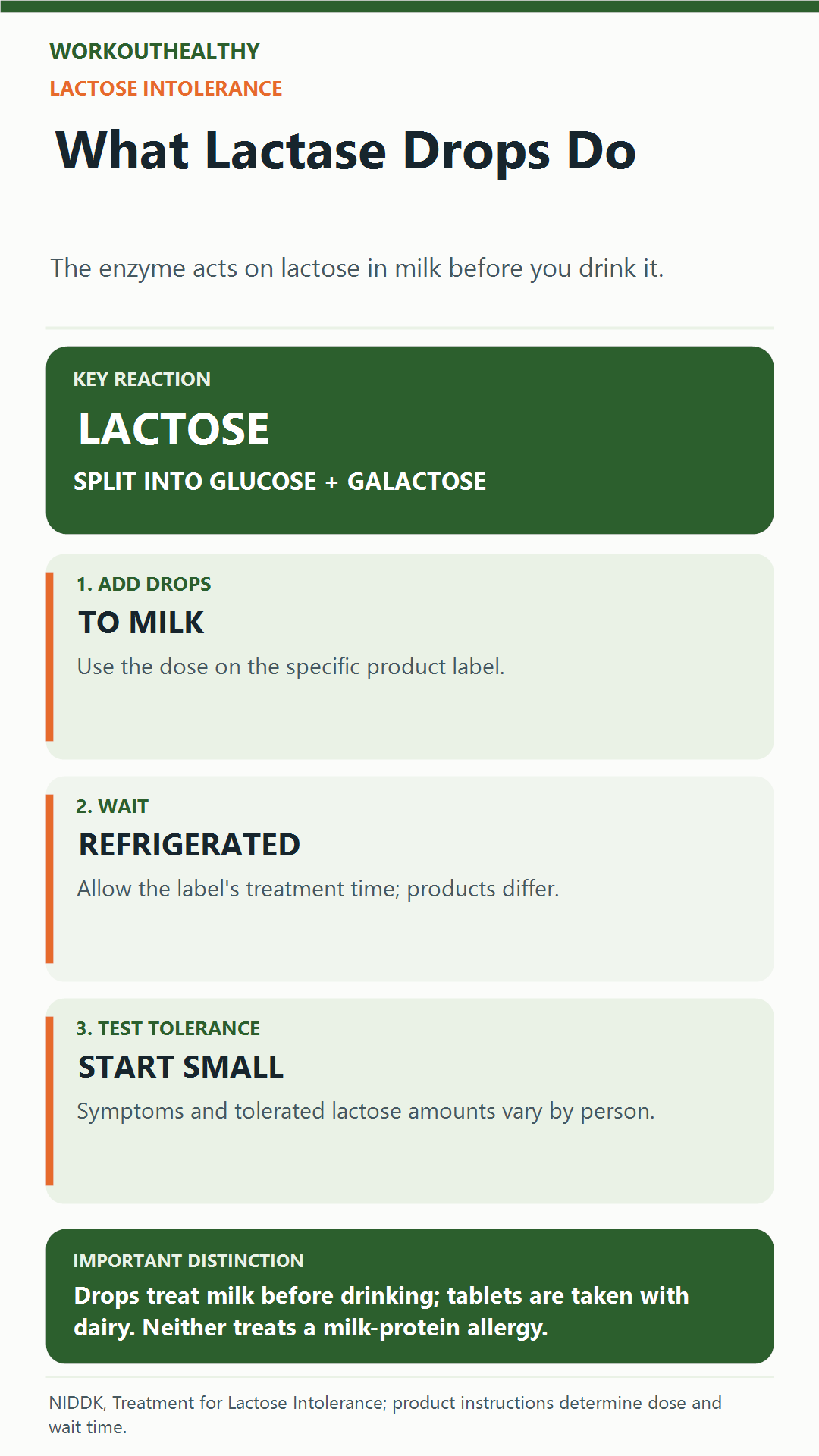
Lactase drops contain the enzyme that splits lactose. When added to milk, they can begin breaking down lactose outside the body before the milk is consumed. The sugars remain in the milk; the drink is not magically “sugar free.” Rather, a portion of lactose has been converted to glucose and galactose. This is why treated milk can taste a little sweeter even when no extra sugar was added.
The National Institute of Diabetes and Digestive and Kidney Diseases explicitly lists drops added to milk as one management option. Lowering the lactose load may reduce the chance of symptoms for some people, but the effect depends on how much enzyme is used, the volume of milk, product instructions, treatment time, and the person’s tolerance. A few drops immediately before drinking should not be assumed to have the same effect as a fully treated batch.
The post’s cited paper on short-chain fatty acids is not evidence about lactase drops. That paper concerns microbial metabolites from dietary fiber. The relevant sources here are lactose-intolerance guidance and studies of lactase or lactose-hydrolyzed milk. Matching the claim to the right evidence matters more than decorating it with an unrelated journal citation.
A practical way to use drops
Start by reading the label of the exact lactase product. Enzyme activity, number of drops, recommended milk volume, and wait time are product-specific. Add the advised amount to cold milk in a clean container, mix as directed, and keep the milk refrigerated while the enzyme works. Do not use a generic internet number of drops or leave milk unrefrigerated simply because someone said the process happens faster when warm.
When the label’s waiting period is complete, try a small serving and note the amount and any symptoms. If the result is not satisfactory, check whether the dose, storage, and timing followed the label before assuming the entire approach cannot work. Some people can tolerate a modest serving without any treatment, while others may need a more complete reduction in lactose or a different option.
Do not add drops to a child’s milk or use them during pregnancy or breastfeeding without asking a clinician if the product is appropriate. NIDDK specifically recommends checking with a healthcare professional in these groups. If diarrhea is severe, persistent, or accompanied by blood, weight loss, fever, or dehydration, seek medical assessment rather than continuing to experiment.
Drops, tablets, and lactose-free milk are not identical
Drops are usually used to treat a container of milk before drinking. Lactase tablets or chewables are taken near the time a person consumes dairy, so the enzyme and food meet during digestion. Both aim to reduce exposure to undigested lactose, but their timing and practical use differ. One may be more convenient at home; the other may be easier at a restaurant.
Commercial lactose-free milk is typically regular dairy milk treated with lactase during manufacturing. NIDDK notes that it remains nutritionally similar to regular milk. The word “free” is a label claim governed by the product process, not evidence that milk proteins have disappeared. Read packaging if you need a specific level of lactose reduction, and remember that a milk-protein allergy is a separate condition.
Some yogurts and aged cheeses naturally contain less lactose than a large glass of milk. Taking dairy with other food or using a smaller serving can also change tolerance. These are options, not a ranking that works for everyone. A registered dietitian can help keep calcium, vitamin D, and protein intake adequate when someone reduces dairy substantially.
What trials can and cannot tell us
The mechanism of lactase is clear, yet symptom outcomes are not perfectly uniform. A 2010 systematic review identified 36 randomized studies of management strategies, including lactase supplements, hydrolyzed milk, lactose-reduced milk, and dose tolerance. The authors found substantial variation in who was enrolled, which products and doses were tested, and how outcomes were measured. That prevented a single simple estimate of how well every product works.
The review also reported that many adults can tolerate roughly 12 to 15 grams of lactose, about a cup of milk, but this is a population finding, not permission to ignore an individual’s symptoms. Some people tolerate less; others tolerate more, especially with a meal. The sensible approach is to identify a personal threshold with appropriate medical guidance rather than assume all-or-nothing rules.
Older trials found differences between lactase preparations, reinforcing why labels and individual response matter. An enzyme supplement may reduce lactose exposure without eliminating every digestive symptom because gas and bloating can have other causes. If the underlying problem is not lactose, a perfect enzyme treatment will not address it.
A biologically sensible mechanism does not mean every person’s bloating will improve with one product.
Milk-protein allergy is a different safety issue
Lactose intolerance is a digestive response to a sugar. Milk allergy is an immune response to proteins in milk. Lactase breaks a sugar bond; it does not remove casein or whey proteins. Therefore lactose-free milk, milk treated with drops, and lactase tablets do not make dairy safe for a person with a confirmed milk-protein allergy.
The American Academy of Allergy, Asthma & Immunology emphasizes that allergies can cause reactions beyond intestinal discomfort and sometimes become dangerous. Hives, swelling, wheezing, throat symptoms, or a history of rapid reactions after milk need medical attention and an allergy-specific plan. Do not “test” milk at home with lactase drops if allergy is suspected.
This is also why the phrase “dairy sensitivity” is too vague to guide treatment. The cause may be lactose, an allergy, another food component, or a digestive condition unrelated to milk. A clear diagnosis avoids unnecessary restriction and prevents an unsafe trial.
A two-week observation plan
If a clinician has not identified an urgent problem and symptoms are mild, a structured record can be more useful than guessing. For one week, note the dairy food, serving size, whether it was eaten with a meal, timing of symptoms, and any other likely triggers. This is not a formal diagnostic test. It is a way to see patterns worth discussing with a professional.
In a second week, choose one variable: for example, a smaller milk serving, a commercial lactose-free milk, or milk treated with drops exactly according to its label. Keep other factors as steady as practical. If you change portions, products, meal timing, and supplements all at once, you will not know what mattered. Compare both the frequency and severity of symptoms, not only whether they occurred at all.
Do not endure repeated severe symptoms for the sake of an experiment. Bring the record to a clinician when symptoms persist. Our broader food-combination evidence check also explains why digestion complaints cannot be reduced to one universal rule, while our protein guide can help with food planning if dairy intake changes.
Bottom line
Adding lactase drops to milk can break down some lactose before drinking and may help a person with lactose intolerance enjoy dairy with fewer symptoms. The amount, timing, and outcome are not universal. Follow the specific product’s directions, keep treated milk refrigerated, start with a manageable serving, and pay attention to your own response.
Drops are not the same as tablets taken with food, and neither is a remedy for milk-protein allergy. If symptoms are severe or unexplained, seek medical evaluation. The useful message in the Facebook post is the enzyme mechanism; the attached short-chain-fatty-acid citation does not support it.
Get the next evidence check.
Five practical fitness stories worth your time, every Friday.
One email a week. No product pitches. Unsubscribe in one click.
References
- National Institute of Diabetes and Digestive and Kidney Diseases. (2018). Treatment for lactose intolerance. National Institutes of Health.
- National Institute of Diabetes and Digestive and Kidney Diseases. (2018). Lactose intolerance. National Institutes of Health.
- Shaukat, A., Levitt, M. D., Taylor, B. C., MacDonald, R., Shamliyan, T. A., Kane, R. L., & Wilt, T. J. (2010). Systematic review: Effective management strategies for lactose intolerance. Annals of Internal Medicine, 152(12), 797–803. https://doi.org/10.7326/0003-4819-152-12-201006150-00241.
- American Academy of Allergy, Asthma & Immunology. (2026). Food allergy.
Medical disclaimer: This article is general information, not a diagnosis or personal treatment plan. Seek qualified medical guidance for severe, persistent, or unexplained symptoms or suspected allergy.