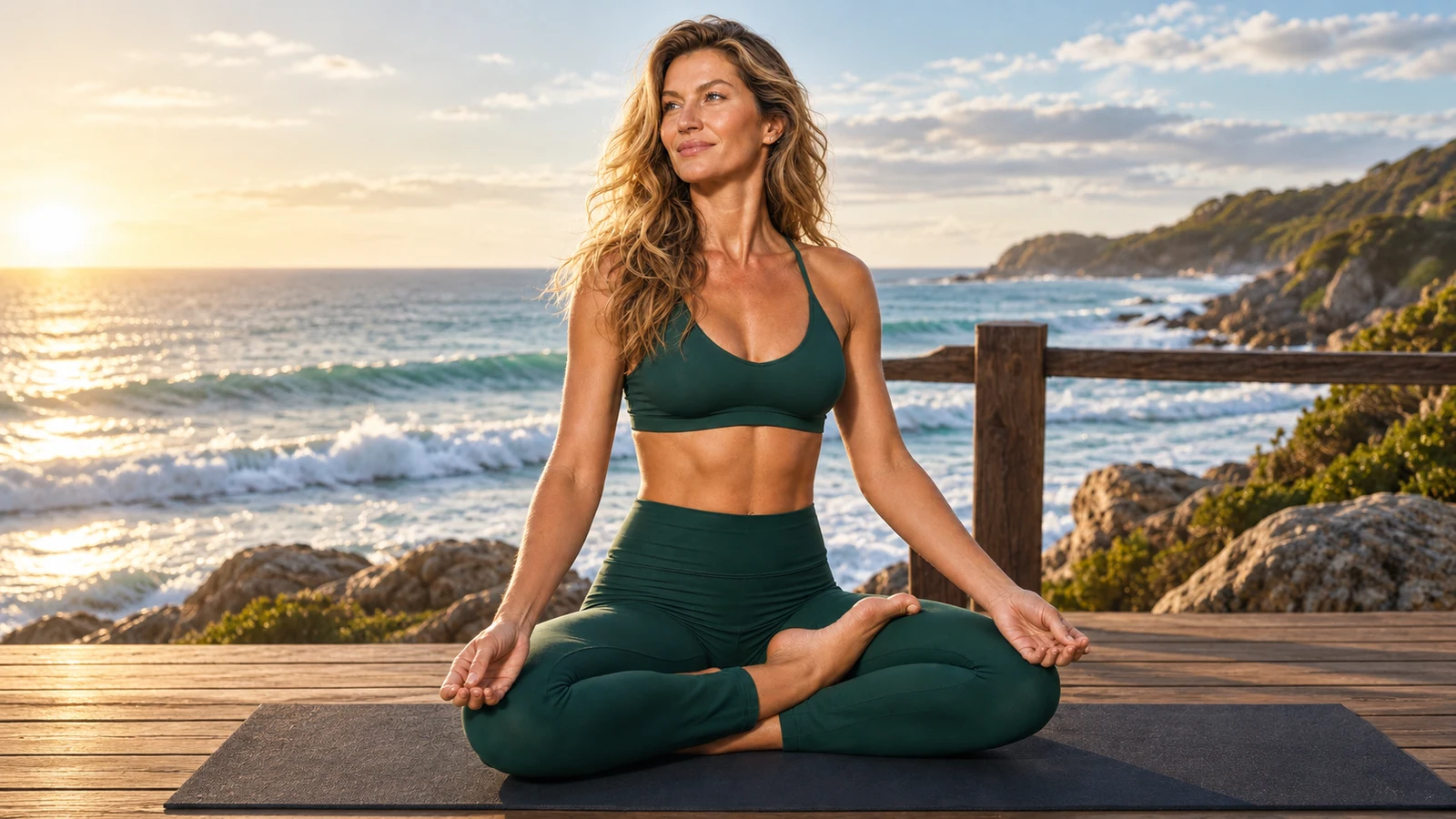

Gisele Bündchen has spoken about taking up yoga and meditation in her early 20s during a difficult period. Decades later, those practices are still part of the public story she tells about well-being. That is a compelling example of a habit lasting through different life stages—but it does not mean a specific pose sequence is the secret to calm, or that yoga replaces care for anxiety.
The accompanying WorkoutHealthy Facebook post names hatha yoga as her long-running style. The firsthand interview we could verify clearly supports yoga since her early 20s; it does not establish that every year of her practice followed one named tradition. This article explains the distinction, summarizes the stress research, and offers a gentle way to find a practice you can actually keep.
What Bündchen has said
In a 2017 Vogue interview, Bündchen said she began yoga while going through a challenging time in her early 20s. In later interviews she has again linked yoga and meditation to changes she made while dealing with panic attacks. Those are personal accounts, not clinical evidence that the practices alone treated a diagnosed condition. They also describe a broader set of changes rather than a single intervention.
That nuance matters. It is reasonable to be inspired by a person who found a practice meaningful for many years. It is not reasonable to turn her story into “do yoga and your panic attacks will disappear.” Severe anxiety deserves professional evaluation, and people can use movement alongside, not instead of, appropriate mental-health treatment.
We also should not assume that every public photo of Bündchen in a yoga pose documents the particular class she took that day. The Facebook image and this article’s hero are editorial illustrations of the subject and setting, not records of a specific workout. Her firsthand words are the source for the history, while yoga trials provide separate evidence about possible effects.
A long-lasting habit tells us that a practice can fit a life; it does not tell us that one person’s exact routine is universally therapeutic.
What hatha yoga means—and what it does not
“Hatha” is used in several ways. In some modern studios it labels a slower, foundational class focused on postures and breathing, often with pauses between positions. In a broader historical sense, many physical yoga traditions can be described as hatha practices. A class named hatha may be gentle or demanding depending on the teacher, sequence, duration and modifications offered.
It is therefore too simple to say that all hatha classes are slower than all vinyasa classes, or that a named style automatically guarantees stress relief. The better question is whether a particular class allows you to move comfortably, breathe normally, and leave feeling supported rather than overwhelmed. If you are new, a beginner-friendly class with accessible options is more important than a fashionable label.
Breath control is also not a contest. Forceful breath-holding or a painful stretch is not required for the possible benefits of mindful movement. People with dizziness, respiratory conditions, pregnancy-related concerns or pain may need modifications or guidance. An instructor should be able to offer alternatives without implying that you failed the class.
What the stress studies show
A 2024 systematic review and meta-analysis of yoga for stressed adults found low-quality evidence for a short-term reduction in stress compared with passive controls. The authors also found some longer-term results favoring yoga against active comparators, but the direction and interpretation differed by comparison. The evidence does not establish that yoga is better than every other form of exercise or mental-health support.
In a randomized controlled trial focused on hatha yoga, researchers examined stress, anxiety and psychological processes under defined study conditions. The trial adds useful detail, but no single trial can answer whether yoga is the right choice for every individual. Other studies have tested even one session: a randomized crossover experiment found changes in stress reactivity and recovery after a hatha session. Short-term laboratory responses are not the same as proving a decades-long mental-health outcome.
Yoga research is difficult to pool cleanly. Trials vary in class style, instructor, session length, participants, control group and how stress is measured. Some compare yoga with doing nothing, while others compare it with an active alternative. Expectation, social connection and the act of making time for yourself can also contribute. These factors do not make the practice worthless; they simply keep the claim honest.
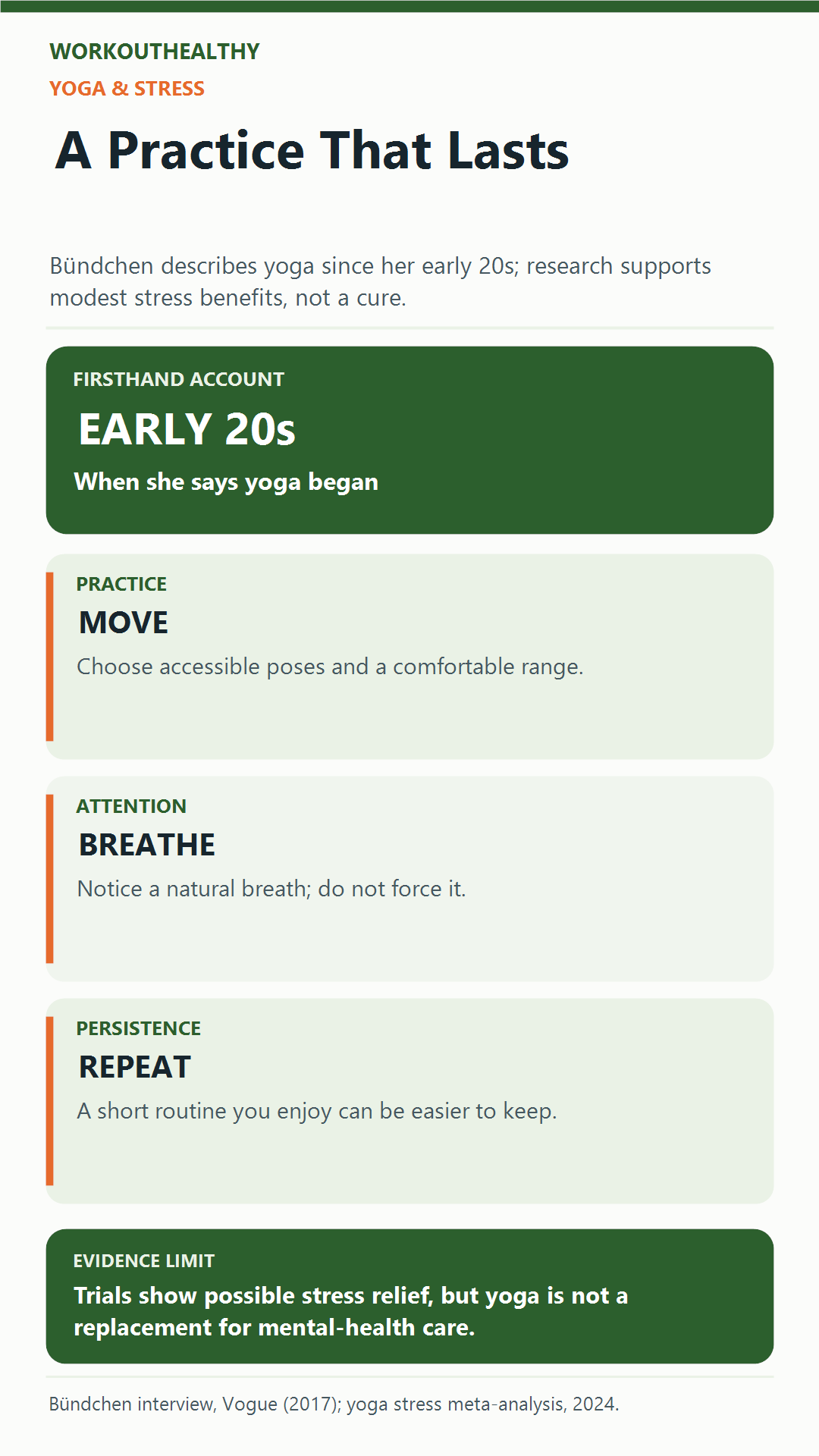
For a person who enjoys it and feels comfortable, yoga can be one way to combine movement, attention and time away from daily demands. It need not be the only way. Walking, resistance training, breathing exercises, social support and therapy may all serve different roles. Our article on cardio and strength training for longevity explains why physical variety remains valuable even if yoga is your favorite calming practice.
Why repeatability matters
The most transferable lesson from Bündchen’s story may be adherence. A practice lasts when it works with a person’s schedule, body and preferences. Enjoyment is not frivolous: if a routine feels punishing or performative, it is harder to return to when life gets busy. A comfortable ten minutes several times a week may establish a stronger habit than a strenuous ninety-minute class that you dread.
Long-term consistency does not mean doing the same sequence forever. Your energy, responsibilities and physical capacity change. A practice can shift from a studio class to a short home session, from standing poses to chair-supported movements, or from physically demanding flows to quieter mobility. The point is not to protect a label; it is to preserve an accessible way to move and pay attention.
That flexibility also makes yoga more inclusive. People of different ages, body sizes and abilities do not need to look like a model in an oceanfront photograph. Yoga is not a physique contest. You may decide that a different form of movement is more pleasant; that is a valid outcome, not a failure to appreciate yoga.
Consistency is easiest to build around a practice that you can adjust and still want to return to.
A useful way to judge whether the practice helps is to track your own experience without expecting a dramatic “before and after.” For two or three weeks, note when you practiced, roughly how stressed you felt before and after, and whether the session affected sleep or discomfort. This is a personal observation, not a clinical experiment: work stress, illness, menstrual cycle changes and many other factors can shift how you feel. Still, a brief log can tell you whether the routine fits your real life better than relying on someone else’s testimony. If the class consistently aggravates symptoms, a different teacher, gentler style or another activity may be the better choice.
It is also okay if calm arrives after the class rather than during every pose. Many beginners feel distracted, stiff or self-conscious. Those sensations do not mean the practice has failed. Nor does a peaceful-looking image prove a person has achieved a special mental state. The realistic goal is to create a repeatable opportunity to move with attention, learn what feels comfortable and return when it is useful.
A practical beginning
Try a brief, low-pressure experiment. Pick a comfortable space, a mat or chair, and a short beginner-level lesson from a qualified instructor. Move through a few simple positions within a pain-free range while breathing naturally. Notice whether your jaw, shoulders or hands are tense. If you feel light-headed, stop and return to ordinary breathing. No pose needs to be held to the point of strain.
Afterward, ask three questions: Did I feel safe? Was there at least one part I enjoyed? Would I be willing to do a version of this again? Those questions are more useful at the start than calorie estimates or how advanced the pose looked. Repeat the same short session enough times to learn it, then add variety if you want. A class that offers modifications is especially useful if you are uncertain about flexibility or balance.
If stress is persistent, sleep is disrupted, panic symptoms recur, or your mood worsens, seek qualified care. Yoga may be a helpful adjunct but is not a substitute for diagnosis, therapy or prescribed treatment. For severe or urgent symptoms, use the appropriate local emergency or crisis support. This article is educational and not individualized medical advice.
Bottom line
Bündchen’s own account supports the core story: she began yoga in her early 20s and has continued to describe it as meaningful. The specific claim that every decade was a particular hatha routine is less well documented. Human research suggests yoga can help some people with stress, but evidence quality and comparison conditions limit sweeping promises. Choose a version that feels accessible and enjoyable, and let professional care handle problems a yoga mat cannot solve.
References
- Bündchen G. Interview on yoga, meditation and beginning in her early 20s. Vogue. 2017. Read interview.
- Effects of yoga on stress in stressed adults: systematic review and meta-analysis. 2024. PubMed.
- The influence of hatha yoga on stress, anxiety and suppression: randomized controlled trial. 2023. PubMed.
- Benvenutti MJ, et al. A single session of hatha yoga improves stress reactivity and recovery after an acute psychological stress task: randomized crossover trial. PubMed.