
A new video from Mark Hyman, MD makes a bold claim about exercise and lifespan.
It says two specific types of workouts matter more than any other for living longer.
This article checks that claim against real, peer reviewed research.
What the Video Claims
Dr. Hyman is a real physician known for his work in functional medicine.
His video is titled “The Exercise Prescription for a Longer, Healthier Life.”
The Facebook framing around it calls it “Mark Hyman’s Two Key Workouts for Longevity.”
That framing points at cardio fitness and strength training as the two pillars.
A full transcript of the video was not available while writing this article.
So this piece treats the “two key workouts” idea as the video’s own framing, not as a settled fact on its own.
Instead, it checks that framing against independent, peer reviewed research on cardio fitness, strength training, and how long people actually live.
What Cardio Fitness Research Shows About Longevity
Cardiorespiratory fitness is often measured as VO2 max, how well your body uses oxygen during hard effort.
A large study published in JAMA Network Open followed adults who took a treadmill fitness test at a major heart center.
Researchers grouped people by fitness level, from low all the way up to elite.
People in the elite fitness group had a dramatically lower risk of dying during the study.
Their adjusted hazard ratio was 0.20, compared to people with low fitness.
That means their risk of death during the study was about 80 percent lower.
Within this observational sample, researchers saw no upper threshold beyond which greater fitness stopped tracking with lower mortality.
Higher measured fitness remained associated with lower mortality even at very high levels, past what most people ever reach.
This pattern shows up again and again across fitness research, not just in one dataset.
Walking is one of the simplest ways to build this kind of base fitness.
Daily step counts also track closely with death risk, as shown in separate research on daily steps and mortality.
People in the highest fitness group had roughly one fifth the death risk of people in the lowest group, with no upper threshold observed within that sample.
What Strength Training Research Shows About Longevity
Resistance training earns its own place in the survival data.
A 2019 systematic review pooled 11 studies covering 370,256 adults.
People who did muscle strengthening exercise had a lower risk of dying than sedentary people.
Their hazard ratio was 0.79, a 21 percent lower risk of death from any cause.
That is a meaningful protective effect from resistance training on its own.
Strength training does more than protect the heart and blood vessels.
It preserves muscle mass, which naturally declines with age if nothing is done about it.
Muscle loss with age is linked to falls, frailty, and loss of independence.
Building and keeping muscle may also support the brain, according to separate research on lifting weights and brain health.
That connection between strength training and long term brain health is still an active area of study.
Why Both Activity Types Were Associated With Lower Risk
The most striking finding is what happens when people combine cardio and strength training.
In that same 2019 review, combining resistance training with aerobic exercise dropped the hazard ratio to 0.60.
That works out to a 40 percent lower risk of death, compared to 21 percent for resistance training by itself.
A separate, very large study backs this up with similar numbers.
Published in The BMJ in 2020, it tracked adults against national physical activity guidelines.
People who met both the aerobic guideline and the muscle strengthening guideline had a 40 percent lower risk of death.
People who only did aerobic activity saw a 29 percent lower risk.
People who only did muscle strengthening activity saw an 11 percent lower risk.
Doing both was clearly better than doing either alone, in two separate datasets, using two different methods.
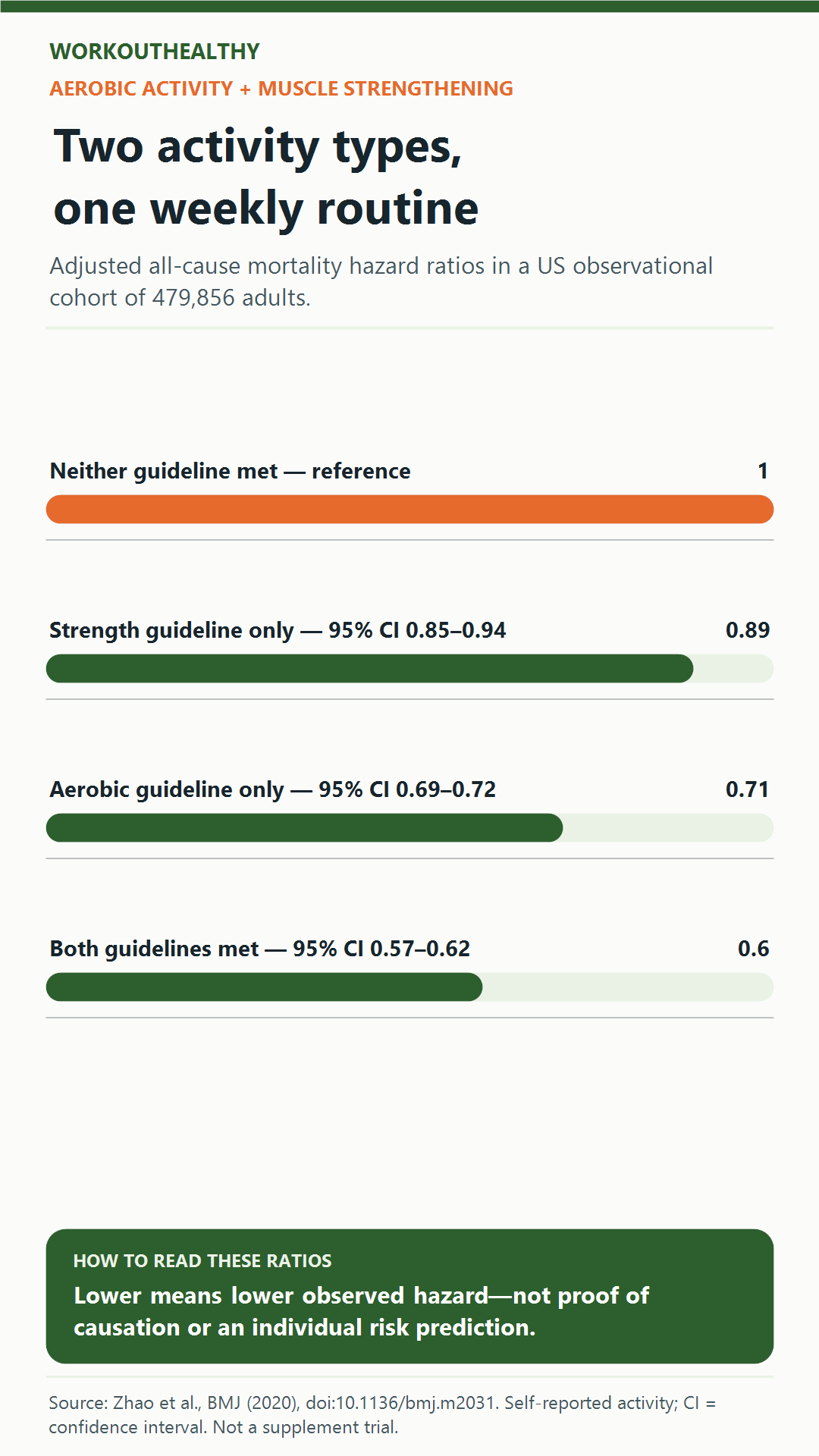
Two large studies, using different methods and different groups of people, arrived at nearly the same number: pairing cardio with strength training was tied to about a 40 percent lower risk of death.
How Much Exercise Actually Counts as “Both”
The guideline used in that BMJ study is the same one used by health agencies in the United States.
It calls for at least 150 minutes of moderate aerobic activity each week.
That works out to about 30 minutes, five days a week, of brisk walking or similar effort.
The strength side of the guideline calls for muscle strengthening work on two or more days a week.
It also asks that those sessions cover all the major muscle groups, not just one or two.
Meeting both parts of the guideline is what produced the 40 percent lower mortality risk in the research above.
Falling short on one part still helped, just less than meeting both.
This gives a concrete target instead of a vague idea of exercising more.
The Biology Behind the Combination
The two types of training help the body in different, complementary ways.
Cardio training improves how well your heart pumps blood and how well your muscles use oxygen.
Over time, this raises VO2 max and strengthens the heart muscle itself.
It also supports healthy blood vessels and helps regulate blood pressure and cholesterol.
Strength training works through a different pathway.
It builds and protects skeletal muscle, which acts like a metabolic reserve for the whole body.
More muscle tends to mean better blood sugar control, since muscle tissue absorbs glucose from the blood.
Stronger muscles and bones also lower the risk of falls and fractures as people age.
Together, the two forms of training cover more of the body’s aging related weak points than either one alone.
That may be part of why the combined numbers look so much better than either alone.
What This Evidence Does Not Prove
None of this research proves that exercise alone guarantees a longer life.
These are observational studies, not controlled experiments where people were randomly assigned to exercise groups.
People who exercise more also tend to smoke less, eat differently, and see doctors more often.
Researchers try to statistically adjust for these factors, but they cannot remove every difference between groups.
It is also possible that healthier people are simply more able to exercise in the first place.
This is sometimes called reverse causation, and it is a real limitation in this kind of research.
The studies also cannot tell us the exact right dose for every single person.
They show averages across large groups, not a guarantee for any one individual.
The video’s own “two key workouts” framing also simplifies a much larger body of exercise science.
Sleep, diet, stress, and genetics all shape how long someone lives too.
Common Mistakes People Make
One common mistake is doing only cardio and skipping strength work entirely.
Long term runners and cyclists sometimes lose muscle mass without noticing it happening.
The opposite mistake is just as common, lifting weights but never raising your heart rate.
Someone can be strong in the gym and still have poor cardiovascular fitness.
Another mistake is starting too hard, too fast, in either type of training.
This raises injury risk and often ends with someone quitting altogether.
Some people chase intensity without a real plan for form or recovery.
Recovery is not optional, since muscle adapts and repairs itself on rest days, not during the workout.
A last mistake is treating one type of training as clearly better than the other.
There has even been public debate about this, as seen in a reader survey on weightlifting versus running.
The research above suggests that debate misses the point, since both matter for a long life.
Who Should Talk to a Doctor First
Anyone starting a new exercise routine after a long break should check in with a doctor first.
This matters even more for people with heart disease, high blood pressure, or diabetes.
People recovering from an injury or surgery should also get clearance before adding intensity.
Older adults starting strength training for the first time benefit from starting under supervision.
A physical therapist can help build a safe starting point for anyone unsure where to begin.
This is especially true for anyone managing joint pain or a past injury.
A Practical Way to Start
Start small if you are new to either type of training.
A simple way to build cardio fitness is a brisk walk most days of the week.
One way to check basic cardiovascular fitness at home is the four flights stair test.
For strength, two to three short sessions per week is enough to start seeing benefits.
Focus on a few basic movements that work your whole body, not isolated single muscle exercises.
Squats, presses, rows, and hip hinges cover most of what a beginner needs.
Add small amounts of weight or reps every couple of weeks, not every single workout.
Track how you feel and how you are sleeping, not just the numbers on a chart.

Consistency across months and years matters more than any single hard workout.
The research above suggests aiming for both types of training every week, not choosing one forever.
A simple weekly split can make this easy to follow without much planning.
- Monday, Wednesday, and Friday: 30 minutes of brisk walking, cycling, or another cardio activity.
- Tuesday and Thursday: a full body strength session covering the major muscle groups.
- Weekends: rest, light movement, or extra cardio if you feel recovered.
A split like this meets both parts of the guideline without requiring hours in the gym every day.
Watch the video
Want more like this? Subscribe to WorkoutHealthy Insider for practical explanations behind popular fitness claims.
References
Mandsager, K., Harb, S., Cremer, P., Phelan, D., Nissen, S. E., & Jaber, W. (2018). Association of cardiorespiratory fitness with long term mortality among adults undergoing exercise treadmill testing. JAMA Network Open, 1(6), e183605. https://doi.org/10.1001/jamanetworkopen.2018.3605
Saeidifard, F., Medina-Inojosa, J. R., West, C. P., Olson, T. P., Somers, V. K., Bonikowske, A. R., Prokop, L. J., Vinciguerra, M., & Lopez-Jimenez, F. (2019). The association of resistance training with mortality: A systematic review and meta-analysis. European Journal of Preventive Cardiology, 26(15), 1647 to 1665. https://doi.org/10.1177/2047487319850718
Zhao, M., Veeranki, S. P., Magnussen, C. G., & Xi, B. (2020). Recommended physical activity and all cause and cause specific mortality in US adults: Prospective cohort study. BMJ, 370, m2031. https://doi.org/10.1136/bmj.m2031
This article is for general information only and is not medical advice. If you have an injury, ongoing pain, or a medical condition, talk to a doctor or physical therapist before you change how you train or eat.