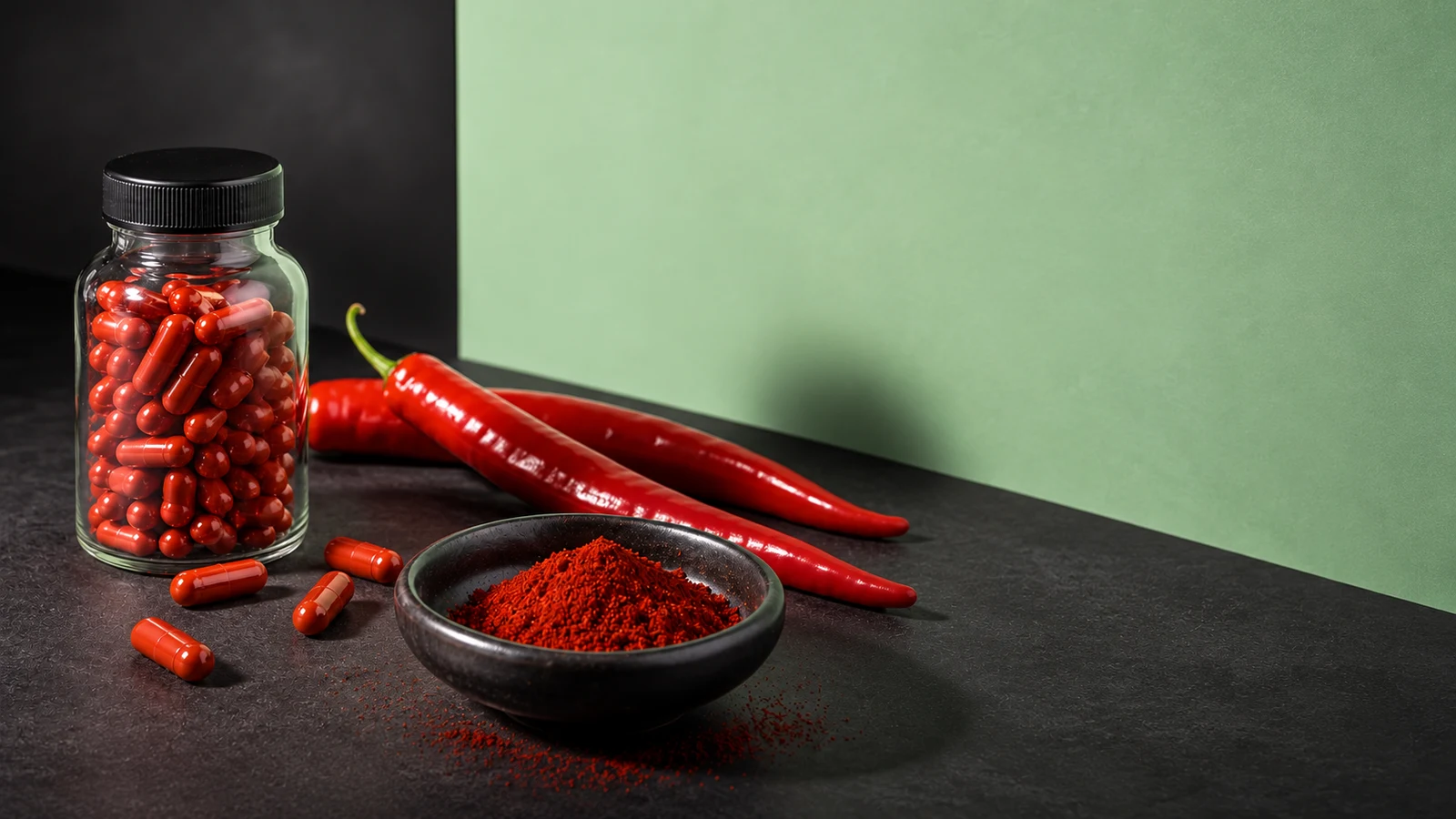

Can hot sauce make a meaningful dent in your daily calorie burn? The answer is less exciting—and more useful—than the usual “spicy food melts fat” headline. Capsaicin, the compound that gives chili peppers their heat, can stimulate sensory pathways involved in heat production. Human studies do find small changes in energy expenditure under some conditions. They do not show that adding chili to dinner reliably produces lasting weight loss.
That distinction matters for the WorkoutHealthy Facebook post about spicy foods and brown fat. The image is a prompt to investigate the science, not proof that one meal turns your body into a calorie furnace. Here is what the experiments measured, why their numbers should not be inflated, and how to use spicy food without treating it as a weight-loss prescription.
Capsaicin, capsinoids and brown fat
Capsaicin binds the TRPV1 receptor, which helps detect heat and pungent compounds. The familiar burning sensation is a sensory signal; it does not mean your stomach or body fat is literally burning. Researchers are interested in whether that signal can increase sympathetic activity and thermogenesis—heat production that uses energy. Brown adipose tissue, often shortened to BAT, is one possible contributor because it can dissipate energy as heat.
There is an important vocabulary distinction. Capsaicin is pungent and common in hot chili peppers. Capsinoids are related, much less pungent compounds used in some laboratory studies. A result from a controlled capsinoid capsule does not automatically describe a plate of spicy food, a hot sauce, or a commercial “fat burner.” Dose, formulation, timing and participants all differ.
Brown fat also is not an on/off switch that you can assess by feeling warm after a meal. In studies it is measured with specialized imaging or indirect markers. The amount and activity of brown fat vary across adults. Some experiments deliberately recruit people with detectable BAT, which makes their results interesting but less universal.
Feeling heat is not the same thing as demonstrating a meaningful or durable change in body fat.
What human studies found
In a controlled study of 18 healthy young men, Yoneshiro and colleagues tested nonpungent capsinoids while measuring energy expenditure and brown-fat status. Acute energy expenditure rose in the participants with detectable active BAT, but not in the BAT-negative group. The experiment supports a possible physiological pathway in a selected group; it cannot tell us that every person who eats a chili-rich meal burns a useful number of extra calories.
A 2020 systematic review and meta-analysis pooling 13 trials of capsaicinoids or capsinoids estimated an average resting metabolic-rate difference of about 34 kilocalories per day compared with control conditions (95% confidence interval roughly 16–52 kcal/day). That is a modest short-term laboratory outcome, not a prediction that an individual will lose a particular amount of weight each week. Combining different compounds, doses and study designs also limits how precisely the pooled number applies to your dinner.
Another 2020 trial followed 40 middle-aged adults given capsinoids for six weeks. Researchers observed a change in an imaging-based proxy related to brown-fat vascular density, but the between-group resting-energy-expenditure result was not statistically significant. A biological marker may move without producing a clearly measured increase in total daily calorie use. This is why it is misleading to cherry-pick a BAT image and claim proven fat loss.
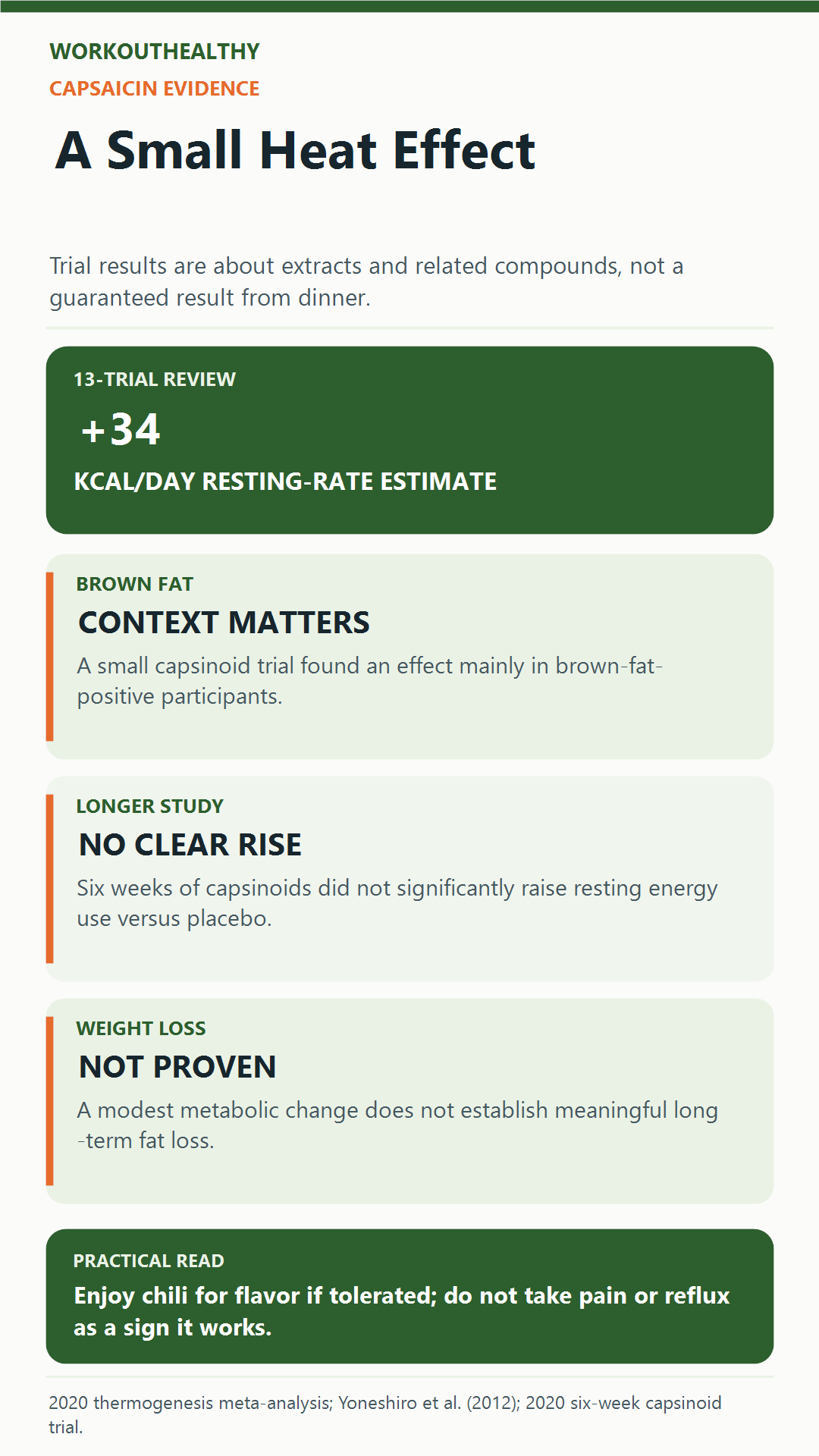
These studies answer slightly different questions. The 18-man experiment asks whether brown-fat-positive participants respond acutely to capsinoids. The meta-analysis asks what short-term resting-metabolism studies estimate on average. The six-week trial asks whether an imaging proxy and resting expenditure change together. None establishes that adding hot pepper to ordinary meals is an effective stand-alone weight-loss program.
It helps to distinguish mechanism, marker and outcome. A mechanism is a plausible biological route, such as TRPV1 signaling. A marker is something a laboratory can detect, such as a brown-fat imaging measure or a brief change in resting energy expenditure. The outcome most readers care about is whether their health or body composition improves over time. Moving from one level to the next requires new evidence; a compelling mechanism is not a substitute for a long-term clinical result. This distinction also protects against an easy mistake: a study can be carefully done and still answer only a narrow question. The capsinoid experiments are valuable precisely because they tell us where the effect might arise and where it may not.
Individual responses are another reason to avoid precise promises. The same spicy meal can feel intense to one person and ordinary to someone accustomed to chili. The composition of the whole meal and the rest of the day also matter. A person might use peppers to flavor a satisfying home-cooked meal; another might add hot sauce to a high-calorie meal and change nothing else. Neither scenario can be captured by a single laboratory resting-rate estimate. Good advice should leave room for that real-world variation instead of pretending the compound acts in isolation.
Why the calorie math is small
Even if a person experienced the pooled estimate of about 34 kcal/day consistently—which has not been demonstrated in everyday use—that is a small signal compared with ordinary variation in meals, activity, sleep and measurement. Laboratory “resting metabolic rate” is not the same as all-day energy expenditure. You cannot multiply the estimate over months and claim a guaranteed number of pounds lost; bodies and behaviors adapt, and the trials do not support that calculation.
The Facebook post’s broad “metabolism” language is best read as a question about a possible modest effect, not a promise. The research cited in the original social caption concerned a different dietary topic and should not be treated as the capsaicin study. The relevant human experiments above are the evidence base for this article.
For durable fitness and body-composition goals, more consequential habits include enough food quality, regular movement, and muscle-preserving strength work. Our guide to combining cardio and strength training for longevity explains why those practices deserve far more attention than a condiment. If you are trying to change body composition, avoid letting a tiny thermogenic signal distract from adequate protein, recovery and sustainable activity; see our discussion of how much protein you actually need.
The useful question is not “Does pepper burn fat?” but “Does this food make a nourishing, sustainable meal more enjoyable for me?”
Appetite is a separate question
Some researchers study whether hot compounds influence appetite or the amount eaten at a later meal. A 2013 meta-analysis pooled eight ad-libitum meal studies involving 191 participants and estimated roughly 74 fewer kilocalories consumed after capsaicinoid exposure. The studies were heterogeneous, so this figure is not a meal-planning rule. A hot meal can be followed by dessert, a larger serving later, or no change at all. Reduced intake in one test meal does not establish long-term weight loss.
Appetite effects may also depend on whether people regularly eat spicy food, how much they enjoy the meal and whether the spice makes it harder to eat. Food satisfaction matters. Forcing down chili because you think it will suppress hunger is neither necessary nor a reliable strategy.
A sensible food-first approach
If you enjoy spicy food, use chili as a flavor tool. A modest amount can make vegetables, beans, soups, eggs, tofu or other balanced meals more appealing without requiring a sugary sauce or a very large portion. Start with the heat level you tolerate. The goal is a meal you would happily repeat, not an endurance contest.
Here is a simple three-check framework:
- Evidence check: Ask whether a claim refers to a short-term laboratory change, an actual change in daily behavior, or long-term weight loss. Those are not interchangeable outcomes.
- Meal check: Build the meal around foods that satisfy and nourish you. Chili is an optional seasoning, not a substitute for a sound eating pattern.
- Tolerance check: Notice reflux, heartburn, stomach discomfort or mouth irritation. If spice triggers symptoms, there is no need to push through them for a tiny theoretical calorie effect.
Be especially skeptical of supplement labels that turn laboratory doses into bold weight-loss promises. Supplements can have different concentrations and may interact with medicines or medical conditions. If you are pregnant, have persistent gastrointestinal symptoms, or are considering concentrated capsaicin products, speak with a qualified clinician. This article is educational, not individualized medical advice.
Bottom line
Capsaicin and related capsinoids can produce small, context-dependent thermogenic effects in human experiments, and brown fat may be part of the mechanism in some participants. The average metabolic-rate difference reported in a trial meta-analysis is modest; a longer intervention did not establish a significant resting-expenditure advantage between groups. None of this proves that a spicy dinner—or a supplement—causes meaningful long-term fat loss.
Eat hot food if you like it and it agrees with you. Treat its possible metabolic effect as a scientific curiosity, not the foundation of your health plan. The bigger win may simply be making a nutritious meal taste good enough to keep eating it.
References
- Yoneshiro T, et al. Nonpungent capsaicin analogs (capsinoids) increase energy expenditure through brown adipose tissue activation in humans. American Journal of Clinical Nutrition. 2012. PubMed record.
- Irandoost P, et al. Effect of capsaicinoids and capsinoids on resting metabolic rate: A systematic review and meta-analysis of randomized controlled trials. 2020. PubMed record.
- Fuse S, et al. Effects of capsinoid ingestion on brown adipose tissue in middle-aged adults: A randomized controlled study. 2020. PubMed record.
- Whiting S, et al. Capsaicinoids and energy intake: A meta-analysis. 2013. PubMed record.