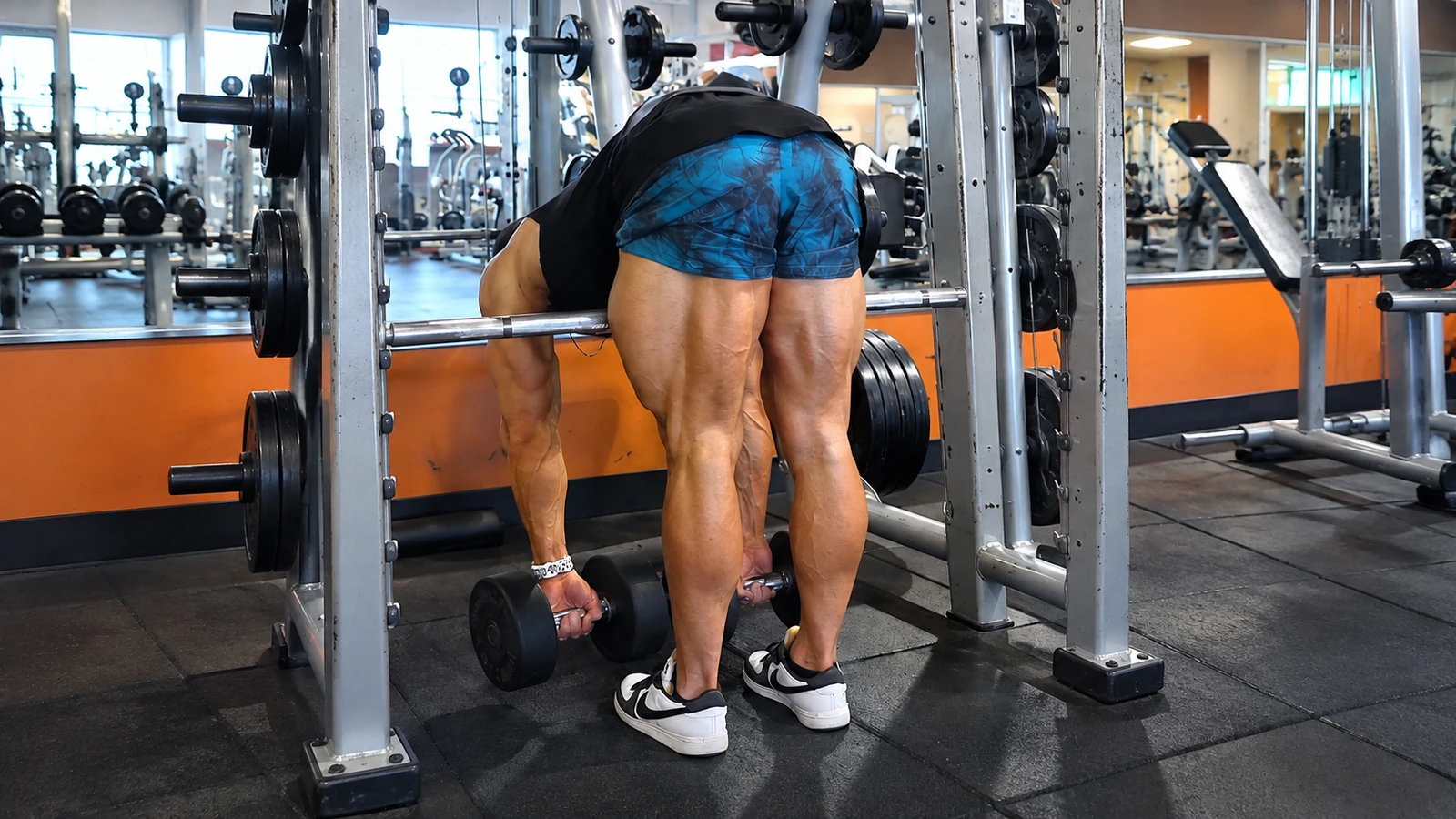

The supported dumbbell RDL shared by bodybuilder and coach Abel Albonetti uses a racked Smith-machine bar as a thigh brace while the hands hold dumbbells.
The support can reduce the feeling of tipping forward and let a lifter focus on the hip hinge.
That does not prove the variation creates more hamstring growth or a deeper useful stretch than a well-performed Romanian deadlift.
We found no direct comparison trial for this exact supported setup in the sources reviewed for this article.
The Short Answer
Albonetti’s variation is a legitimate accessory exercise when balance limits a conventional RDL.
It changes the task by letting the thighs push into a fixed support, which means the lifter no longer has to keep the combined body and dumbbell load balanced in the same way.
The useful range still ends when the hips stop traveling back without the lower back rounding.
A stronger stretch sensation, lighter dumbbells, or next-day soreness does not automatically mean a better muscle-building stimulus.
A support bar can reduce balance demands, but it does not prove the exercise creates a better hamstring stimulus.
What Abel Albonetti Actually Demonstrated
In the original Instagram demonstration, Albonetti places the front of his thighs against a Smith-machine bar that is locked around mid-thigh height.
He holds a dumbbell in each hand and hinges his hips backward while using the fixed bar as a brace (Albonetti, n.d.).
Muscle & Fitness later described the move and quoted Albonetti telling viewers to place the quadriceps against the machine and stretch only as far as comfortable.
The report also says he did not claim to invent the exercise (Felstead, n.d.).
This is not the usual Smith-machine RDL.
In a conventional Smith RDL, the guided bar is the resistance, while in Albonetti’s version the bar is only a support and the dumbbells provide the load.
Our existing guide to the standard Smith-machine RDL explains the fixed bar path, foot position, depth, and loading tradeoffs.
Those mechanics should not be copied blindly into this supported dumbbell variation.
What the Thigh Support Changes
A normal RDL is a balance problem as well as a hip-extension exercise.
As the hips travel backward and the torso inclines, the lifter keeps pressure through the whole foot while the dumbbells remain close to the legs.
The following is a mechanical interpretation of the setup, not a measured finding about muscle growth.
The thigh brace supplies an external stabilizing force.
It can let the hips travel farther behind the feet without the lifter feeling as if the body and dumbbells will rotate backward or forward out of balance.
That support may be useful for a bodybuilder who wants a stable hamstring accessory after other leg work.
It also removes part of the balance and trunk-control demand that gives a free-weight hinge value outside a single muscle-building session.
The support is not free resistance.
If a lifter leans heavily into the bar, some body weight is transferred through the thighs instead of being controlled entirely through the feet and posterior chain.
There is no simple rule that says more hip travel must equal more hamstring tension.
The result depends on hip angle, knee angle, pelvic position, spinal control, dumbbell path, external support, and how close the working set comes to a challenging effort.
Does a Deeper Stretch Build More Hamstring?
The broad idea of training a muscle at longer lengths has evidence behind it, but the evidence is exercise-specific.
A 12-week trial found greater hamstring growth from seated leg curls than prone leg curls (Maeo et al., 2021).
The difference was greatest in the two-joint hamstrings lengthened by hip flexion.
That study did not test an RDL or external thigh support.
It supports taking long-muscle-length training seriously, not the claim that every exercise that feels stretchier will produce more growth.
A 2025 randomized trial compared six weeks of eccentrically biased RDLs with Nordic hamstring exercise.
The study author reported increases in hamstring cross-sectional area with both programs (Crawford et al., 2025).
That comparison does not establish that the exercises are interchangeable for every goal or person.
The trial used a defined RDL program, not Albonetti’s supported variation.
It shows that RDL training can change hamstring size and architecture without proving which RDL setup is best.
A systematic review reported lower erector spinae activation than biceps femoris and semitendinosus activation during Romanian deadlifts (Martín-Fuentes et al., 2020).
Surface muscle activation still cannot rank long-term hypertrophy between untested variations.
A study of ten competitive bodybuilders compared Romanian, step-Romanian, and stiff-leg deadlifts (Coratella et al., 2022).
The step variation produced higher excitation in several measured muscles during parts of the movement.
Greater range and muscle elongation were possible explanations, but ten acute EMG observations are not a growth trial.
How to Set Up the Supported Dumbbell RDL
- Use an empty Smith bar and confirm that both hooks are fully engaged. Set safety stops so an accidental release cannot let the bar drop onto your legs.
- Rack the bar around mid-thigh height. Stand facing the bar with the front of the thighs touching it.
- Hold light dumbbells beside the legs with the arms long. Keep the feet about hip width and the pressure spread across each whole foot.
- Soften the knees and keep that angle nearly steady. Do not lock the knees hard or turn the movement into a squat.
- Brace the trunk, send the hips backward, and let the torso incline while the dumbbells stay close to the thighs.
- Stop when the hamstrings limit further hip motion or the pelvis and lower back begin to change position. Stand by driving the hips forward without leaning back at the top.
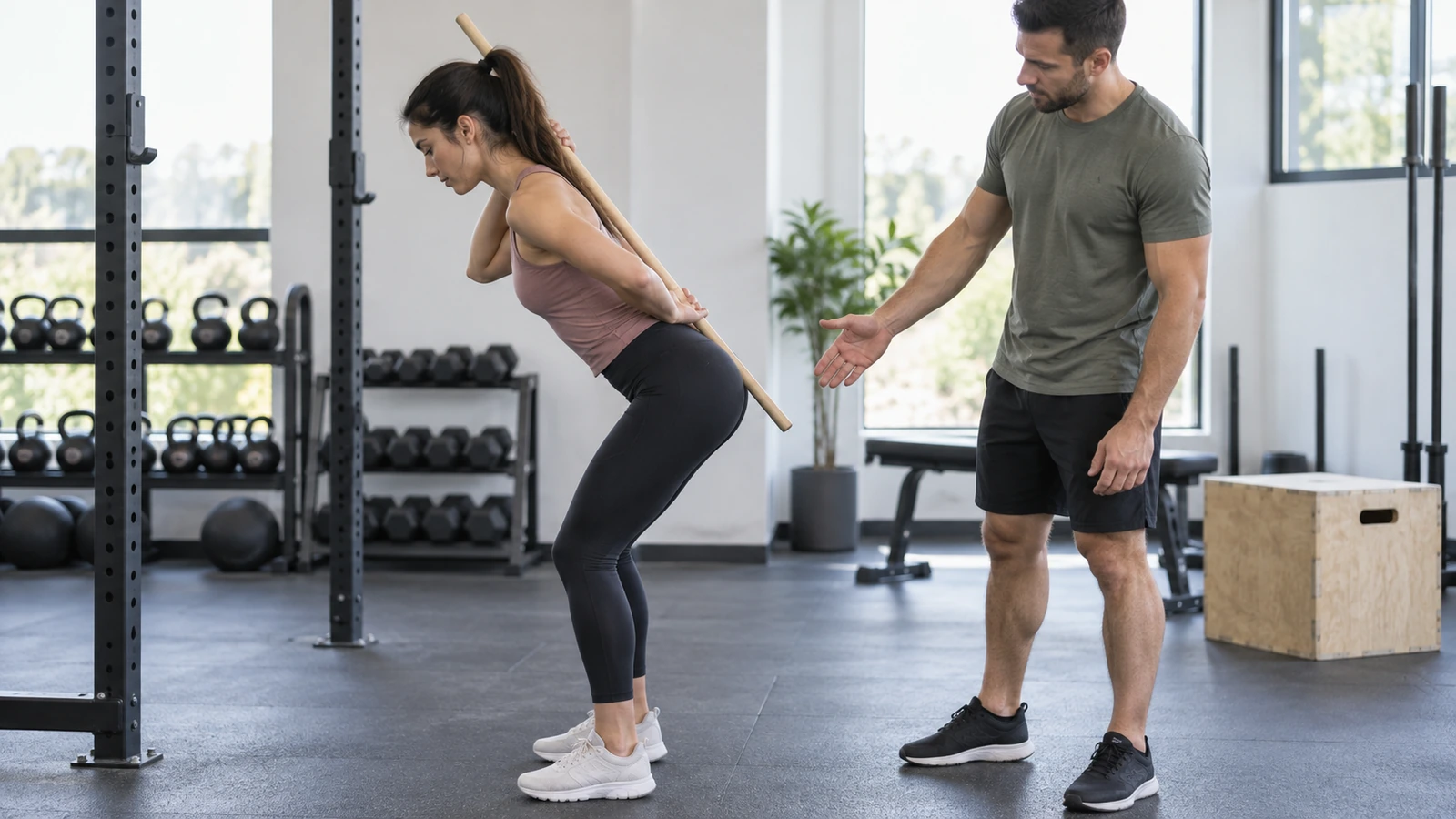
The bar should be a reference and a light brace, not a surface that carries most of your weight.
If the thighs hurt, the bar rolls, the hooks feel uncertain, or the machine is needed by someone actively lifting, choose another setup.
Film a light set from the side.
The knees should remain softly bent, the spine should look stable, the hips should move backward, and each repetition should end at approximately the same depth.
Depth Should Come From the Hips, Not the Spine
Albonetti cues a comfortable stretch, which is the important limit.
The caption’s idea that support lets everyone sit the hips much farther back can become a problem when a lifter treats range of motion as a contest.
Hamstring length, limb proportions, pelvic control, and training experience change the bottom position.
Some lifters will reach mid-shin, while others will stop around the knee and still complete a full hip hinge.
Do not chase a torso parallel to the floor.
The dumbbells only need to descend as far as the hips can continue moving backward without the lower back rounding or the knees bending more.
Anyone learning the hinge may benefit more from an unrestricted dumbbell RDL with a shorter range.
Our guide to deadlift alternatives by goal helps match a simpler movement to strength, muscle, back comfort, or equipment limits.
A Two-Session Supported RDL Test
Start with dumbbells that feel almost too light for the first practice set.
The external support and unfamiliar bottom position can make the movement feel easy until the hamstrings reach a length and fatigue level the lifter has not controlled before.
The following two-session test is a WorkoutHealthy coaching example, not Albonetti’s documented program or a validated research protocol.
Use two sets of 8 controlled repetitions for the first session, resting two to three minutes between sets.
That is 2 sets × 8 repetitions = 16 practice repetitions, not a target for everyone.
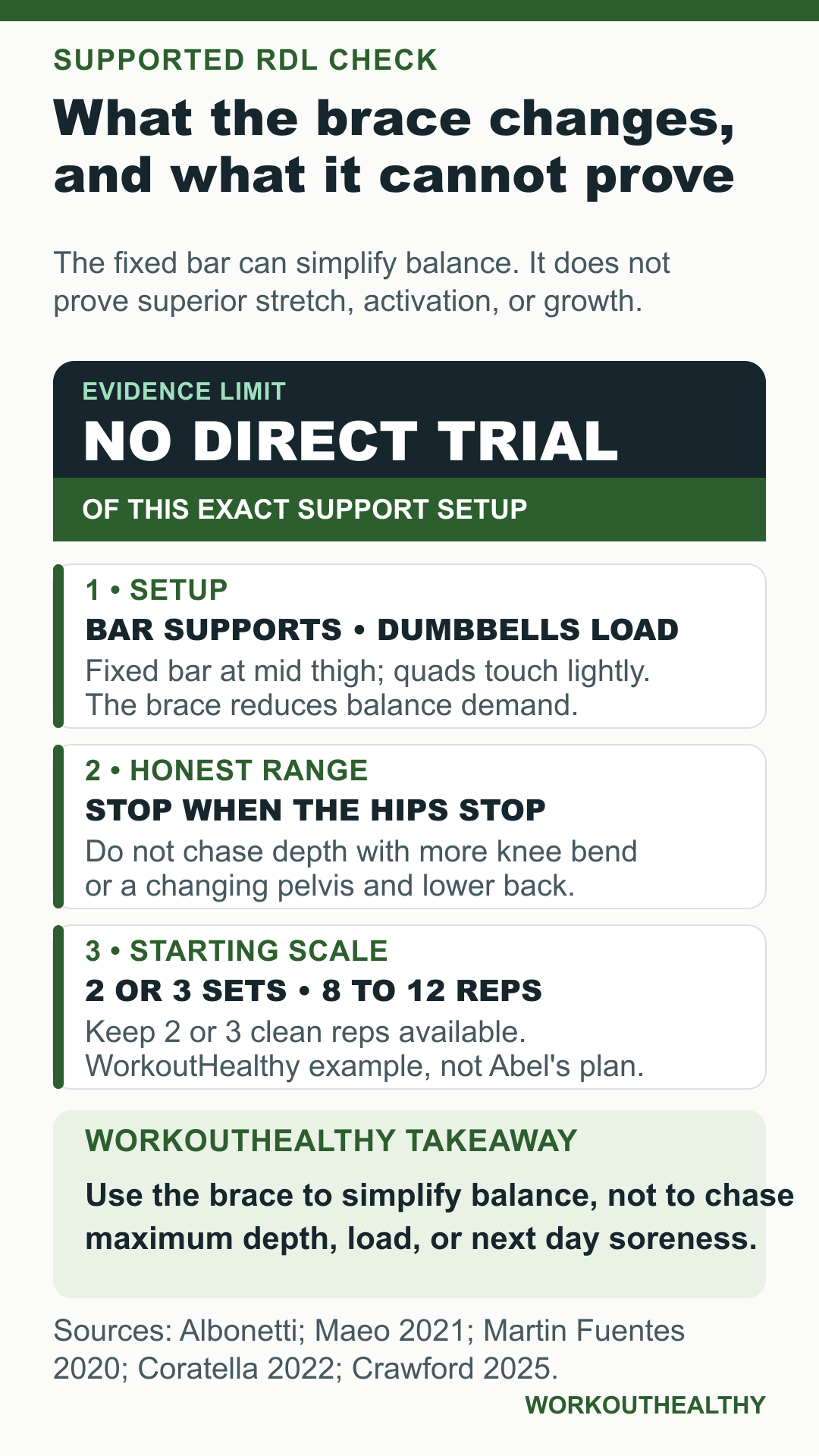
The infographic shows a broader coaching range of two or three sets of 8 to 12 repetitions.
This first practice session uses the low end; the wider range is not a proven ideal dose for this variation.
If the setup remains stable and the response is tolerable, repeat it at the next normal lower-body session.
Keep the same load and compare control, repeatable depth, and symptoms before considering an extra repetition or set.
Stop each set with about two or three clean repetitions still available while you learn the setup.
Use a two- or three-second lowering phase to make the bottom position visible, not to turn tempo into a magic growth mechanism.
Add repetitions before load, and add load only when the same depth and spinal position repeat across the set.
Training to failure does not appear necessary for muscle growth in the studies summarized by Grgic et al. (2022).
That finding does not identify the ideal effort for this untested variation.
Ending a new supported hinge before technique deteriorates is a conservative coaching choice, not proof of a superior growth strategy.
Keep the first several sessions conservative before deciding whether the exercise deserves a regular place in the program.
Soreness Is Not the Score
The social caption promises soreness in unfamiliar places, and the Muscle & Fitness report quotes followers describing strong soreness.
A new lengthened-position exercise can absolutely create delayed soreness, especially when its range and eccentric emphasis are unfamiliar.
Soreness does not prove that the exercise isolated the hamstrings better or will build more muscle.
One resistance-training study linked muscle protein synthesis more clearly with hypertrophy after early muscle damage subsided (Damas et al., 2016).
It did not test soreness as an individual growth score or study this supported RDL.
Judge the movement by repeatable technique, a tolerable joint response, stable progression, and whether the hamstrings remain the intended limit.
Do not add extra sets merely to recreate the first session’s soreness.
Progress is a repeatable hinge you can control, not soreness you can collect.
Who Should Use It, and Who Should Skip It?
The supported dumbbell RDL can suit an experienced lifter whose balance limits hamstring work, a bodybuilder finishing a leg session, or someone who can hinge well but wants a stable accessory variation.
It is optional, not a correction every RDL needs.
Beginners who have not learned a hip hinge should practice a simple unloaded or light dumbbell version first.
Lifters whose back pain, numbness, or radiating leg symptoms appear during hinges need assessment rather than a device that lets them move deeper.
Older lifters and people returning after injury may need a smaller range, different exercise, or clinician-guided progression.
Our guide to deadlifting after 50 explains how to scale the hinge without using pain as a training test.
Bottom Line
Abel Albonetti’s supported dumbbell RDL is a clever way to reduce the balance demand of a hamstring-focused hinge.
The fixed thigh brace may let some lifters control a longer hip excursion with lighter dumbbells.
No direct study shows that the variation creates more stretch, activation, or growth than a standard RDL.
Use it as a carefully loaded accessory, stop at an honest hip range, keep the Smith bar securely racked, and measure progress rather than soreness.
Get the next evidence check.
Five practical fitness stories worth your time, every Friday.
One email a week. No product pitches. Unsubscribe in one click.
References
Albonetti, A. [@abelalbonetti]. (n.d.). Smith-machine-supported dumbbell RDL demonstration [Video]. Instagram. Original demonstration.
Coratella, G., Tornatore, G., Longo, S., Esposito, F., & Cè, E. (2022). An electromyographic analysis of Romanian, step-Romanian, and stiff-leg deadlift: Implication for resistance training. International Journal of Environmental Research and Public Health, 19(3), Article 1903. https://doi.org/10.3390/ijerph19031903
Crawford, S. K., Sandberg, C. M., Vlisides, J., Thompson, Q., Mosiman, S. J., Heiderscheit, B. C., & Hickey, J. T. (2025). Hamstrings muscle architecture and morphology following 6 wk of an eccentrically biased Romanian deadlift or Nordic hamstring exercise intervention. Medicine & Science in Sports & Exercise, 57(8), 1799 to 1809. https://doi.org/10.1249/MSS.0000000000003701
Damas, F., Phillips, S. M., Libardi, C. A., Vechin, F. C., Lixandrão, M. E., Jannig, P. R., Costa, L. A. R., Bacurau, A. V., Snijders, T., Parise, G., Tricoli, V., Roschel, H., & Ugrinowitsch, C. (2016). Resistance training-induced changes in integrated myofibrillar protein synthesis are related to hypertrophy only after attenuation of muscle damage. The Journal of Physiology, 594(18), 5209 to 5222. https://doi.org/10.1113/JP272472
Felstead, S. (n.d.). Try this ‘Genius’ Romanian Deadlift hack like Abel Albonetti. Muscle & Fitness. Original report.
Grgic, J., Schoenfeld, B. J., Orazem, J., & Sabol, F. (2022). Effects of resistance training performed to repetition failure or non-failure on muscular strength and hypertrophy: A systematic review and meta-analysis. Journal of Sport and Health Science, 11(2), 202 to 211. https://doi.org/10.1016/j.jshs.2021.01.007
Maeo, S., Huang, M., Wu, Y., Sakurai, H., Kusagawa, Y., Sugiyama, T., Kanehisa, H., & Isaka, T. (2021). Greater hamstrings muscle hypertrophy but similar damage protection after training at long versus short muscle lengths. Medicine & Science in Sports & Exercise, 53(4), 825 to 837. https://doi.org/10.1249/MSS.0000000000002523
Martín-Fuentes, I., Oliva-Lozano, J. M., & Muyor, J. M. (2020). Electromyographic activity in deadlift exercise and its variants. A systematic review. PLOS ONE, 15(2), Article e0229507. https://doi.org/10.1371/journal.pone.0229507
Medical disclaimer: This article provides general fitness and nutrition information, not medical advice. If you have a medical condition, an injury or concerning symptoms, discuss suitable training, diet and supplement choices with a qualified healthcare professional before making changes.