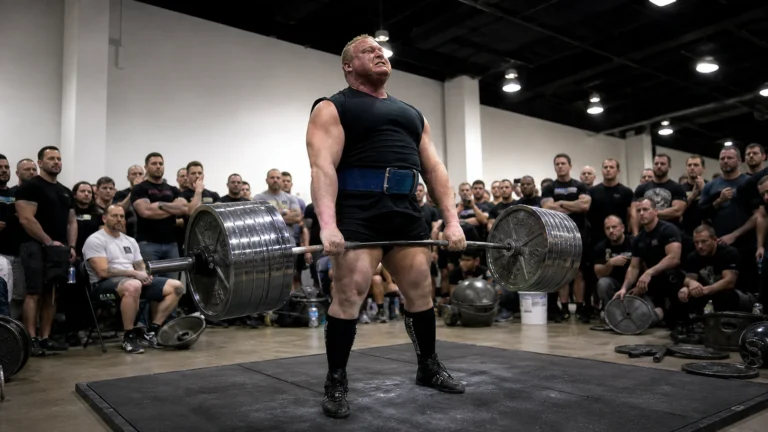

Ilja Dragunov returned to WWE after more than a year away with an ACL injury and won the United States Championship on his first night back.
During the long build toward that October 17, 2025 return, he posted difficult Zercher variations, including squats, deadlifts, and a single-leg pistol version.
The lifts are real. The viral idea that pain was the point of his rehabilitation goes too far. Zerchers may have supported strength and wrestling-specific preparation, but they did not replace a staged ACL recovery.
The ACL Injury Happened in 2024
Dragunov tore his anterior cruciate ligament during a WWE live event in 2024.
An ACL tear can affect knee stability during cutting, landing, and sudden changes of direction. Those demands are central to professional wrestling even when the match outcome is scripted.
Wrestlers still sprint, jump, absorb impacts, lift opponents, and react to another moving body.
He Was Away for More Than a Year
Dragunov did not make a rapid comeback. He returned on the October 17, 2025 episode of SmackDown after roughly 13 months away.
That timeline alone shows why the story cannot be reduced to one brutal exercise.
ACL recovery usually includes phases for swelling, range of motion, strength, running, jumping, cutting, sport practice, and confidence under unpredictable demand.
Calendar Time Is Not the Only Standard
Months since injury matter because healing takes time, but the calendar cannot show whether an athlete has restored strength, control, and tolerance for repeated work.
Two athletes at the same month can have different swelling, range of motion, quadriceps deficits, and confidence. Progression should respond to those findings rather than a deadline alone.
Dragunov’s long absence created time for rebuilding, but the public cannot infer his test results from the date of his return.
The Return Was Dramatic and Verified
WWE’s own video confirms Dragunov answered Sami Zayn’s open challenge and won the United States Championship on his return night.
The title change made the comeback unusually visible. It does not tell viewers which exercise repaired his knee or whether every physical capacity was already back to its previous level.
Performance in one match is evidence of readiness for that event, not a complete medical report.
What a Zercher Lift Is
In a Zercher squat, the lifter holds a barbell in the crooks of the elbows in front of the torso. That front-loaded position challenges the legs, trunk, upper back, and arms.
A Zercher deadlift starts lower and brings the bar into the elbow position. A Zercher pistol squat adds a demanding single-leg pattern.
The shared feature is not pain. It is a front-loaded resistance that requires bracing and control.
Ed Zercher Popularized the Setup
The name comes from strongman Ed Zercher, who used the position before modern squat racks were common.
Some lifters still begin from the floor, while others unrack the bar at a comfortable height.
The historical origin explains the awkward hold. It does not make the movement automatically functional or safer for every trainee.
Dragunov Posted Multiple Variations
Muscle & Fitness highlighted Dragunov’s Zercher squat, Zercher deadlift, and Zercher pistol squat posts.
It interpreted the exercises as a good match for wrestling because they combine leg drive with trunk and upper-body tension.
That interpretation is reasonable. It remains an interpretation of public training footage, not a complete program supplied by his medical team.
The Pistol Variation Was Especially Advanced
A pistol squat requires single-leg strength, balance, ankle mobility, hip control, and confidence at deep knee flexion.
Holding a bar in the elbows raises the challenge further and changes the center of mass.
Someone early in ACL rehabilitation should not use Dragunov’s finished variation as a starting exercise.
Deep single-leg work also exposes side-to-side differences. That can be useful late in a progression when the athlete can control the position, but it can be frustrating or unsafe when basic strength and balance are not ready.
The Quote Glorified Discomfort
Dragunov called the single-leg variation a romance of self-destruction. The language fits his intense wrestling character and the difficulty of the set.
It is poor rehabilitation guidance when stripped from that performance context.
Exercise can be hard without making tissue damage, joint pain, or loss of control the goal.
Muscle Effort and Joint Pain Are Different
A hard set can create burning muscles, heavy breathing, and general fatigue. Sharp joint pain, instability, swelling, or a sudden loss of function communicates something else.
Athletes and clinicians adjust load, range, tempo, and exercise choice according to symptoms and phase.
Toughness does not make every signal safe to ignore.
Symptom response after training also matters. A knee that swells later that day or loses range the next morning may have received more load than it could recover from, even if the exercise looked controlled on video.
Zerchers Did Not Rebuild the Ligament
Strength training can rebuild quadriceps, hamstrings, hips, trunk capacity, and tolerance for load after injury.
It does not physically substitute for a torn ACL or prove a surgical graft has matured.
The reviewed sources do not say Dragunov’s clinicians prescribed Zerchers as the central rehabilitation exercise.
The Dungeon Added Sport Practice
Dragunov later said training at the Dungeon with Natalya and TJ Wilson helped him prepare for his comeback.
That environment could reintroduce wrestling timing, contact, footwork, ropes, and reactions that a gym lift cannot reproduce.
Return to sport requires both general capacity and exposure to the actual sport.
Strength Symmetry Is Only One Check
Clinicians may assess quadriceps and hamstring strength, hopping, landing, change of direction, swelling, pain, range of motion, and psychological readiness.
No single test guarantees that reinjury will not occur.
Athletes progress when several pieces align, not when they survive one impressive lift.
Fatigue testing can reveal deficits that a fresh single repetition misses. Wrestling requires repeated sequences, so readiness must survive more than one jump, cut, or squat performed under perfect conditions.
Psychological readiness matters too. Hesitation can change landing and movement strategy even when strength numbers appear acceptable.
Why the Exercise Can Suit Wrestling
The front load demands a strong brace while the legs produce force. The arms and upper back must also keep the weight close.
Those qualities can resemble the effort of controlling another body in front of the torso.
Specificity has limits. A barbell does not move, resist, or fall like an opponent.
Why Most Lifters Need a Simpler Entry
Beginners can train similar patterns with a goblet squat, front squat, sandbag hold, or light Zercher squat from a rack.
Padding the bar may reduce elbow discomfort, but the movement should still be stopped if numbness, sharp pain, or loss of control appears.
The best variation is the one that provides a useful training effect at a manageable cost.
Zercher loading can also irritate the elbow crease or encourage the torso to collapse when load exceeds bracing capacity. Starting light and filming from the side can help a coach assess depth, balance, and trunk position.
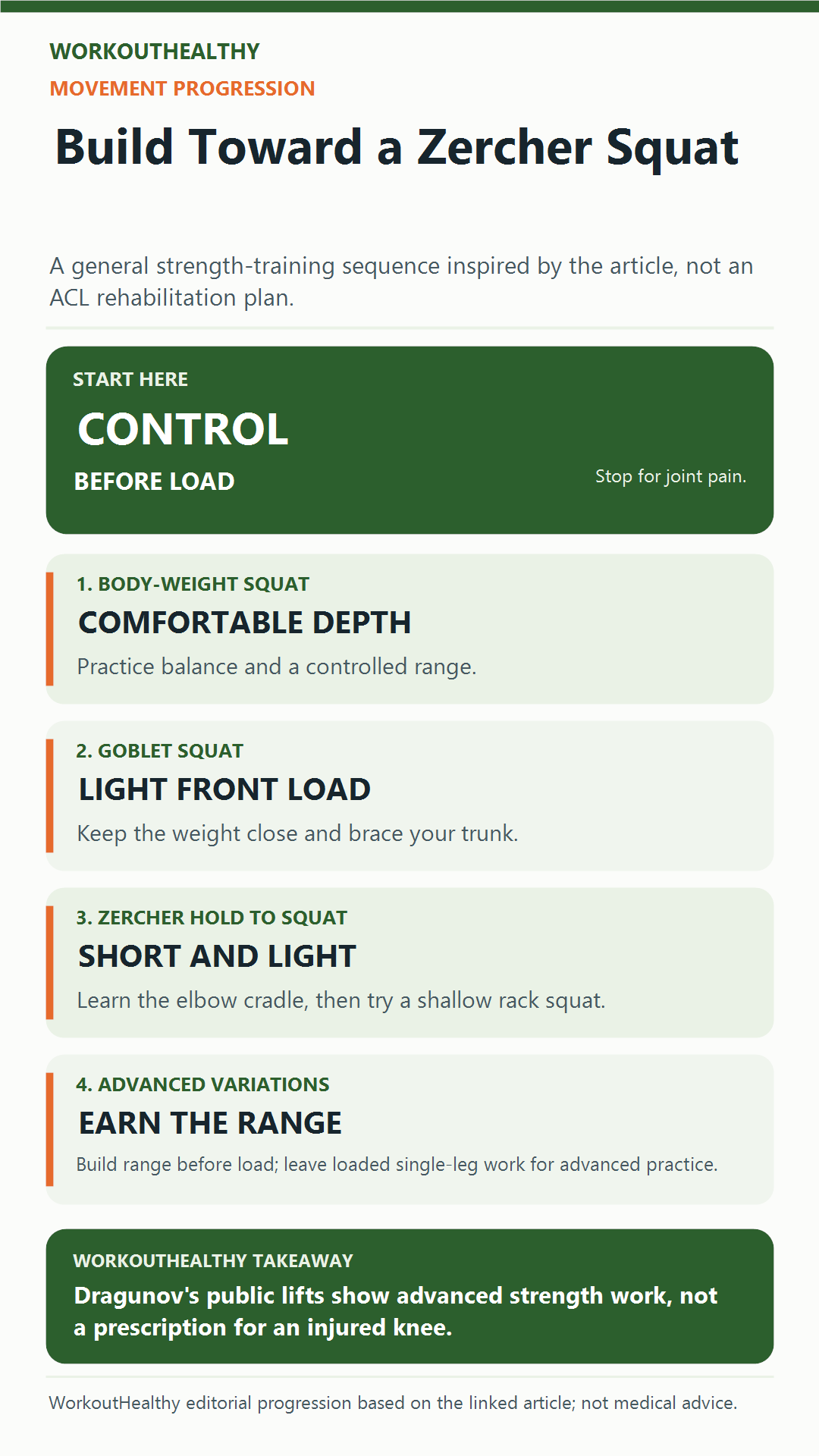
A Safer Progression
- Learn a body-weight squat to a comfortable depth.
- Use a goblet squat to practice front loading.
- Try a light Zercher hold or carry.
- Add a shallow Zercher squat from a rack.
- Increase range before chasing heavy load.
- Leave single-leg loaded variations for advanced practice.
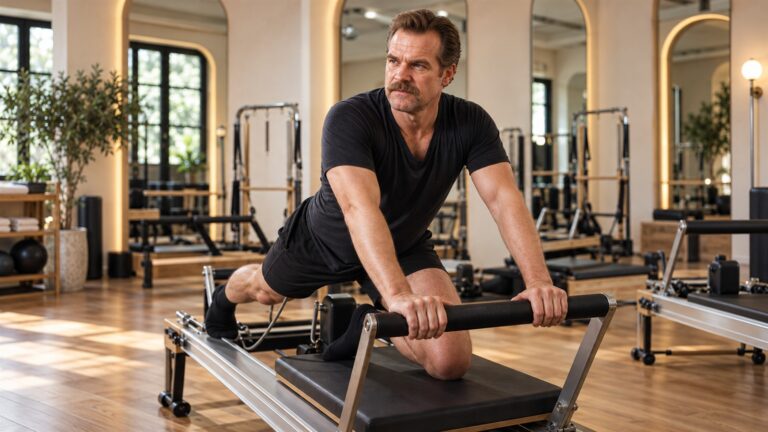
Our 30-minute standing dumbbell workout offers a simpler full-body starting point.
Do Not Copy an ACL Return From Social Media
An ACL program depends on treatment, graft or nonoperative plan, other damaged structures, sport, symptoms, and testing.
A video usually shows the successful repetition, not the weeks of preparation or the exercises that were removed.
Our article on whether a cool-down speeds recovery explains why visible rituals rarely reveal the whole process.
What Dragunov’s Return Actually Shows
He completed a long rehabilitation and sport-preparation process, used demanding strength variations, returned to WWE, and won a championship.
The public evidence supports Zerchers as part of his later training. It does not prove they were the secret to healing.
His achievement was the accumulation of medical care, rehabilitation, strength, wrestling practice, patience, and readiness.
That layered explanation does not reduce the intensity of his work. It gives the achievement its real scale. Returning to a chaotic contact environment after a major knee injury requires many ordinary sessions that never become social-media highlights.
Those quiet sessions are the foundation.
Selected training clips cannot show how his workload changed week by week.
A heavy Zercher video provides no baseline for earlier weights, range of motion, sets, next-day symptoms, or movement quality. Those missing details matter when clinicians judge whether a drill fits an athlete at a particular stage.
Return-to-sport guidance considers clinical examination, strength, psychological readiness, and sport demands together. The public evidence supports Dragunov’s preparation, but it cannot reveal the medical decisions behind it.
The Bottom Line
Ilja Dragunov’s Zercher training was intense and relevant to the full-body tension of professional wrestling.
The lesson is not that pain builds resilience or that one awkward lift repairs an ACL. The lesson is that advanced exercises belong at the right stage of a much larger return-to-sport plan.
Get the next evidence check.
Five practical fitness stories worth your time, every Friday.
One email a week. No product pitches. Unsubscribe in one click.
Medical disclaimer: This article is for general information only and is not medical advice. If you have an injury, ongoing pain, or a medical condition, talk to a doctor or physical therapist before you change how you train or eat.