
This standing dumbbell workout uses one 30-minute clock: five minutes to warm up, two nine-minute strength rounds, five minutes of easy movement, and a two-minute cool-down. It needs no bench or floor work, and every strength station has a lighter or supported option.
Women over 50 can train strength with dumbbells, but age does not dictate one load or movement. The Improved Health video below is a separate follow-along session; the clock here is an editorial example you can follow or adapt.
Before you start
Use a clear floor, shoes that feel stable, and dumbbells you can control without holding your breath. Keep a sturdy wall or chair nearby for support, especially if balance is uncertain.
If you have osteoporosis, a recent fracture or fall, a joint replacement, chest symptoms, or a condition that changes exercise tolerance, ask a clinician or physical therapist which movements and loads fit you. A lighter option is sensible when a movement causes pain or unsteadiness.
The exact 30-minute standing workout clock
| Clock | What to do |
|---|---|
| 0:00 to 5:00 | Easy warm-up: two minutes of walking or marching, one minute of shoulder and arm movement, and two minutes practicing shallow squats and hip hinges without weights. |
| 5:00 to 14:00 | Round one: six stations, each with 45 seconds of controlled movement and 45 seconds for rest and position changes. |
| 14:00 to 23:00 | Round two: repeat the same six stations at a pace you can control. |
| 23:00 to 28:00 | Easy walking or marching; this is not a sprint finisher. |
| 28:00 to 30:00 | Slow down, breathe normally, and note which movement to adapt next time. |
Two rounds of six 90-second stations make 18 minutes, so the pieces add up to 30 minutes. If one round is enough, stop after the first round and use the same five-minute easy walk and two-minute finish for a 21-minute option.
The six standing stations
| Station | Movement and cue | Supported or lighter choice |
|---|---|---|
| 1. Squat | Hold weights at your sides, sit your hips back a comfortable distance, then stand tall. | Use a shallow range or tap a stable chair before standing. |
| 2. Hip hinge | Keep knees soft, move hips back with a long torso, then return upright. | Practice without weights or keep hands on hips to learn the motion. |
| 3. Push | Press light dumbbells overhead only if the motion is comfortable and steady. | Use a wall push-up instead; the station stays standing. |
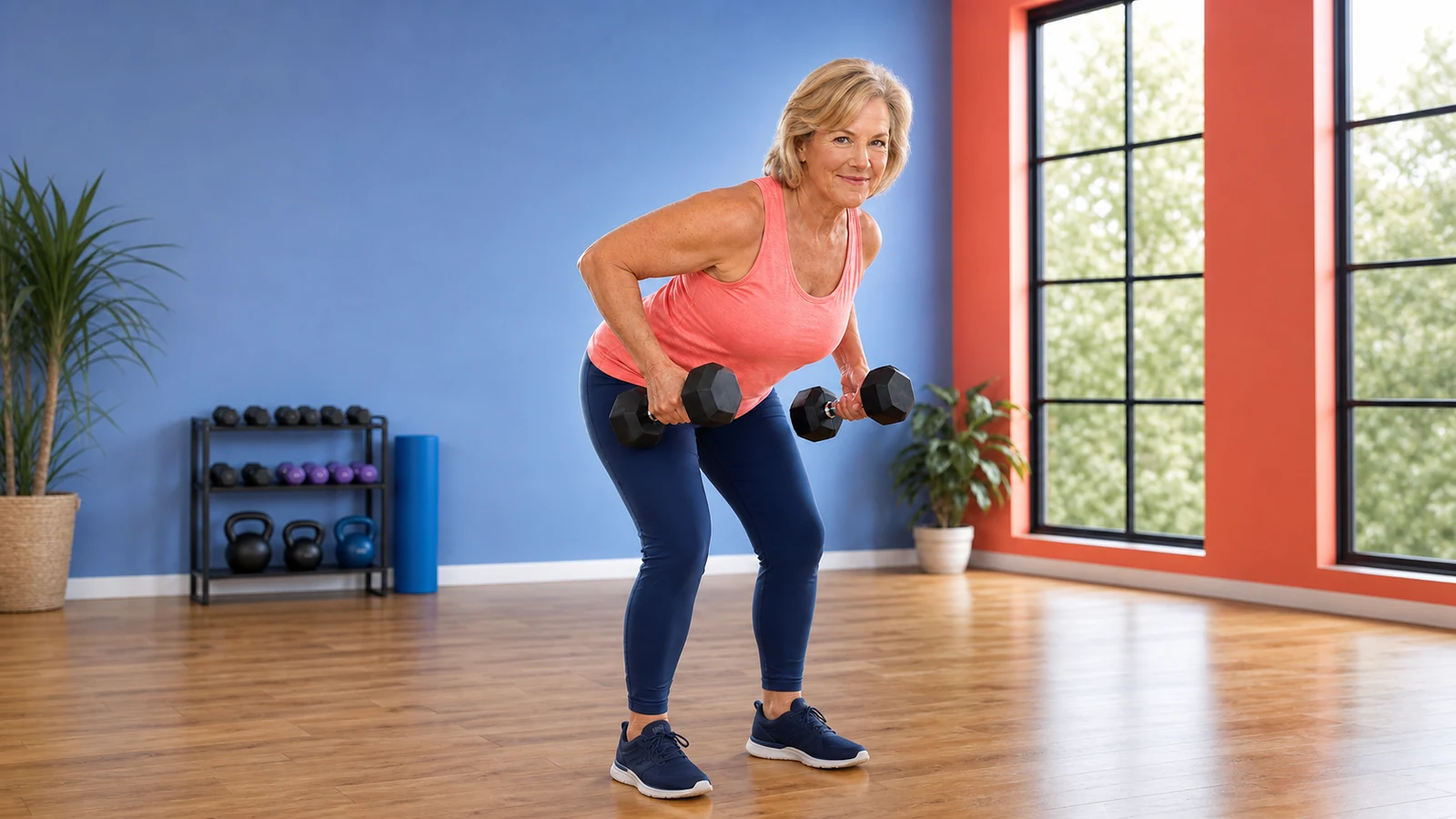
| 4. Pull | Brace one hand on a stable chair or counter and row one dumbbell, changing sides partway through. | Use a lighter weight and smaller range while keeping your torso supported. |
| 5. Step | Tap one foot behind you and return, alternating sides without rushing. | Hold the chair or replace the step with supported heel raises. |
| 6. Carry | Hold one dumbbell at your side and walk a short clear path, changing hands partway through. | Stand near support and hold a lighter dumbbell at your side without walking. |
Use the 45-second movement period for a few well-controlled repetitions, not a race to fill every second. Rest during the work period too if your form changes; the clock is a structure, not a quota.
For the row and carry, switch sides halfway through the work interval. If you cannot make a safe change quickly, use one side in round one and the other side in round two, or extend the pause and accept a shorter workout.
How to choose and progress the dumbbells
Start with a load that lets you move smoothly and breathe normally through every station. Record the weight or bodyweight option, the movements completed, and which station felt hardest.

After several sessions with steady technique, add a controlled repetition or choose a slightly heavier weight for one exercise. There is no required weekly increase, and balance or comfort can be a better reason to keep a lighter version.
This page covers one standing session; it is not a full weekly strength plan. The CDC advises adults 65 and older to include aerobic activity, strength work, and balance practice across the week, within their abilities.
What the research behind the video can and cannot show
Resistance training can help older adults gain lean mass and strength, but this exact timer was not tested in a trial. A meta-analysis by Peterson and colleagues pooled 49 studies and found a positive average lean-mass response to resistance exercise in aging adults.
The LIFTMOR trial is a stronger bone-health example with a very different intervention: 101 screened postmenopausal women with low bone mass were assigned to eight months of supervised high-intensity resistance and impact work or low-intensity home exercise. Its 30-minute twice-weekly sessions used heavy loads and professional screening, so a lighter home dumbbell session cannot inherit its bone-density result.
A Cochrane falls review found a lower average fall rate across structured exercise programs in community-dwelling older adults. It pooled many types of programs, often with balance training, and does not show this single dumbbell session reduces an individual’s fall risk by 23%.
| Source | Supported point | Limit for this workout |
|---|---|---|
| Watson et al., 2018 | Supervised heavy resistance and impact training improved bone measures in screened women with low bone mass. | Different loading, screening, supervision, and eight-month duration. |
| Peterson et al., 2011 | Resistance training was associated with more lean mass across aging-adult studies. | Does not identify one standing 30-minute routine as optimal. |
| Sherrington et al., 2019 | Exercise programs reduced the average rate of falls across pooled older-adult trials. | Not a trial of this six-station session or a personal risk estimate. |
The original Improved Health video can be useful as a follow-along demonstration, but its bone, muscle, and balance effects are not guaranteed by the studies above. If you want a program for osteoporosis or fall prevention, seek one matched to your health history and supervised as needed.
Watch the Original Video
Want more like this? Subscribe to WorkoutHealthy Insider for practical explanations behind popular fitness claims.
References
CDC, Older Adult Activity: An Overview, aerobic, muscle-strengthening, and balance guidance for adults 65 and older.
Watson et al. (2018), Journal of Bone and Mineral Research, LIFTMOR randomized trial.
Peterson et al. (2011), Medicine and Science in Sports and Exercise, resistance-training and lean-mass meta-analysis.
Sherrington et al. (2019), Cochrane exercise and falls review.
This workout is general fitness information, not a personal medical prescription. For osteoporosis, a recent fall, joint pain, or another health condition, ask a clinician or physical therapist how to select and adapt exercises.