
You just finished a hard workout, and a video or a trainer tells you to spend the next ten to fifteen minutes stretching everything out.
The idea sounds reasonable. Move your joints, ease the tension, and walk away feeling loose instead of stiff.
A video like MIZI’s fifteen minute full body cool down stretch routine promises exactly that kind of relief right after a tough training session.
But does stretching after a workout actually do what these routines promise, or is most of the benefit just in how it feels in the moment?
What a Cool Down Stretch Routine Claims to Do
A typical cool down stretch routine, the kind shown in MIZI’s video, moves through the major muscle groups one at a time once training is finished.
The pitch behind these routines usually includes a few specific promises. Less soreness the next day is the biggest one.
Better flexibility over time, a calmer body after a hard effort, and a lower chance of getting hurt in a future workout usually round out the list.
Some of these claims hold up reasonably well under real research.
Others do not, and the gap between the two is worth understanding before you build a routine around them.
MIZI’s video frames the routine as a way to get full body recovery in fifteen minutes.
That is the creator’s own framing of the workout, and it is worth treating as a starting claim to test rather than an established fact, since a fifteen minute stretch session is not the same thing as full physiological recovery from a hard workout.
What the Research Actually Supports About Post Workout Stretching
The part of the claim with the strongest evidence behind it is flexibility.
A large 2025 meta analysis in the journal Sports Medicine pooled 189 studies and more than 6,600 participants and found that static stretching produces a real, measurable increase in range of motion.
The effect was moderate after a single stretching session and grew larger with repeated sessions over weeks.
The researchers also found a practical dosing detail.
Flexibility gains leveled off beyond about four minutes of stretching per muscle group in a single session, and beyond about ten minutes of total stretching per week over time.
More stretching past those amounts did not produce meaningfully more flexibility.
Static stretching reliably improves how far a joint can move, and that benefit shows up whether the stretching happens before, after, or completely separate from a workout. What it does not reliably do is erase soreness or guarantee a better performance the next day.
People also commonly say a cool down helps them feel calmer and less wound up after training.
That reported sense of relaxation is real to the person feeling it, and there is nothing wrong with valuing it.
It is similar to how people describe the wind down feeling after a foot massage, where the felt experience is genuine even when it is hard to measure in a lab.
The 2018 Sports Medicine review by Van Hooren and Peake looked directly at this question and found something interesting.
Most controlled studies found no significant change in objective measures of mood or psychological recovery after an active cool down, yet people who did a cool down still rated it as more helpful than doing nothing.
The researchers suggested part of that gap comes from belief in the routine itself, not just the physical movements.
In other words, expecting a cool down to help you relax may be part of why it works for you personally, even if a lab test cannot fully capture that effect.
Why Soreness Relief Is the Weakest Part of the Claim
Soreness reduction is the promise that gets repeated the most, and it is also the one with the least support.
A 2011 Cochrane review, one of the most rigorous types of research summary that exists, pooled data from twelve trials on stretching and delayed onset muscle soreness.
The reviewers, Herbert, de Noronha, and Kamper, concluded that stretching before or after exercise produced only a tiny reduction in soreness, less than half a point on a 100 point pain scale at any single time point.
That is not a typo.
The effect was small enough that the review called it not clinically meaningful for most people.
An earlier 2002 systematic review by Herbert and Gabriel in the BMJ reached a similar conclusion using a different set of studies.
That review found stretching reduced next day soreness by less than two millimeters on a 100 millimeter scale, an amount too small to notice in daily life.
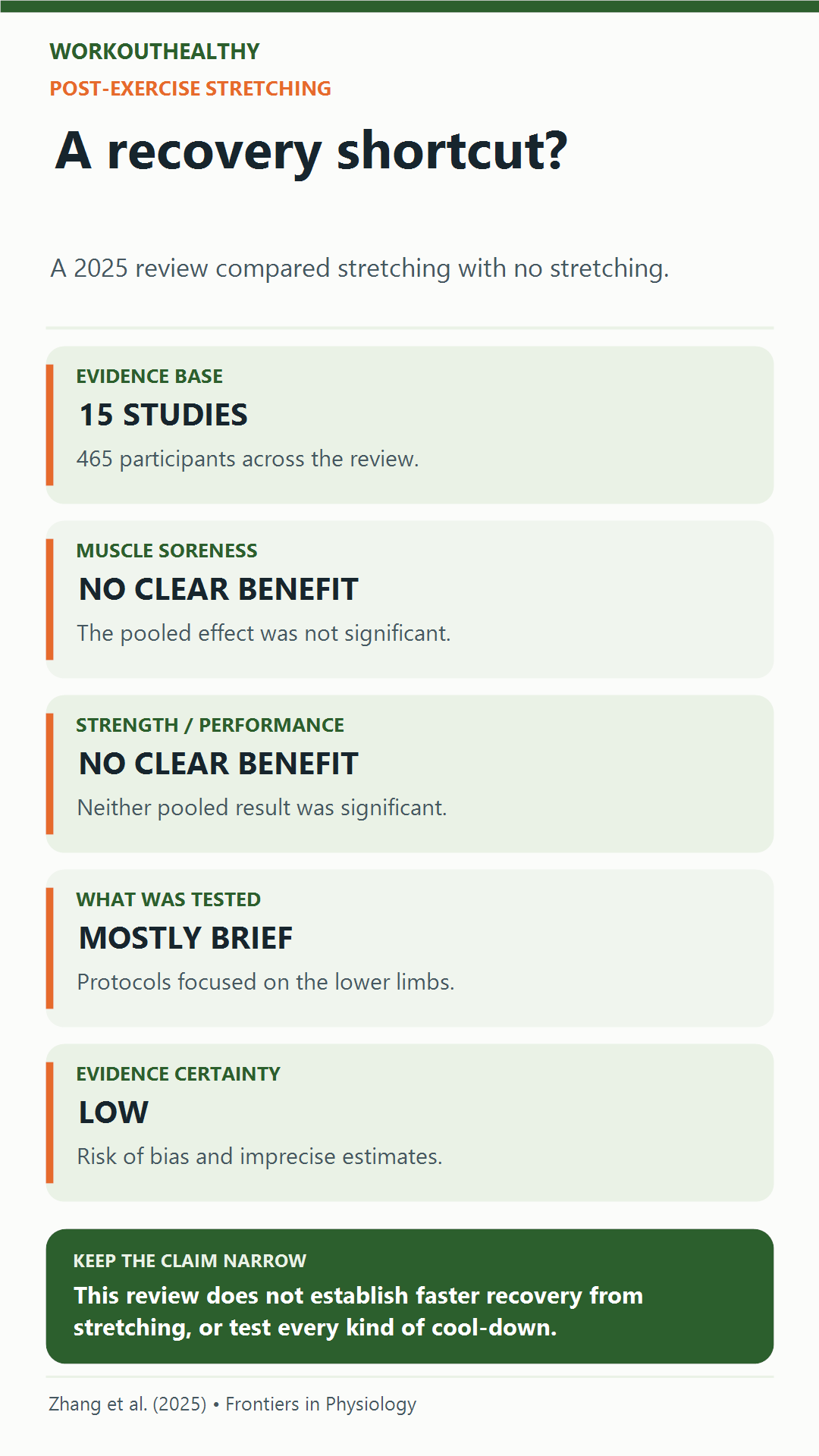
A more recent 2025 meta analysis in Frontiers in Physiology looked specifically at post exercise stretching, the kind done as a cool down rather than before training.
Across fifteen studies and 465 participants, the researchers found no significant benefit for soreness, strength, flexibility, or pain sensitivity when stretching was used as the only recovery method after a workout.
Put plainly, three separate reviews, spanning more than twenty years of research, keep landing on the same answer.
Stretching after a workout does not reliably stop you from being sore the next day.
What the Evidence Does Not Prove
It helps to be just as clear about what the research does not show, since a lack of proof for one claim does not mean a routine is worthless.
The evidence does not show that stretching after exercise reliably prevents injury.
The 2002 BMJ review found that pre exercise stretching lowered injury risk by about five percent, a difference small enough that it was not statistically meaningful, meaning it could easily have been due to chance.
The 2018 Van Hooren and Peake review reached the same conclusion for cool down routines specifically.
Active cool downs, including stretching, did not appear to meaningfully lower injury rates in the studies available.
The evidence also does not show that a cool down fully prevents soreness. It shows a small, inconsistent effect at best, not a reliable fix.
The same review found mixed results for next day performance.
A few studies found a small benefit, some found no change, and a few found a slightly worse result on measures like sprint speed or jump height the day after an active cool down.
None of this means a cool down is pointless.
It means the specific, dramatic claims often attached to it, things like preventing injury or erasing soreness, go further than the data currently supports.
Common Mistakes People Make With Cool Downs
The biggest mistake is treating a cool down stretch as an injury shield rather than what it more likely is, a low cost habit with modest, mostly comfort based benefits.
Skipping any easy movement and going straight into deep, forceful stretching right after intense effort is another common error.
Muscles are already fatigued and slightly damaged after a hard session, and pushing hard into a stretch at that point raises the odds of discomfort without adding any proven benefit.
A related mistake shows up after especially jarring movements, like box jumps or other high impact training, where people skip any gentle transition and drop straight into static holds while joints and tendons are still under load from the session.
Bouncing during a stretch, sometimes called ballistic stretching, is another mistake, since it increases the chance of a small muscle tear without adding flexibility benefit.
Holding a stretch to the point of sharp pain is also common and unnecessary.
Research on flexibility gains, including the 2025 dose response meta analysis, used stretches held to mild tension, not pain, and still found real improvements in range of motion.
Finally, many people expect a fifteen minute stretch session to substitute for actual recovery basics like sleep, protein, and hydration.
A cool down is a small piece of recovery, not a replacement for the larger habits that do more of the real work.
Who Should Check With a Doctor or Physical Therapist First
Most healthy adults can safely do a gentle cool down stretch routine without special guidance.
A few groups should get personal advice before following a general routine like the one in MIZI’s video.
Anyone with a recent muscle strain, joint sprain, or other fresh injury should check with a doctor or physical therapist before stretching that area, since stretching a healing tissue too soon can slow recovery rather than help it.
People recovering from a joint replacement or major surgery fall into this same category.
The kind of structured, professionally guided process described in Misty Copeland’s hip replacement recovery shows how different a supervised rehab stretching plan is from a generic online cool down video.
People with joint hypermobility, meaning joints that move further than typical and may feel loose or unstable, need a different approach entirely.
For a hypermobile joint, pushing further into a stretch is rarely the goal, and a physical therapist can help build a plan focused on control and stability instead of extra range of motion.
Anyone with a chronic condition affecting connective tissue, circulation, or nerve function should also get individual guidance rather than following a general video routine.
If a stretch causes sharp, shooting, or radiating pain rather than a mild pulling sensation, stop and get that checked out instead of pushing through it.
A Simple, Safe Cool Down Structure You Can Use
If you want to keep a cool down in your routine, and there is no strong reason not to, a simple structure keeps it low risk.
Start with two or three minutes of easy movement, like slow walking or light cycling, to bring your heart rate down gradually rather than stopping all at once.

Move into gentle stretches for the muscle groups you trained, holding each one for around twenty to thirty seconds at a point of mild tension, never sharp pain.
That lines up with the dosing research, since roughly four minutes of total stretching per session is enough to capture most of the flexibility benefit available.
Breathe slowly and normally through each stretch instead of holding your breath, since tension in your breathing tends to translate into tension in the muscle you are trying to release.
End with a minute or two of stillness if that feels good to you, since the psychological wind down effect, even if it is more about perception than measurable physiology, is a real and reasonable part of why people keep the habit.
Treat the whole thing as optional maintenance rather than a required step that determines how sore you will be tomorrow.
Watch the Original Video
Want more like this? Subscribe to WorkoutHealthy Insider for practical explanations behind popular fitness claims.
References
Herbert, R. D., de Noronha, M., & Kamper, S. J. (2011). Stretching to prevent or reduce muscle soreness after exercise. Cochrane Database of Systematic Reviews, 2011(7), CD004577. https://doi.org/10.1002/14651858.CD004577.pub3
Herbert, R. D., & Gabriel, M. (2002). Effects of stretching before and after exercising on muscle soreness and risk of injury: systematic review. BMJ, 325(7362), 468 to 470. https://doi.org/10.1136/bmj.325.7362.468
Van Hooren, B., & Peake, J. M. (2018). Do we need a cool-down after exercise? A narrative review of the psychophysiological effects and the effects on performance, injuries and the long-term adaptive response. Sports Medicine, 48(7), 1575 to 1595. https://doi.org/10.1007/s40279-018-0916-2
Ingram, L. A., Tomkinson, G. R., d’Unienville, N. M. A., Gower, B., Gleadhill, S., Boyle, T., & Bennett, H. (2025). Optimising the dose of static stretching to improve flexibility: a systematic review, meta-analysis and multivariate meta-regression. Sports Medicine, 55(3), 597 to 617. https://doi.org/10.1007/s40279-024-02143-9
Zhang, P., Chen, J., & Xing, T. (2025). Effects of post exercise stretching versus no stretching on lower limb muscle recovery and performance: a meta analysis. Frontiers in Physiology, 16, 1674871. https://doi.org/10.3389/fphys.2025.1674871
This article is for general information only and is not medical advice. If you have an injury, ongoing pain, or a medical condition, talk to a doctor or physical therapist before you change how you train or eat.