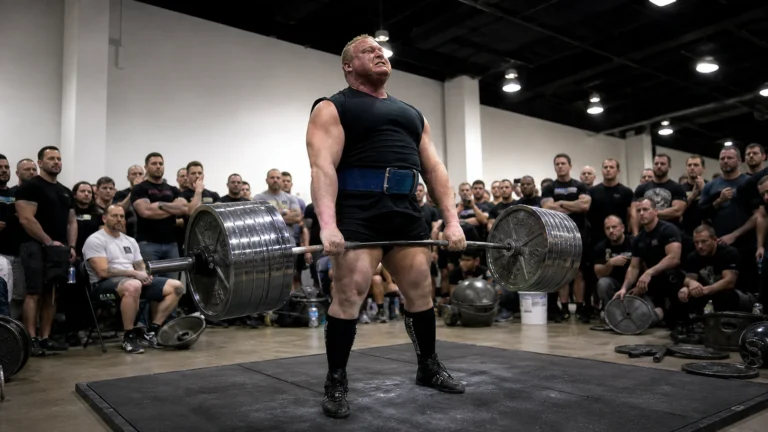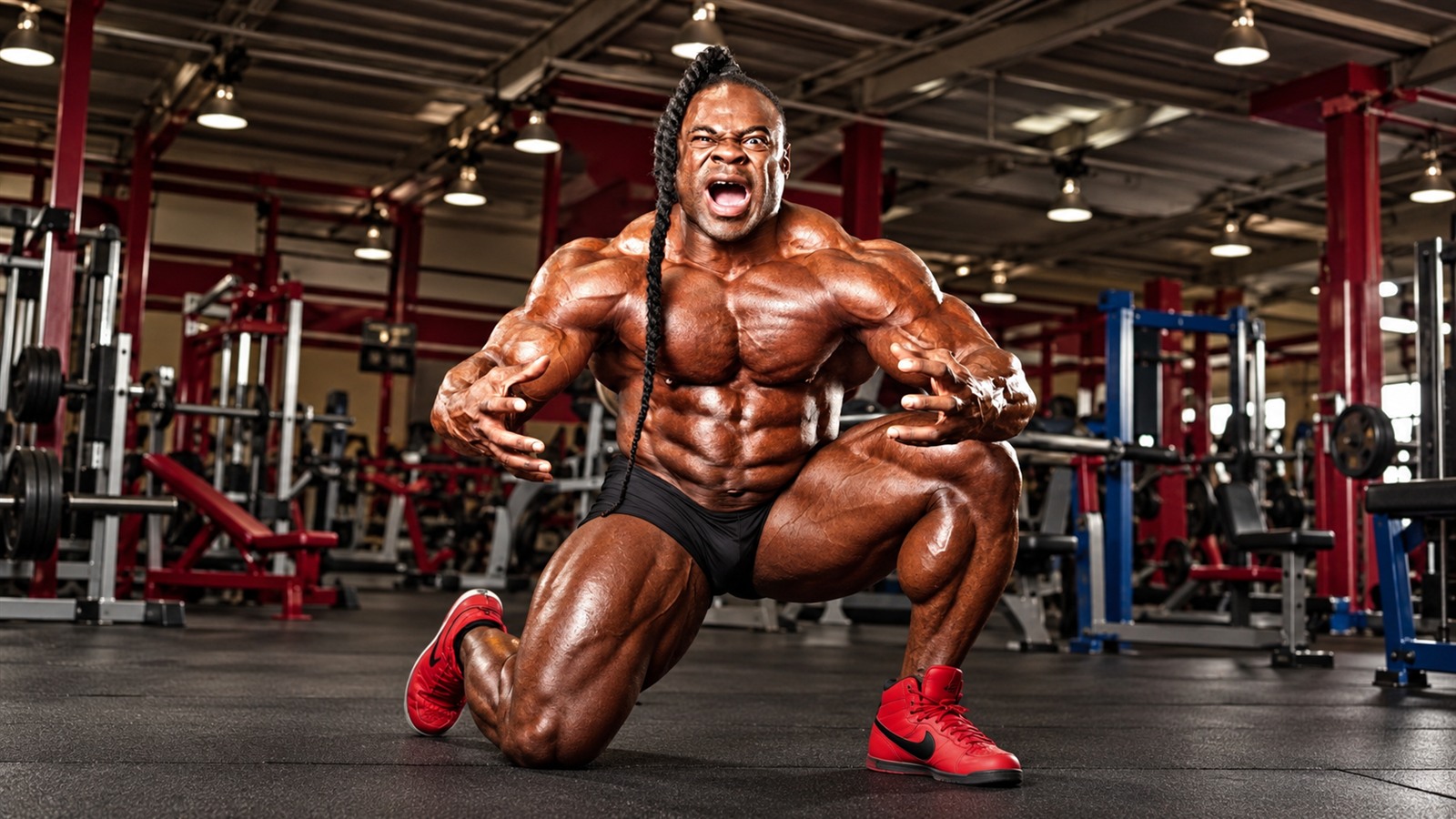

Kai Greene has described an early bodybuilding phase built around enormous meals, including pizza and ice cream. That part of the viral story has a direct source: Greene discussed those habits on his own show in 2025.
The lesson attached to the story is less reliable. A large calorie surplus can help a hard-training athlete gain weight, but calories are not automatically converted into muscle. Training experience, the size of the surplus, protein intake, recovery, genetics, and time all affect where that new weight goes.
The Pizza and Ice Cream Story Came From Greene
Generation Iron’s recap of episode 18 of The Kai Greene Effect reports that Greene talked about eating gallons of ice cream and two pizza boxes in one meal during his earlier bulking years. He framed the story as a habit he eventually learned to control, not a current nutrition recommendation.
That distinction matters. The anecdote is evidence that Greene ate those foods while trying to become larger. It is not a controlled comparison showing that pizza and ice cream built more muscle than a smaller, better-planned surplus would have built.
It also does not establish the exact frequency of the meals. A memorable extreme meal can become an online summary of an entire diet even when the source describes only a period or pattern.
Some Viral Details Remain Unverified
The caption adds beef patties eaten by the dozen, three-hour leg sessions, and a metabolism that supposedly made clean food inadequate. Those details were not established by the sources reviewed for this article.
Greene has publicly emphasized eating a great deal. In a 2023 Esquire Middle East interview, he said that gaining his kind of size required eating even when he was not hungry and keeping food available throughout the day.
That supports the broad picture of unusually high intake. It does not let us assign a precise calorie requirement, metabolic rate, or meal list to a particular season without a documented log.
A Surplus Supports Growth, but It Does Not Command It
Building new muscle is energetically expensive. A calorie deficit can make lean-mass gain harder, especially for an experienced lifter. That is why bodybuilding off-seasons often use a surplus.
The surplus creates available energy. Resistance training supplies a reason for the body to adapt, and adequate protein provides amino acids. None of those inputs acts alone.
If the training stimulus is too small, the recovery is poor, or the surplus greatly exceeds what can support new tissue, more of the gain can be fat. A surplus is a condition that can support muscle growth, not a guarantee about the composition of every pound.
The Insulin Explanation Is Too Simple
The caption says sugar and fat spiked insulin and drove nutrients into Greene’s muscles. Insulin does help regulate nutrient storage and suppress muscle protein breakdown, but that sentence turns normal physiology into a special muscle-building trick.
Eating carbohydrate raises insulin whether the carbohydrate comes from pizza, rice, fruit, or another mixed meal. Muscle contraction also increases glucose uptake. A dramatic spike is not required for a resistance-trained person to build muscle.
Pizza and ice cream can make a surplus easier because they are calorie dense and palatable. Their practical advantage in a bulk is ease of intake, not a unique hormonal route that sends all of their energy to muscle.
Bigger Surpluses Usually Mean More Fat Gain
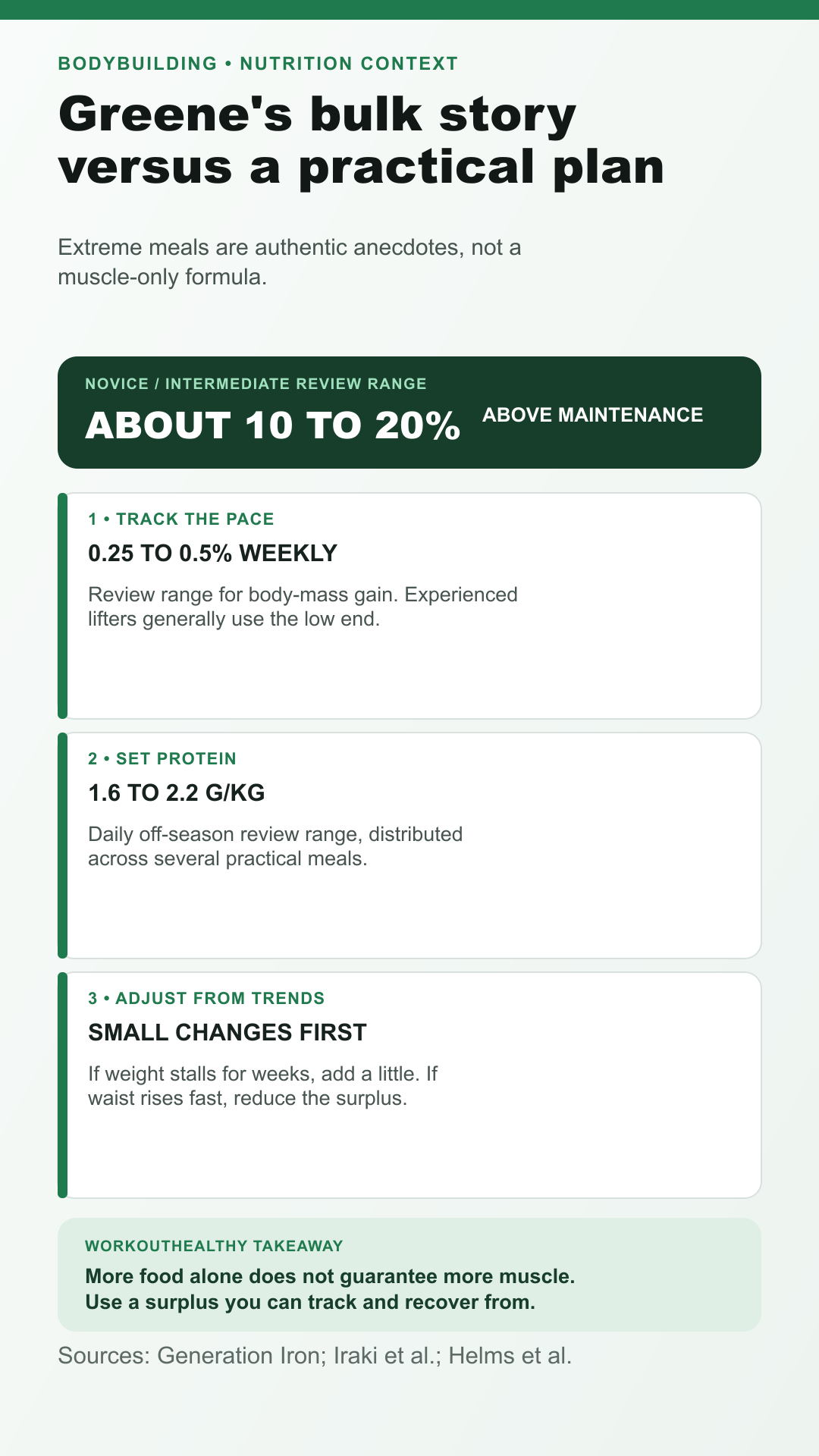
A 2023 study compared maintenance intake with smaller and larger surpluses in resistance-trained people. Larger surpluses did not produce a clear across-the-board advantage in muscle thickness or strength, while faster body-mass gain had a stronger relationship with increases in skinfold thickness.
The researchers recommended conservative surpluses, roughly 5 to 20 percent above maintenance depending on experience, and weight gain around 0.25 to 0.5 percent of body mass per week. Advanced trainees should generally use the lower end because their potential rate of new muscle gain is slower.
This is why a professional bodybuilder’s old eating story is a poor template for a recreational lifter. The ability to tolerate more food does not mean every additional thousand calories improves the result.
Protein Still Has a Practical Target
An off-season bodybuilding review recommends about 1.6 to 2.2 grams of protein per kilogram of body weight per day, distributed across several meals. That range gives most lifters room to support training without pretending that protein intake has no upper practical limit.
For a 180-pound person, or about 82 kilograms, the range is roughly 130 to 180 grams per day. Individual preferences and medical needs can change the plan, but the calculation is more useful than copying a celebrity’s plate.
Readers who struggle to increase intake can use the same fundamentals described in our guide to gaining muscle when naturally skinny: make food predictable, increase portions gradually, and track the trend rather than judging one meal.
Eating Every Two Hours Is Not Mandatory
Greene told Esquire Middle East that he ate every two hours when pursuing extreme size. That schedule can help someone consume very high calories without making each meal impossibly large.
It is not a universal muscle-building interval. Daily calories and protein matter more than obeying a two-hour clock. Many people can meet their targets with three to five eating occasions.
A useful meal schedule is one that supports training, digestion, work, and sleep. If six meals create stress or gastrointestinal discomfort, fewer meals can still work. If large meals are difficult, smaller and more frequent meals can be a practical tool.
Training Sets the Ceiling for Useful Weight Gain
Greene became known for elite professional bodybuilding, extraordinary muscularity, and years of high-volume training. The food was paired with a stimulus far outside the routine of most social-media readers.
Even then, training cannot turn unlimited energy into unlimited muscle. There is a rate at which tissue can be built, and that rate generally slows with experience.
Greene also told Esquire that beginners should not make heavy weight their first priority. Technique, tolerance, and progressive training come first. That is a more transferable lesson than the size of his most extreme meal.
Food Quality Still Matters During a Bulk
A person can gain weight while meeting calorie and protein targets with many different food patterns. Body weight alone does not capture fiber, micronutrients, saturated fat, sodium, blood lipids, blood pressure, or digestive health.
Pizza or ice cream can fit in an overall diet. Making them the main strategy can crowd out fruits, vegetables, legumes, whole grains, and varied protein sources.
Performance can suffer too. Extremely large meals may cause reflux, sluggishness, or poor sleep. The best surplus is not merely the one a person can force down. It is the one that supports months of productive training without creating avoidable health and adherence problems.
A Better Lean-Bulk Starting Plan
Start with a modest increase rather than an uncontrolled eating challenge. Track morning body weight several times per week and compare weekly averages.

- Choose a slow target. Aim for about 0.25 percent of body weight per week if you already train seriously.
- Set protein first. Use roughly 1.6 to 2.2 grams per kilogram per day unless a clinician has given different guidance.
- Use carbohydrate around training. It supports hard sessions and can make higher training volume easier to recover from.
- Progress the program. Add repetitions, load, or productive sets when performance and recovery allow.
- Adjust from evidence. If weight is not moving after two or three weeks, add a small amount. If waist and skinfold measures are rising rapidly, reduce the surplus.
Muscle-building transformations for film and sport often look dramatic from the outside. Our review of Paul Mescal’s Gladiator II preparation shows the same need to separate the visible result from the full training, nutrition, and production context.
Who Should Avoid an Aggressive Bulk
People with diabetes, high blood pressure, abnormal blood lipids, kidney disease, digestive disorders, or a history of disordered eating should not copy an extreme surplus from a celebrity anecdote. A doctor and registered dietitian can help set appropriate goals.
Aggressive bulking is also a poor match for someone who does not yet have a consistent resistance-training program. Establish the habit and learn the lifts before increasing food dramatically.
Rapid weight gain, persistent swelling, shortness of breath, severe gastrointestinal symptoms, or a worsening relationship with food are reasons to stop and seek qualified help.
The Real Lesson From Greene’s Story
Kai Greene’s pizza and ice cream story is authentic as a recollection of how he once ate. It illustrates how difficult extreme bodybuilding size can make the simple act of consuming enough energy.
It does not prove that dirty food is anabolic, that insulin funnels a binge directly into muscle, or that a recreational lifter should imitate an elite professional’s largest meals.
The useful lesson is quieter: muscle gain needs adequate energy, protein, progressive resistance training, and patience. More food helps only until the surplus outruns the body’s ability to use it productively.
Get the next evidence check.
Five practical fitness stories worth your time, every Friday.
One email a week. No product pitches. Unsubscribe in one click.
References
Generation Iron. (2025). Kai Greene used to bulk with gallons of ice cream and two pizza meals.
Esquire Middle East. (2023). Kai Greene: To get big, you need to eat every two hours, like a machine.
Iraki, J., Fitschen, P., Espinar, S., & Helms, E. (2019). Nutrition recommendations for bodybuilders in the off-season: A narrative review. Sports, 7(7), 154.
Helms, E. R., et al. (2023). Effect of small and large energy surpluses on strength, muscle, and skinfold thickness in resistance-trained individuals. Sports Medicine Open.
Medical disclaimer: This article is for general information only and is not medical advice. If you have an injury, ongoing pain, or a medical condition, talk to a doctor or physical therapist before you change how you train or eat.