
Paul Mescal spent months turning himself into a Roman gladiator before a single camera rolled.
The Irish actor was cast in Ridley Scott’s Gladiator II, playing Lucius, a role that required him to look and move like someone who actually belonged in the Colosseum.
Gladiator II opened in the United States on November 22, 2024, sixteen years after the story picks up from the original film.
Mescal had built his reputation on quieter, more intimate roles.
Normal People made him a breakout star, and All of Us Strangers earned him a BAFTA nomination.
Gladiator II was something else entirely, a major studio blockbuster built around sword fights, chariot chases, and hand to hand combat.
Getting his body ready for that shift took real, sustained work.
The role also put him alongside Denzel Washington and Pedro Pascal, in a production with the scale and physical expectations of a Ridley Scott epic.
That combination of pressure and physical demand shaped how his team approached training from the start.
What Mescal’s Transformation Reportedly Involved
Reports on his preparation describe a training plan built around boxing style sessions, functional strength work, and a high protein diet.
Mescal is reported to have gained roughly 18 pounds of muscle for the role.
His diet leaned on simple, high protein foods, including sweet potatoes and ground beef, rather than a complicated meal plan.
Beyond the weight room, he trained in fight choreography, horse riding, and sword fighting, skills that do not show up in a typical strength program at all.
Ridley Scott reportedly brought Mescal to the completed Colosseum set before filming began, so the actor could get familiar with the space ahead of the demanding physical work to come.
Gladiator II was Mescal’s first major studio blockbuster, which made the scale of the physical preparation new territory for him personally, not just for the character.
In His Own Words
Mescal has spoken about specific moments during filming that tested his conditioning in ways a gym session alone could not replicate.
Describing the rhinoceros fight sequence, which took two or three days to shoot, he said the heat on set affected his physicality during those days.
That kind of detail says something real about what film ready training actually has to prepare an actor for.
It is not just about how a body looks in a trailer.
It is about performing demanding physical sequences for hours at a time, in costume, under studio lights, often more than once to get a shot right.
Mescal’s own account of the shoot suggests the training paid off in a very literal, practical sense, not just a visual one.
What the Research Says About Building Muscle This Way
Gaining a meaningful amount of muscle in a matter of months is a real, well studied process, even if 18 pounds sounds dramatic.
A comprehensive review in Frontiers in Nutrition examined whether an energy surplus, eating more calories than the body burns, is actually required to maximize muscle growth from resistance training (Slater et al., 2019).
The researchers found that while some surplus generally supports faster, more reliable gains, especially for people who already train hard, the size of that surplus matters less than consistent training stimulus and adequate protein.
That lines up with Mescal’s reported approach of pairing hard training with simple, protein heavy meals rather than an extreme bulking diet.
Protein intake specifically has its own large body of evidence behind it.
A systematic review and meta-analysis in the British Journal of Sports Medicine pooled data from dozens of studies on protein supplementation and resistance training, finding that higher protein intake meaningfully supports muscle mass and strength gains, with benefits that taper off once total intake reaches a certain point per pound of body weight (Morton et al., 2018).
More protein helps up to a point, but the training itself is still what drives the adaptation.
On the mechanism side, research on how muscle actually grows points to a few key drivers working together.
A widely cited review in the Journal of Strength and Conditioning Research described mechanical tension, metabolic stress, and muscle damage as the three primary pathways behind hypertrophy, the technical term for muscle growth (Schoenfeld, 2010).
Training that combines heavy resistance work with functional, full body movement, the kind Mescal reportedly did for Gladiator II, hits more than one of those pathways at once.
What This Evidence Does Not Prove
None of the studies behind this article measured Mescal himself.
His exact training log, his precise calorie intake, and his individual recovery routine were never published in a way that could be independently checked.
The 18 pound figure comes from reporting on the production, not from a released before and after body composition scan.
The research on energy surplus, protein, and hypertrophy mechanisms describes general patterns across many people studied in controlled settings, not a guarantee for any one individual.
Genetics, training history, age, and existing muscle mass all affect how quickly a person can add muscle, and actors preparing for roles have professional support that most readers will not have access to.
What the research does support is the general shape of what Mescal’s team reportedly did, hard functional training paired with a protein forward, moderately increased calorie intake, which is a well established formula for building muscle in a defined timeframe.
How This Compares to General Guidance
Most people are not trying to gain 18 pounds of muscle in a few months for a film role.
A more sustainable pace for a typical lifter, especially someone newer to structured training, is closer to one to two pounds of muscle a month under ideal conditions.
That slower pace still relies on the same basic ingredients Mescal’s team reportedly used.
Progressive resistance training, adequate protein, and enough total calories to support recovery and growth.
The specific skills, sword fighting, horse riding, fight choreography, were unique to the role, but the underlying training principles are the same ones that apply to anyone trying to build real strength and muscle over time.
What changes for most people is the timeline and the intensity, not the fundamentals.
Common Mistakes People Make Trying to Bulk Up Fast
The most common mistake is chasing the calorie surplus without matching it to real training intensity.
Eating more food without a demanding enough training stimulus tends to add fat, not muscle.
A second mistake is treating protein as the only variable that matters and ignoring total calories and sleep.
Muscle repair and growth happen during recovery, not just during the workout itself.
A third mistake is copying a compressed, months long transformation timeline without professional oversight.
Actors preparing for roles typically have trainers, physical therapists, and chefs managing the process closely, and trying to match that pace alone raises real injury risk.
People also tend to underestimate how much skill based training, like the sword work and horse riding Mescal did, adds real fatigue on top of a strength program.
Stacking a new physical skill on top of an already demanding lifting schedule without adjusting volume is a common way people end up overtrained.
A final common mistake is ignoring old injuries while adding new, unfamiliar movement patterns.
Sword fighting and horse riding both demand rotational control and hip mobility that a pure gym routine rarely trains directly, and jumping into that kind of movement without preparation raises strain risk on the lower back and shoulders.

How to Build Muscle the Sustainable Way
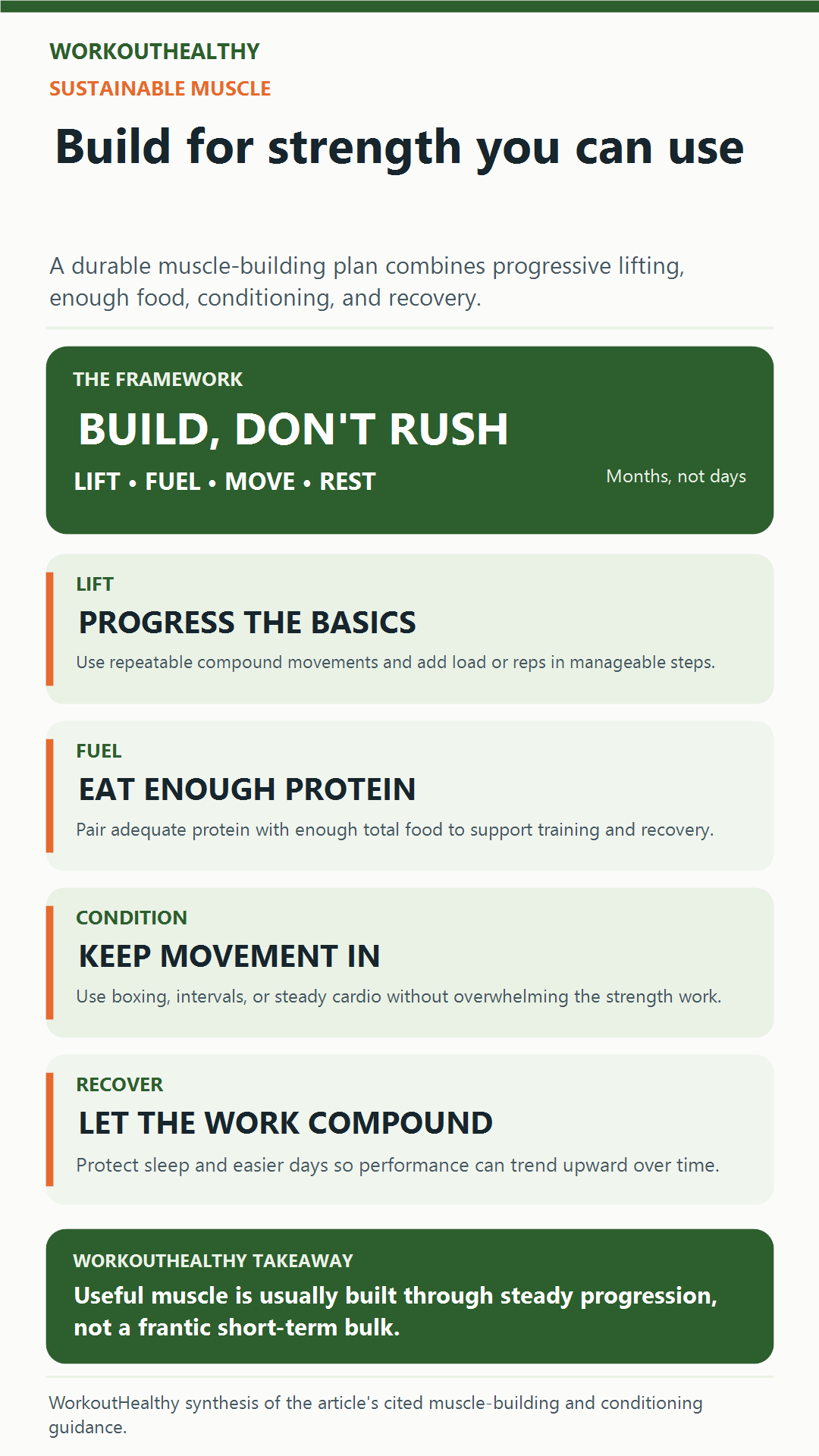
Start with a structured resistance training program that hits every major muscle group at least twice a week.
Consistency over months matters far more than any single workout.
Aim for roughly 0.7 to 1 gram of protein per pound of body weight daily, spread across meals rather than loaded into one sitting.
Simple, whole food sources work just as well as expensive supplements for most people.
Eat in a modest calorie surplus if muscle gain is the primary goal, generally 200 to 500 calories above maintenance.
A smaller, steadier surplus tends to add more muscle relative to fat than a large, aggressive one.
Prioritize sleep as seriously as the training itself, since most of the actual muscle repair process happens during rest.
Track your lifts over time and aim to gradually increase weight, reps, or sets as you get stronger.
That gradual increase in demand is what actually drives long term progress.
If a specific skill or sport matters to your goals, train it directly rather than assuming general strength training alone will transfer.
Weigh yourself and take progress photos under consistent conditions every one to two weeks rather than daily.
Body weight naturally fluctuates with water and food intake, and daily numbers can be discouraging without telling you anything useful.
Reassess your calorie intake roughly every three to four weeks.
As you gain muscle, your maintenance calorie needs shift, and a surplus that worked in month one may need a small adjustment by month three.
Our guide on unexpected weight and muscle loss covers the flip side of this process, what it means when the body is losing muscle instead of building it.
Our guide on how to decide whether you need a personal trainer can help if you want expert guidance building a program suited to your own goals.
References
Slater, G. J., Dieter, B. P., Marsh, D. J., Helms, E. R., Shaw, G., & Iraki, J. (2019). Is an energy surplus required to maximize skeletal muscle hypertrophy associated with resistance training? Frontiers in Nutrition, 6, 131.
Morton, R. W., Murphy, K. T., McKellar, S. R., Schoenfeld, B. J., Henselmans, M., Helms, E., Aragon, A. A., Devries, M. C., Banfield, L., Krieger, J. W., & Phillips, S. M. (2018). A systematic review, meta-analysis and meta-regression of the effect of protein supplementation on resistance training-induced gains in muscle mass and strength in healthy adults. British Journal of Sports Medicine, 52(6), 376-384.
Schoenfeld, B. J. (2010). The mechanisms of muscle hypertrophy and their application to resistance training. Journal of Strength and Conditioning Research, 24(10), 2857-2872.
This article is for general educational purposes and is not a substitute for personalized advice from a qualified fitness or medical professional.
Rapid, intensive muscle building programs are typically supervised by trainers and medical professionals, so anyone attempting a significant transformation should build in professional guidance and adequate recovery time.