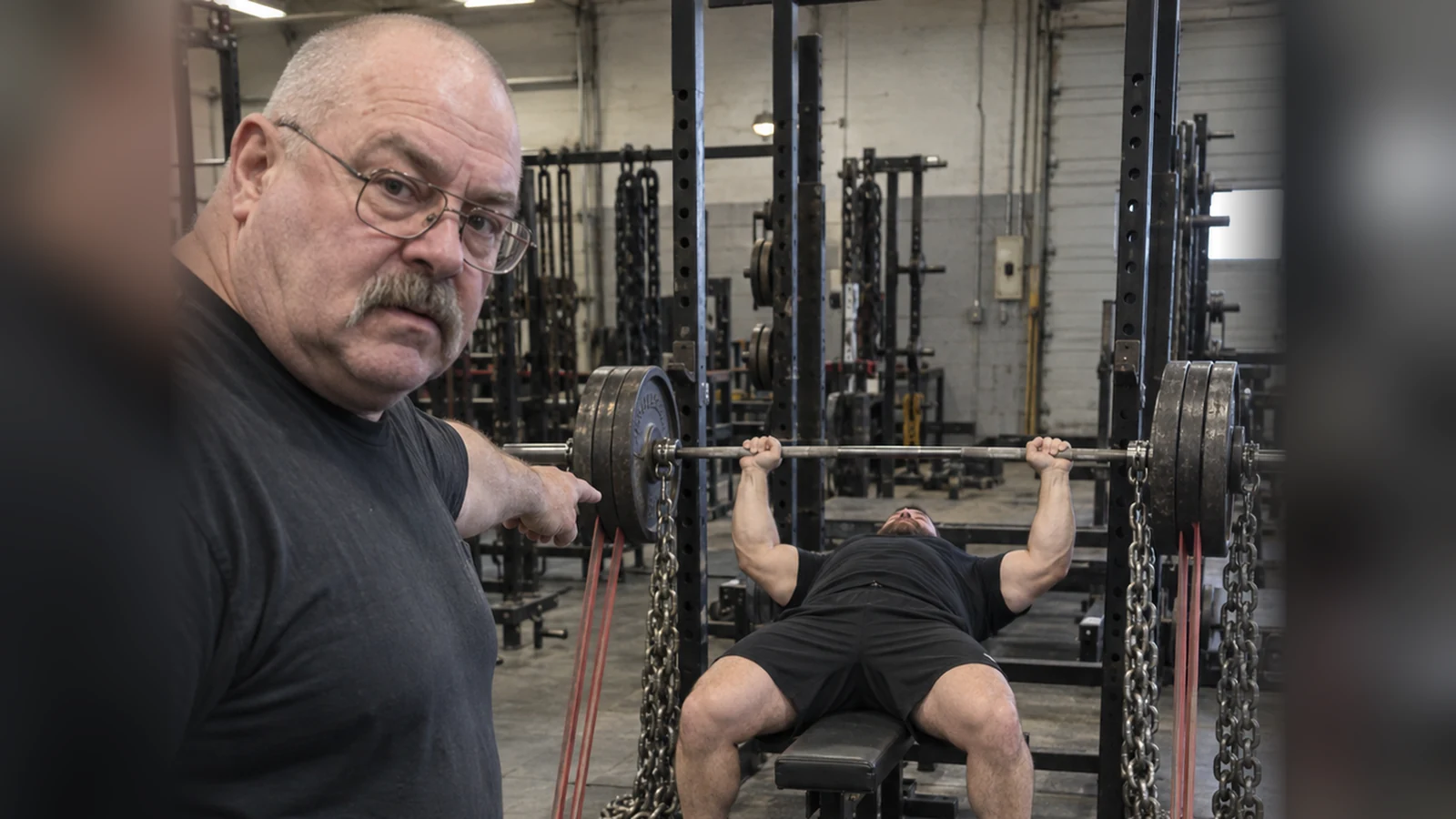

Walk into a powerlifting gym and you may see barbells draped in heavy chains or strapped to the floor with thick rubber bands.
It looks strange. The reasoning is simple.
A popular post says Louie Simmons attached bands or chains to a barbell so resistance increased as the lift became mechanically easier.
That is an accurate description of a method Simmons made famous at Westside Barbell.
Here is how it works, what Simmons wrote about it, and what the research shows.
The Problem Bands and Chains Solve
Most barbell lifts have a hard part and an easy part.
In a squat or bench press, the bottom is usually the hardest position.
Near the top, your joints are in a stronger position, so the same weight feels lighter.
With a plain barbell, the load stays the same the whole way.
That means the top of the lift may be underloaded, and lifters often slow down near lockout to avoid throwing the bar.
Bands and chains change that pattern.
They add load where the lifter has the most leverage.
How the Method Works
Chains hang from the bar and pile up on the floor at the bottom of the lift.
As you stand or press up, more links lift off the floor, so the load rises.
Bands are anchored to the rack or floor and stretch as the bar rises.
More stretch means more tension at the top.
Researchers call this variable resistance training. Coaches often call it accommodating resistance.
The load is lighter where you are weak and heavier where you are strong.
A chain on the bar asks a simple question: can you keep pushing when the lift gets easier?
What Simmons Wrote About It
Simmons, who founded Westside Barbell in Columbus, Ohio, died in March 2022.
In a 2016 Westside article titled “Chains and Bands,” he described the purpose as “accelerating strength training and accommodating resistance.”
He paired the tools with speed work.
For bench press speed days, he wrote to “use 60% of a no-shirt max on the bar,” plus chains.
For squats, he described waving bar weights from 50 to 60 percent over a 3 or 4 week cycle.
He listed chain loads in pounds, from about 11.5 to 51 pounds for bench and about 40 to 120 pounds for squats.
He also warned readers to “be careful not to overdue it,” since bands can cause a lot of soreness.
For bench chains, he advised setting them so about half rests on the floor when the bar touches the chest.
What Research Says About Strength and Power
A 2026 network meta analysis by Bao and colleagues compared several ways of loading lower body training.
It included 27 randomized controlled trials with 694 participants.
Variable resistance training, using bands, chains, or cam machines, significantly improved back squat one rep max compared with standard percentage based training.
In the rankings, it had the highest probability of being the most effective method for squat strength.
For jump performance, a measure of explosive power, variable resistance showed only a non significant trend toward improvement.
The authors urged caution because the studies varied a lot.
What Research Says About Muscle Growth
The picture for muscle size is more modest.
A 2024 systematic review by Fuentes-García and colleagues screened 528 articles and included 12 studies.
It compared variable resistance training with conventional training on muscle mass.
Both approaches produced similar gains, with no significant differences.
The authors noted that the studies were short to medium in length and mostly used untrained people.
So bands and chains are not a shortcut to bigger muscles.
What the Evidence Does Not Settle
Neither review tested the full Westside system.
Studies use different band tensions, chain weights, and lifters, which makes them hard to compare.
The claim that bands build speed off the bottom is common in coaching, but the jump results above were not clear.
Much of the research involves short programs, so long term effects in advanced lifters are less certain.
How to Try Bands or Chains Safely
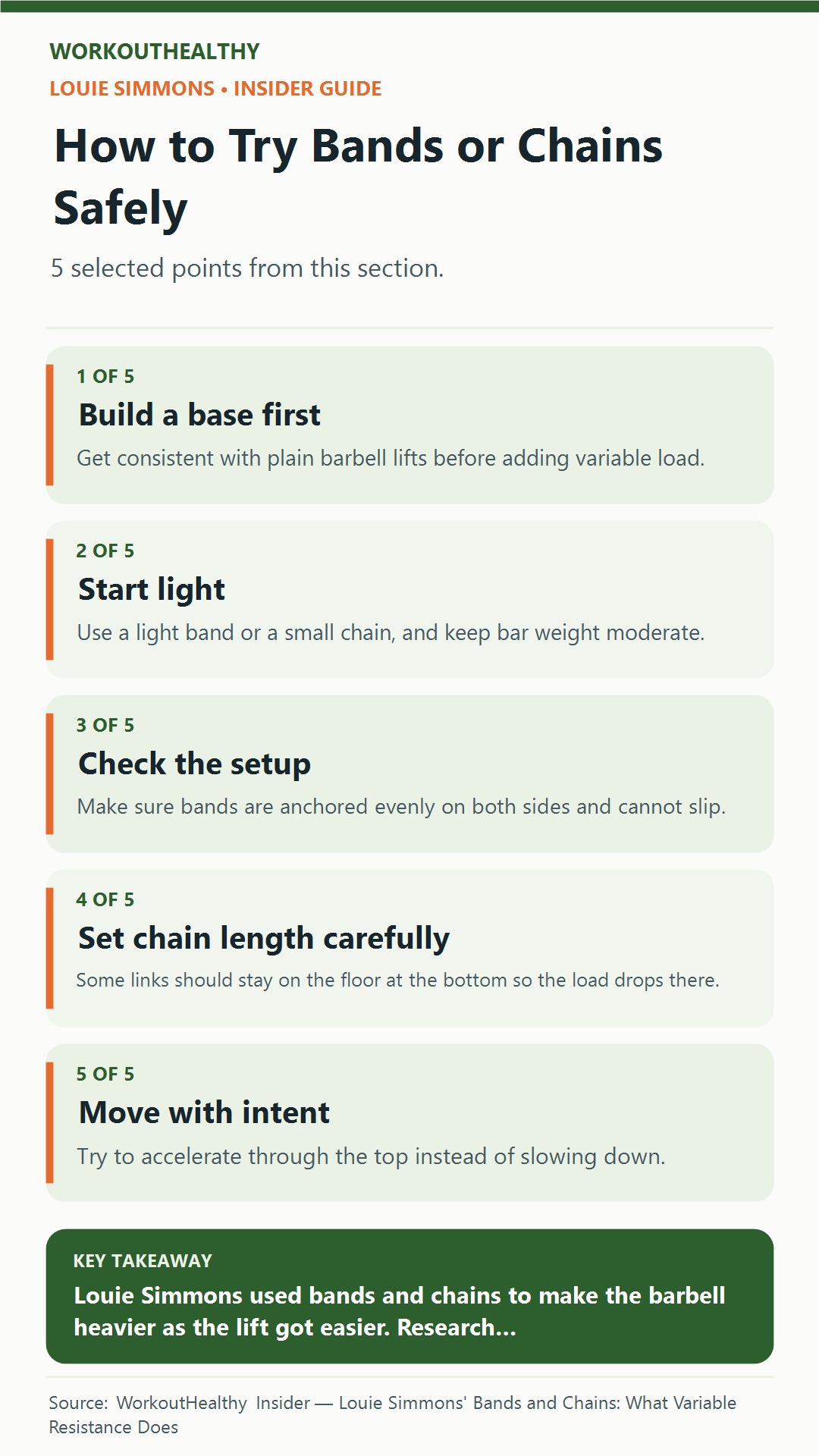
- Build a base first. Get consistent with plain barbell lifts before adding variable load.
- Start light. Use a light band or a small chain, and keep bar weight moderate.
- Check the setup. Make sure bands are anchored evenly on both sides and cannot slip.
- Set chain length carefully. Some links should stay on the floor at the bottom so the load drops there.
- Move with intent. Try to accelerate through the top instead of slowing down.
- Limit the dose. Bands can leave you very sore, so add them to one lift at a time.
For context on what strong lockouts look like at the top level, read about Lucy Underdown’s 325 kg deadlift.
If you are building strength later in life, our strength plan for your 40s covers the basics first.
Common Mistakes
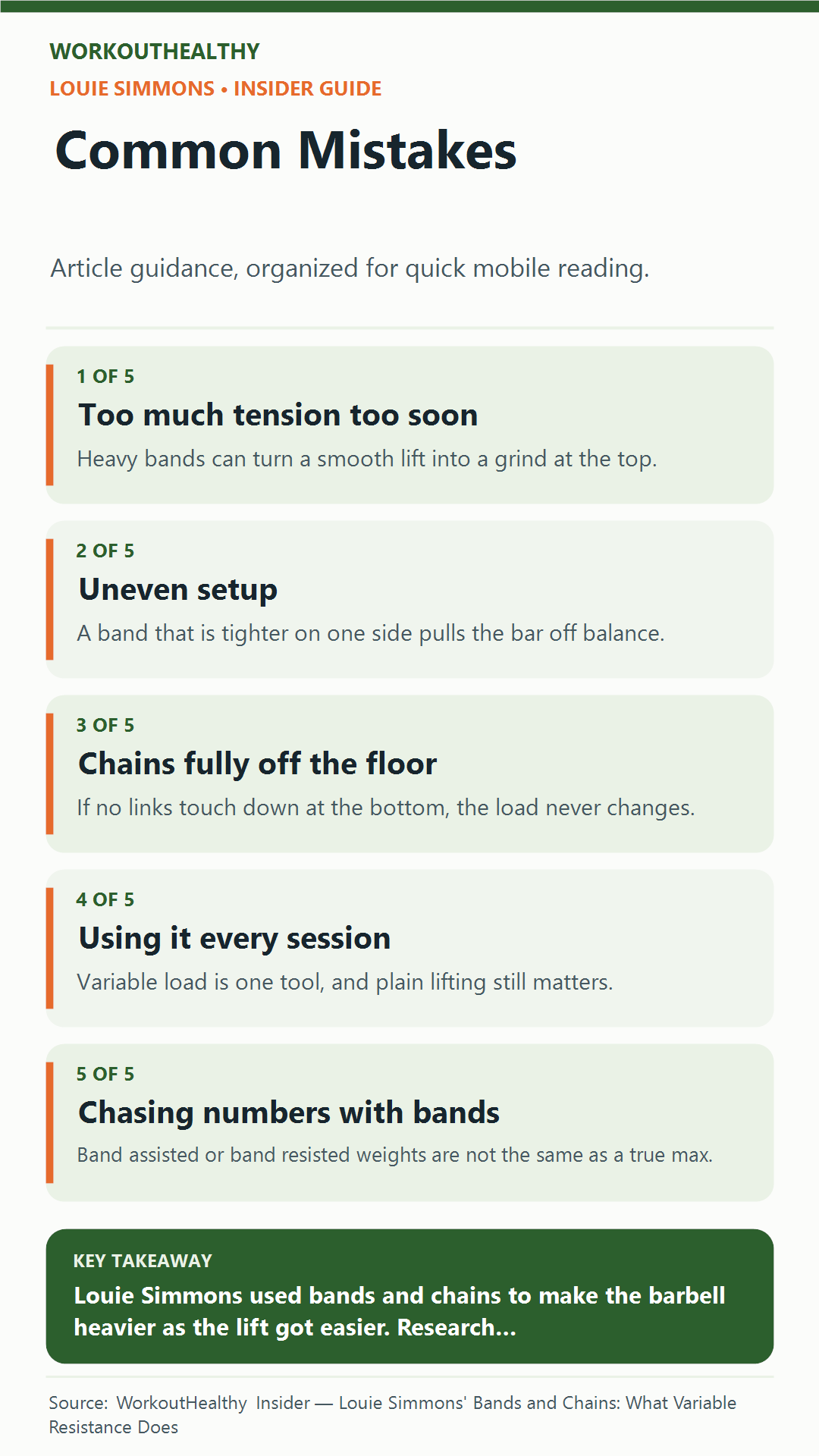
- Too much tension too soon. Heavy bands can turn a smooth lift into a grind at the top.
- Uneven setup. A band that is tighter on one side pulls the bar off balance.
- Chains fully off the floor. If no links touch down at the bottom, the load never changes.
- Using it every session. Variable load is one tool, and plain lifting still matters.
- Chasing numbers with bands. Band assisted or band resisted weights are not the same as a true max.
Who Should Be Careful
Bands store energy and can snap back hard if they tear or slip.
Inspect them for nicks and wear before each session.
Beginners, and anyone with shoulder, back, or knee problems, should learn the method with a qualified coach.
The Bottom Line
Louie Simmons used bands and chains to make the barbell heavier as the lift got easier.
Research suggests this approach can boost squat strength compared with standard loading.
It does not appear to build more muscle than regular training, and its effect on jumping power is unclear.
Used carefully by experienced lifters, it is a useful tool, not a requirement.
Want more stories like this? Subscribe to WorkoutHealthy Insider for practical explanations behind popular fitness claims.
References
- Bao, J., Liu, X., Huang, Y., Liu, X., & Wang, Z. (2026). Relative effectiveness of different resistance training modalities on lower-body strength and explosive power: A systematic review and network meta-analysis. Frontiers in Physiology, 17, 1823323. https://doi.org/10.3389/fphys.2026.1823323
- Fuentes-García, M. A., Malchrowicz-Mośko, E., & Castañeda-Babarro, A. (2024). Effects of variable resistance training versus conventional resistance training on muscle hypertrophy: A systematic review. Sport Sciences for Health, 20(1), 37 to 45. https://doi.org/10.1007/s11332-023-01103-6
- Simmons, L. (2016, October 18). Chains and bands. Westside Barbell.
- Wikipedia contributors. (n.d.). Louie Simmons. In Wikipedia. Retrieved September 16, 2026, from https://en.wikipedia.org/wiki/Louie_Simmons
This article is for general information only and is not medical advice. If you have an injury, ongoing pain, or a medical condition, talk to a doctor or physical therapist before you change how you train or eat.