
Overtraining sounds like a modern problem, born in sports science labs.
Yet one of China’s oldest medical books already warned against wearing the body out.
That book is the Huangdi Neijing, often called the Yellow Emperor’s Inner Classic.
A popular post says it taught people to balance work with rest, avoid overexertion, and adjust daily life to the seasons.
That summary holds up well, as long as we are careful about what the text actually says.
What the Huangdi Neijing Is
Despite the title, the book was not written by a single emperor.
Scholars see it as a collection of writings by many anonymous authors, gathered and edited over a long time.
The usual dating puts its compilation somewhere between about 400 BCE and 260 CE.
It has two parts, each with 81 chapters.
The Suwen, or “Basic Questions,” covers theory and diagnosis. The Lingshu, or “Spiritual Pivot,” covers acupuncture.
Much of it is written as a dialogue between the Yellow Emperor and his ministers, especially one named Qibo.
The Opening Warning About Overwork
The first chapter of the Suwen contrasts people of ancient times with people of the author’s own day.
It says those who understood the Way ate and drank in moderation and kept regular daily habits.
They also did not overwork themselves recklessly.
The original phrase is 不妄作勞, which roughly means “not laboring without restraint.”
Because of this, the text says, their bodies and spirits stayed together and they lived past 100.
The “modern” people it describes do the opposite.
They drink wine like water, treat recklessness as normal, and have no regularity in their daily lives.
The result, the text claims, is that they start to decline by age 50.
The ages are symbolic, not data. The message about regular habits and restraint is the point.
Hard work builds you up only when rest has a regular place in the plan.
What It Says About the Seasons
The second chapter of the Suwen gives advice for each season.
Much of it is about when to sleep and when to rise.
- Spring. Rest at night, rise early, and take broad walks in the courtyard.
- Summer. Rest at night, rise early, and do not tire of the sun.
- Autumn. Go to bed early and rise early, along with the roosters.
- Winter. Go to bed early and rise late, waiting for daylight.
This is not a training plan in the modern sense.
It is a daily rhythm that shifts with light, temperature, and the natural world.
The spring advice to walk broadly is the closest thing to an exercise tip in the passage.
The idea behind it is to live in step with the season rather than against it.
What Modern Research Says About Overdoing It
In 2013, the European College of Sport Science and the American College of Sports Medicine published a joint statement on overtraining.
The authors, led by Romain Meeusen, wrote that successful training “must involve overload but also must avoid the combination of excessive overload plus inadequate recovery.”
They describe a range of problems, from short term overreaching to the more serious overtraining syndrome.
Symptoms of the syndrome include fatigue, falling performance, and mood problems.
They also note that telling the stages apart is very difficult and often depends on how things turn out.
What Modern Research Says About Seasons
A 2007 systematic review by Tucker and Gilliland looked at how season and weather affect physical activity.
It found that activity levels vary with the seasons.
Poor or extreme weather was identified as a barrier to staying active.
The authors suggested that indoor options during cold and wet months may help people stay active all year.
So the seasons do shape how people move, even if the old text framed it in different terms.
What the Old Text Does Not Prove
The Huangdi Neijing rests on ideas like yin and yang, not on modern physiology.
Its claims about living past 100 are not evidence that its habits guarantee long life.
Its seasonal sleep times were written for one climate and one way of life.
What lines up with modern science is the broader idea: steady routines, enough rest, and no reckless overwork.
How to Apply It Today
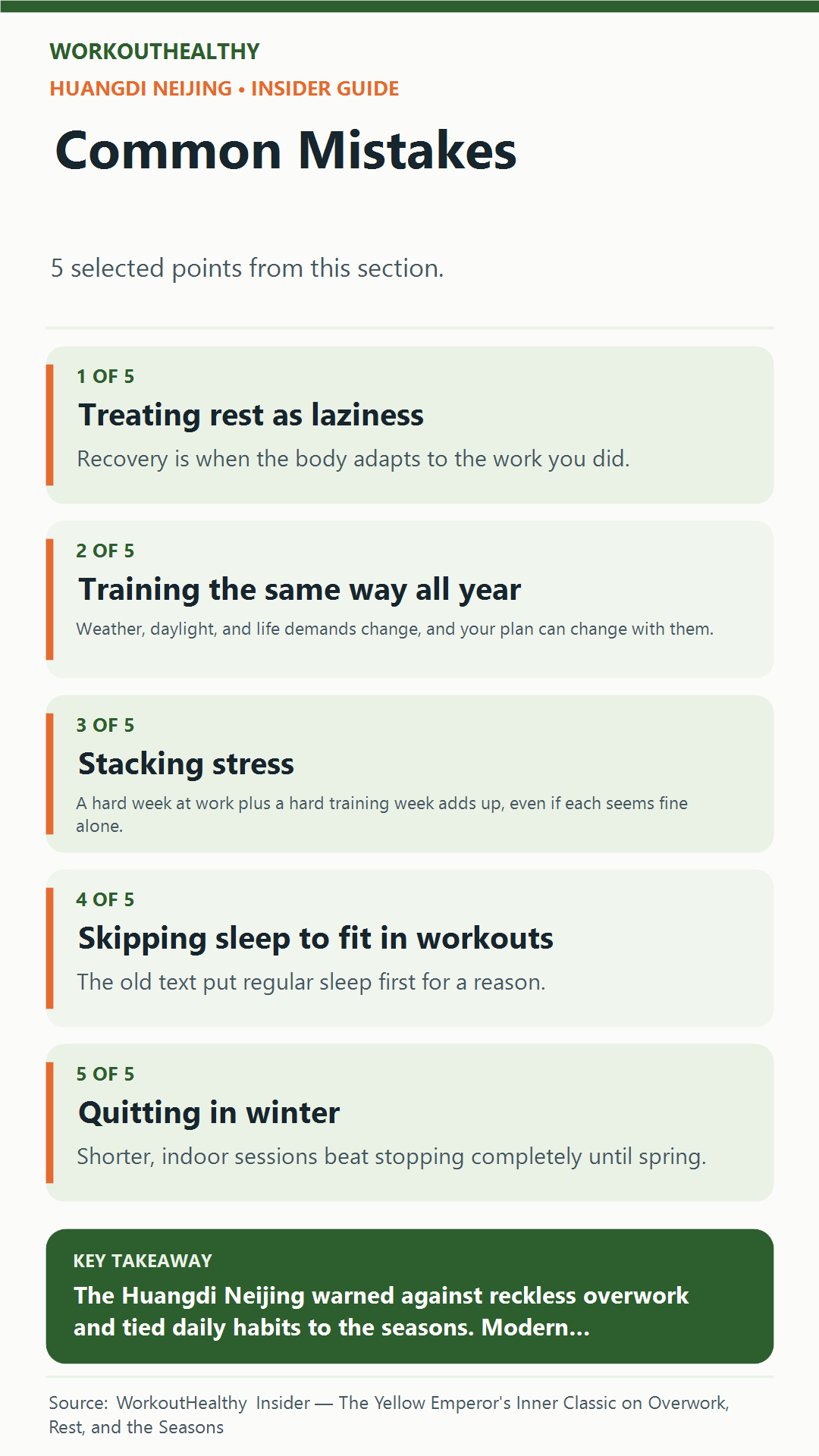
- Keep a regular schedule. Consistent sleep and training times make recovery easier.
- Plan easier weeks. Hard blocks should be followed by lighter ones, a point covered in our guide to what to do after a program ends.
- Watch for warning signs. Lasting fatigue, poor sleep, and slipping performance mean it is time to back off.
- Adjust with the weather. Move workouts indoors in bad conditions, such as with this quiet home cardio routine.
- Use the light. Early daylight walks in spring and summer fit both the old advice and modern habits.
Common Mistakes
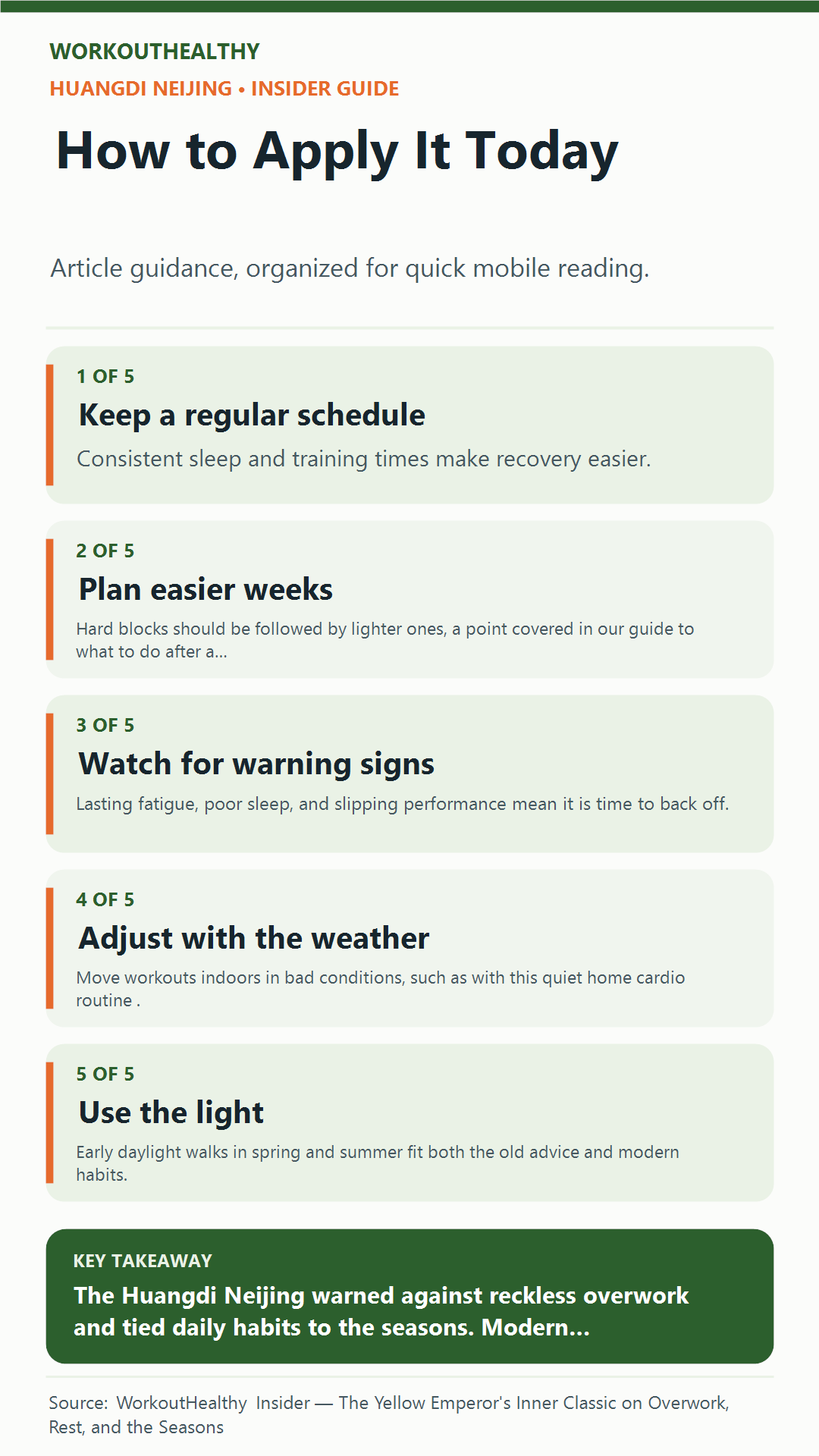
- Treating rest as laziness. Recovery is when the body adapts to the work you did.
- Training the same way all year. Weather, daylight, and life demands change, and your plan can change with them.
- Stacking stress. A hard week at work plus a hard training week adds up, even if each seems fine alone.
- Skipping sleep to fit in workouts. The old text put regular sleep first for a reason.
- Quitting in winter. Shorter, indoor sessions beat stopping completely until spring.
- Ignoring small signals. Nagging aches and stalled progress are easier to fix early than late.
Who Should Be Careful
Athletes with heavy, year round training loads should watch closely for signs of overreaching.
People with heart disease should take extra care exercising in extreme heat or cold.
If fatigue and low mood last for weeks despite rest, see a doctor to rule out other causes.
The Bottom Line
The Huangdi Neijing warned against reckless overwork and tied daily habits to the seasons.
Modern research supports the core of that: overload needs recovery, and seasons affect how active people are.
Take the principle, not the exact bedtimes, and build rest into your plan on purpose.
Want more stories like this? Subscribe to WorkoutHealthy Insider for practical explanations behind popular fitness claims.
References
- Meeusen, R., Duclos, M., Foster, C., Fry, A., Gleeson, M., Nieman, D., Raglin, J., Rietjens, G., Steinacker, J., & Urhausen, A. (2013). Prevention, diagnosis, and treatment of the overtraining syndrome: Joint consensus statement of the European College of Sport Science and the American College of Sports Medicine. Medicine & Science in Sports & Exercise, 45(1), 186 to 205. https://doi.org/10.1249/MSS.0b013e318279a10a
- Tucker, P., & Gilliland, J. (2007). The effect of season and weather on physical activity: A systematic review. Public Health, 121(12), 909 to 922. https://doi.org/10.1016/j.puhe.2007.04.009
- Huangdi Neijing Suwen, chapter 1 (Shang Gu Tian Zhen Lun) and chapter 2 (Si Qi Tiao Shen Da Lun). Chinese Text Project. https://ctext.org/huangdi-neijing/shang-gu-tian-zhen-lun
- Wikipedia contributors. (n.d.). Huangdi Neijing. In Wikipedia. Retrieved September 16, 2026, from https://en.wikipedia.org/wiki/Huangdi_Neijing
This article is for general information only and is not medical advice. If you have an injury, ongoing pain, or a medical condition, talk to a doctor or physical therapist before you change how you train or eat.