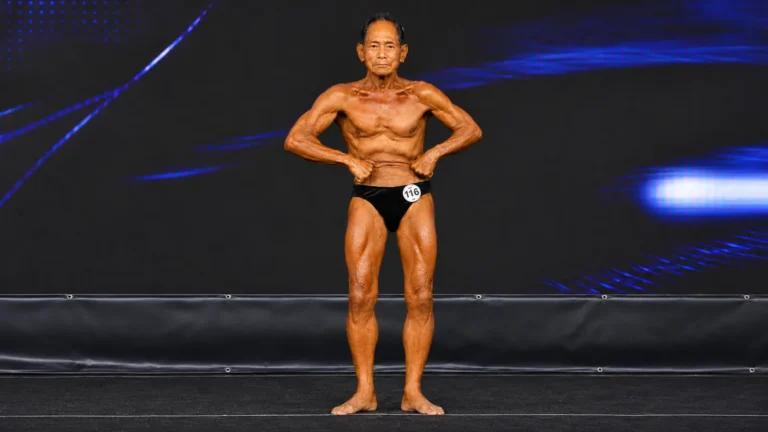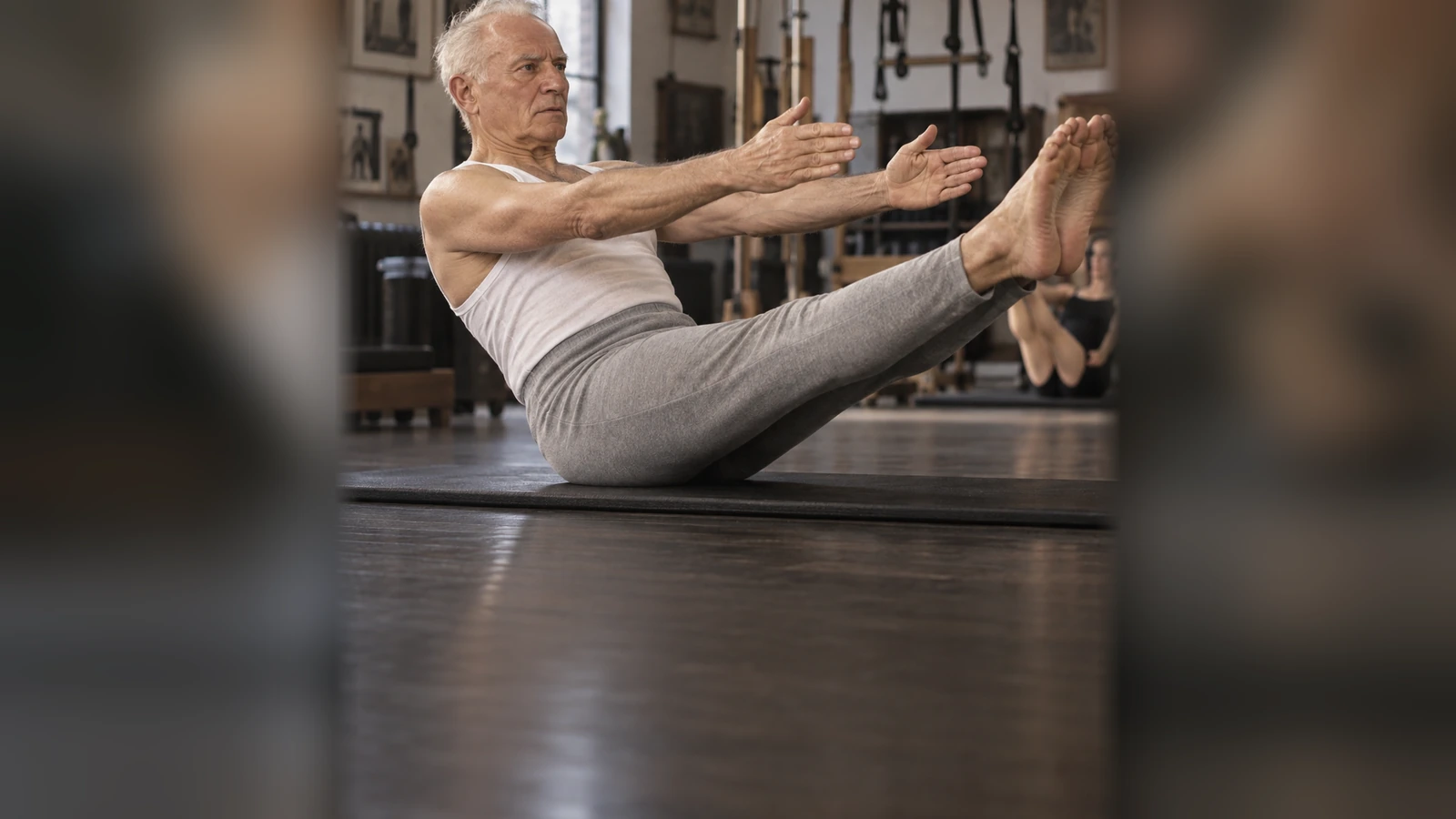

Joseph Pilates did not treat breathing as an afterthought.
In his 1945 book, he put it right alongside the exercises themselves.
A popular post says he believed breath, core control, and precision build balanced, uniform strength.
That matches his writing fairly well, with a few details worth sorting out.
Here is what he said, what modern research can and cannot confirm, and how to use the ideas in a class or at home.
Who Joseph Pilates Was
Joseph Pilates was born on December 9, 1883, in Mönchengladbach, in what was then the Kingdom of Prussia.
During World War I, British authorities interned him at Lancaster Castle, where he taught wrestling and self defense and refined his mat exercises.
Around 1925, he moved to the United States and opened a studio in New York City with his future wife, Clara.
He called his system “Contrology.”
He died on October 9, 1967, in New York City, at age 83.
What He Wrote About Breathing
Pilates wrote Return to Life Through Contrology with coauthor William Miller, and it was published in 1945.
In it, he urged readers to “learn how to breathe correctly.”
He also told them to “squeeze” every atom of air from the lungs until they are almost as free of air as a vacuum.
He had strong views on poor breathing habits.
He wrote that “lazy breathing” turns the lungs, figuratively speaking, into “a cemetery” for diseased and dying germs.
That last claim reflects the health ideas of his era, not modern lung science, so it should not be taken literally.
What He Meant by Uniform Development
The idea of balanced strength also comes straight from the book.
Pilates wrote that “Contrology develops the body uniformly, corrects wrong postures, restores physical vitality, invigorates the mind, and elevates the spirit.”
He also stressed precision, telling readers to “concentrate on the correct movements EACH TIME YOU EXERCISE.”
He tied the physical side to the mental side as well.
So the pieces in the popular post, breath, control, and precision, all appear in his own words.
“Contrology is complete coordination of body, mind, and spirit.”
What We Could Not Confirm
A widely shared version promises one specific breathing pattern that he taught with every movement.
We could not confirm a single universal pattern from the passages we reviewed.
We also could not confirm that Pilates himself published a formal numbered list of principles.
Wikipedia notes that most versions of Pilates taught today are based on up to nine principles, which suggests later teachers organized and expanded his ideas.
What Research Says About Pilates
One major review of Pilates looked at low back pain.
A 2015 Cochrane review by Tiê Yamato and colleagues included 10 randomized controlled trials with 510 participants.
Compared with minimal intervention, there was low quality evidence that Pilates reduced pain in the short term.
There was moderate quality evidence that it improved disability at intermediate follow up.
Compared with other types of exercise, Pilates showed no significant difference for disability.
The authors concluded there was no conclusive evidence that Pilates is better than other exercise for low back pain.
What Research Says About Breathing Practice
Research on breathing is a separate field, and it did not test Pilates directly.
A 2020 narrative review by Hidetaka Hamasaki looked at diaphragmatic breathing, a slow and deep style of breathing.
It covered 10 systematic reviews and 15 randomized controlled trials.
Diaphragmatic breathing appeared to help exercise capacity and lung function in people with chronic obstructive pulmonary disease.
It may also help with stress and some other conditions, but the author said study quality was poor.
That supports paying attention to breath, even if it does not prove Pilates’ specific methods.
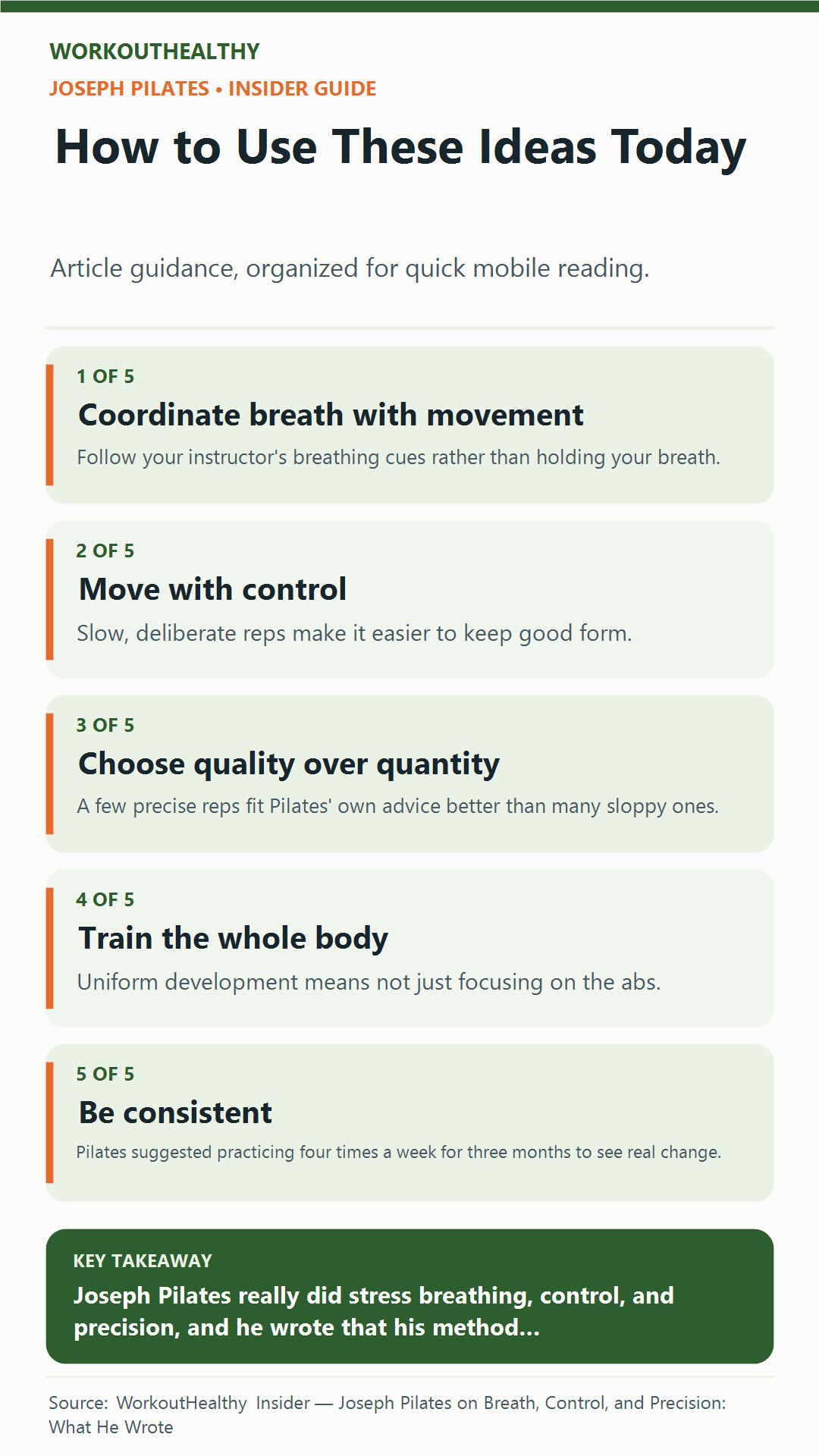
How to Use These Ideas Today
- Coordinate breath with movement. Follow your instructor’s breathing cues rather than holding your breath.
- Move with control. Slow, deliberate reps make it easier to keep good form.
- Choose quality over quantity. A few precise reps fit Pilates’ own advice better than many sloppy ones.
- Train the whole body. Uniform development means not just focusing on the abs.
- Be consistent. Pilates suggested practicing four times a week for three months to see real change.
For a celebrity example, read how Keke Palmer turned a Pilates class into a lesson on movement.
Pilates has also been tested in clinical groups, as our summary of a home Pilates trial for multiple sclerosis shows.
For more trunk work, see the core exercise two physical therapists ranked first.
A Simple Breath and Control Drill
This short drill is a general practice, not a routine taken from Pilates’ book.
Lie on your back with your knees bent and feet flat on the floor.
Place one hand on your lower ribs and one on your belly.
Breathe in slowly through your nose and feel your ribs widen.
Breathe out fully and steadily, as if gently emptying the lungs.
On the next breath out, slowly lift one foot a few inches, then lower it with control.
Alternate sides for five to eight slow reps each.
Keep your pelvis steady and your neck relaxed the whole time.
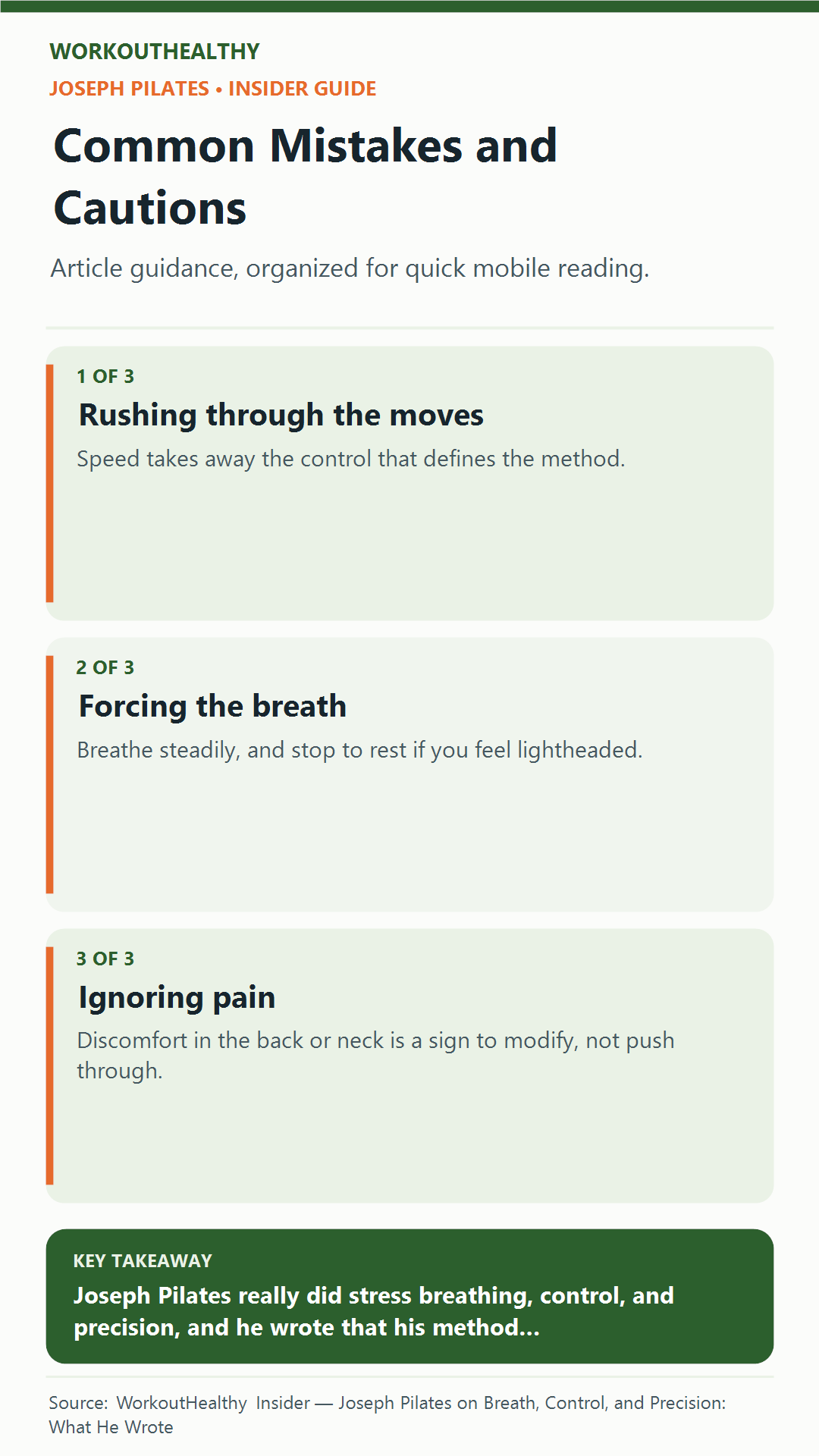
Common Mistakes and Cautions
- Rushing through the moves. Speed takes away the control that defines the method.
- Forcing the breath. Breathe steadily, and stop to rest if you feel lightheaded.
- Ignoring pain. Discomfort in the back or neck is a sign to modify, not push through.
People with lung or heart conditions should ask a doctor before doing forceful breathing drills.
Anyone with back pain, recent surgery, or osteoporosis should work with a qualified instructor or physical therapist.
Pregnant people should use a class designed for pregnancy.
The Bottom Line
Joseph Pilates really did stress breathing, control, and precision, and he wrote that his method develops the body uniformly.
Some of his health claims about breathing reflect his era.
Research shows Pilates can help with back pain, though not clearly more than other exercise.
Careful breath and controlled movement remain a sound way to practice.
Want more stories like this? Subscribe to WorkoutHealthy Insider for practical explanations behind popular fitness claims.
References
- Hamasaki, H. (2020). Effects of diaphragmatic breathing on health: A narrative review. Medicines, 7(10), 65. https://doi.org/10.3390/medicines7100065
- Pilates, J. H., & Miller, W. J. (1945). Return to life through contrology.
- Wikipedia. (n.d.). Joseph Pilates. https://en.wikipedia.org/wiki/Joseph_Pilates
- Yamato, T. P., Maher, C. G., Saragiotto, B. T., Hancock, M. J., Ostelo, R. W. J. G., Cabral, C. M. N., Menezes Costa, L. C., & Costa, L. O. P. (2015). Pilates for low back pain. Cochrane Database of Systematic Reviews, CD010265. https://doi.org/10.1002/14651858.CD010265.pub2
This article is for general information only and is not medical advice. If you have an injury, ongoing pain, or a medical condition, talk to a doctor or physical therapist before you change how you train or eat.