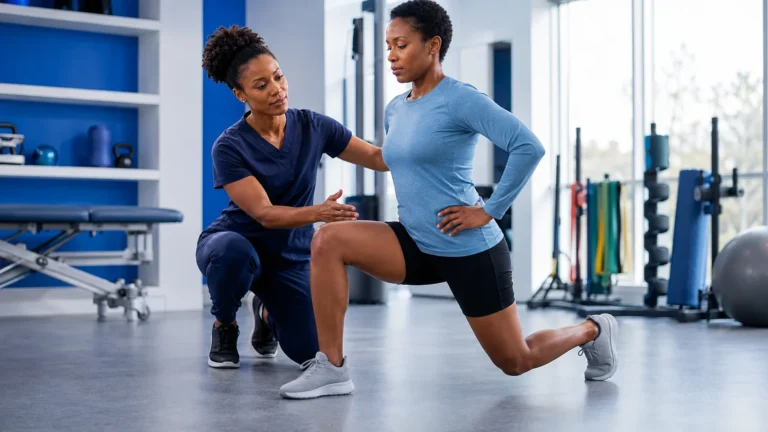

Two well known physical therapists tested ten different core exercises for adults over fifty, and the winner surprised a lot of people.
It wasn’t crunches or sit ups.
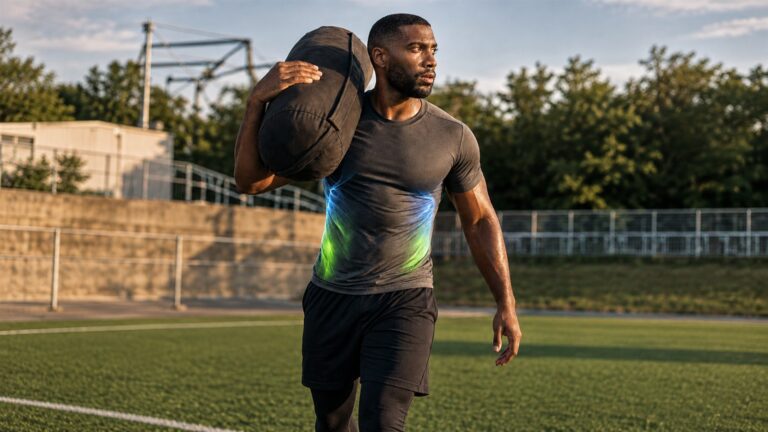
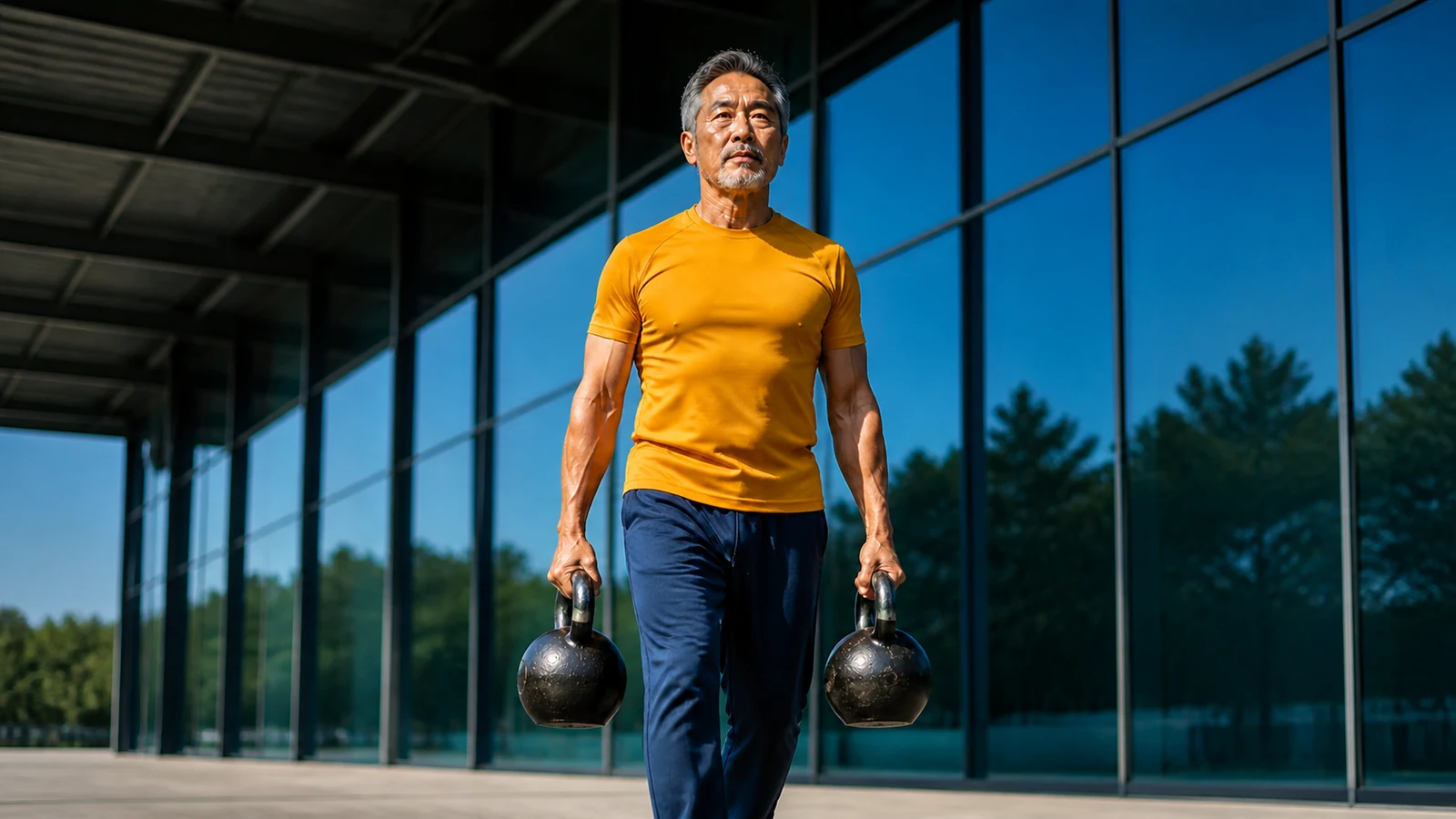
It was the farmer’s carry, an exercise most people think of as a grip or shoulder move, not a core move.
What the Video Tested
Brad Heineck and the Bob and Brad team ranked ten exercises from least effective to most effective for real world core strength in older adults.
Sit ups landed at the bottom of the list.
Crunches worked the abdominal muscles but ignored the muscles that keep the spine stable.
The farmer’s carry, where you simply walk while holding a heavy weight in each hand, came out on top.
What the Research Actually Shows
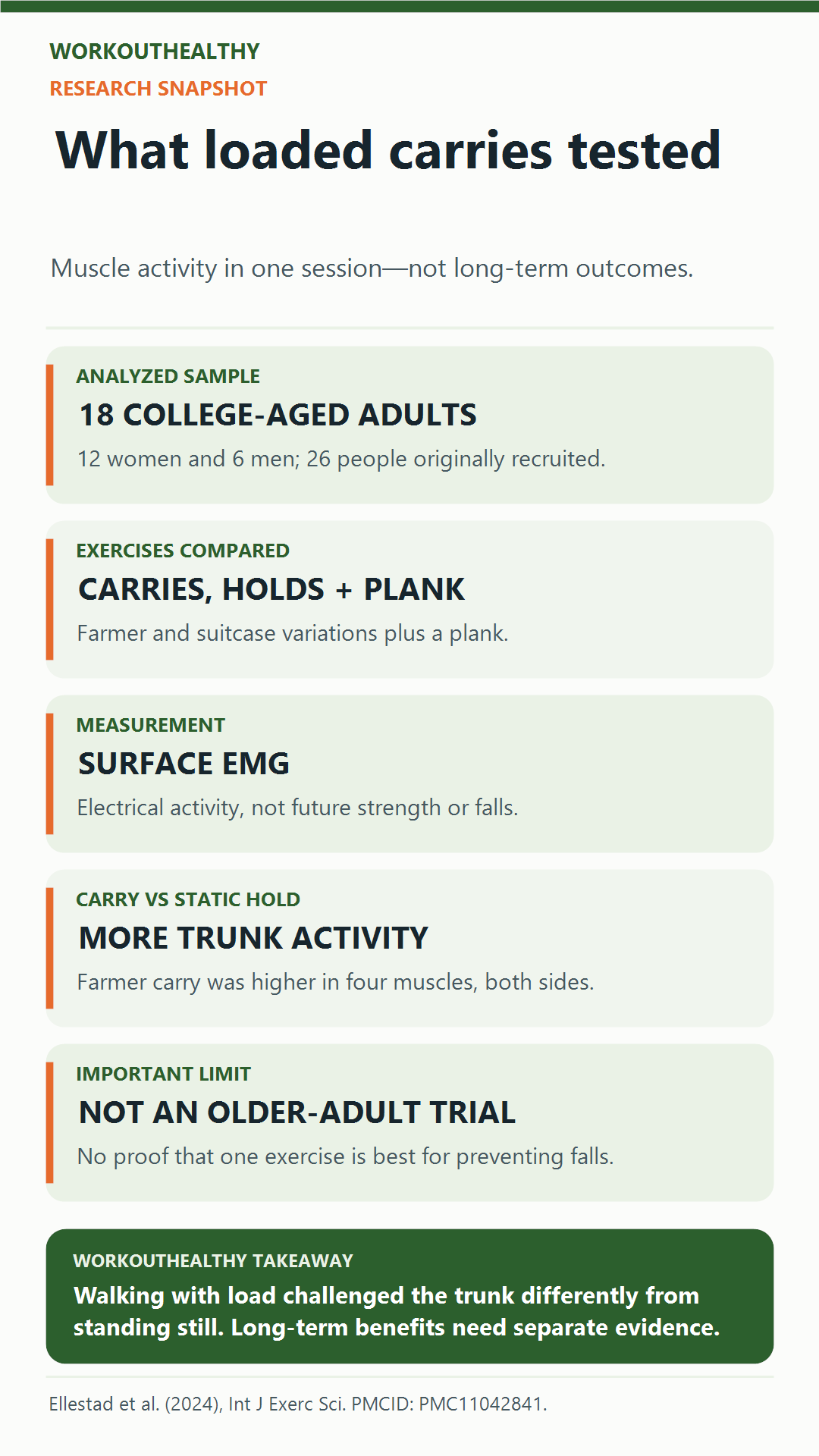
A 2024 study measured muscle activation with electrodes placed on the rectus abdominis, the external obliques, and two deep spinal stabilizer muscles while people performed loaded carries and static holds (Ellestad et al., 2024).
The farmer’s carry produced higher activation across all four muscles, on both sides of the body, than simply standing and holding the weight still.
That matters because a lot of core exercises train one thing at a time.
The farmer’s carry asks your entire core to work together to keep you upright and stable while you move, which is closer to what your core actually has to do in daily life.
A crunch trains your abs to bend. A farmer’s carry trains your whole core to resist being bent, which is the harder and more useful skill as you get older.
The Mechanism: Why Resisting Movement Beats Creating It
A crunch works by shortening the front of your torso over and over.
That builds the muscle’s ability to create spinal flexion, but it does very little to train the muscle’s other main job, which is resisting motion it does not want.
Walking while carrying a heavy weight in one or both hands challenges your core in a completely different way.
Every step shifts your weight slightly from side to side, and the load in your hands wants to pull you into a side bend or a rotation.
Your deep spinal muscles and obliques have to fire continuously to keep your torso upright and stacked, which is called an anti movement or anti flexion demand.
That is a different skill than bending on purpose, and it is arguably the more useful one, since most real injuries to the low back happen when a spine gets pulled into an unwanted position it could not resist.
A Second Look: Core Strength and Fall Risk in Seniors
The Ellestad study measured muscle activity, not falls.
For that link, a systematic review pulled together 20 studies on trunk muscle strength in older adults and found a consistent connection between a stronger trunk and better balance, functional performance, and lower fall risk (Granacher et al., 2013).
The review also found that trunk specific training programs produced real strength gains and matching improvements in balance measures in this age group.
That review did not test the farmer’s carry specifically.
But it backs up the general idea behind why the exercise might matter for older adults: a core that can resist being pulled off balance is tied to real world stability, not just a stronger looking midsection.
What This Evidence Does Not Prove
It is worth staying precise here. The Ellestad study measured electrical activity in muscles during a single session.
It did not track anyone over weeks or months, and it did not measure whether doing farmer’s carries regularly actually reduces falls, back pain, or injury.
Higher muscle activation on an EMG reading is a reasonable sign that a muscle is working hard, but it is not the same as proof of a long term benefit.
The Granacher review adds real support for trunk strength mattering to balance in general, but it is not a trial that isolated the farmer’s carry against other trunk exercises.
And a separate large study on grip strength, discussed more below, found no significant link between grip strength and fall related injury, a reminder that stronger does not automatically mean fewer falls for every measure researchers have tried.
Why This Matters More as You Age
Falls and balance problems become a bigger risk after fifty, and a strong core that can resist unwanted movement helps protect against both.
The muscles this study measured, the deep multifidus and longissimus along the spine, are exactly the ones that keep your back stable when you’re walking on uneven ground or catching yourself from a stumble.
The exercise also carries over well to everyday tasks.
Carrying groceries, luggage, or a laundry basket is essentially a farmer’s carry you already do without thinking about it.

The grip component matters too, separate from the core benefit.
A very large international study tracking grip strength in adults found that every 5 kilogram drop in grip strength was linked to a meaningfully higher risk of death from any cause over the following years (Leong et al., 2015).
That same study did not find a significant link between grip strength and fall related injury specifically, which the researchers called unexpected, since falls depend on balance, vision, and reaction time as much as raw strength.
Grip strength looks like a useful marker of overall health, even if it is not a direct fix for falls on its own.
Common Mistakes People Make With the Farmer’s Carry
The most common mistake is letting one side sag lower than the other, especially when carrying a single heavy weight instead of two matched ones.
That defeats the anti movement benefit, since you are giving in to the side bend instead of resisting it.
A second mistake is shrugging the shoulders up toward the ears to help hold the weight.
This pulls tension into the neck instead of the core and grip, and tends to cause soreness in the wrong place.
A third mistake is holding your breath through the whole walk.
Breathing normally while keeping the core braced is a skill worth practicing on its own before adding weight.
A fourth mistake is picking a weight so heavy that posture breaks down within the first few steps.
A carry only works as a core exercise if you can hold a tall, stable position.
Once your torso is caving to one side, the weight has become too heavy to train the intended muscles well.
Who Should Check With a Doctor or Physical Therapist First
If you have a hernia, an uncontrolled heart or blood pressure condition, or a recent back injury, check with a doctor or physical therapist before adding loaded carries to your routine.
The same goes for anyone with a wrist or elbow condition that makes gripping a heavy load painful.
Anyone recovering from a recent fall or with a diagnosed balance disorder should also get individual guidance before starting, since walking with an offset load does add a real balance challenge on top of the strength demand.
How to Start and Progress Safely
Pick a weight in each hand that you can carry with good posture, shoulders back and core braced, for 30 to 40 feet.
Walk at a normal pace and keep your ribs stacked over your hips instead of leaning to one side.
Start with two matched weights, one in each hand, before trying a single sided or suitcase carry.
Two even weights are more forgiving while you learn the bracing pattern.
Once that feels controlled, a single weight on one side raises the anti movement demand and makes the exercise harder in the way that actually matters.
Progress distance before you progress load.
Once you can comfortably walk 40 to 60 feet with solid posture, add a small amount of weight rather than immediately doubling it.
Small, steady jumps in load let your grip and core adapt without your form breaking down.
Two or three sets of one carry per side is plenty to start, done once or twice a week alongside your regular training.
There is no need to do this every day.
Like any strength exercise, the core and grip need rest between sessions to actually adapt.
If your grip gives out well before your core or legs feel challenged, that is common and not a sign you are doing anything wrong.
You can keep training the core benefit by using lifting straps or a slightly lighter weight while your grip strength catches up on its own over time.
You are doing it right if your torso stays upright and roughly level the entire walk, your breathing stays steady, and your grip is the thing that gives out first rather than your lower back rounding or your shoulder hiking up.
You are doing it wrong if you notice one hip dropping lower with every step, if your neck and shoulders are doing more work than your midsection, or if you need to stop because your low back feels strained rather than because your hands are simply tired.
For more ways to keep your training well rounded, see our look at whether lifting weights keeps your brain young, and our article on why people lose weight and muscle mass together.
Our coverage of Misty Copeland’s hip replacement recovery looks at another angle on staying stable and strong as the body ages, and our guide to how many miles you should walk a day covers the other half of this exercise, the walking itself.
Watch the Original Video
Get the next evidence check. Subscribe to WorkoutHealthy Insider for practical explanations behind popular fitness claims.
References
Ellestad, S. H., Holcomb, T. P., Swiergol, A. M., Holmstrup, M. E., & Dicus, J. R. (2024). The quantification of muscle activation during the loaded carry movement pattern. International Journal of Exercise Science, 17(1), 480 to 490. https://pmc.ncbi.nlm.nih.gov/articles/PMC11042841/
Granacher, U., Gollhofer, A., Hortobágyi, T., Kressig, R. W., & Muehlbauer, T. (2013). The importance of trunk muscle strength for balance, functional performance, and fall prevention in seniors: A systematic review. Sports Medicine, 43(7), 627 to 641. https://doi.org/10.1007/s40279-013-0041-1
Leong, D. P., Teo, K. K., Rangarajan, S., Lopez-Jaramillo, P., Avezum, A., Orlandini, A., Seron, P., Ahmed, S. H., Rosengren, A., Kelishadi, R., Rahman, O., Swaminathan, S., Iqbal, R., Gupta, R., Lear, S. A., Oguz, A., Yusoff, K., Zatonska, K., Chifamba, J., … Yusuf, S. (2015). Prognostic value of grip strength: Findings from the Prospective Urban Rural Epidemiology (PURE) study. The Lancet, 386(9990), 266 to 273. https://doi.org/10.1016/S0140-6736(14)62000-6
This article is for general information only and is not medical advice. If you have an injury, ongoing pain, or a medical condition, talk to a doctor or physical therapist before you change how you train or eat.