
Most people cannot do a single muscle-up.
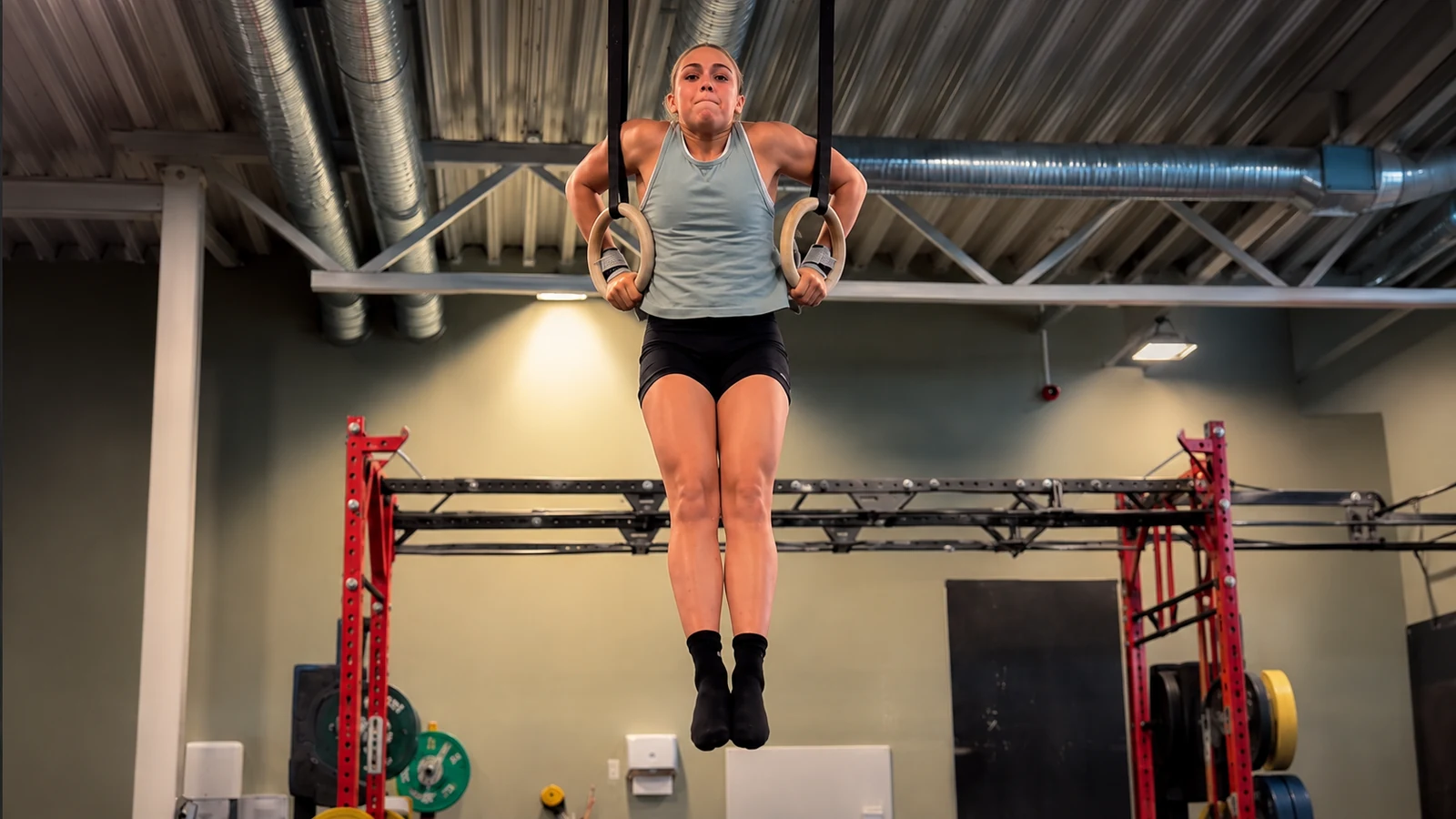
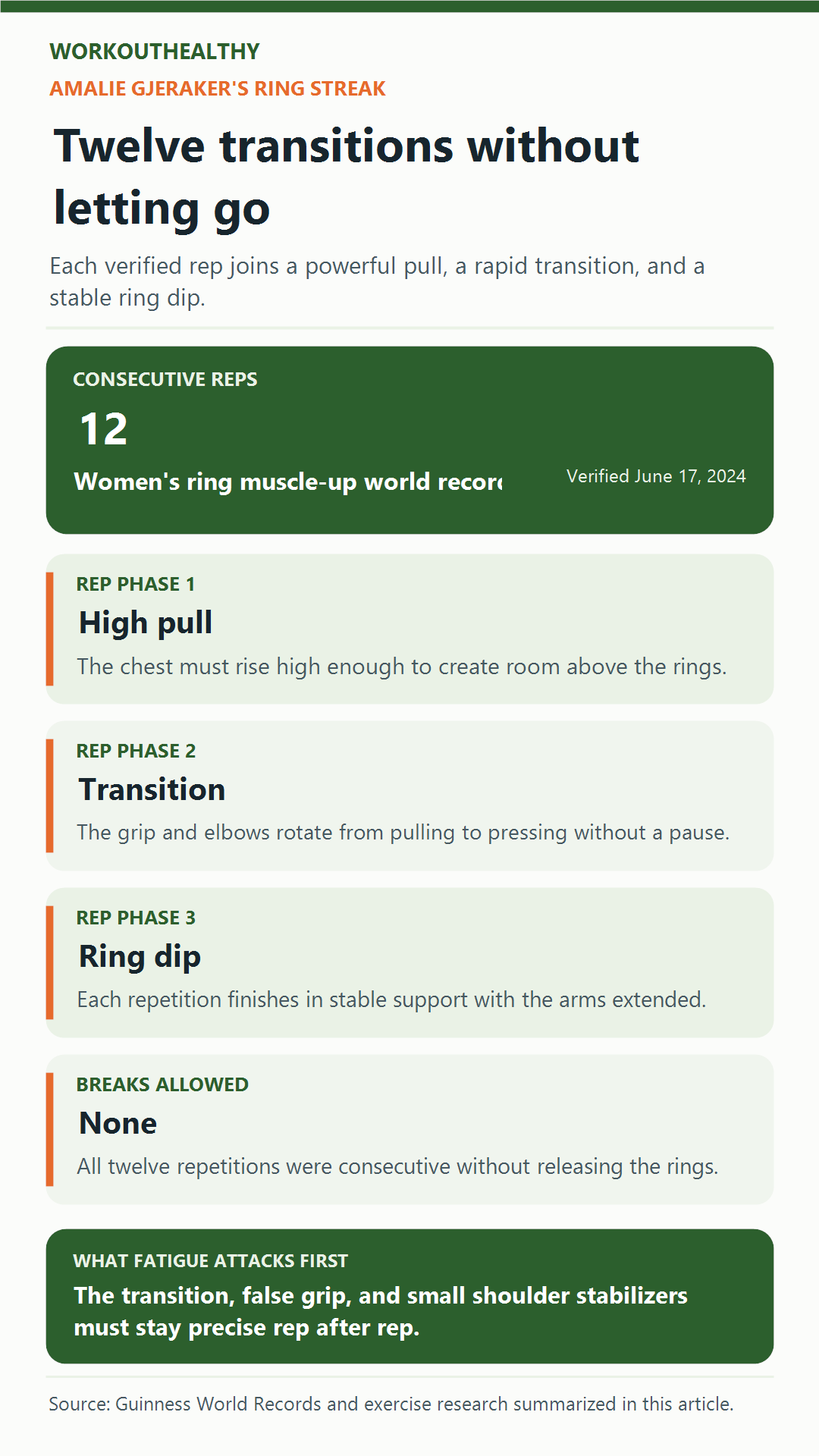
On June 17, 2024, a gymnast named Amalie Gjeraker did twelve of them in a row, on gymnastic rings, without ever letting go.
Guinness World Records verified the feat in Bergen, Norway, and it still stands as the current world record for most consecutive ring muscle-ups by a woman.
This is not really a story about one extraordinary rep.
It is a story about what a trained body can repeat twelve times without a single break in form, and the exercise science explains a surprising amount of how that is possible.
What Guinness Actually Verified
The Guinness World Records page for this record lists the athlete as Amalie Gjeraker.
It lists the number of reps as twelve.
It lists the date as June 17, 2024, and the location as Bergen, Norway.
Every one of those details checks out, with no discrepancy worth flagging.
It had been her dream to try and achieve this record.
Guinness requires attempters for this specific title to be at least 16 years old.
It defines the movement itself as a powerful pull-up performed until the arms and torso are straight and extended above the rings.
A Muscle-Up Is Two Exercises Stitched Together
A muscle-up looks like one smooth movement, but it is really two separate exercises joined in the middle.
The first half is a pull-up, driving your chin and then your chest up toward the rings.
The second half is a dip, pressing your body up and over the rings until your arms lock out straight.
That second half asks for the same kind of pressing strength you would use in a floor press or a bench press, just applied through your own bodyweight instead of a bar.
What makes a muscle-up hard is rarely the pull or the dip on their own.
It is the moment in between, when your hands have to flip position while your body weight is still moving and your momentum is working against you.
The Transition Is Where Most Muscle-Ups Are Won or Lost
Researchers have studied a similar transition on a far more common piece of equipment: the pull-up bar.
A 2018 study in the journal Sports Biomechanics compared a strict, controlled pull-up to a kipping pull-up, where athletes add a hip and leg swing to help carry their body past the bar (Dinunzio et al., 2018).
The kipping version changed both the path the body traveled and which muscles fired hardest, shifting more of the work toward the hip flexors and the muscles that drive the legs forward.
A ring muscle-up borrows from that same idea, on a smaller scale.
Instead of a big leg kip, most trained athletes use a fast, small hip pop paired with a quick wrist flip, turning the rings from a pulling position into a pressing position in well under a second.
A 2023 review of the biomechanics of gymnastics rings work found that this kind of pulling and swinging action places heavy demand on the shoulder muscles, especially the small rotator cuff muscles called the supraspinatus and infraspinatus, along with the hip flexors that help control the swing (Malíř et al., 2023).
Those rotator cuff muscles are some of the smallest and most fatigue-prone muscles involved in the whole movement.
That is a big part of why the transition, more than the pull or the dip, is usually the first thing to break down under fatigue.
A muscle-up is not one movement performed twice. It is a pull and a press forced through the same short window, with no pause to reset in between.
Why Most People Can’t Do a Single Muscle-Up
The most common reason a first attempt fails has nothing to do with the dip.
It is that the pull never gets high or fast enough to leave room to flip the grip before gravity wins.
A standard pull-up only needs to bring your chin over the bar.
A muscle-up needs your chest to rise well above the rings, with leftover speed to carry you through the transition.
That gap is why coaches generally want a lifter comfortable with strict pull-ups, often for several reps and sometimes with added weight, before they start drilling the transition at all.
Shoulder mobility is the second common block.
The transition asks the wrists and shoulders to rotate through a range most people never train, and a stiff shoulder will stall out halfway through the flip no matter how strong the pull is.
The Grip Problem: False Grip and Forearm Fatigue
Elite ring athletes do not grip the rings the way you would grip a pull-up bar.
They use what is called a false grip, rotating the wrist so the ring presses into the base of the palm instead of sitting across the fingers.
A false grip keeps the wrist in a stronger position through the transition, but it takes real forearm and finger strength to hold, especially under fatigue.
That fatigue question has been studied in a related population: climbers, who also depend on sustained, near-maximal grip strength.
A 2020 study in the International Journal of Environmental Research and Public Health tested grip strength decline across repeated near-maximal squeezes in both recreational and more advanced climbers (Labott et al., 2020).
The researchers found that how much grip strength faded over repeated efforts did not clearly separate the stronger climbers from the weaker ones.
What mattered more was how much raw grip strength each climber started with in the first place.
That finding lines up with what a twelve-rep muscle-up streak likely demands: less a special, trainable kind of grip endurance, and more a very large reserve of raw grip and forearm strength to draw down from, rep after rep.
How Elite Calisthenics Athletes Actually Train Ring Strength
Nobody builds a twelve-rep muscle-up streak by only practicing muscle-ups.
A 2021 study measured the raw strength elite male gymnasts needed to hold difficult static ring positions, like the iron cross and the support scale (Schärer et al., 2021).
Some of those positions required pressing or pulling strength equal to well over half the gymnast’s own bodyweight.
Eccentric strength, meaning the ability to control a slow lowering motion, mattered even more than the ability to press up into the position in the first place.
That is the base most serious ring athletes build before they ever chain reps together: heavy ring dips, ring rows, weighted pull-ups, and slow, controlled lowers.
False grip strength itself gets trained in isolation too, often through false grip hangs, where an athlete simply holds the rotated grip position for time.
Straight-arm strength, supporting bodyweight with the elbows locked instead of bent, also gets dedicated training time, since a tired straight-arm position is a common reason a transition collapses partway through a long set.
Coaches who work with this kind of training often recommend hiring a personal trainer or a knowledgeable coach for the false grip transition specifically, since bad wrist habits are easy to build without someone watching in person.
What This Research Does Not Prove
None of the studies behind this article looked at ring muscle-ups performed for twelve consecutive reps.
The kipping pull-up research measured a single bar-based rep, not a fast-paced streak on rings.
The ring strength research measured static holds, not the dynamic, repeated motion a muscle-up set demands.
The grip fatigue research was done on climbers gripping a bar, not gymnasts gripping rotated rings.
Applying any of it directly to a twelve-rep world record is an extrapolation, not a proven mechanism, and it deserves to be read that way.
What the research does support is the general shape of the demand: real pulling and pressing strength, a well-drilled transition, strong shoulders and forearms, and a large reserve of all of it to draw from rep after rep.
Common Mistakes People Make Chasing a Muscle-Up
The most common mistake is jumping straight to the rings or the bar before building a real pull-up base.
A shaky pull-up rarely turns into a clean muscle-up.
It usually just turns into a wild, uncontrolled kip.
The second common mistake is trying to muscle through the transition with the arms alone, instead of using the small hip pop that helps carry the body’s momentum forward.
The third is training the transition only at full speed, with no slow, controlled reps to build a real feel for where the wrists and elbows should travel.
The fourth is ignoring recovery and training the movement every single day.
Skipping recovery rarely speeds up progress toward a first muscle-up.
It more often slows it down, the same way chronic under-fueling can quietly cost you the very muscle mass you are trying to build.
Who Should Be Careful With This Movement
Muscle-ups put real, repeated stress on the shoulders, elbows, and wrists, more than most beginner exercises do.
Anyone with a history of shoulder impingement, a labrum injury, or ongoing elbow or wrist pain should get clearance from a doctor or physical therapist before attempting the transition.
The false grip itself can aggravate an already irritated wrist, since it asks the joint to sit in a rotated position under load.
Beginners are usually better served training the pull and the dip separately for weeks or months first, rather than risking a joint injury chasing a movement they are not ready for.
A Realistic Way to Build Toward Your First Muscle-Up
Start with strict pull-up strength.
Aim to comfortably do five to eight strict pull-ups with a full range of motion before adding any muscle-up specific drills.
Next, build ring or bar dip strength on its own, working toward eight to ten controlled dips with your elbows fully locking out at the top.
Once both of those feel solid, start training the false grip by itself.
Hang from rings or a bar with your wrist rotated into the false grip position, working up to holding it for twenty to thirty seconds at a time.
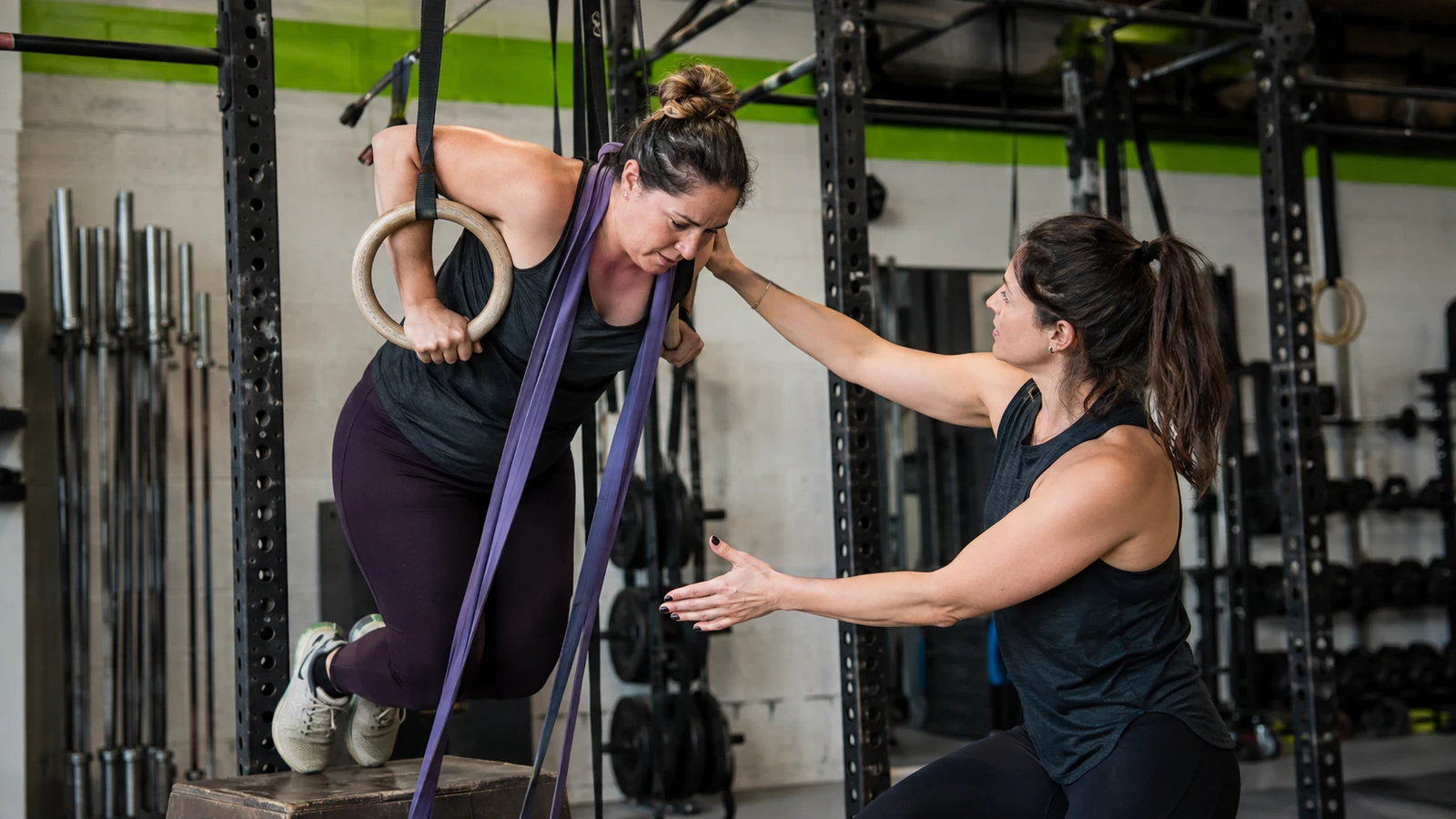
From there, try banded muscle-ups, where a resistance band looped over the bar or rings gives you an assist through the hardest part of the transition.
Reduce the band’s assistance gradually over several weeks as your transition strength improves.
Practice slow, controlled negatives too, lowering yourself from the top support position back down through the transition and into a hang.
That builds real control in exactly the range where most people lose the movement.
Some lifters time caffeine before a max effort attempt like this one, and the general research on caffeine timing before a workout suggests it can modestly help power output, though the ideal dose and timing still vary by person.
Once you land your first unassisted rep, resist the urge to chase volume right away.
Build up slowly toward two, then three reps in a row, giving your shoulders and forearms real rest between sessions.
That patient, gradual approach is likely the same one sitting underneath a streak of twelve.
Watch the Record
Amalie Gjeraker originally posted the footage of her full attempt to her own TikTok account.
See the official listing on the Guinness World Records site.
Enjoyed this breakdown? Subscribe to WorkoutHealthy Insider for practical explanations behind popular fitness claims.
References
Dinunzio, C., Porter, N., Van Scoy, J., Cordice, D., & McCulloch, R. S. (2018). Alterations in kinematics and muscle activation patterns with the addition of a kipping action during a pull-up activity. Sports Biomechanics, 18(6), 622-635. https://doi.org/10.1080/14763141.2018.1452971
Labott, B. K., Held, S., & Donath, L. (2020). Grip strength-endurance in ambitious and recreational climbers: Does the strength decrement index serve as a feasible measure? International Journal of Environmental Research and Public Health, 17(24), 9530. https://doi.org/10.3390/ijerph17249530
Malíř, R., Chrudimský, J., Šteffl, M., & Stastny, P. (2023). A systematic review of dynamic, kinematic, and muscle activity during gymnastic still rings elements. Sports, 11(3), 50. https://doi.org/10.3390/sports11030050
Schärer, C., Huber, S., Bucher, P., Capelli, C., & Hübner, K. (2021). Maximum strength benchmarks for difficult static elements on rings in male elite gymnastics. Sports, 9(6), 78. https://doi.org/10.3390/sports9060078
Guinness World Records. (2024). Most consecutive ring muscle-ups (female). https://www.guinnessworldrecords.com/world-records/661192-most-consecutive-ring-muscle-ups-female
This article is for general information only and is not medical advice. If you have an injury, ongoing pain, or a medical condition, talk to a doctor or physical therapist before you change how you train or eat.