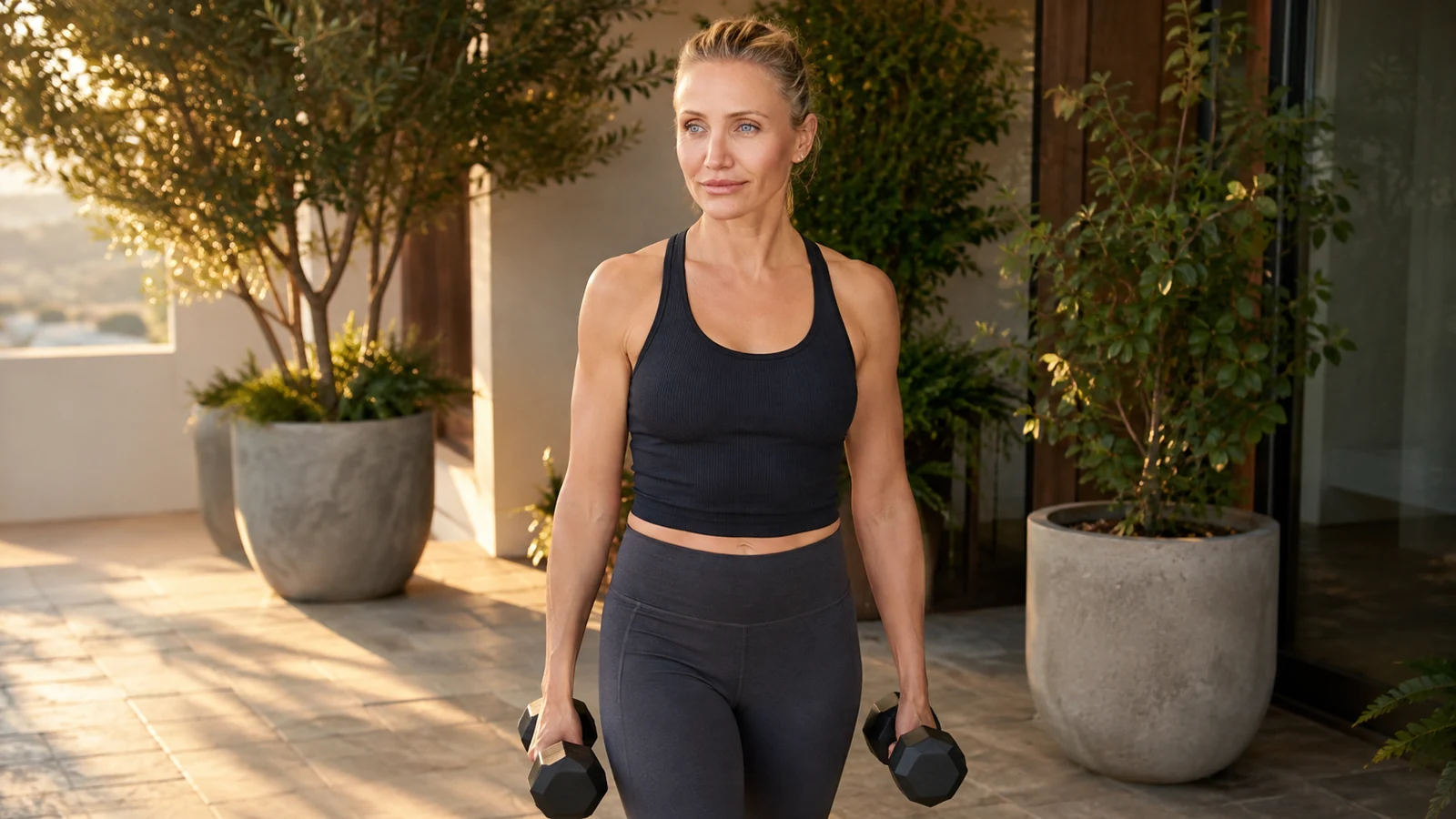

Cameron Diaz once said fitness happened to her by accident. She started training at 27 for a movie role, and the habit never left.
Nearly three decades later, she is still doing a version of that same routine, and she has become one of Hollywood’s more consistent voices on why aging well matters more to her than looking a certain way.
Who Diaz Is and Why Her Approach Is Worth Looking At
Diaz is 54 years old. She built her career on films like The Mask, There’s Something About Mary, and the Charlie’s Angels franchise, then stepped away from acting for nearly a decade.
She returned to the screen in the 2025 Netflix film Back in Action, alongside Jamie Foxx, and has spoken publicly about how motherhood reshaped her priorities around health.
She became a parent later in life, and that timing appears to have sharpened her focus on longevity specifically, not just staying in shape.
“I want to live to be 110, since I’ve got a young child.”
She has also talked about wanting to be present for her daughter’s future decades, which she has said motivates her more than any aesthetic goal.
What Her Actual Training Looks Like
Diaz has worked with trainer Teddy Bass for years, and their sessions reportedly combine strength training, high intensity interval work, and Pilates rather than sticking to one method.
One specific piece of her cardio work involves a five minute interval block on an elliptical machine, alternating one minute sprints with one minute of easier recovery pacing, repeated five times through.
That structure is a simple, accessible version of interval training that does not require advanced equipment or a full hour to complete.
She has also described a much less formal habit from earlier in her career: dancing in her bedroom first thing in the morning simply to get her body moving before the day started.
The Philosophy Behind the Routine
What stands out in Diaz’s own comments is how often she frames fitness around function rather than appearance.
“It’s not about having a ripped stomach. It’s about taking care of myself.”
She has also been candid that her routine is not rigid.
In a past interview, Diaz said that on some days she skips a workout entirely and stays in bed because sleep matters more.
On other days she keeps a session to just 10 minutes rather than skipping it, saying that showing up at all is what matters to her, even briefly.
She has also spoken about wanting to preserve function as she gets older rather than chase a specific look.
“I want to make sure I can maintain quality of life.”
The Exercise Science Behind Combining These Three Methods
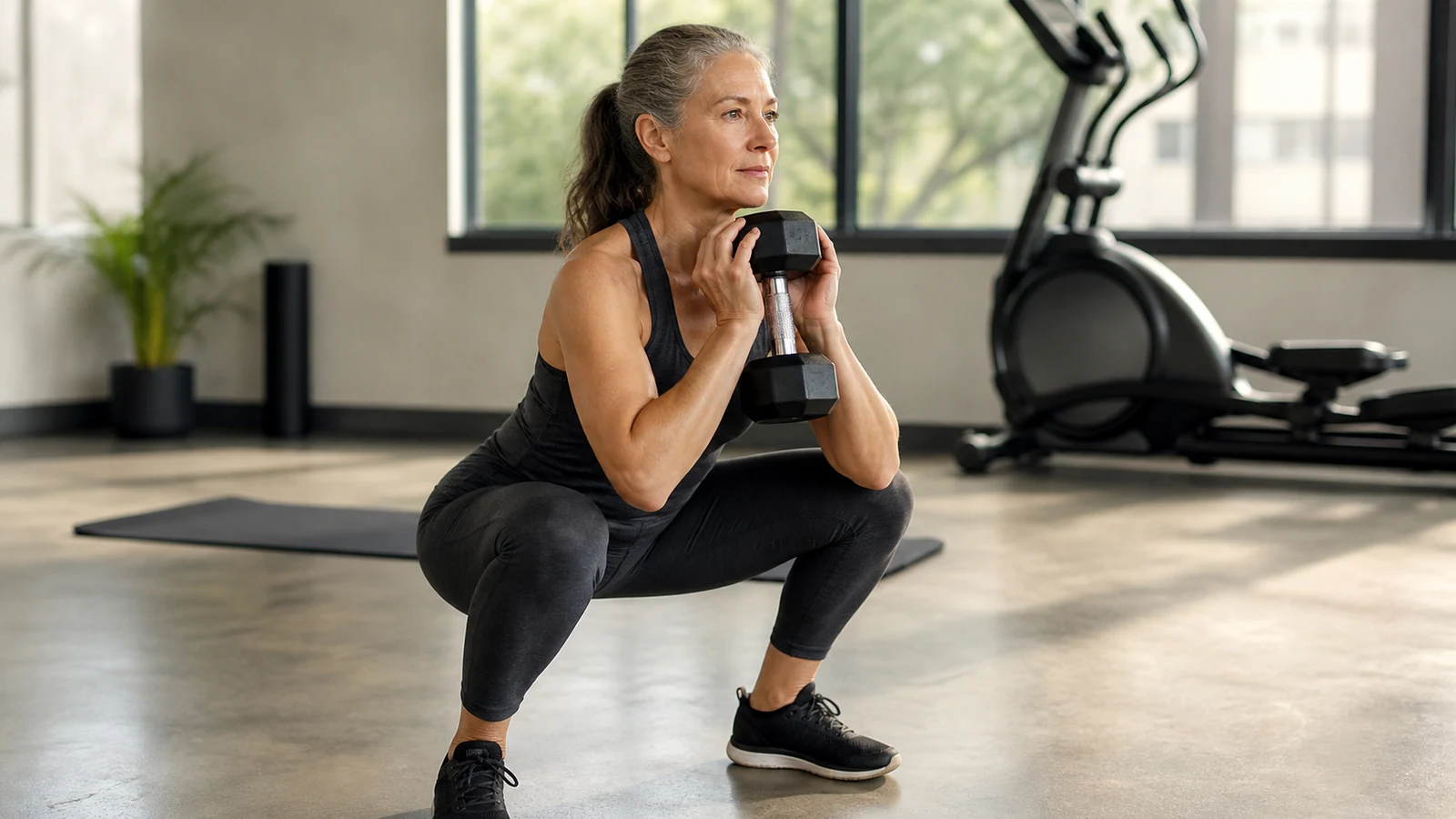
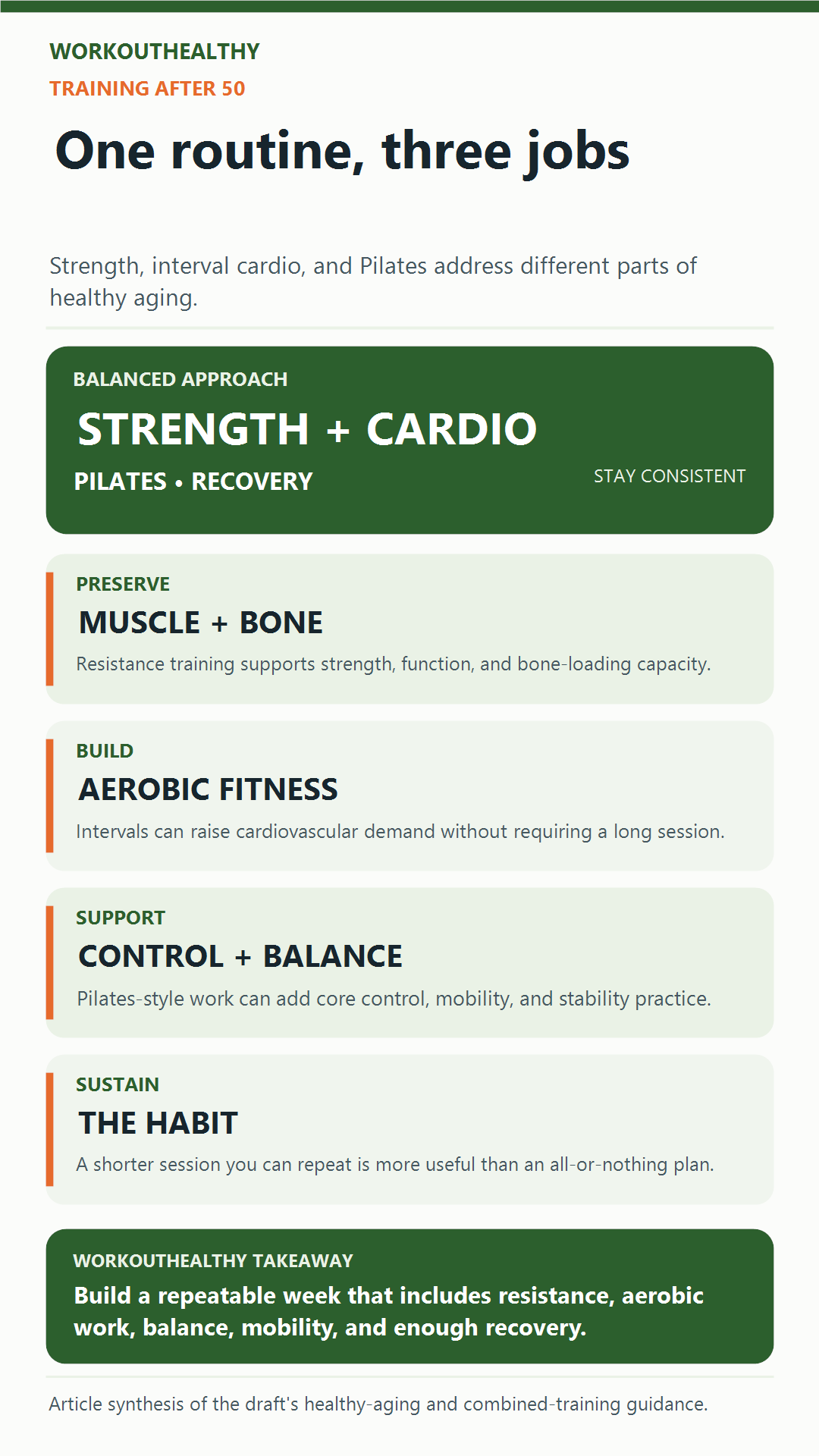
Diaz’s combination of strength training, interval cardio, and Pilates is not a random mix. Each piece addresses a different part of what tends to decline with age in women specifically.
Muscle mass and strength begin dropping more steeply around the menopause transition. A 2009 review in the Journal of Musculoskeletal and Neuronal Interactions found that women lose muscle mass and strength at an accelerated rate in the years surrounding menopause, driven partly by declining estrogen levels.
Resistance training is the most direct countermeasure available. It is also one of the few interventions shown to help preserve bone density, which matters because bone loss accelerates through the same hormonal transition.
The American College of Sports Medicine’s position stand on physical activity and bone health specifically recommends weight bearing and resistance exercise as core strategies for maintaining bone density across the lifespan, particularly for women navigating menopause related bone loss.
The interval cardio piece targets a different system. Reviews of high intensity interval training, including a widely cited 2014 analysis in the British Journal of Sports Medicine, have found it produces cardiovascular fitness improvements comparable to longer, steady state cardio sessions in a fraction of the time.
Pilates rounds out the combination by building core control, balance, and joint stability without the impact of running or jumping.
Recent research specifically on Pilates in older adults has found real, though sometimes overstated, benefits for strength, balance, and mobility.
Balance training in particular matters more with each passing decade, since falls become a leading cause of serious injury later in life.
A stronger, more stable core also supports better posture and lower back health during everyday tasks, not just during a workout.
How This Compares to a Cardio Only Approach
A lot of popular fitness advice for women still centers almost entirely on cardio, treating it as the default tool for weight management.
Cardio alone burns calories effectively and supports heart health, but it does relatively little to preserve the muscle and bone density that decline with age.
Diaz’s approach, built around resistance training as a foundation with cardio and mobility work layered on top, matches what most exercise physiologists now recommend for women in midlife specifically.
Muscle is not just about strength. It is also metabolically active tissue that helps regulate blood sugar and support a healthy metabolism as hormones shift, which is part of why maintaining it matters beyond appearance.
A cardio only routine can still be a reasonable starting point for someone new to exercise.
It is simply incomplete as a long term strategy for the specific changes that happen to the body during and after menopause, and it should not be treated as the whole plan on its own.
What This Story Does Not Prove
Diaz’s specific interval workout and her long relationship with one trainer do not mean any one formula is the secret to aging well.
Her flexible, forgiving approach to missed workouts is easy to admire, but it also reflects the reality of someone with significant resources, including consistent access to a personal trainer over many years.
Some of Diaz’s most quoted comments about her routine and her diet come from interviews given a decade or more ago, when she was in her early 40s.
Her current, specific weekly schedule at 54 has not been laid out publicly in the same level of detail.
The general pattern, strength work, intervals, and Pilates with a trainer, is what’s confirmed across her more recent interviews.
An exact, current, day by day plan simply is not part of the public record.
It’s also worth being clear that no single celebrity’s exercise habits, however sensible, are a substitute for medical guidance during a major hormonal transition like menopause.
The same caution applies to other public figures known for aging visibly well, such as Christie Brinkley or Gabrielle Union.
The confirmed specifics behind those stories are usually more modest than the viral version people share online.
Common Mistakes People Make Copying This
The most common mistake is picking just one piece, usually the cardio, and skipping the strength training that actually addresses age related muscle and bone loss.
Another mistake is assuming Pilates alone builds enough strength to replace resistance training with actual external load.
Pilates is valuable for core control and stability, but it is not a strong enough stimulus by itself to maintain significant muscle mass in most people over time.
People also tend to copy the flexible, low pressure attitude toward missed workouts without first building the consistent habit that makes flexibility sustainable rather than an excuse to stop entirely.
Finally, some readers assume a wealthy celebrity’s daily schedule maps cleanly onto a working adult’s week.
It rarely does. A realistic version of this routine needs to fit around a full time job and family responsibilities, not a schedule built entirely around training and recovery.
Who Should Be Cautious With This Approach
Women in perimenopause or menopause who are new to strength training should start with lighter loads and proper coaching on form, since bone density changes can make certain movements riskier without good technique.
Anyone with an existing heart condition should get medical clearance before starting interval training, since the sprint portions raise heart rate quickly and significantly.
People with a history of pelvic floor issues, including after childbirth, should mention this to a Pilates or fitness instructor before starting core focused work, since some exercises need modification.
How to Build a Similar Routine
Start with two strength training sessions a week built around basic compound movements: squats, rows, presses, and hip hinges, using a weight that challenges you by the last two reps of each set.
Add one or two short interval sessions using Diaz’s basic structure as a template: five rounds of one minute at a hard, sustainable effort followed by one minute of easier movement, on any cardio machine or even walking outside.
Include one Pilates or core stability session a week, either in a class or through a well reviewed online program, focusing on control rather than speed.
Treat missed days honestly rather than harshly. If a scheduled workout conflicts with real sleep debt, prioritize the sleep and return to training the next day rather than skipping the week entirely.
If you are approaching or navigating menopause, talk with your doctor about a bone density screening and ask specifically how your training should account for any changes in bone health or cardiovascular risk factors.
Keep sessions short when time is tight. A real 10 minute strength session most days will do more for long term muscle and bone health than an occasional hour long workout squeezed in once every two weeks.
References
- USA Today, via AOL, “Cameron Diaz, 52, ‘Transformed’ Her Body For This Classic 2000 Film, And Has Kept Up Her Exercise Routine Ever Since”: aol.com
- Fox News, “Cameron Diaz Says She Fell Into Intense Fitness And Becoming A Great Body Icon” (2014): foxnews.com
- Fox News, “Cameron Diaz Turns 50: Why She Chose to Leave Business and What Brought Her Back for Back in Action”: foxnews.com
- Maltais, M. L., Desroches, J., & Dionne, I. J. (2009). Changes in muscle mass and strength after menopause. Journal of Musculoskeletal and Neuronal Interactions, 9(4), 186 to 197.
- Kohrt, W. M., Bloomfield, S. A., Little, K. D., Nelson, M. E., & Yingling, V. R. (2004). American College of Sports Medicine position stand: physical activity and bone health. Medicine & Science in Sports & Exercise, 36(11), 1985 to 1996.
- Weston, K. S., Wisløff, U., & Coombes, J. S. (2014). High-intensity interval training in patients with lifestyle-induced cardiometabolic disease: a systematic review and meta-analysis. British Journal of Sports Medicine, 48(16), 1227 to 1234.
This article is for general information and is not medical advice. Talk with a doctor before starting a new exercise program, especially if you are pregnant, navigating perimenopause or menopause, or managing a heart condition.