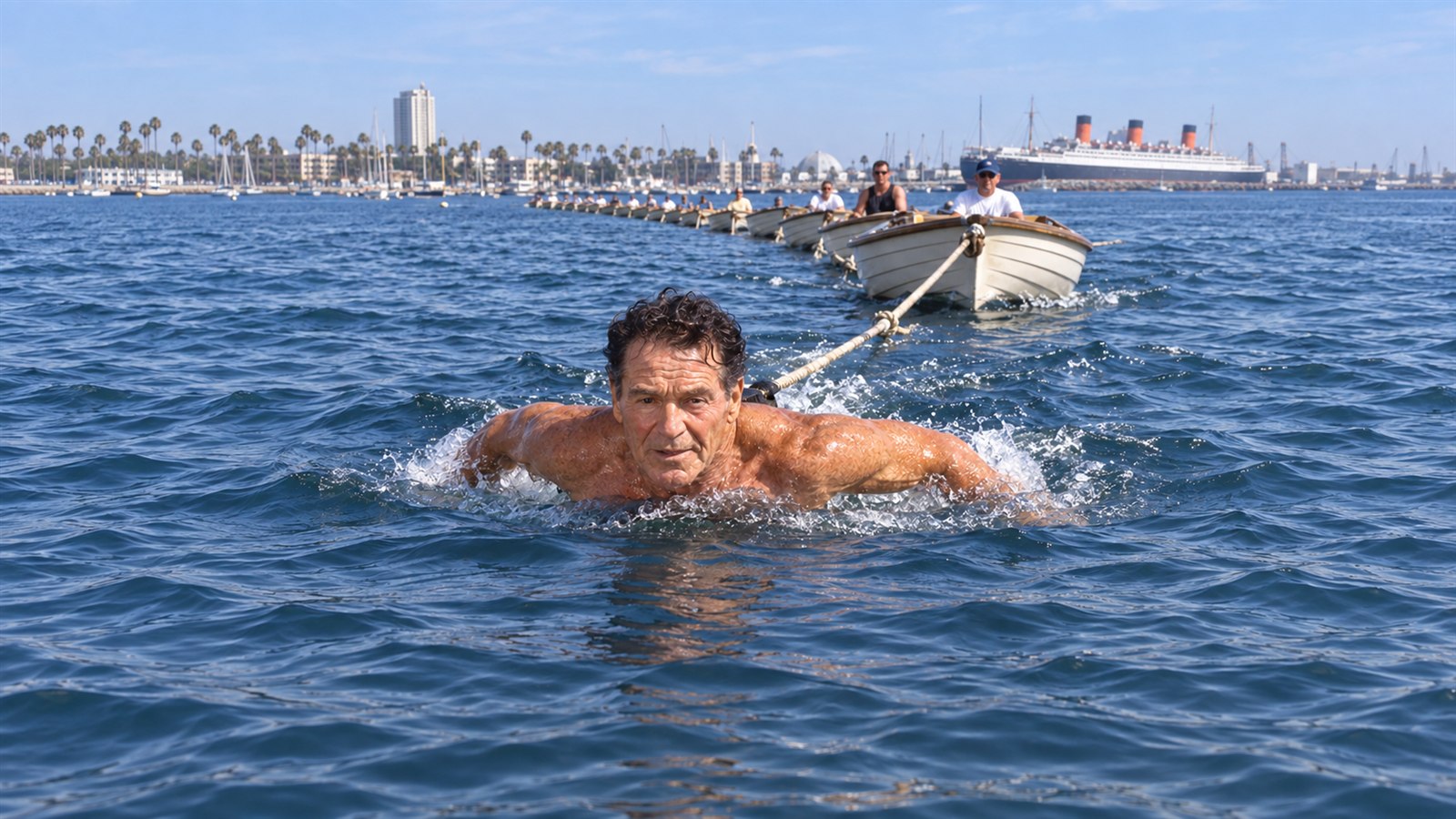

Jack LaLanne’s 70-boat swim at 70 is more than an internet legend. Contemporary UPI reporting describes the boat-towing performance in Long Beach Harbor, including the restraints (United Press International, 1984).
Some details differ across accounts. A careful retelling should keep those differences visible while explaining what the achievement can reasonably say about fitness in later life.
The photograph-like hero is an editorial reconstruction based on the scheduled Facebook creative, not an archival photograph of the event.
The useful follow-up is a question about your own routine: what kind of activity can you plan, repeat and adapt? The historical feat and modern exercise evidence help answer different parts of that question.
Who Jack LaLanne was
LaLanne was born on September 26, 1914, in San Francisco and died on January 23, 2011, aged 96 (Television Academy, 2011).
His career was much broader than one swim. He opened an Oakland fitness studio in 1936 and used television to introduce exercise to home audiences (BeFit Enterprises, n.d.).
The Jack LaLanne Show began locally in 1951 and became national in 1959. His routines often used simple household objects and encouraged viewers to participate (Television Academy, 2011).
That background matters when interpreting the harbor performance. A dramatic feat was one way to attract attention to a message he also delivered through ordinary, repeatable exercises.
Most readers will have more in common with the people exercising at home than with a man preparing a boat-towing display. The home audience was part of the fitness story too.
What the age 70 swim accounts say
A contemporary UPI report published on November 21, 1984, describes LaLanne towing 70 rowboats through Long Beach Harbor (United Press International [UPI], 1984).
It says the swim covered a mile and was performed with his hands and feet shackled (UPI, 1984).
The contemporary report directly supports the restraint detail. That detail can remain in an account of the feat when its source is identified.
LaLanne’s current official biography also describes a mile-long restrained swim, adding that the 70 boats carried 70 people (BeFit Enterprises, n.d.).
The Television Academy’s 2011 retrospective gives the distance as a mile and a half (Television Academy, 2011). We therefore describe the core achievement as towing 70 boats at 70, rather than treating the exact distance as settled.
UPI’s copy also says he turned 70 that Tuesday, although his documented birthday was September 26. That inconsistency is another reason not to assign an exact swim date from this report alone (UPI, 1984; Television Academy, 2011).
The report’s publication date is not necessarily the event date. Keeping those two dates separate is useful whenever an archive story is recirculated decades later.
The supported boat count, age and harbor setting are enough to understand why the feat drew attention. The remaining details should retain their source and qualification.
How the swim fits his public career
Boat towing belonged to a longer public career. The official biography lists a handcuffed Alcatraz swim in 1955, a televised 1,033-push-up performance in 1956 and a swim towing a 1,000-pound boat at 60 (BeFit Enterprises, n.d.).
UPI also recalled his bicentennial display involving 13 boats and 76 passengers, and a 1979 event involving 65 boats in Japan (UPI, 1984).
The boat counts supplied a memorable hook. A number linked to age or an anniversary is easy to repeat in a headline and gives viewers a clear way to remember the event.
These selected examples are not a complete record ledger. We are not assigning a Guinness title, comparing every performance with later records, or treating a publicity account as a standardized competition result.
The historical question is whether the feat happened as reported. The practical fitness question is what an ordinary person can learn from the broader commitment to activity.
Those questions need different evidence. An archive report can support a boat count; exercise trials and current guidance are better tools for planning a weekly routine.
You do not need a harbor full of boats to prove you are still strong. You need a plan you can repeat next week.
Why a harbor stunt is a different activity
Swimming with restrained limbs removes ways a swimmer would ordinarily move, recover and respond to trouble. A towing display also changes the task beyond ordinary recreational swimming.
Harbor conditions and attached boats add circumstances that a home exercise session does not have. This is a specialized performance, not a sensible test of whether a reader is fit for their age.
There is no reason to recreate the restraint component to benefit from exercise. A pool session, walk or strength workout can have a clear purpose without turning the session into a stunt.
Choose the environment around the activity you actually intend to do. For swimming, that means an appropriate supervised setting and a task within your swimming ability.
The decision to admire a historical achievement does not create an obligation to duplicate it. A useful goal should leave you able to train again.
What research says about strength with age
A Cochrane review included 121 randomized trials and 6,700 older participants. Most programs used progressive resistance training two or three times weekly, often at high intensity (Liu & Latham, 2009).
The review found a large overall effect on muscle strength, a small improvement in broad physical ability and improvement in tasks such as rising from a chair (Liu & Latham, 2009).
These outcomes are relevant to everyday function. They do not require a person to perform an extraordinary public feat to count as meaningful progress.
The authors also noted poor reporting of adverse events, including musculoskeletal complaints in studies that monitored them. Their findings should not become a blanket claim that every program is appropriate for every clinical population (Liu & Latham, 2009).
Progressive training means the challenge can change as capacity improves. It does not mean copying the heaviest effort performed by someone with a different history.
An exercise log can make that distinction concrete: record the movement, resistance, repetitions and how the session went. The useful comparison is the same task under comparable conditions over time.
What research says about endurance with age
Tanaka and Seals (2008) reviewed Masters endurance athletes. They described peak endurance performance as generally maintained until about 35, with modest declines through roughly 50 to 60 and steeper declines thereafter.
Declining maximal oxygen uptake was a major mechanism. Changes in training intensity and volume also contributed to the pattern (Tanaka & Seals, 2008).
Masters athletes illustrate substantial capacity in later life, but their results do not erase aging. An exceptional athlete’s performance is not a guarantee for another person with a different starting point.
It is also a different question from whether an individual can improve after becoming more active. Long-term age trends and an individual’s response to a new routine can both be real.
For a recreational plan, choose a repeatable activity and record how much you do. You need not compare every walk or swim with the best performance of a lifelong athlete.
The historical swim can provide motivation; a manageable weekly schedule provides the opportunity to use it.
What these findings can and cannot tell you
Resistance-training trials support improvements in older adults’ strength and function. A review of Masters athletes describes how high performance changes with age. Neither is a study of LaLanne’s specific preparation (Liu & Latham, 2009; Tanaka & Seals, 2008).
We cannot infer the training program behind the 70-boat swim, the contribution of every factor, or what would have happened if he had trained differently.
One exceptional performer also cannot establish that anyone can match the feat with enough determination. A public success story gives little information about people who trained but did not reach a comparable outcome.
The more useful aim is to identify a personally meaningful task and a way to practice it. For one person that might be getting out of a chair more comfortably; for another it might be completing a community walk.
Neither needs an audience. The goal becomes useful when it helps you decide what to do this week and what to review next month.
Make the goal specific enough to guide a week of activity, and ordinary enough to repeat.
A practical weekly activity framework
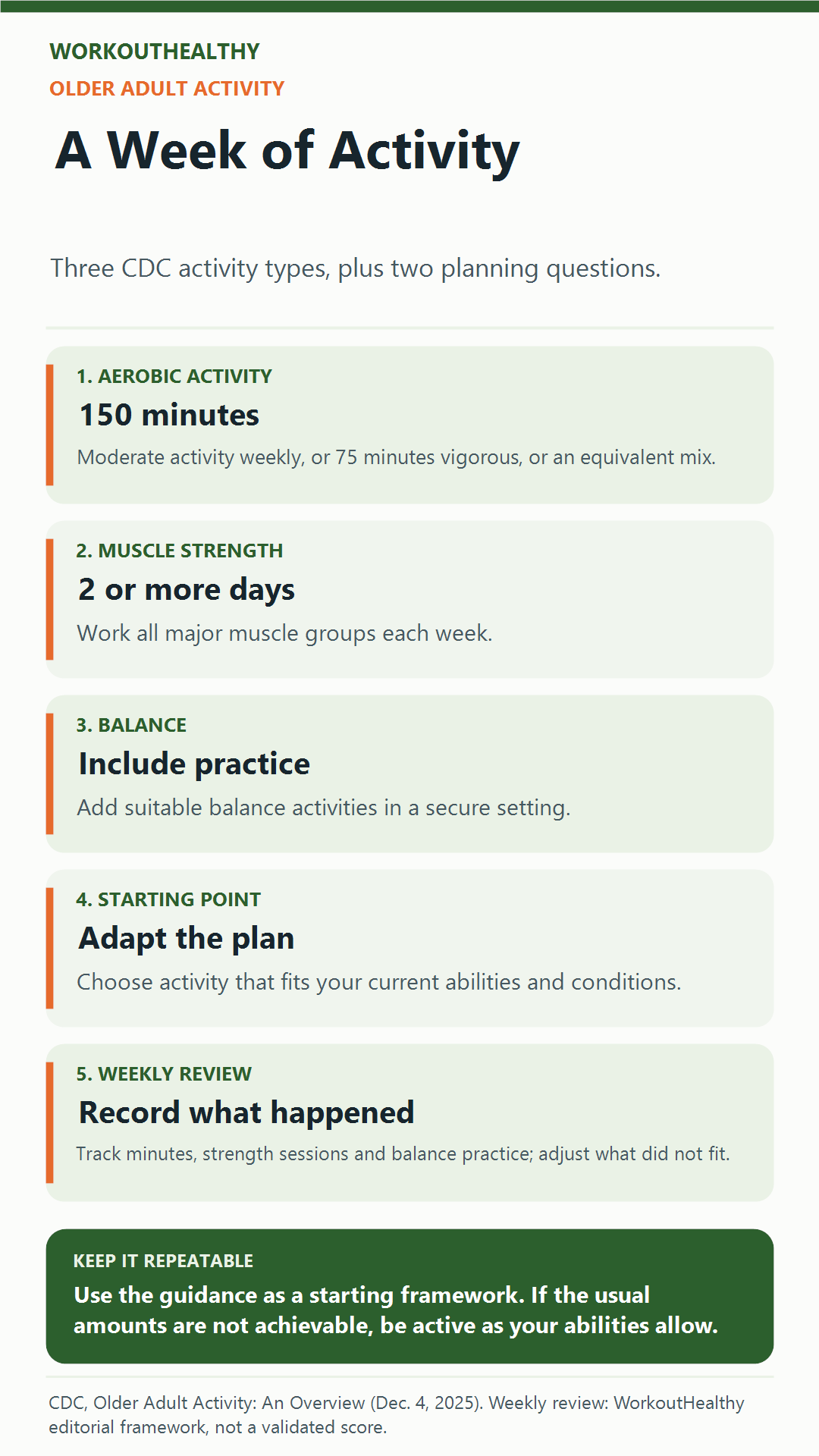
For adults 65 and older, CDC guidance combines at least 150 minutes of moderate aerobic activity, or 75 minutes of vigorous activity, with at least two days of muscle strengthening and balance activities (Centers for Disease Control and Prevention [CDC], 2025).
An equivalent mix of moderate and vigorous activity is another option. The guidance also says to be as active as abilities and conditions allow when those amounts are not achievable (CDC, 2025).
Use this three-part weekly planning sheet as an editorial framework, not an individualized prescription:
- Aerobic activity: List the activity, setting and planned minutes. Choose something you can realistically access, such as walking, cycling or an appropriate pool session.
- Strength work: Set aside sessions that cover the major muscle groups. Record the exercises and current level of challenge so progression can be deliberate.
- Balance activity: Add suitable practice in a secure setting. Someone with balance difficulties can seek guidance about the support and exercise selection they need.
Then review what was actually completed. A plan that repeatedly misses the same session may need a different time, location or activity rather than a more dramatic target.
Keep the record simple. Minutes, sessions and brief notes are enough to reveal whether the routine fits your week; a complicated scoring system is unnecessary.
Our story on David Beckham adding upper-body training after retirement offers another example of how a routine can change over a career.
Our guide to strength training and protein after menopause discusses a related muscle-maintenance question.
Adjusting the plan to your circumstances
CDC recommends choosing effort relative to current fitness and understanding how chronic conditions affect activity. When health conditions prevent meeting the usual amounts, activity should fit what the person can do (CDC, 2025).
That makes a program adaptable. The appropriate starting point for a regular exerciser can be different from that of someone returning after illness or years of inactivity.
If an existing condition or a balance problem makes exercise selection uncertain, a clinician or appropriately qualified professional can help adapt the plan.
An adjusted routine is still a routine. There is no need to use LaLanne’s swim as a pass-fail test of your own health or determination.
The takeaway
Contemporary reporting supports LaLanne towing 70 rowboats at 70 in Long Beach Harbor with his hands and feet restrained. Sources differ on distance, so a precise universal figure deserves qualification (UPI, 1984; Television Academy, 2011).
His long public career helped make exercise visible and approachable. The practical opportunity is a repeatable mix of activity suited to your circumstances.
Choose a goal, plan the week and review what you completed. The boat count belongs to the historical feat; your next useful session belongs in your calendar.
Get the next evidence check.
Five practical fitness stories worth your time, every Friday.
One email a week. No product pitches. Unsubscribe in one click.
References
BeFit Enterprises. (n.d.). Jack LaLanne: The godfather of fitness. https://www.jacklalanne.com/jack
Centers for Disease Control and Prevention. (2025, December 4). Older adult activity: An overview. https://www.cdc.gov/physical-activity-basics/guidelines/older-adults.html
Liu, C.-J., & Latham, N. K. (2009). Progressive resistance strength training for improving physical function in older adults. Cochrane Database of Systematic Reviews, 2009(3), Article CD002759. https://doi.org/10.1002/14651858.CD002759.pub2
Tanaka, H., & Seals, D. R. (2008). Endurance exercise performance in Masters athletes: Age-associated changes and underlying physiological mechanisms. The Journal of Physiology, 586(1), 55-63. https://doi.org/10.1113/jphysiol.2007.141879
Television Academy. (2011, January 24). Fitness icon and television star Jack LaLanne dies at 96. https://www.televisionacademy.com/features/news/news/fitness-icon-and-television-star-jack-lalanne-dies-96
United Press International. (1984, November 21). 70-year-old Jack LaLanne pulls 70 boats. https://www.upi.com/Archives/1984/11/21/70-year-old-Jack-LaLanne-pulls-70-boats/8387469861200/
Medical disclaimer: This article is general product information, not medical advice. The equipment described here is not a treatment for any condition. If you have an injury, ongoing pain, or a medical condition, talk to a doctor or physical therapist before using any of it.