

Rest days do not build muscle by themselves, but they create room for the training response to unfold. The workout provides a stimulus; recovery determines whether you can adapt and return ready to produce another useful stimulus.
That does not mean every sore muscle needs complete inactivity or that one hard session requires exactly 48 hours off. Recovery depends on the exercise, muscle group, total volume, training experience, sleep, nutrition, age, stress, and how the next session is organized.
Quick answer: use rest days to manage fatigue, preserve training quality, and avoid stacking hard sessions faster than you can tolerate them. A lighter day, different muscle group, or full day off can all be valid forms of recovery.
Recovery is not the absence of training. It is part of the design.
What recovery does after lifting
Resistance exercise disrupts the body’s usual state and triggers repair and remodeling processes. Muscle protein synthesis rises after training, but the size and timing of that response vary among people and sessions.
A 2024 systematic review analyzed 79 controlled trials with 237 participants. The pooled evidence showed a robust increase in postabsorptive muscle protein synthesis after resistance exercise, with measurable elevations reported soon after training and up to 48 hours later (Davies et al., 2024).
That 48-hour finding is not a universal countdown. The review found substantial variation related to age, exercise loading, training status, the muscle measured, and other methods.
Recovery also includes replenishing fuel, repairing connective tissue, restoring fluid balance, and reducing fatigue across the nervous system and the rest of the body. Muscle growth is one outcome inside a larger process.
A rest day can therefore support future training quality even when it does not create a dramatic feeling. You may simply arrive at the next session able to use better technique, more load, or more productive repetitions.
The goal is not to eliminate all fatigue. Training has to be challenging enough to cause adaptation, but not so poorly distributed that performance keeps sliding.
Soreness is an imperfect guide because it usually falls as you become familiar with a program. A productive session can cause little soreness, and a novel but poorly targeted session can make you extremely sore without producing a better long-term result.
Performance trends are often more useful. If comparable warm-ups and working sets remain stable or improve, the program may be recoverable even when you feel some normal fatigue.
Why more training is not always more progress
Volume and frequency can support growth, but only while the work remains recoverable. Adding sessions without adjusting effort, sets, sleep, or food can turn productive stress into accumulated fatigue.
A sports-recovery consensus emphasizes balancing training and competition demands with recovery, including pressures outside sport. Underrecovery can contribute to nonfunctional overreaching, injury, illness, and performance decline (Kellmann et al., 2018).
The overtraining consensus distinguishes short-term functional overreaching from longer, more serious problems. A brief performance dip can be planned, but persistent decline accompanied by mood, sleep, or health changes needs a different response (Meeusen et al., 2013).
Training-load research also shows why slogans are risky. A systematic review of 57 studies found broad support for a relationship between load and injury risk, but the direction depended on the type of load and the time frame measured (Eckard et al., 2018).
High workloads are not automatically harmful, and low workloads are not automatically protective. Problems often appear when the workload changes faster than the athlete’s capacity and context can support.
This is why one person’s six-day plan can work while another person’s identical calendar fails. The sets, effort, exercise selection, sleep, work stress, and training history behind the schedule are different.
Frequency should therefore be discussed together with weekly hard sets and effort. Six short, well-distributed sessions may create less fatigue than three marathon workouts pushed to failure.
The calendar is only the container. The dose inside it determines what the body must recover from.
Full rest versus active recovery
A full rest day means no structured training, but it does not require bed rest. Normal walking, household activity, and comfortable mobility can remain part of the day.
Active recovery usually means low-intensity movement that does not add meaningful fatigue. Easy walking, cycling, swimming, mobility work, or technique practice can fit that definition.
The word “active” is not a license to turn recovery into another hard workout. If the session includes grinding sets, intervals, or a competitive pace, it should be counted as training load.
Some soreness may feel better after gentle movement because temperature, circulation, and joint motion change temporarily. That sensation does not prove the tissue is fully recovered or ready for maximum effort.
Training a different muscle group can also be reasonable. An upper-body session after demanding leg work may allow local recovery, although whole-body fatigue and sleep loss can still carry over.
Choose full rest when illness, pain, severe fatigue, or a crowded life schedule makes even easy training a poor trade. Choose active recovery when movement improves how you feel without stealing from the next key session.
The WorkoutHealthy recovery traffic light
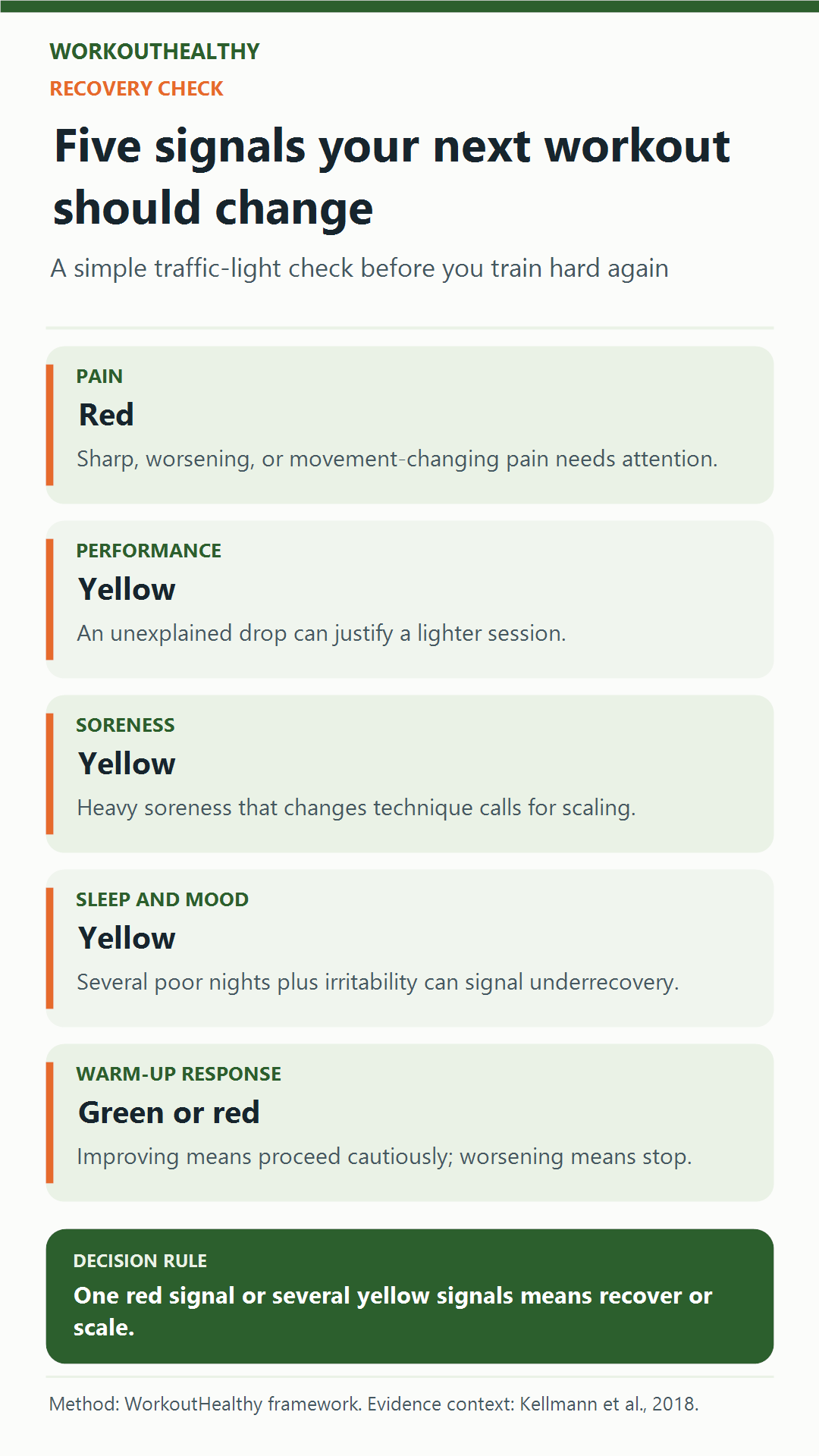
This is an original coaching framework, not a diagnostic tool. Check five signals before a hard workout: pain, performance trend, soreness, sleep and mood, and response to the warm-up.
Green means normal soreness, stable motivation, expected performance, and a warm-up that makes movement feel better. Proceed with the planned session while staying attentive.
Yellow means one meaningful concern, such as unusually heavy soreness, several poor nights of sleep, irritability, or a small unexplained performance drop. Reduce volume, effort, or exercise complexity.
Red means sharp or worsening pain, symptoms that change technique, illness, dizziness, or a warm-up that makes the problem worse. Stop the hard session and address the reason.
One red signal outweighs several green ones. Several yellow signals together can also justify a recovery day even when no single symptom looks dramatic.
Track the pattern instead of judging one morning in isolation. A single poor session happens; a week of declining performance, mood, and sleep is a trend.
The framework is intentionally simple. It creates a repeatable pause between “I planned to train” and “training hard is the best choice today.”
Write the result next to the workout rather than relying on memory. Over several weeks, you may notice that certain exercise combinations, late sessions, or workdays repeatedly produce yellow signals.
That pattern can guide programming before fatigue becomes a crisis. Move the demanding session, reduce redundant sets, or protect sleep on the nights that matter most.
How to place rest days in a weekly plan
Beginners often do well with full-body resistance training two or three nonconsecutive days per week. The days between sessions provide practice-free recovery without requiring a complicated split.
More experienced lifters may train more frequently by distributing muscle groups, volume, and effort. A four-day upper-lower split, for example, can preserve multiple recovery windows while increasing weekly practice.
Place rest before the session that matters most if fatigue tends to limit it. A day off before heavy lower-body training may be more useful than saving every rest day for the weekend.
After unusually demanding travel, work, or competition, reduce training expectations even if the calendar says you should be fresh. Non-exercise stress still consumes recovery resources.
If you train with another person, agree in advance that scaling is allowed. Our review of workout-partner benefits explains how accountability can help without turning every session into competition.
Deload weeks can also reduce accumulated stress without stopping completely. Lower the sets, load, effort, or exercise complexity for several sessions, then rebuild based on performance.
There is no morally superior training streak. A plan is successful when it produces adaptation you can sustain.
Sleep, food, and stress still count
A rest day cannot compensate for chronically short sleep. Research on athletic sleep interventions suggests that sleep extension may improve some performance outcomes, although the evidence remains limited and varies by measure (Bonnar et al., 2018).
Protect a consistent sleep window before searching for advanced recovery technology. Our article on caffeine and sleep timing covers one common obstacle.
Muscle remodeling also requires adequate energy and protein. Severe or prolonged under-fueling can make the training-recovery balance harder, even when the weekly schedule includes days off.
Hydration matters, but drinking excessive water is not a recovery hack. Replace fluid based on thirst, environment, and training losses, and include electrolytes when the situation warrants them.
Stress-management practices can help if they fit the person. A short walk, social connection, quiet breathing, or simply reducing commitments may be more restorative than another device or supplement.
Sauna, massage, and similar methods can change soreness or relaxation, but they do not erase poor programming. Our evidence review of sauna and heart health shows why a useful add-on should not be asked to replace the foundation.
The next good workout is one of the outcomes your rest day should protect.
The bottom line
Rest days support muscle growth indirectly by helping you recover, adapt, and return capable of quality work. They are not wasted days, and they do not need to be completely sedentary.
Use symptoms, performance, sleep, mood, and the warm-up response to choose between hard training, a scaled session, active recovery, or full rest. The right choice serves the next month, not just today’s streak.
Get the next evidence check.
Five practical fitness stories worth your time, every Friday.
One email a week. No product pitches. Unsubscribe in one click.
References
Bonnar, D., Bartel, K., Kakoschke, N., & Lang, C. (2018). Sleep interventions designed to improve athletic performance and recovery: A systematic review of current approaches. Sports Medicine, 48(3), 683-703. https://doi.org/10.1007/s40279-017-0832-x
Davies, R. W., Lynch, A. E., Kumar, U., & Jakeman, P. M. (2024). Characterisation of the muscle protein synthetic response to resistance exercise in healthy adults: A systematic review and exploratory meta-analysis. Journal of Nutrition and Metabolism, 2024, 3184356. https://doi.org/10.1155/2024/3184356
Eckard, T. G., Padua, D. A., Hearn, D. W., Pexa, B. S., & Frank, B. S. (2018). The relationship between training load and injury in athletes: A systematic review. Sports Medicine, 48(8), 1929-1961. https://doi.org/10.1007/s40279-018-0951-z
Kellmann, M., Bertollo, M., Bosquet, L., Brink, M., Coutts, A. J., Duffield, R., Erlacher, D., Halson, S. L., Hecksteden, A., Heidari, J., Kallus, K. W., Meeusen, R., Mujika, I., Robazza, C., Skorski, S., Venter, R., & Beckmann, J. (2018). Recovery and performance in sport: Consensus statement. International Journal of Sports Physiology and Performance, 13(2), 240-245. https://doi.org/10.1123/ijspp.2017-0759
Meeusen, R., Duclos, M., Foster, C., Fry, A., Gleeson, M., Nieman, D., Raglin, J., Rietjens, G., Steinacker, J., & Urhausen, A. (2013). Prevention, diagnosis, and treatment of the overtraining syndrome: Joint consensus statement of the European College of Sport Science and the American College of Sports Medicine. Medicine & Science in Sports & Exercise, 45(1), 186-205. https://doi.org/10.1249/MSS.0b013e318279a10a
Medical disclaimer: This article is general product information, not medical advice. The equipment described here is not a treatment for any condition. If you have an injury, ongoing pain, or a medical condition, talk to a doctor or physical therapist before using any of it.